Who Owns AI-Generated 3D Models?
TL;DR
- Under current U.S. copyright registration guidance, material generated entirely by AI is not registrable; any protection depends on identifiable human-authored expression, and ownership questions can remain fact- and jurisdiction-specific.
- The platform's Terms of Service is the binding contract that actually determines what you can do with outputs: commercial use, resale, and licensing all depend on which plan you are on.
- No single "claimant" (user, developer, or AI) has a universally recognized legal claim; jurisdiction matters — the US, EU, and UK each treat this differently.
- You may be able to sell AI-generated 3D models when the generator terms permit the intended use, your inputs are lawful, and the destination marketplace accepts the listing.
- Marketplace policies add a separate layer of restrictions on top of generator terms, so check the current policy of the specific marketplace before listing.
The answer to who owns AI-generated 3D models depends on the country, the amount of human creativity involved, and the platform’s terms of service. Copyright law may leave a machine-generated mesh unprotected, while a contract still gives its user commercial rights. This guide covers copyright basics, platform licenses, selling rights, and jurisdiction differences, with tools like Tripo AI’s AI 3D model generator as practical context. This article is for informational purposes only and does not constitute legal advice.
What Are AI-Generated 3D Models?
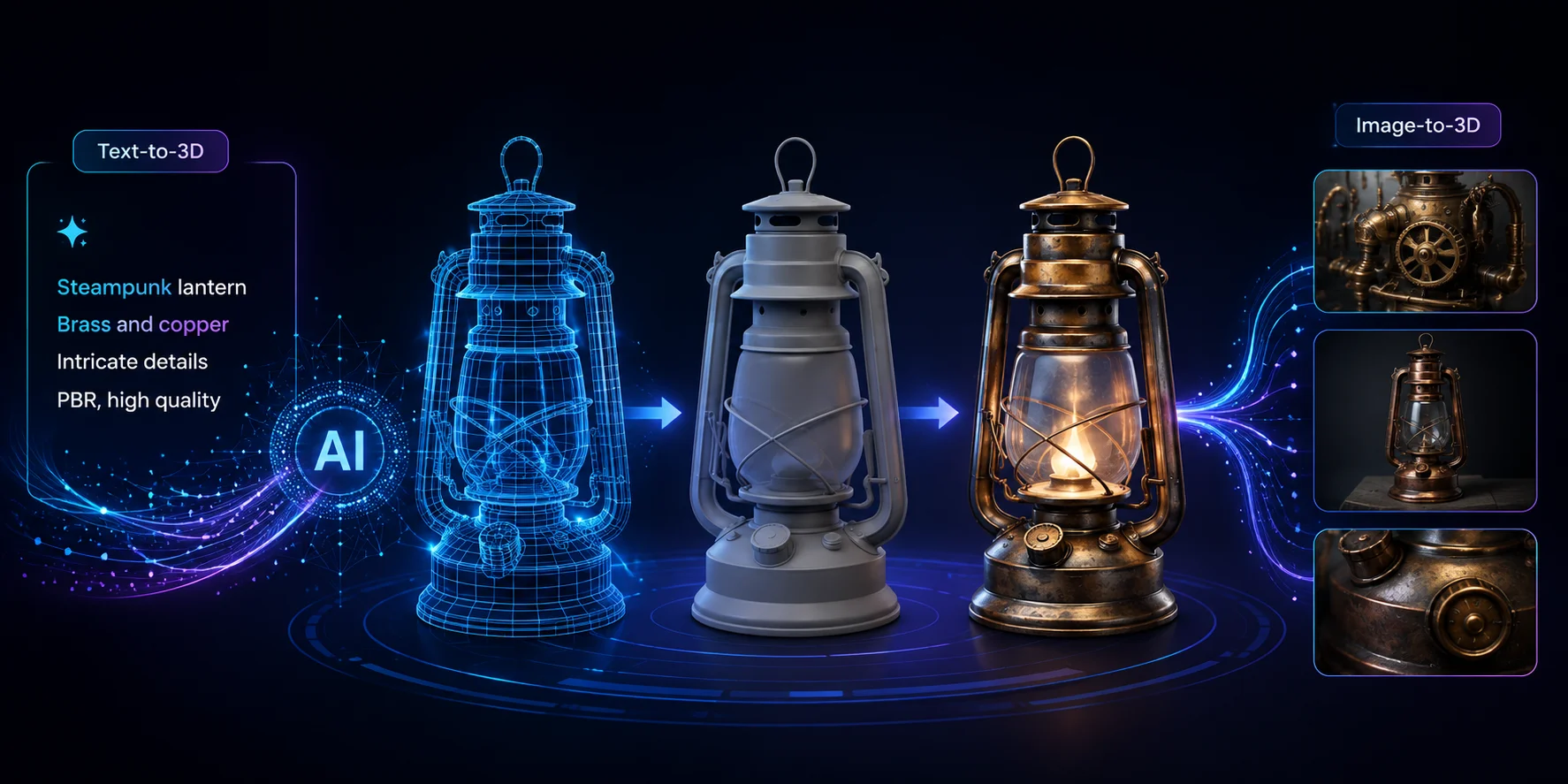
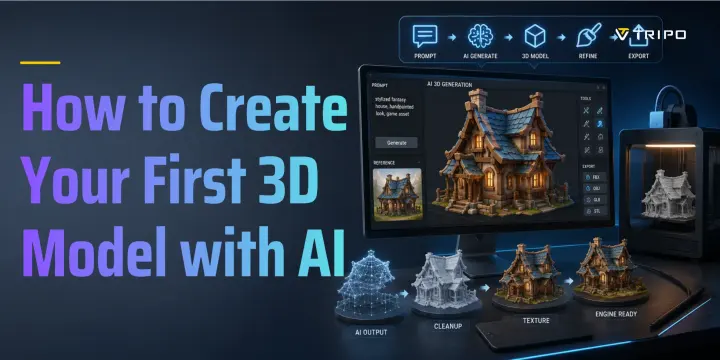
AI-generated 3D models are digital meshes produced from a text description, reference images, or both. The system predicts geometry, textures, and sometimes materials, topology, or a rig without the user manually building every vertex.
Text-to-3D starts with a prompt, while image-to-3D reconstructs an object from visual references. Platforms such as Tripo AI and Meshy provide both workflows through browser-based studios, including Tripo Studio.
Copyright Law and the Human Authorship Requirement
In the United States, copyright protects original human authorship. The U.S. Copyright Office says material generated entirely by AI is not registrable, although human-created selection, arrangement, editing, or other expressive additions may be protected. Prompts alone normally do not establish authorship because the system determines the output’s expressive details.
Human involvement therefore matters. Deliberately reshaping forms, sculpting features, painting textures, and combining outputs may support a claim in those human-created elements. There is no universal “percentage of editing” test.
Who Are the Claimants: User, Developer, or AI?
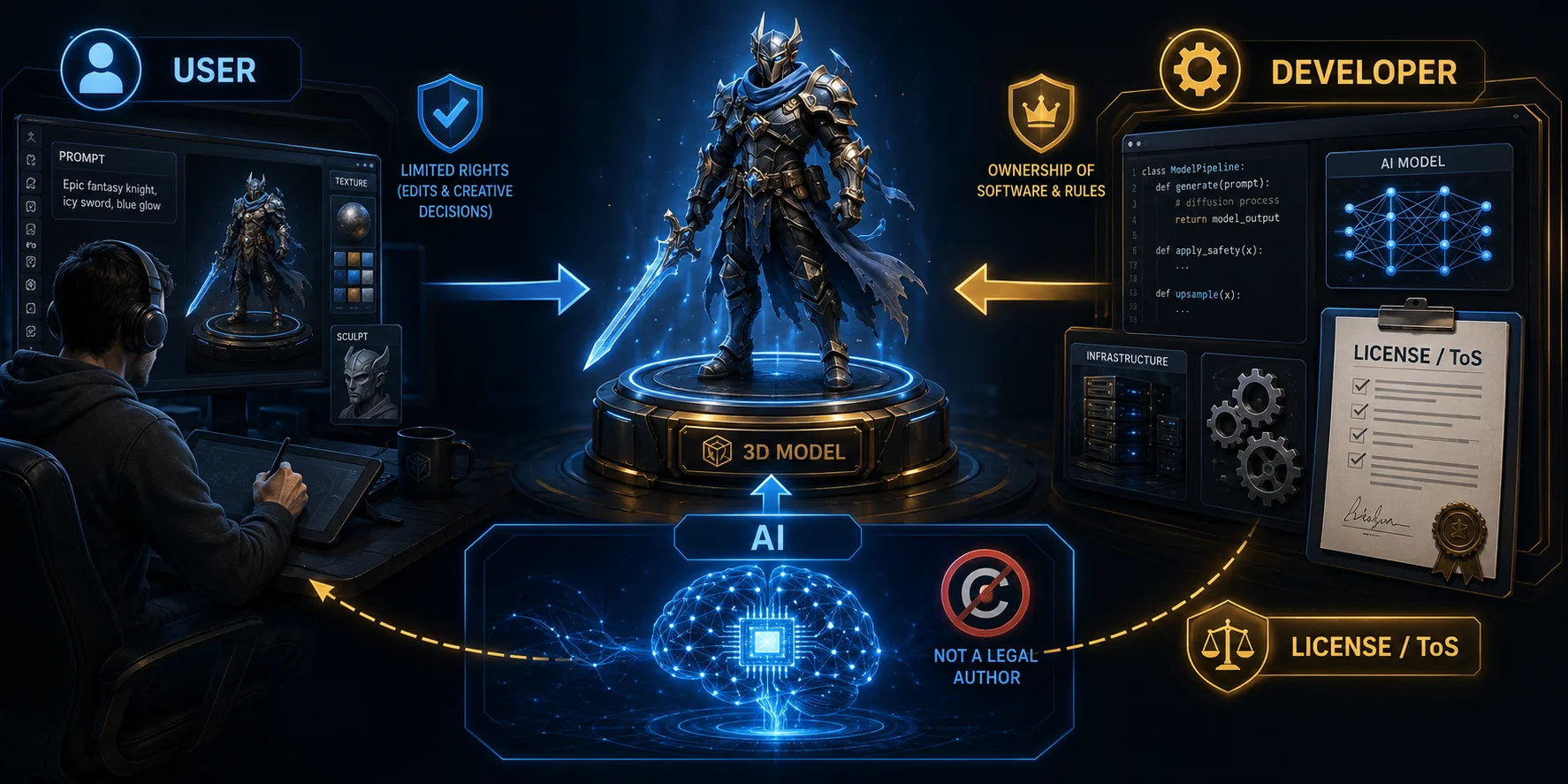
The user may claim rights in original edits, textures, or modeling decisions, but not necessarily in untouched machine-generated geometry. The developer retains intellectual property in its software, models, and algorithms, while its terms set contractual permissions for outputs. In the United States, the Copyright Office requires human authorship for registration; other jurisdictions may take different approaches. The user's practical rights often come from the platform terms.
Jurisdiction Breakdown: US, EU, and UK
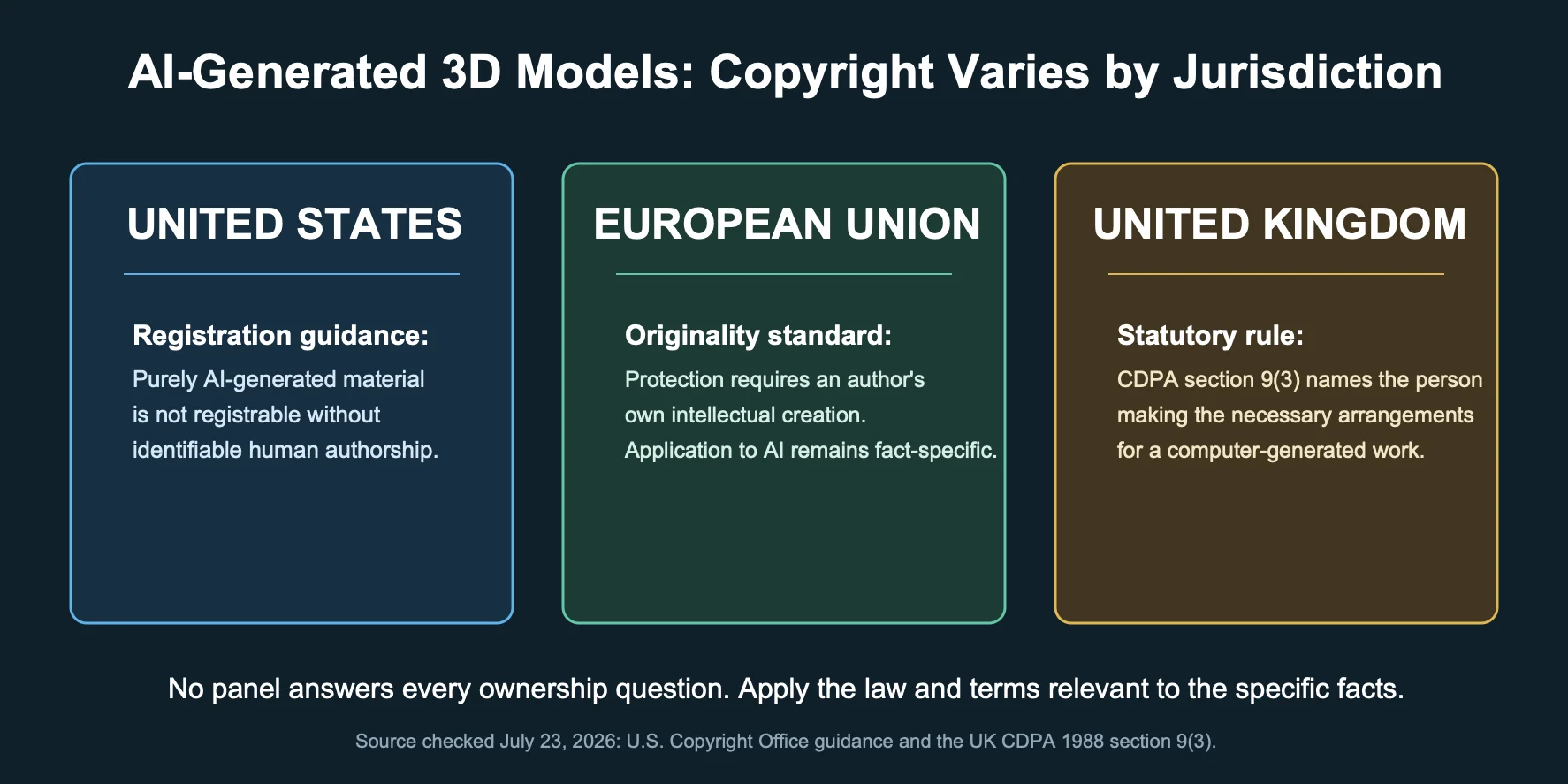
United States: For copyright registration, material generated without human authorship is not registrable. Protection may cover identifiable human-created portions, but the assessment turns on the human-authored expression in the specific work.
European Union: EU originality requires a work to express its author’s “own intellectual creation,” reflecting free and creative choices. A fully autonomous output is therefore unlikely to qualify, while an AI-assisted work may qualify through its human-authored features.
United Kingdom: Section 9(3) of the Copyright, Designs and Patents Act 1988 treats the person making the necessary arrangements as the author of a computer-generated artistic work. This is more accommodating, although identifying that person can still be disputed.
Can You Sell AI-Generated 3D Models Commercially?
Often yes, provided the generator’s terms permit the intended use and your inputs do not infringe third-party rights. Copyright ownership and commercial permission are different: an output can lack copyright protection yet still be licensed for games, advertising, client work, or resale.
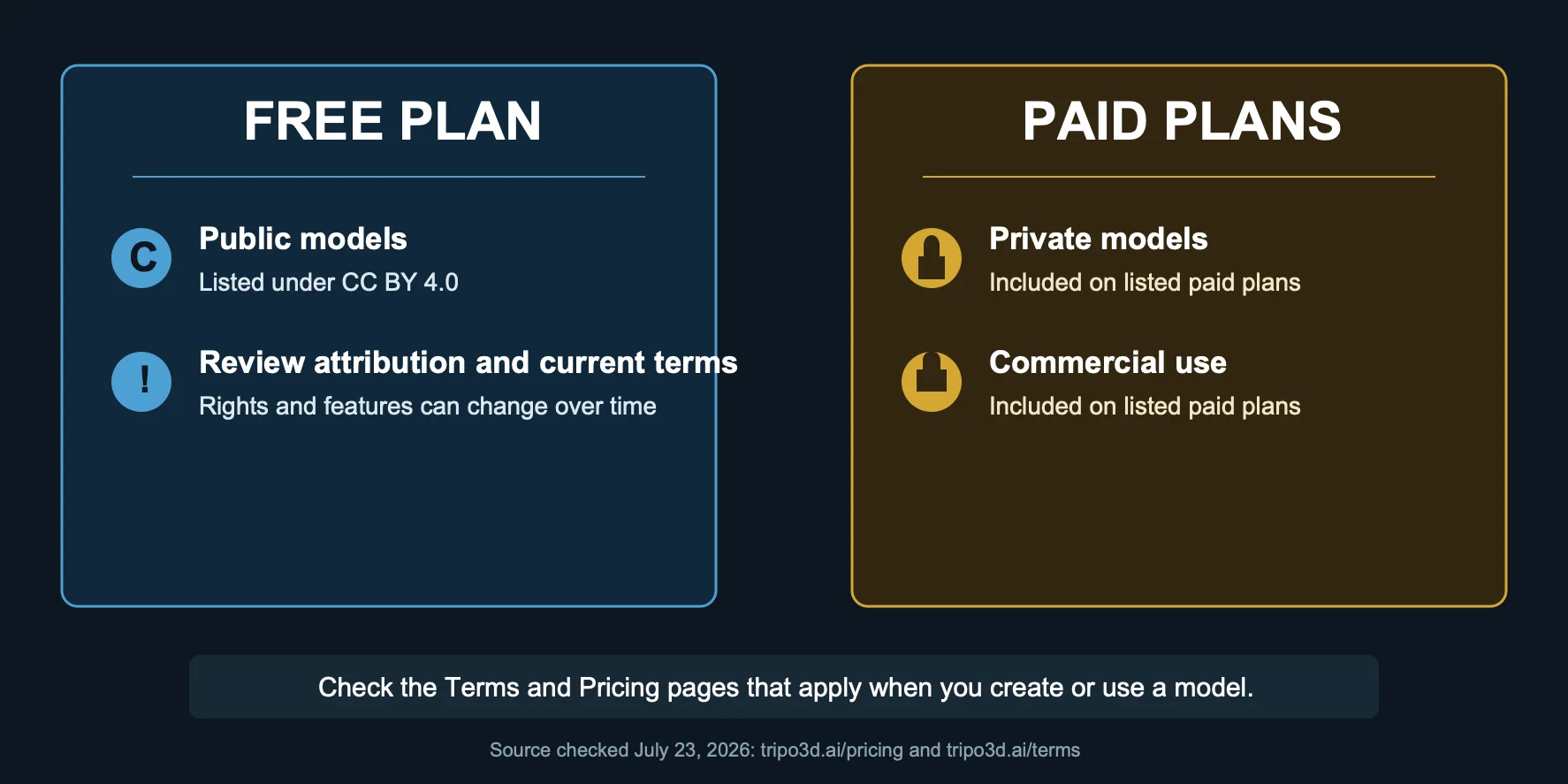
Tripo's current Pricing page lists public models under CC BY 4.0 on the Free plan and lists private models and commercial use on its paid plans. Its Terms also distinguish Free and Paid Users, so check both pages and the terms in force when the model was created. For details, review the official Tripo AI Pricing and Tripo AI Terms.
Platform ToS: The Real Contract That Governs Your Rights
A platform may retain output rights and license them to users, grant broad rights to paid users, or publish outputs under an open license. Read clauses covering inputs, outputs, commercial use, privacy, training, sublicensing, non-uniqueness, and warranties.
Tripo's Terms distinguish Free and Paid Users. They state that Tripo retains broad rights in Free Users' inputs and outputs, while Paid Users generally have listed rights in their inputs and outputs, subject to the agreement and applicable obligations; the Terms also say the company will not use Paid Users' inputs and outputs as AI training data. These contractual permissions are separate from whether a particular output qualifies for copyright protection.
Free Tier vs. Paid Plan Rights
For experiments, a public or attribution-based free license may be enough. For confidential products, client work, paid games, or marketplace sales, review a plan that expressly lists private models and commercial use, then confirm the Terms that apply to your account and generation date. See Tripo AI Pricing for current options.
Save the ToS version, pricing page, invoice, and generation date. Platform licenses and subscription features can change, so the terms in force when an asset was created may become important later; review Tripo AI Terms for details.
AI Training Data and IP Concerns
Training on copyrighted material remains contested, but training disputes and output ownership are separate questions. Risk rises when an output reproduces recognizable protected expression, characters, logos, branded products, or distinctive designs.
Andersen v. Stability AI concerns several training- and infringement-related theories involving AI image generation; it does not decide ownership of AI-generated 3D models. Users should inspect outputs and avoid assuming that a platform's commercial permission eliminates every possible third-party claim.
Legal Implications and Notable Cases
- Thaler v. Vidal (2022): A patent case holding that AI cannot be named as an inventor. It is a useful analogy, but not a copyright ruling.
- Thaler v. Perlmutter: A U.S. copyright case concerning a work claimed to have been created without human authorship; it is directly relevant to the U.S. human-authorship requirement, not a universal ownership rule.
- Zarya of the Dawn (2023): Human-authored text and arrangement were protected, but the individual AI-generated images were excluded.
- Andersen v. Stability AI: A U.S. civil dispute involving claims about AI image-generation systems; it may inform broader debates about training and infringement, but it does not decide 3D-model ownership.
Best Practices for Protecting Your Work
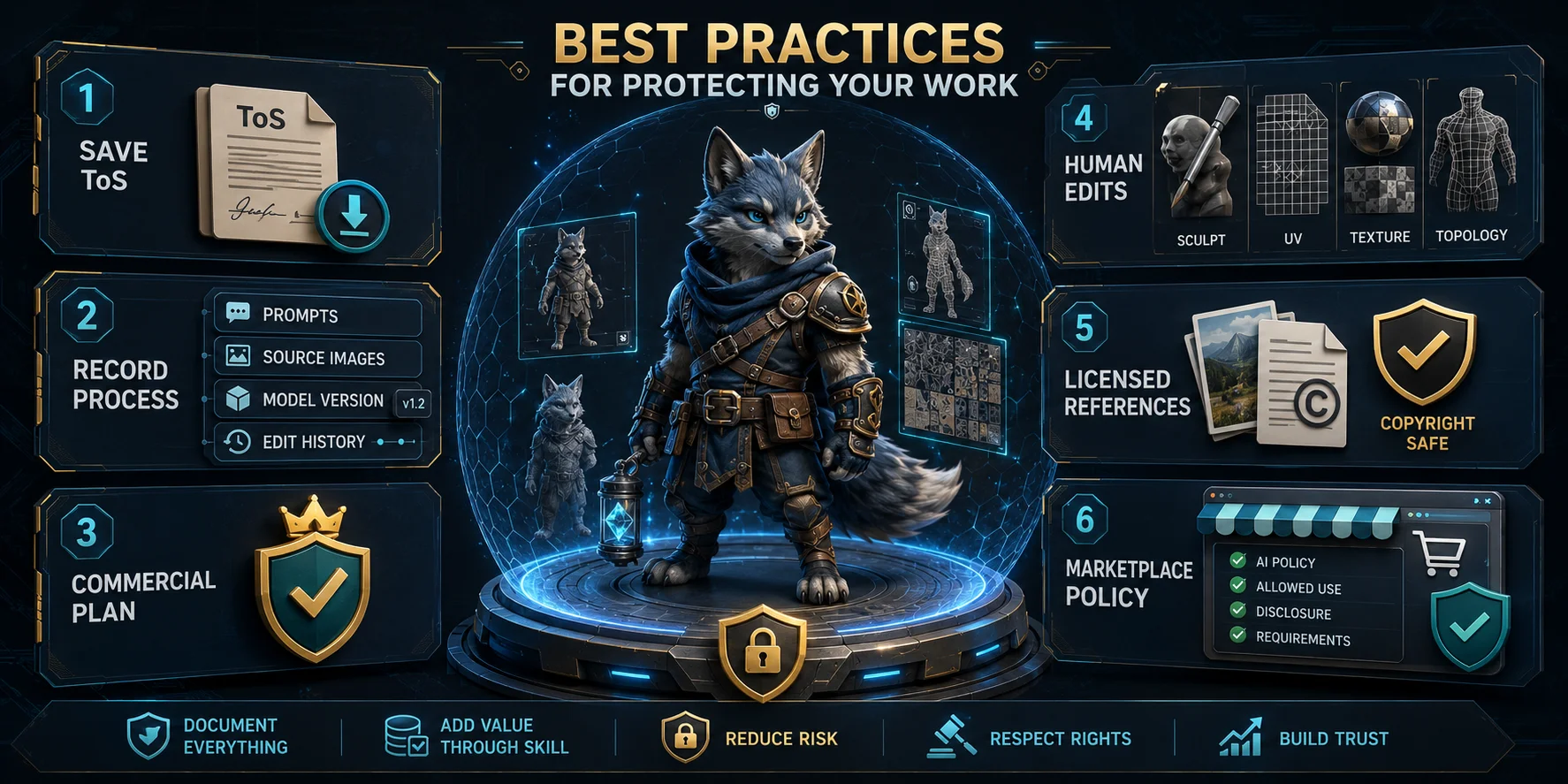
- Save the applicable ToS and license.
- Record prompts, source images, model versions, and edit history.
- Use a plan that expressly covers commercial work.
- Add meaningful sculpting, topology, UV, texture, and design decisions.
- Confirm that reference images, brands, characters, and product designs are licensed.
- Check the destination marketplace’s current AI policy before listing.
Marketplace Policies: TurboSquid, CGTrader, and Sketchfab
Marketplace policies are separate from the generator's license and may change. Before listing an AI-assisted model, check the current submission, labeling, and content rules on the specific marketplace rather than relying on a general comparison.
Marketplace terms commonly require sellers to have the rights needed to upload their work and to avoid infringement, but AI-specific listing and disclosure rules vary. Read the current marketplace policy and contact its support when the policy does not clearly address your use case.
Frequently Asked Questions
Are AI-generated 3D models copyrighted?
In the United States, purely AI-generated material is not registrable without identifiable human authorship. Human-created edits, textures, selection, or arrangement may receive protection, while contractual commercial rights remain a separate issue.
Who actually owns AI art?
Whether a user, developer, or neither holds copyright depends on the jurisdiction, the human contribution, and the applicable platform terms. In the United States, copyright registration requires human authorship; a platform license can grant practical permissions without resolving every copyright question.
Can I sell 3D models made with AI?
Yes, when the generator permits commercial use, your inputs are lawful, and the destination marketplace accepts AI-assisted assets. A commercial license from the generator does not override marketplace restrictions.
Who Is the Owner of 3D AI Studio?
“3D AI studio” is a generic description rather than one universal product. For a named platform, confirm ownership and company information on that platform's official legal or company pages.
Does Tripo AI Grant Commercial Rights to Generated Models?
Its current paid plans explicitly include private models and commercial use. Review Tripo AI Pricing and the current terms before beginning commercial production.
How Do AI 3D Platforms Handle IP Ownership?
Policies differ across AI 3D platforms. Review the current terms for the specific tool you use, including clauses on inputs, outputs, public visibility, commercial use, training, and warranties; do not assume another platform's free or paid-plan rules apply to Tripo.
Conclusion
Copyright questions around AI 3D generation depend on the jurisdiction, the human contribution, and the applicable contracts. Before commercial use, confirm the current license, document meaningful human contributions, and check the destination marketplace's current policy. Create a first model in Tripo AI Studio and review Tripo AI Pricing before choosing a plan for commercial production.