Can You Sell AI Generated 3D Models? A 2026 Guide
TL;DR
- Yes, you can sell AI-generated 3D models when the generator license covers your intended use, your inputs are cleared, and the output does not infringe third-party rights.
- Do not assume every paid plan or every free tier grants the same rights; check the terms for the exact plan and generation date.
- In the United States, copyright protects human-authored expression, while purely machine-generated material may not qualify on its own.
- Copyright, trademark, design, privacy, and likeness risks remain even when a generator permits commercial use.
- Choose a sales channel only after checking its current AI-content, disclosure, quality, and licensing rules.
Yes, in most cases you can sell AI-generated 3D models—but only when three things are true: your AI tool and plan permit commercial use, you have the necessary rights to every input, and the finished model does not infringe protected characters, brands, designs, or likenesses. That distinction matters because a platform license is not a legal shield against third-party claims.
This guide explains commercial rights, copyright, sales-channel policies, disclosure, and risk reduction. Tripo AI’s AI 3D Model Generator supports text- and image-based creation; its current pricing distinguishes public free-plan models from paid-plan benefits that include private models and commercial use. Always check the terms that apply to the exact plan and generation date.
This article provides general information, not legal advice. Laws vary by country and by the facts of each project.
The Short Answer: Can You Sell AI 3D Models?
Yes—provided all three conditions are satisfied.
- The generator’s terms permit your intended commercial activity. Check the exact plan used when the model was generated, not merely the platform’s homepage.
- Your inputs are cleared. Original photos and sketches are safest. Stock images require a license that covers your use, including AI-assisted generation where relevant.
- The output is legally clean. A paid subscription does not authorize you to sell a recognizable franchise character, a copied product design, a protected logo, or someone’s likeness without permission.
| Generation situation | Practical answer |
|---|---|
| Paid commercial plan + your original input + original output | Usually suitable for sale |
| Free plan + your original input | Depends on the free-tier license, attribution, and public-output rules |
| Paid plan + third-party copyrighted reference | Commercially risky; obtain permission |
| Any plan + recognizable character, logo, branded design, or unlicensed likeness | Do not list without rights clearance |
| High-value or legally ambiguous model | Ask an IP lawyer |
Commercial Rights Granted by AI Platform Terms
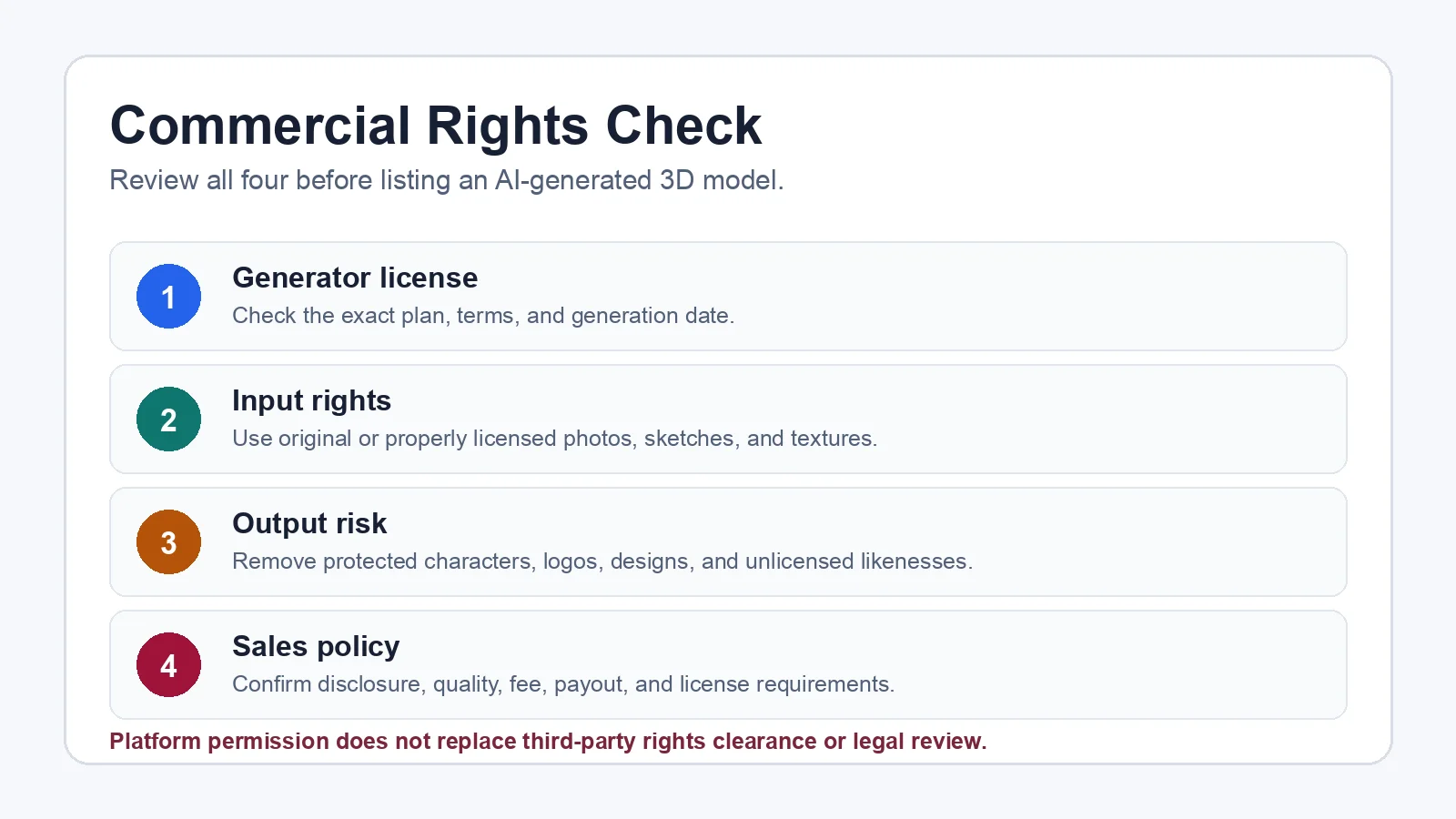
“Commercial rights” normally means permission to use an output in revenue-generating work. Depending on the contract, the platform may grant a commercial license, allow marketplace resale, waive royalties, or assign certain contractual rights in the output. They do not guarantee copyright ownership, originality, or non-infringement.
Plan-level checking matters because platform terms can distinguish public and private outputs, attribution duties, resale rights, and commercial use. For Tripo AI, the current pricing page lists free-plan models as public under CC BY 4.0 and lists private models and commercial use among paid-plan benefits. Those platform permissions do not promise copyright ownership, exclusivity, originality, or freedom from third-party claims.
Save a PDF or screenshot of the applicable terms and your invoice on the generation date. Policies can change, and the binding contract may differ from marketing copy.
Input Rights and Copyright Caveats
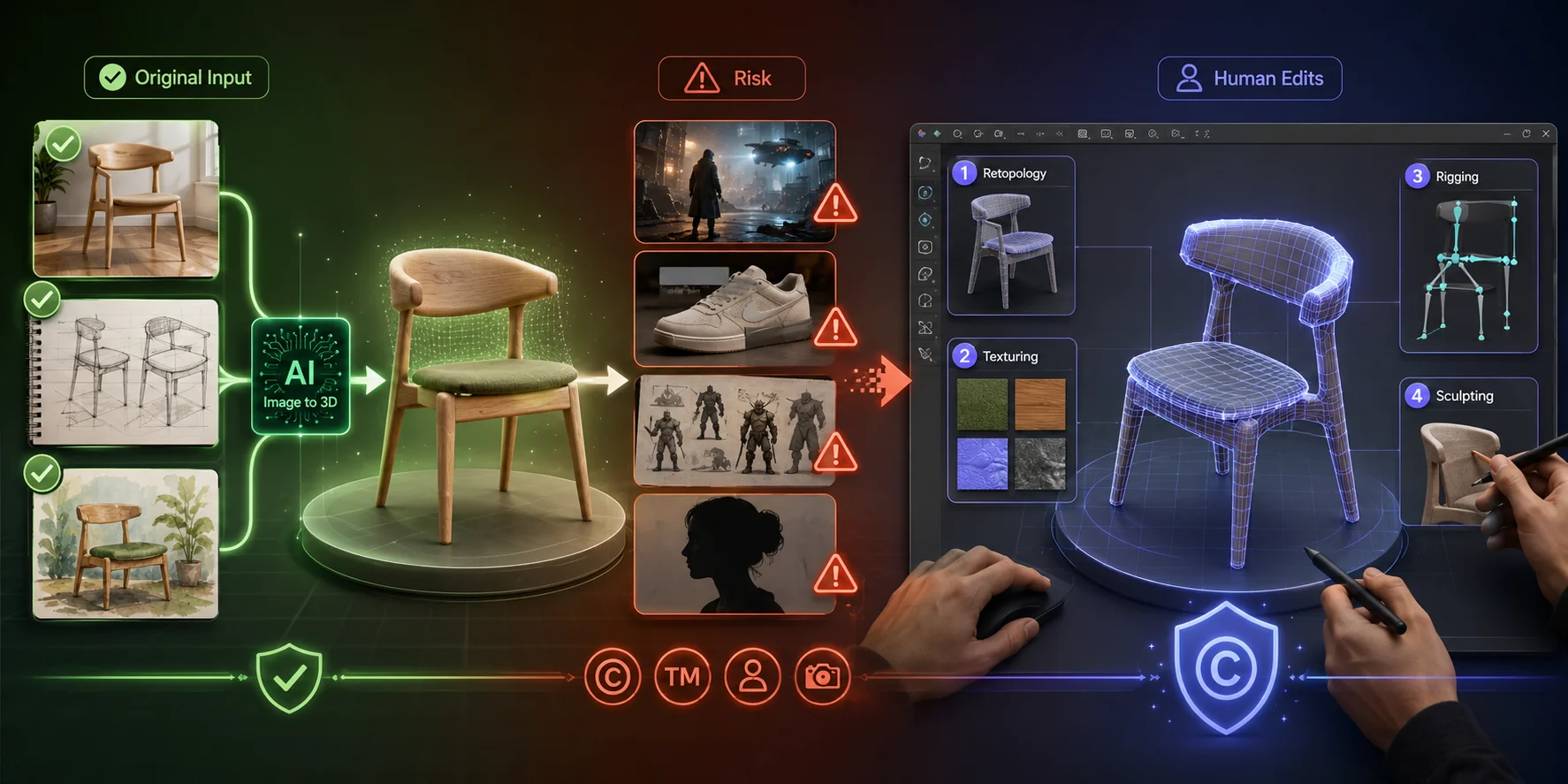
Tool permission is only half the equation. The material you upload may carry separate copyright, trademark, privacy, or publicity rights.
Using your own product photographs, sketches, or original artwork is usually the safest route. A commercially licensed stock image may also work, but some stock licenses restrict machine-learning or generative uses. Movie stills, another artist’s character sheet, branded product photography, and downloaded concept art create a much higher derivative-work risk. Tripo AI’s Image to 3D feature is therefore safest when the uploaded images are yours or clearly licensed for this purpose.
Copyright protection for the output is a separate question. The U.S. Copyright Office’s 2025 report says generative-AI material is protected only where a human determines sufficient expressive elements; prompts alone are generally not enough. Human-authored modifications, creative arrangement, sculpting, retopology, texturing, rigging, and other expressive edits may be protectable even when raw AI material is not.
Trademark and IP Infringement Risks
A generator’s terms cannot override copyright, trademark, design-patent, or right-of-publicity law. Avoid selling models that clearly reproduce famous characters, brand mascots, logos, distinctive commercial products, or real people without authorization.
Use a simple test: would an ordinary buyer immediately identify a specific franchise, company, product, celebrity, or individual? If yes, changing the color, ears, costume, or name may not remove the risk. Prompt for original visual traits rather than named characters or living artists, remove accidental logos, inspect reference provenance, and run reverse-image searches on preview renders before listing.
Where to Sell AI 3D Models
Sales channels differ in what they accept, how they handle AI-generated content, and what sellers must disclose. Compare the current seller agreement, AI-content policy, quality requirements, fees, payout terms, and license options before choosing where to list.
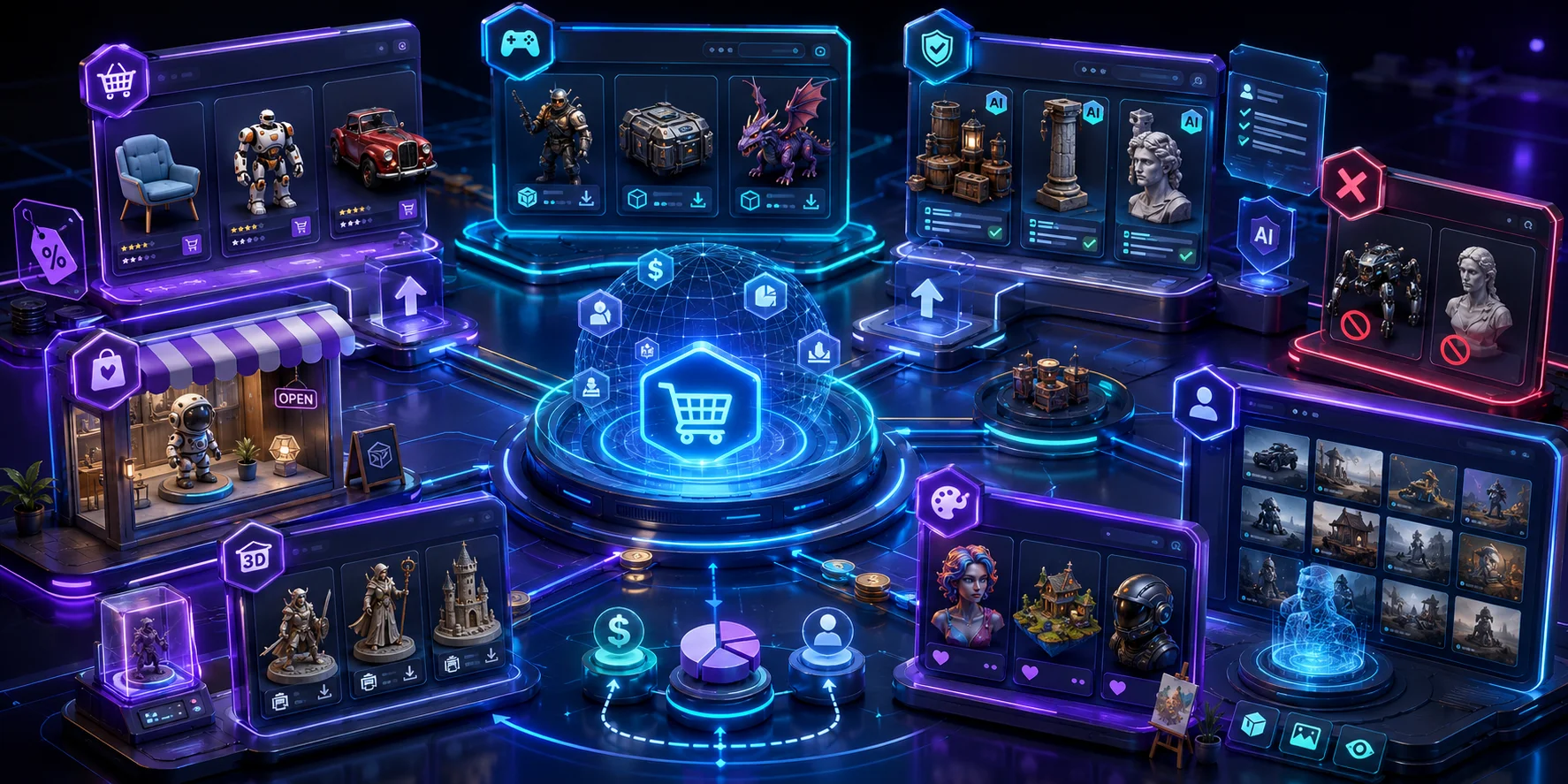
- Specialist 3D marketplaces: useful when buyers expect technical specifications, previews, topology details, and clear asset licenses.
- Game-asset marketplaces: suitable for engine-ready packs, but submission, originality, disclosure, and quality rules may be stricter.
- Portfolio marketplaces: useful when sales are tied to an established creator profile and presentation quality.
- Direct storefronts: offer more control over pricing, bundles, customer communication, and license wording, but place more responsibility on the seller.
Always read the current seller policy before uploading. A model permitted by the generator may still be rejected by the marketplace.
What “Commercial Use” Means in Practice
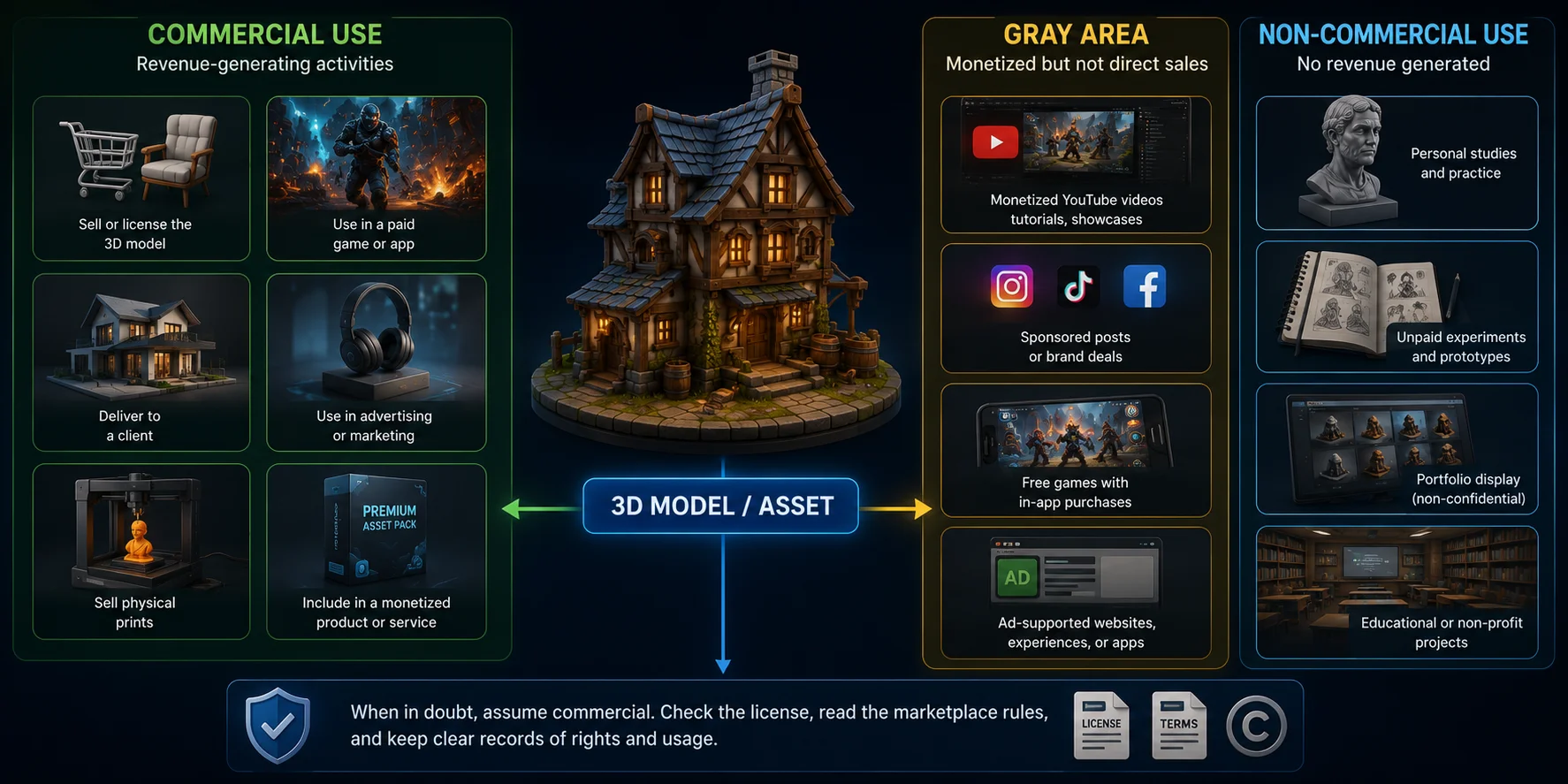
Commercial use includes more than selling the file itself. It normally covers licensing a model, placing it in a paid game or app, delivering it to a client, using it in advertising, selling physical prints, or including it in a monetized product.
Personal studies and unpaid experiments are generally non-commercial. Portfolio use may still be restricted by confidentiality or input licenses. Monetized videos, sponsored posts, ad-supported experiences, and free games with in-app purchases belong in the commercial or gray-area category, so check the governing license rather than assuming “free to viewers” means non-commercial.
Free Tier vs. Paid Plan Rights
| Tripo plan status | What to check before selling |
|---|---|
| Free plan | Current pricing lists public models under CC BY 4.0. Check attribution and public-availability implications before listing. |
| Paid plan | Current pricing lists private models and commercial use among paid-plan benefits. Confirm the exact plan, terms, and generation date. |
| Any plan | Commercial-use language does not clear third-party inputs, protected IP, or marketplace requirements. |
Do not assume “paid” means exclusive copyright ownership, indemnity, or permission to copy third-party IP. It usually means the platform will not object to the covered commercial use.
How to Make Money Selling AI 3D Models
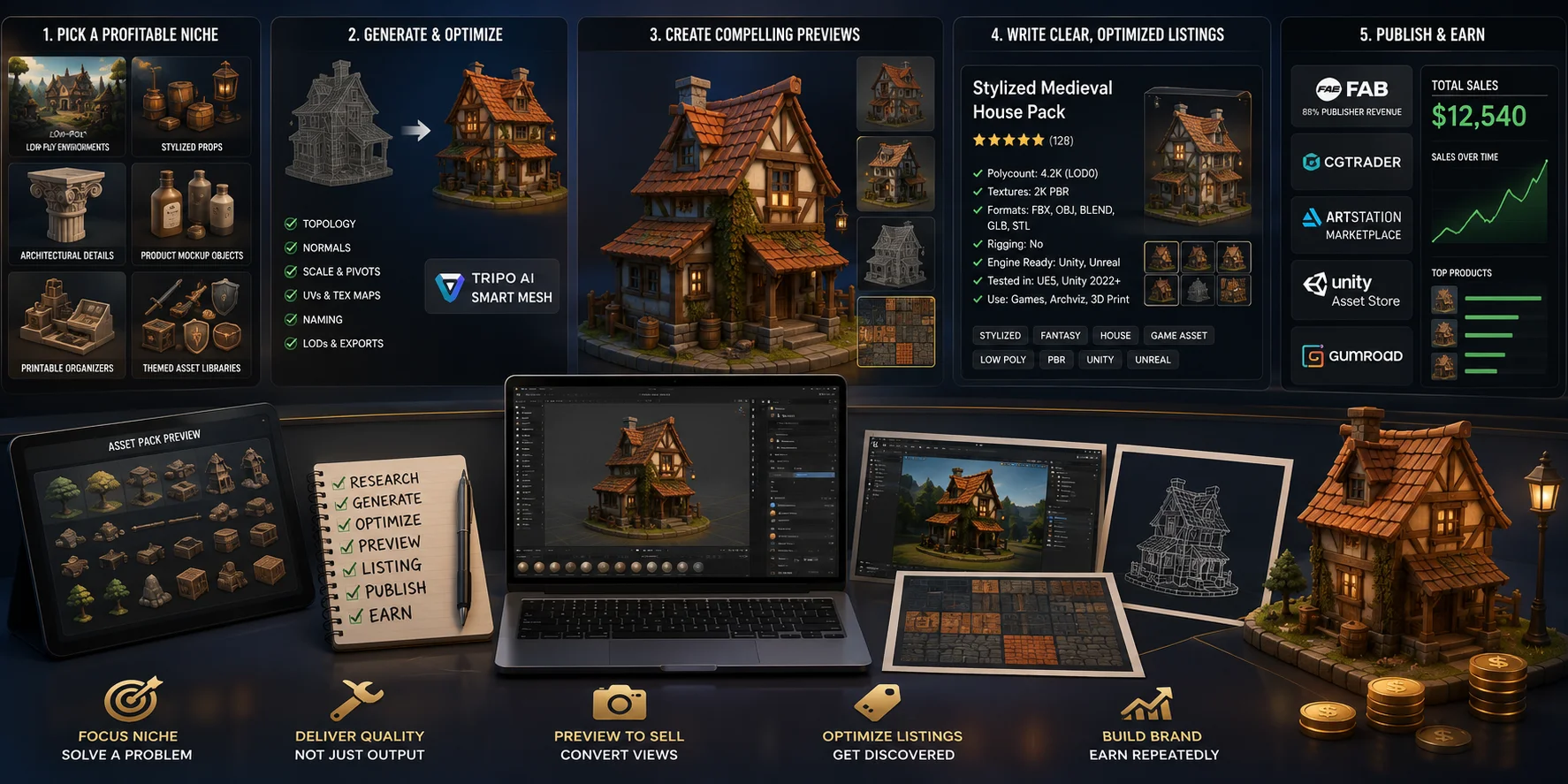
Choose narrow categories where buyers need consistency: low-poly environment packs, stylized props, architectural details, product-mockup objects, printable organizers, or themed asset libraries. A coherent pack usually delivers more value than unrelated one-off models.
Raw generations rarely command premium pricing. Fix topology, normals, scale, pivots, UVs, naming, and texture maps; create LODs and engine-ready exports where appropriate. Tripo AI’s Smart Mesh can accelerate mesh optimization, but every result still needs inspection.
Preview images do the selling. Use clean lighting, multiple angles, close-ups, wireframes, and in-engine screenshots. State polygon count, texture resolution, included formats, rigging status, printability, and tested software. Finally, optimize titles and tags around the object, style, use case, engine, polycount, and file format—without keyword stuffing.
Protecting Yourself Before You List
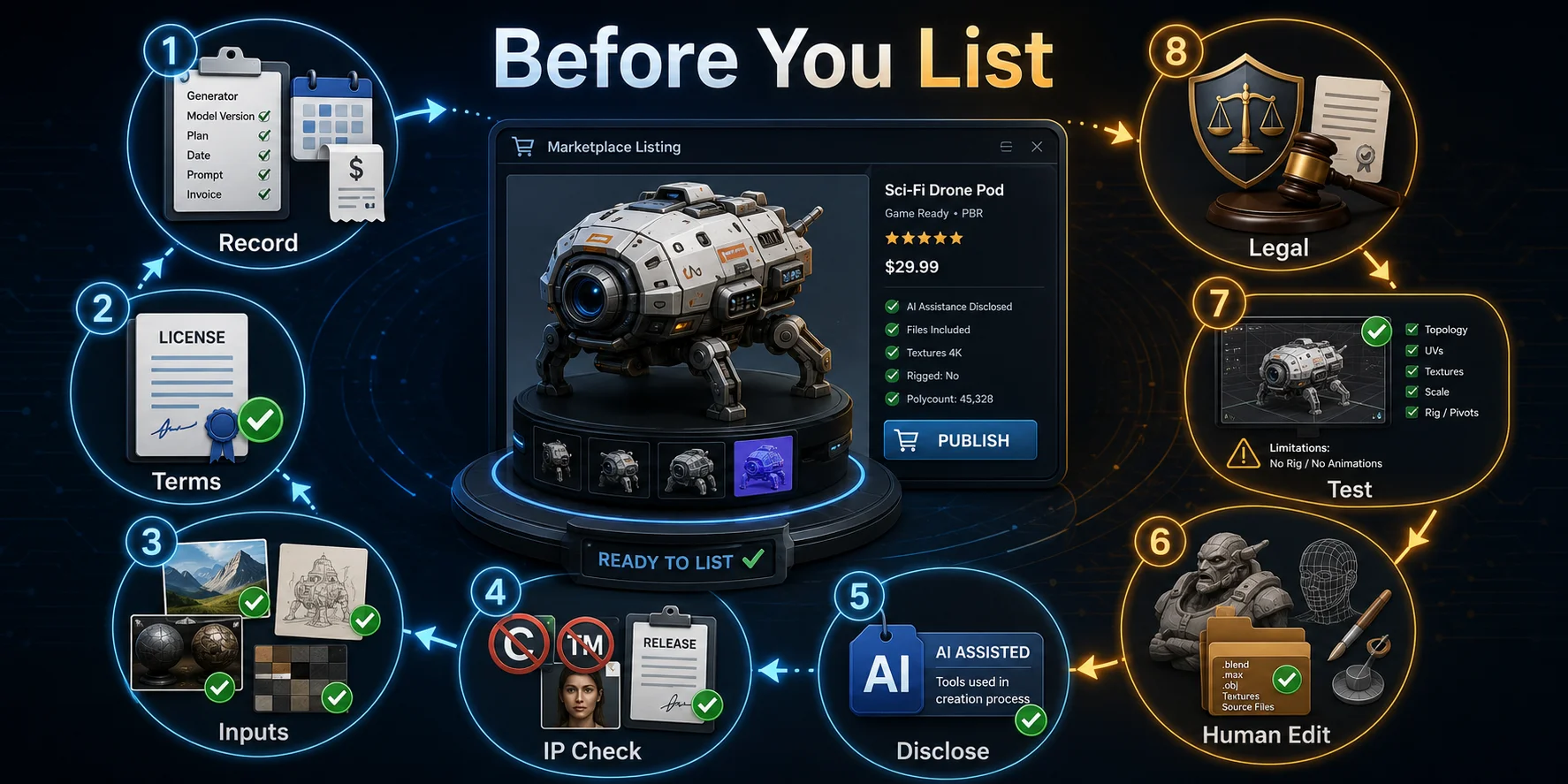
- Record the generator, model version, plan, generation date, prompt, and invoice.
- Save the terms that applied on that date.
- Confirm that every photo, sketch, logo, texture, and reference is original or licensed.
- Remove recognizable protected IP and obtain releases for identifiable people.
- Disclose AI assistance exactly as the marketplace requires.
- Add meaningful human work and keep source files that document it.
- Test the model technically and describe limitations honestly.
- Seek legal review for valuable, branded, commissioned, or borderline assets.
Conclusion
You can sell AI-generated 3D models in 2026, but success depends on more than clicking “generate.” Use a plan that clearly covers commercial work, control your inputs, avoid protected IP, disclose AI involvement, and improve the asset before listing.
Start generating on Tripo AI Studio See Tripo AI Pricing
Frequently Asked Questions
Are AI-generated 3D models copyrighted?
Not automatically in the United States. The U.S. Copyright Office’s January 2025 report says copyright can protect human-authored expression in a work that also contains AI-generated material, but purely AI-generated material is not protected on its own; the analysis remains fact-specific.
Can you sell AI-generated models?
Yes, when the generator’s license permits your intended sale, your inputs are cleared, the output avoids protected IP, and the chosen sales channel accepts the content.
Is it illegal to sell 3D-printed models?
Not inherently. Risk arises when the underlying design infringes protected rights or when the source file’s license does not permit commercial printing; the answer depends on the design, license, jurisdiction, and facts.
Where can you sell AI 3D models?
Possible routes include specialist 3D marketplaces, game-asset marketplaces, portfolio marketplaces, and direct storefronts. Check each channel’s current AI-content, disclosure, quality, fee, payout, and licensing rules before listing.
Is it legal to sell 3D models created with AI?
Often, but not automatically. Legality depends on the tool contract, input rights, output similarity, sales-channel rules, and applicable local law; platform permission alone is insufficient.
Can I monetize AI-generated 3D assets?
Yes, if every relevant license permits the intended use. Monetization can include model files, asset packs, physical prints, client deliverables, or products that contain the models.
What are the ethical considerations?
Disclose AI involvement where relevant, avoid imitating living artists or exploiting unlicensed references, respect likeness rights, and describe the production process honestly.
Can a beginner 3D artist sell AI-generated models?
Yes, but a sellable asset still needs basic cleanup, UVs, materials, scale, export, testing, and quality assurance. Buyers pay for usable assets and accurate documentation, not generation speed alone.
What are the first steps for a side hustle?
Pick one niche, confirm the generator and sales-channel licenses, create and clean a small coherent asset pack, prepare professional previews, and test one channel before expanding.
Are there restrictions on selling AI-generated assets on a marketplace?
Usually, yes. A marketplace may require disclosure of the AI tools and generated portions, evidence of meaningful modifications, technical quality checks, or specific license language; read its current seller policy before submission.