Will AI Replace Motion Capture? Where AI Falls Short
TL;DR
- AI will replace some mocap tasks (prototyping, video tracking) but not professional capture sessions, performers, or production pipelines.
- The right choice depends on fidelity, control, repeatability, latency, cleanup time, rights, and delivery risk.
- Hybrid pipelines combining AI speed with traditional mocap quality are likely to dominate professional workflows.
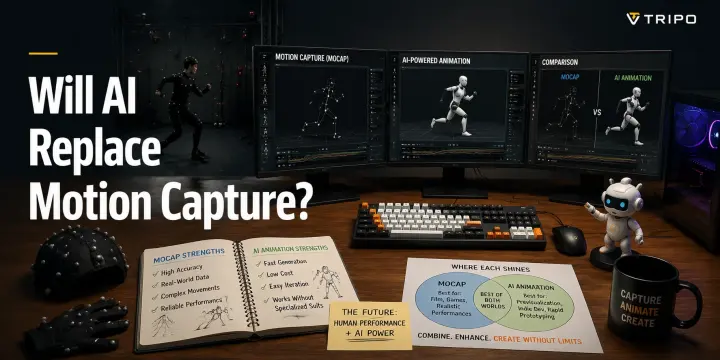
AI will replace some motion-capture tasks, especially fast prototyping, rough animation blocking, and lower-control video-based tracking workflows. However, it is unlikely to replace every capture session, performer, animator, or professional production pipeline. The future of motion capture will depend on factors such as performance fidelity, creative control, repeatability, latency, cleanup requirements, rights management, and delivery risk.
The key is understanding that “AI animation” is not one single technology. Generative motion systems, markerless AI tracking from video, and professional mocap using dedicated hardware each solve different problems. This guide separates these approaches, compares where each one works best, and explains why the most effective studios will likely combine AI tools with traditional capture methods rather than replace one with the other.
What Does “AI Replacing Motion Capture” Actually Mean?
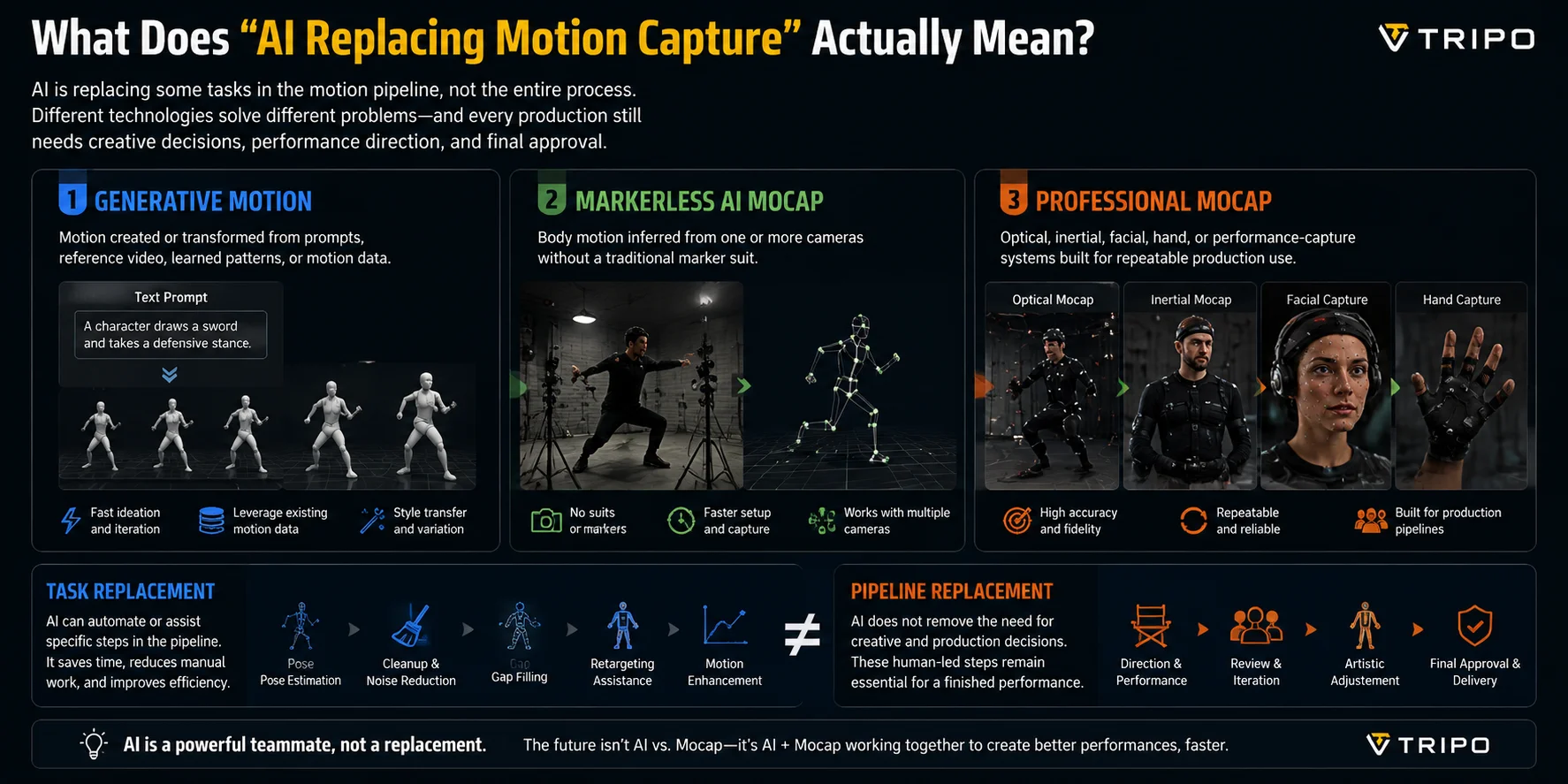
The phrase “AI replacing motion capture” can mean several different things, and confusing these technologies leads to unrealistic expectations. In practice, AI is replacing specific tasks inside the animation pipeline rather than removing the entire need for motion capture.
Generative motion refers to AI systems that create or modify animation data using prompts, reference videos, existing motion libraries, or learned movement patterns. These tools can generate a walk cycle, transform one movement style into another, or create a first animation pass without recording a performer. They are especially useful for prototypes, background characters, and rapid iteration.
Markerless AI mocap uses computer vision models to estimate body movement from regular camera footage without requiring traditional reflective markers or sensor suits. A creator can record an actor with one or multiple cameras, and AI tracks body joints to produce usable motion data. This reduces setup time and makes motion capture more accessible, but accuracy can vary depending on camera angle, lighting, occlusion, and movement complexity.
Professional motion capture refers to dedicated production systems using optical markers, inertial sensors, facial capture, hand tracking, or full performance-capture setups. These systems are designed for repeatability, precise acting choices, and high-end animation where small details matter.
The important distinction is task replacement versus pipeline replacement. AI can automate parts of the process, such as pose estimation, cleanup, retargeting assistance, or generating early animation ideas. However, a complete production still requires direction, performance decisions, animation review, artistic adjustments, and final approval. AI may reduce the time spent on technical steps, but it does not eliminate the creative and production decisions behind a finished performance.
Where AI Motion Tools Already Save Time
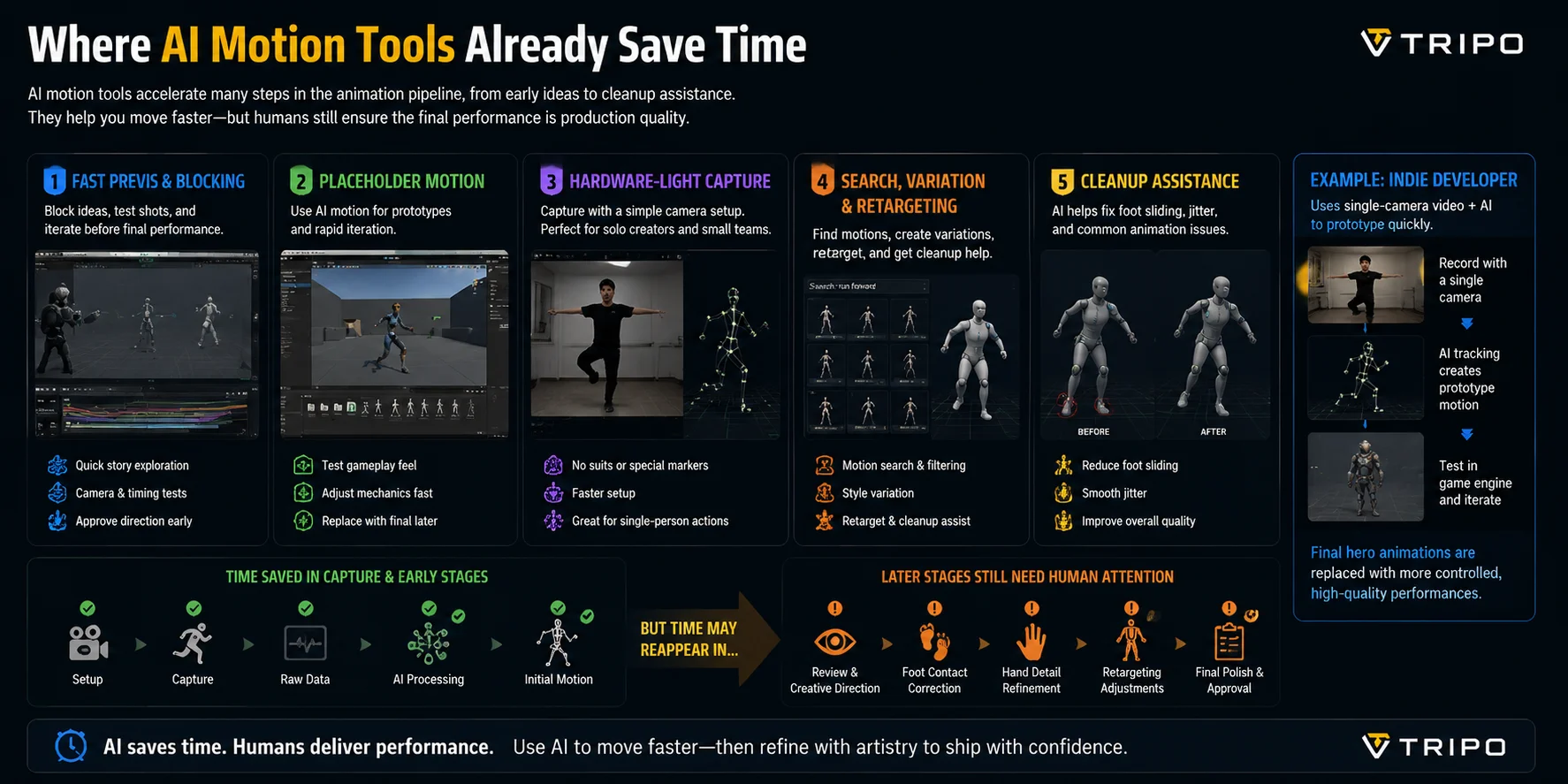
AI motion tools are already making animation workflows faster, but their biggest impact is reducing repetitive tasks rather than replacing the entire performance process. One of the clearest advantages is previsualization and blocking. Teams can quickly generate rough movement ideas, test camera shots, and evaluate gameplay or cinematic timing before committing to a final performance.
For game development, AI-generated or AI-assisted motion is especially useful for placeholder animation during prototyping. An indie developer can record a simple single-camera video, convert it into usable character motion, and quickly test movement, combat timing, or level design. Once the game direction is confirmed, hero animations can be replaced with a more controlled workflow using professional mocap or animator refinement.
AI also helps creators who lack expensive capture equipment. Solo developers and small teams can create basic motion without marker suits, dedicated studios, or complex setups, making early iteration much more accessible. Beyond generation, AI can assist with motion search, creating variations, retargeting movements to different characters, and cleaning up selected animation issues.
However, saved time during capture does not always mean zero additional work. Some of that effort often moves into later stages, including reviewing animation quality, correcting foot sliding, refining hand details, adjusting body contact, and improving retargeting results. AI makes motion creation faster, but production-quality animation still depends on human review and creative control.
Where AI Motion Capture Still Falls Short
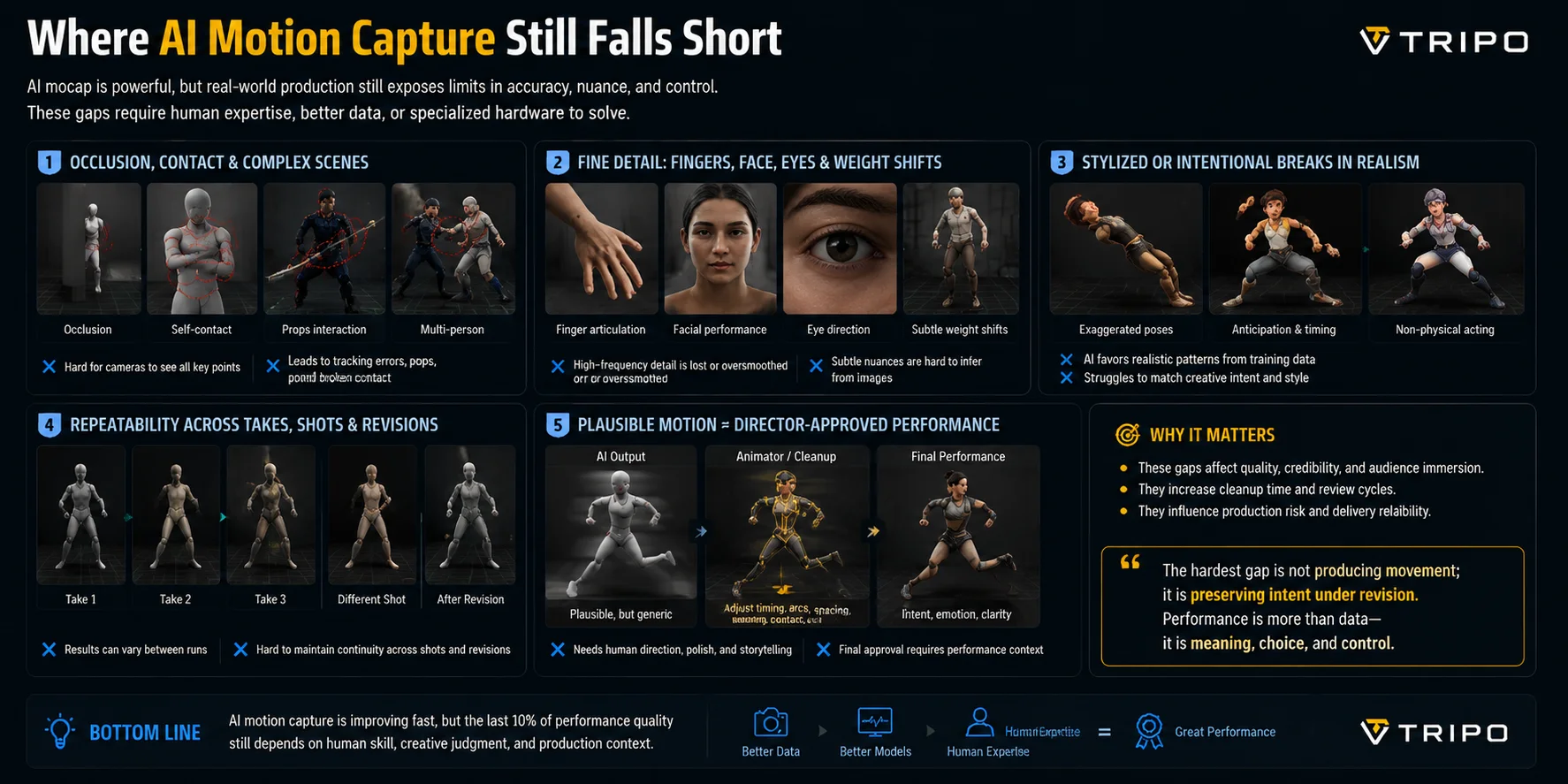
AI motion capture has improved rapidly, but it still struggles with the situations where production quality depends on precision, context, and performance intent. The biggest challenges appear when the movement is difficult to interpret from visual data, such as occlusion, self-contact, prop interaction, floor contact, fast rotations, and multi-person scenes. A character holding a weapon, grabbing another character, sitting on a moving object, or performing complex combat choreography can create ambiguous motion data that requires additional cleanup and correction.
Fine performance details remain another major limitation. AI systems can often capture the general body movement, but subtle elements such as finger articulation, facial expressions, eye direction, breathing, and small weight shifts are much harder to reproduce consistently. These details are often what separate a technically correct animation from a convincing character performance.
AI also has difficulty with stylized acting. Many games and films intentionally break realistic physics or timing to create a specific emotional effect. A character may exaggerate a pose, delay a reaction, or use unnatural movement for artistic reasons. Since AI systems are usually trained on existing motion patterns, they may produce believable movement without understanding the creative reason behind those choices.
Another challenge is repeatability. Professional productions require the same character, performance style, and animation quality to remain consistent across multiple takes, camera angles, revisions, and shots. AI-generated results may vary between runs, making supervision and approval more complex.
The hardest gap is not producing movement; it is preserving intent under revision. AI can generate plausible motion quickly, but a director-approved performance requires control, consistency, and the ability to refine every important detail. For this reason, AI motion tools are becoming valuable production assistants rather than complete replacements for professional capture workflows.
AI Pose Estimation vs Optical and Inertial Mocap: What Should You Validate?
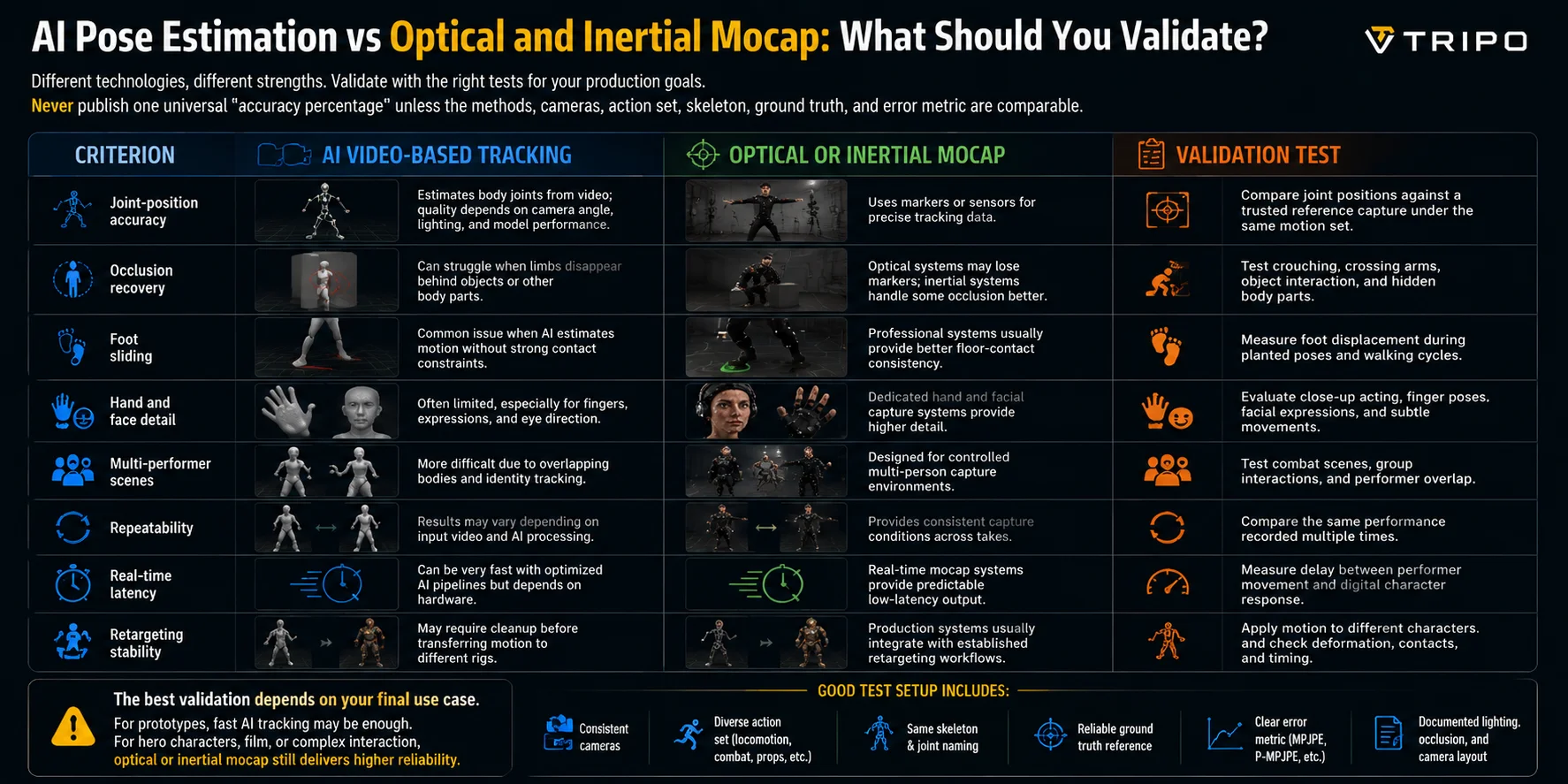
Comparing AI pose estimation with traditional motion capture requires more than asking which system is “more accurate.” Different technologies are designed for different conditions, and a meaningful evaluation depends on the camera setup, motion type, skeleton definition, ground truth data, and error metrics being measured. A single accuracy percentage is not useful unless all testing conditions are comparable.
| Criterion | AI Video-Based Tracking | Optical or Inertial Mocap | Validation Test |
|---|---|---|---|
| Joint-position accuracy | Estimates body joints from video; quality depends on camera angle, lighting, and model performance | Uses markers or sensors for precise tracking data | Compare joint positions against a trusted reference capture under the same motion set |
| Occlusion recovery | Can struggle when limbs disappear behind objects or other body parts | Optical systems may lose markers; inertial systems handle some occlusion better | Test crouching, crossing arms, object interaction, and hidden body parts |
| Foot sliding | Common issue when AI estimates motion without strong contact constraints | Professional systems usually provide better floor-contact consistency | Measure foot displacement during planted poses and walking cycles |
| Hand and face detail | Often limited, especially for fingers, expressions, and eye direction | Dedicated hand and facial capture systems provide higher detail | Evaluate close-up acting, finger poses, facial expressions, and subtle movements |
| Multi-performer scenes | More difficult due to overlapping bodies and identity tracking | Designed for controlled multi-person capture environments | Test combat scenes, group interactions, and performer overlap |
| Repeatability | Results may vary depending on input video and AI processing | Provides consistent capture conditions across takes | Compare the same performance recorded multiple times |
| Real-time latency | Can be very fast with optimized AI pipelines but depends on hardware | Real-time mocap systems provide predictable low-latency output | Measure delay between performer movement and digital character response |
| Retargeting stability | May require cleanup before transferring motion to different rigs | Production systems usually integrate with established retargeting workflows | Apply motion to different characters and check deformation, contacts, and timing |
The best validation process depends on the final use case. For a game prototype, fast AI tracking with acceptable cleanup may be enough. For a hero character, cinematic performance, or complex interaction scene, optical or inertial mocap may still provide the reliability required.
The key question is not whether AI pose estimation matches every professional mocap system. It is whether the captured result meets the project’s required quality level, revision needs, and delivery schedule.
Does AI Reduce Cost, or Move the Cost Into Cleanup?
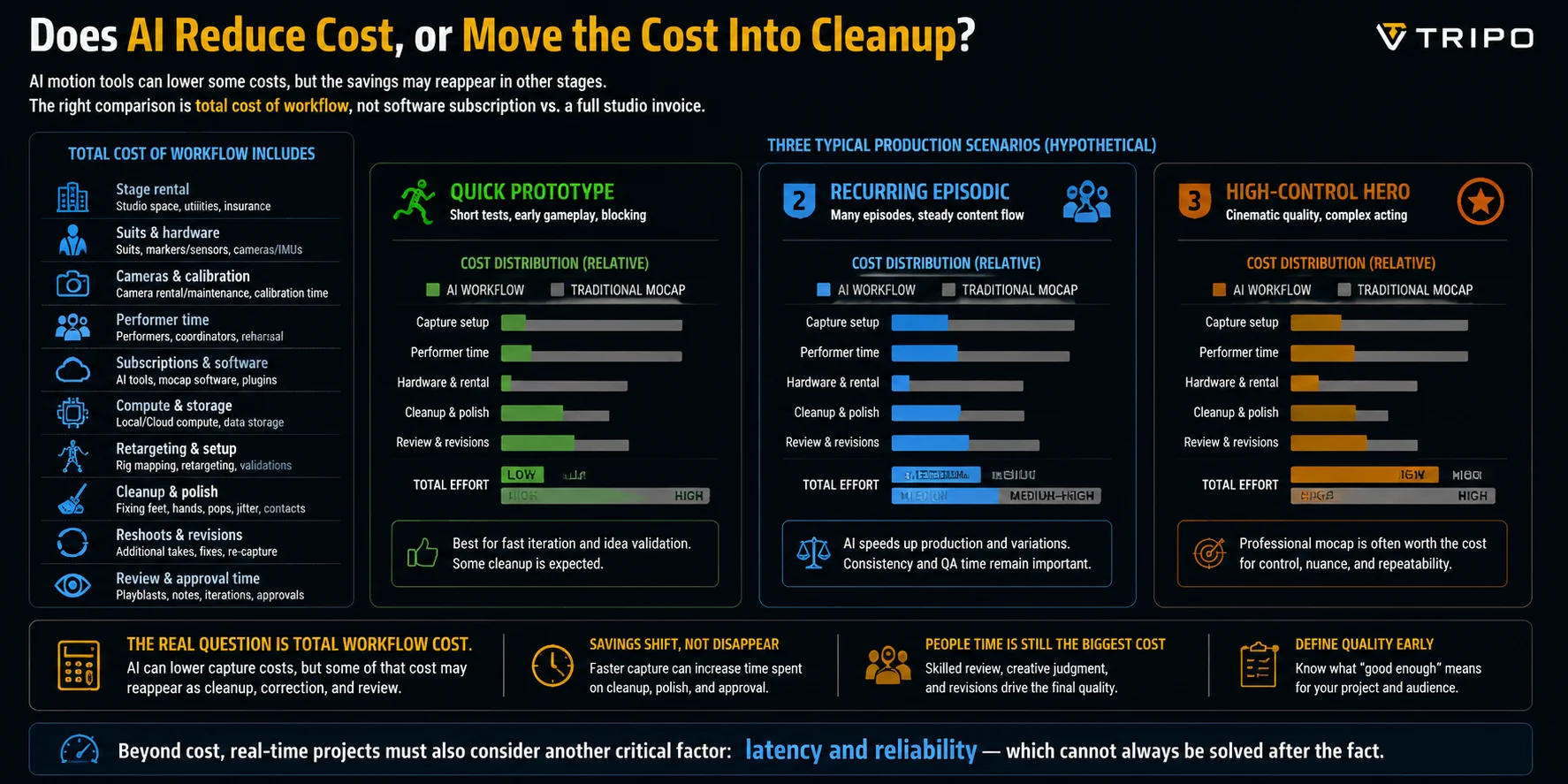
AI motion tools can reduce certain production costs, but the savings are not always as simple as replacing an expensive mocap session with a software subscription. A better way to evaluate cost is to compare the total workflow cost: capture setup, performer time, hardware rental, calibration, data processing, subscriptions, computing resources, retargeting, cleanup, revisions, and review cycles.
For a quick prototype, AI can create significant savings by removing the need for a dedicated capture stage. A solo developer can generate placeholder motion from video or AI tools, test gameplay ideas, and iterate quickly. The trade-off is that some time may move into cleanup, fixing foot sliding, adjusting poses, or preparing the animation for a final character.
For a recurring episodic production, the calculation becomes more complex. AI can accelerate early animation creation, motion search, and variation generation, but teams still need consistent results across many episodes, characters, and revisions. Review and quality-control time become important parts of the budget.
For a high-control hero performance, professional mocap may still provide better value despite higher upfront costs. Complex acting, facial detail, hand performance, and repeatable director-approved results often require specialized capture and experienced performers.
The key comparison is not a software license versus a studio invoice. It is whether AI reduces the total effort required to deliver the final approved animation. AI can lower capture costs, but some of that cost may reappear as cleanup, correction, and review. Beyond budget, real-time projects must also consider another critical factor: latency and reliability, which cannot always be solved after the fact.
Can AI Replace Mocap in Real-Time Virtual Production?
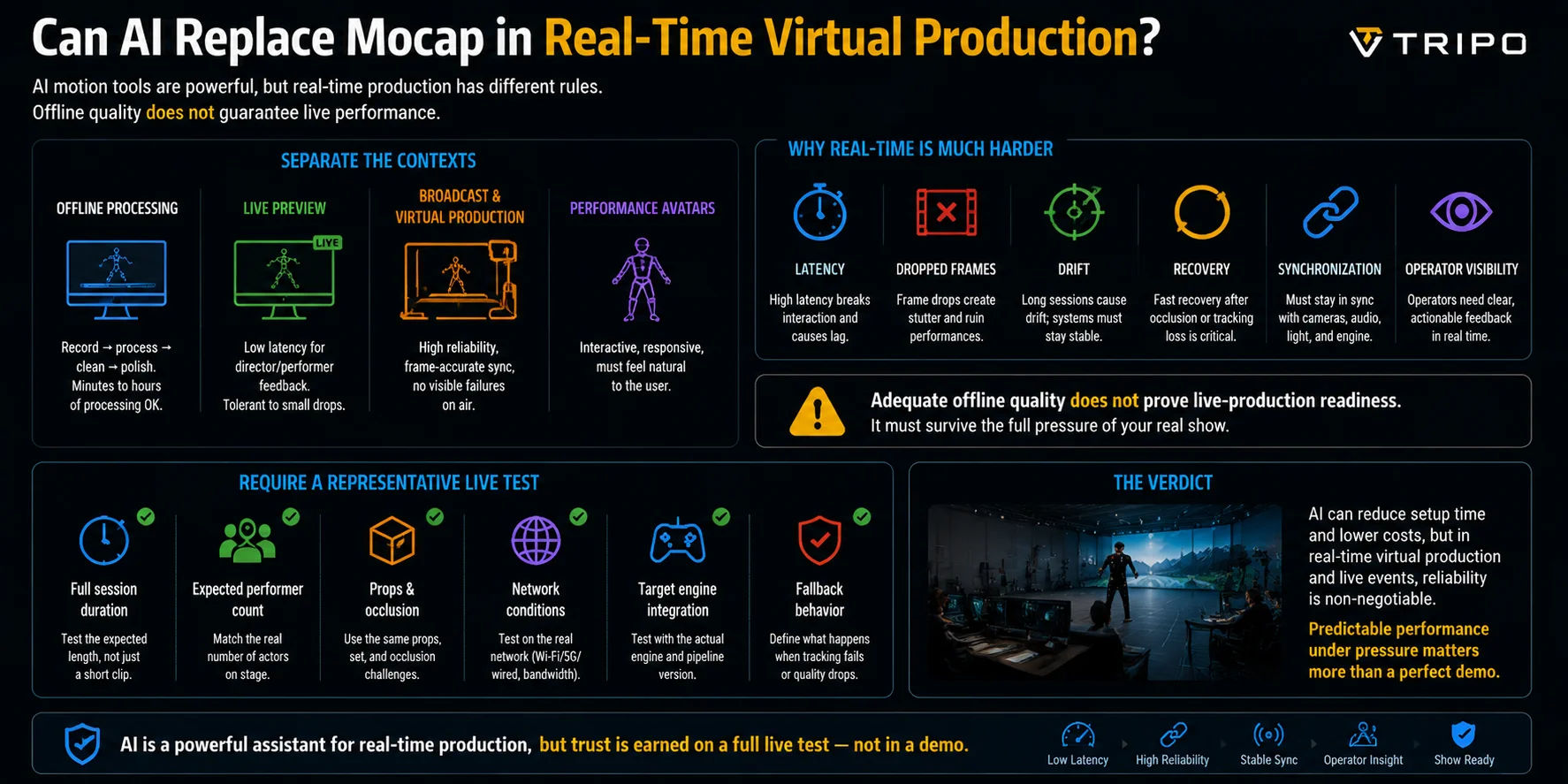
AI motion tools can be highly effective for offline animation workflows, but real-time virtual production introduces a different set of requirements. Generating usable motion after recording a video is not the same as delivering stable, low-latency performance data for live broadcasts, virtual production stages, or interactive avatars.
In real-time environments, factors such as latency, dropped frames, tracking drift, recovery speed, synchronization, and operator visibility become critical. A system that produces acceptable motion after several minutes of processing may still fail during a live performance if tracking breaks, delays increase, or the operator cannot quickly identify and correct problems.
This is why live AI motion capture should be evaluated with a representative production test rather than a simple demo. The test should match the real environment: full session duration, expected number of performers, required props, possible occlusion scenarios, network conditions, target engine integration, and fallback behavior when tracking fails.
Offline quality alone does not prove live-production readiness. A motion system may create convincing animation for a recorded clip but struggle when a performer must move continuously, interact with objects, or respond in real time. For virtual production and live events, reliability is often more important than a single impressive result.
AI is likely to become a valuable part of real-time pipelines by reducing setup time, improving accessibility, and assisting operators. However, professional live performance still requires systems that can deliver predictable results under pressure.
Why Performer Rights and Training Data Affect the Replacement Question
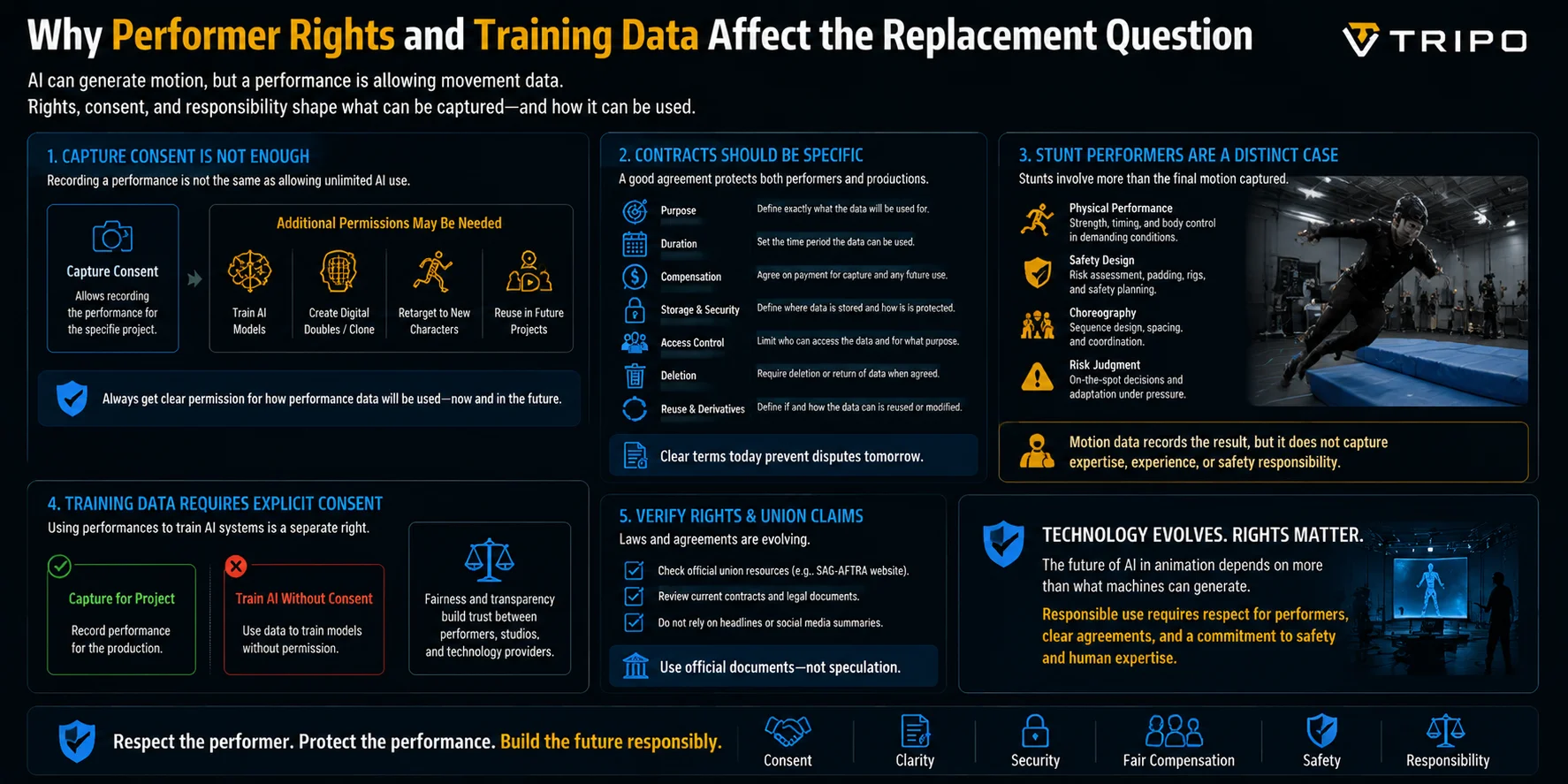
The question of whether AI can replace motion capture is not only a technical issue. It is also a question of rights, consent, and responsibility. A captured performance is not automatically permission to use that data for every possible purpose. There is an important difference between allowing a production to record motion and granting permission to train AI models, create digital doubles, generate derivative performances, retarget movement to new characters, or reuse the data in future projects.
For professional workflows, contracts need to clearly define how performance data can be used. Key areas include the purpose of capture, usage duration, compensation, data storage, access controls, deletion policies, and whether the performance can be reused or modified. As AI systems become better at generating human-like movement, unclear ownership rules can create uncertainty for performers and studios.
Stunt performers highlight this issue even further. A stunt is not only a sequence of body positions. It includes physical decision-making, safety awareness, choreography, timing, risk assessment, and the ability to adapt during a live performance. Motion data can record the result, but it does not fully represent the expertise behind creating that performance safely.
Rights discussions around AI and performance continue to evolve, and specific legal or union requirements should always be checked against current official agreements and documents rather than simplified summaries. The future of AI in animation is not determined only by whether machines can generate motion, but also by whether creators, performers, and productions can establish responsible ways to use that technology.
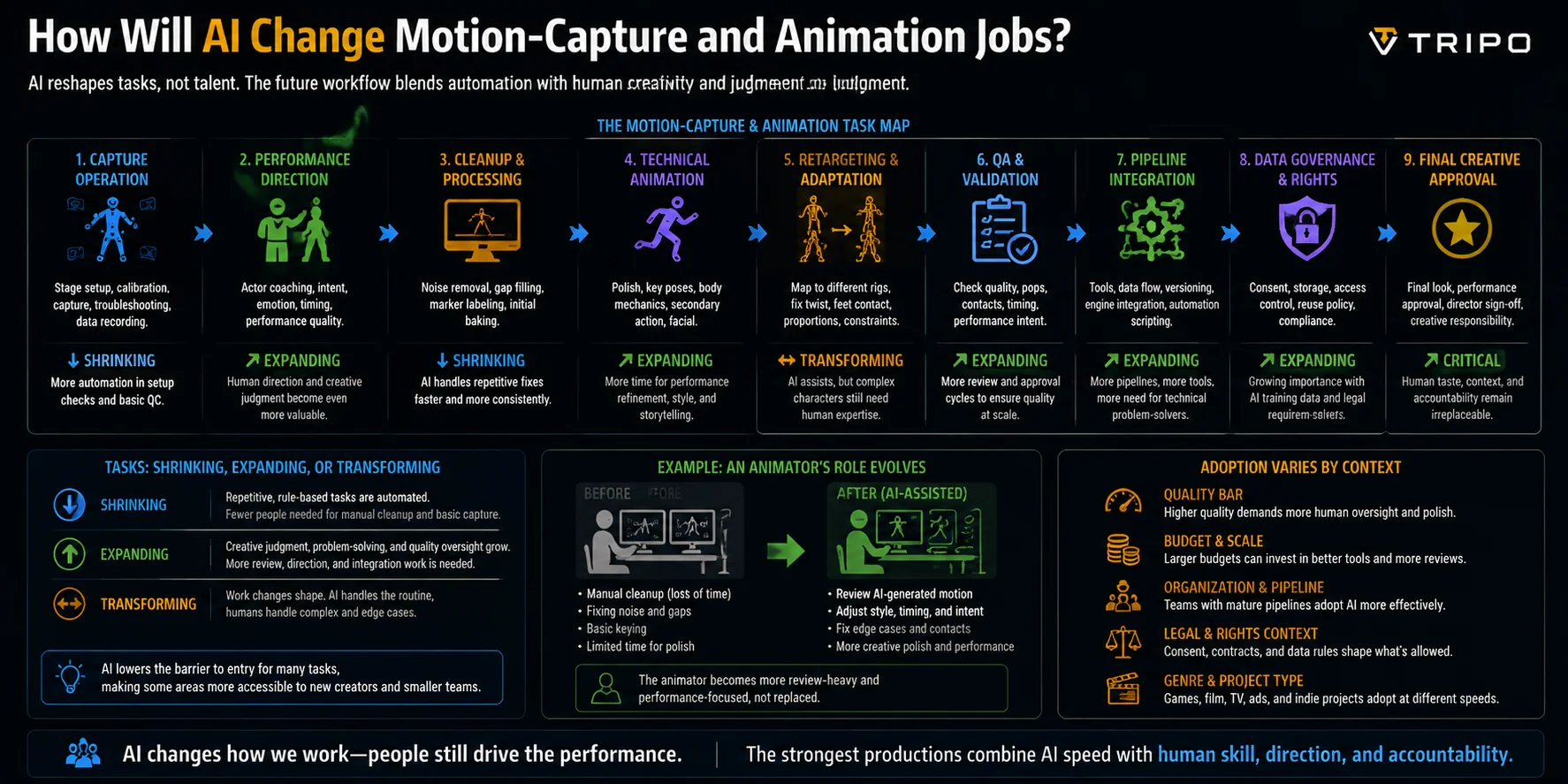
How Will AI Change Motion-Capture and Animation Jobs?
AI is more likely to change motion-capture and animation jobs by shifting tasks than by simply replacing entire roles. Instead of asking whether a job disappears, it is more useful to look at which parts of the workflow are automated, reduced, expanded, or made more accessible.
Tasks such as basic capture setup, rough motion generation, repetitive cleanup, and early animation blocking may require less manual effort as AI tools improve. At the same time, areas such as performance direction, technical animation, retargeting, pipeline integration, quality assurance, data governance, and final creative approval become increasingly important because human judgment is still required.
For example, an animator who previously spent hours cleaning raw motion data may spend more time reviewing AI-generated results, correcting style problems, adjusting character intent, and ensuring the animation matches the director’s vision. The role becomes less about manually fixing every frame and more about supervising, refining, and making creative decisions.
However, adoption will not happen at the same speed everywhere. A small indie team creating prototypes may benefit from AI automation much earlier than a high-end film studio working with strict performance requirements. Budget, quality standards, production scale, legal considerations, and project genre all influence how much AI changes a workflow.
It is also important not to confuse motion-capture careers with motion-design roles, which involve different skills and production goals. AI will reshape many creative processes, but the strongest pipelines will likely combine automation with human expertise rather than remove the need for artists and performers.
How to Choose Between AI, Traditional Mocap, and a Hybrid Workflow
Choosing between AI motion tools, traditional mocap, and a hybrid workflow starts with the production goal, not the technology itself. The right choice depends on what quality level you need, how much control the performance requires, and what risks your pipeline can accept.
Use these questions as a decision checklist:
Is this previs, background motion, or a final hero performance?
AI is often ideal for previs, prototypes, and secondary characters, while hero performances usually require greater control and refinement.
- How much acting nuance and art direction must survive revisions?
If emotional timing, character personality, and subtle performance choices are critical, prioritize workflows that preserve direct artistic control. - Are hands, face, props, contacts, or multiple performers critical?
Complex interactions usually increase the value of specialized capture systems and additional cleanup. - Is the work offline or latency-sensitive?
Offline animation can tolerate processing time, but live events and virtual production require predictable low latency and reliable tracking. - What cleanup and retargeting budget is available?
Faster capture does not always mean less work. Consider how much time your team can spend fixing motion, adjusting rigs, and preparing assets. - What accuracy and repeatability test will define acceptance?
Establish measurable requirements before choosing a tool instead of judging results from a single demo. - What performer-consent and motion-data rights are required?
Confirm how captured performances can be stored, reused, trained on, or transformed before production begins. - What is the fallback if the AI output fails the test?
A reliable pipeline should have a backup plan, whether that means manual animation, additional cleanup, or traditional capture.
Three practical decisions:
- Solo prototype: Choose AI motion tools for speed, accessibility, and quick iteration. Perfect accuracy is usually less important than testing ideas quickly.
- Stylized game hero: A hybrid workflow often works best — use AI for early exploration and variation, then refine important performances with stronger control.
- Live multi-performer production: Traditional mocap or a carefully tested hybrid system remains the safer choice because reliability, synchronization, and performer direction matter most.
The strongest workflows will not be defined by replacing one technology with another, but by combining each approach where it creates the most value.
Where Tripo AI Fits Before Animation or Mocap
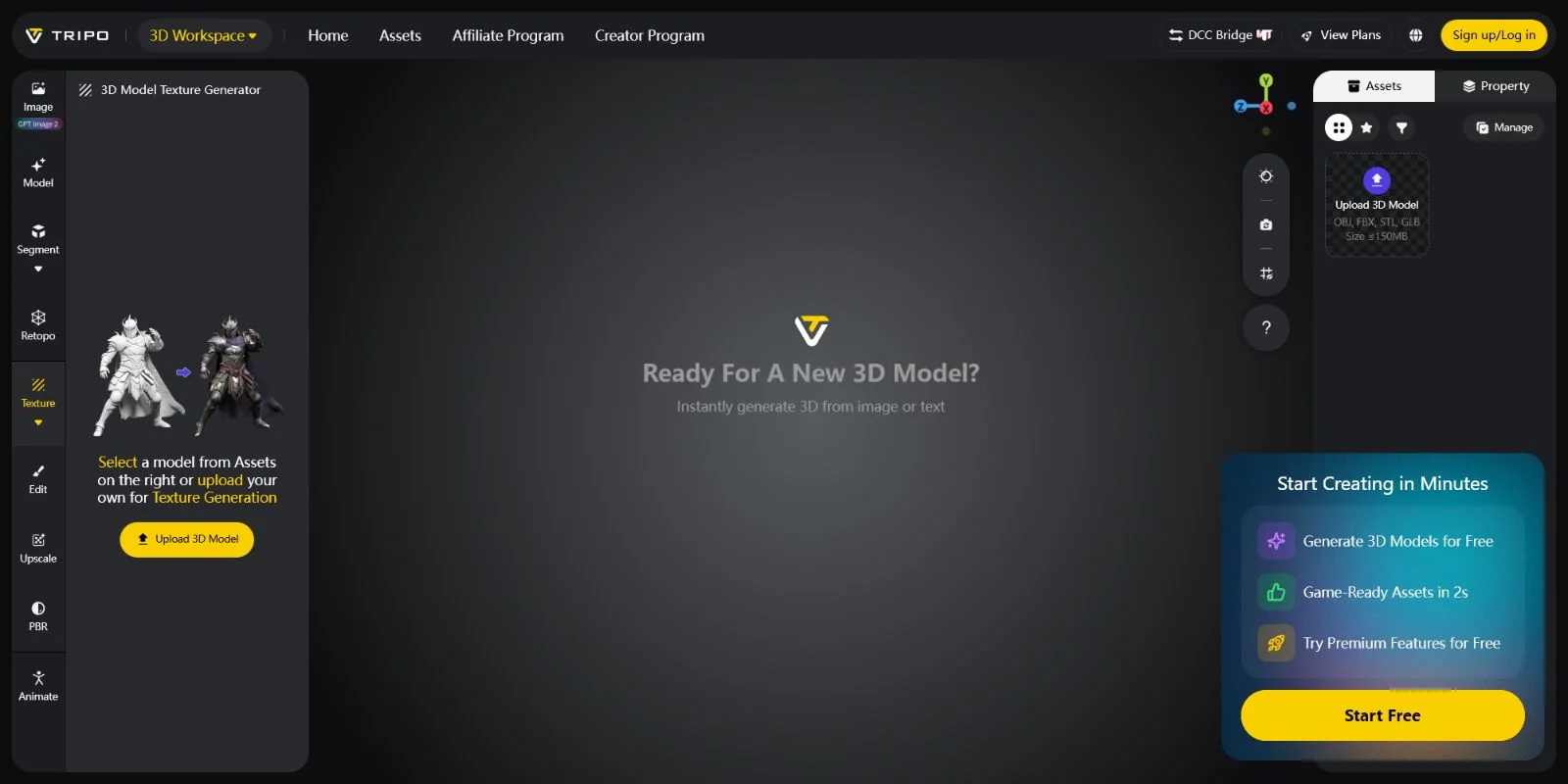
Before choosing an animation or motion-capture workflow, you first need a usable character asset. Tripo AI fits at this earlier stage by helping creators generate starting 3D characters from text prompts or reference images through Tripo AI Studio. These generated models can then be prepared for animation workflows with tools such as Auto Rig, which can create skeletal bindings for supported uploaded GLB or OBJ models.
However, Auto Rig is not designed for every type of character. Current supported targets focus on T-pose humanoids and standard standing quadrupeds. Non-standard poses, highly unusual creatures, and abstract forms may not produce reliable rigging results and may require manual adjustments.
After rigging, always test the exported GLB or FBX file inside your target DCC tool or game engine. Check the skeleton structure, skin weights, model scale, orientation, and animation tracks before using the asset in production.
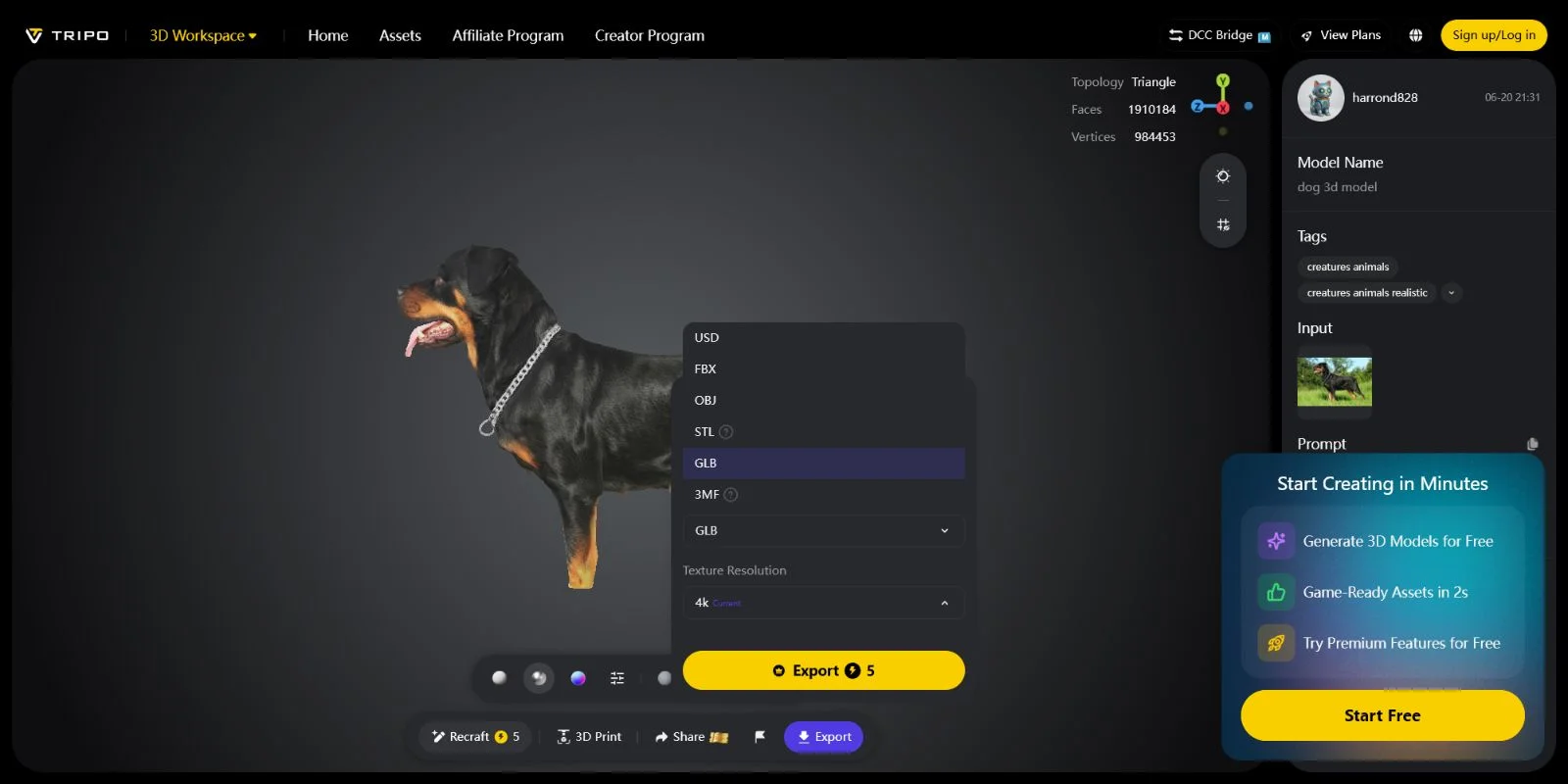
You can prepare a test character with AI auto-rigging, then validate the exported rig before choosing a capture workflow. Tripo AI helps create and prepare the character foundation, while motion capture and animation tools handle the performance layer that comes afterward.
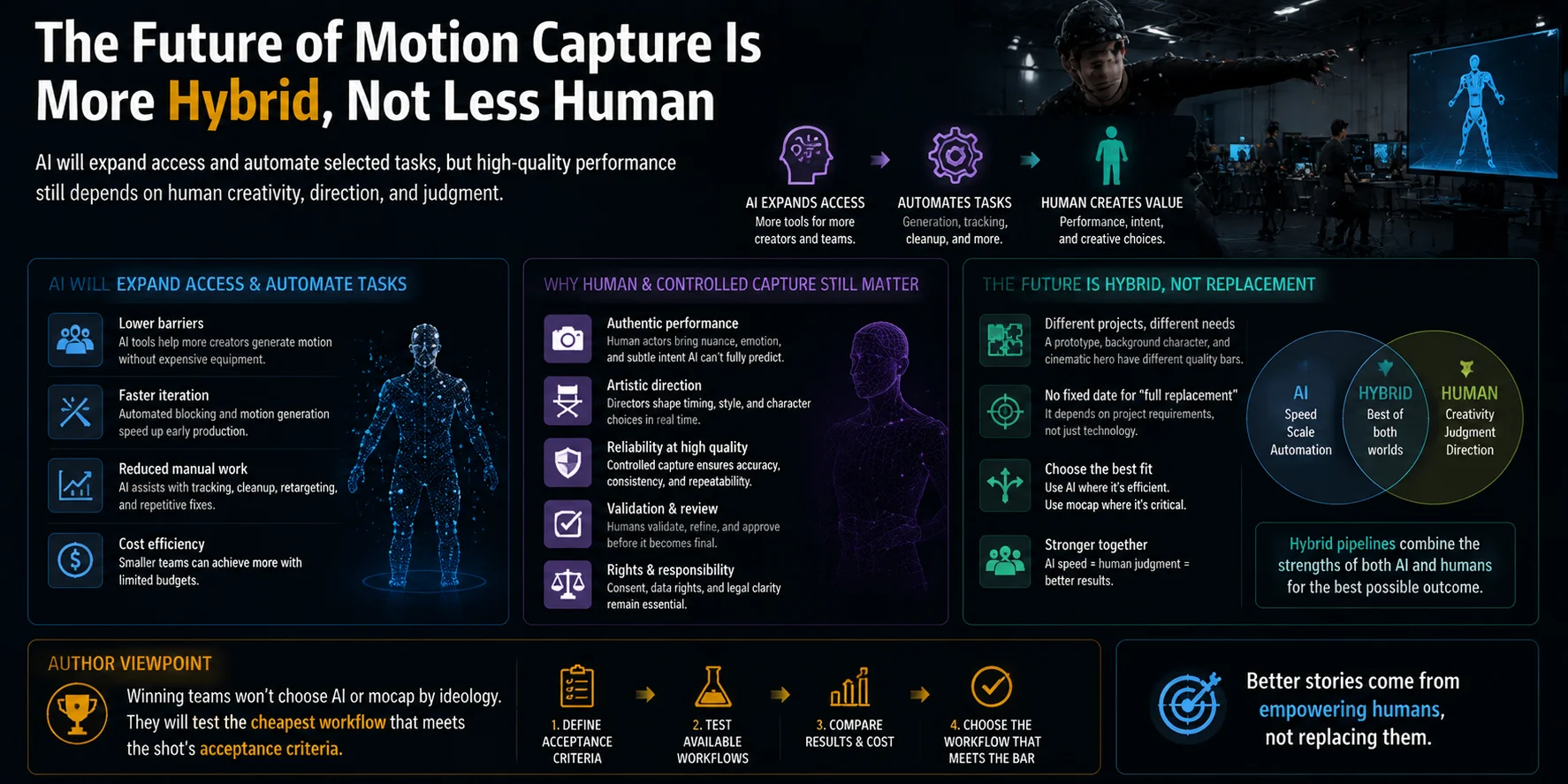
The Future of Motion Capture Is More Hybrid, Not Less Human
The future of motion capture is unlikely to be defined by AI replacing people. Instead, AI will expand access to motion creation and automate selected tasks such as early blocking, motion generation, tracking assistance, and cleanup. This will allow more creators and smaller teams to experiment with animation workflows that previously required expensive equipment or specialized resources.
However, as quality requirements increase, controlled capture, human performance, artistic direction, validation, and clear rights management remain essential. A convincing performance is not only about producing movement data; it is about preserving intent, emotion, consistency, and creative decisions throughout production.
There is no reliable date for a complete “replacement” of motion capture because the answer depends on project requirements. A stylized prototype, a background character, and a cinematic hero performance all have different acceptance standards.
The strongest teams will not choose AI or traditional mocap based on ideology. They will evaluate each shot, test available workflows, and select the most efficient approach that meets the required quality, reliability, and production constraints. The future belongs to hybrid pipelines that combine AI speed with human judgment.
Frequently Asked Questions
Will AI replace mocap?
AI will not completely replace motion capture, but it will automate parts of the workflow, including prototyping, video-based tracking, motion generation, and cleanup. Professional mocap will remain important for high-fidelity performances, complex interactions, and projects requiring precise control and repeatability. The future will likely combine AI efficiency with human direction and performance capture.
What is the future of motion capture?
The future of motion capture will involve hybrid workflows in which AI assists with tracking, motion generation, cleanup, and iteration. Human performers and artists will remain essential for creative control and expressive performances. Traditional mocap will continue supporting high-quality productions, while AI-powered tools make motion creation faster, more flexible, and accessible to smaller teams.
Is AI motion capture accurate enough for professional work?
AI motion capture is accurate enough for many professional applications, including previs, prototyping, background characters, and rapid animation iteration. However, high-end productions often still require traditional mocap or hybrid workflows for complex performances, facial details, hand movements, and consistent results. The best approach depends on the project’s quality requirements, budget, and validation standards.
Does AI motion capture eliminate cleanup?
No, AI motion capture does not eliminate cleanup completely. It can reduce manual work by improving tracking, generating motion, and applying basic corrections, but artists may still need to fix foot sliding, hand details, physical contacts, retargeting errors, and performance style. The amount of cleanup depends on the source footage and required production quality.
Can AI capture facial expressions and finger motion?
AI can capture facial expressions and finger motion, particularly when used with specialized models, cameras, or dedicated AI-assisted systems. However, subtle facial acting, accurate eye direction, and precise finger articulation remain challenging. For high-quality character performances, AI capture is often combined with professional facial or hand capture equipment and manual refinement by experienced artists.
Will AI replace mocap performers or stunt performers?
AI is unlikely to completely replace mocap or stunt performers because human performance involves acting choices, physical skill, safety judgment, and creative interpretation. AI may reduce repetitive work and help generate, modify, or extend existing movements. However, skilled performers will remain essential for expressive, physically convincing, and director-controlled performances in high-quality productions.
Can Tripo AI do motion capture?
No, Tripo AI does not directly perform motion capture. It primarily focuses on generating 3D character assets and preparing them for animation through features such as AI-powered modeling and auto-rigging. You can create and rig a character with Tripo AI, then export it to a separate mocap or animation tool to apply recorded movement.
Conclusion
If you need a character asset before testing an animation workflow, create a controlled sample in Tripo AI Studio and validate the rig in your target DCC or engine. Use the exported character as a foundation for your animation pipeline, then choose the right motion workflow based on your performance requirements. Review Tripo AI Pricing before planning exports and larger-scale production use.