What Is Spatial Intelligence? How AI Learns to See in 3D
TL;DR
- Spatial intelligence is the ability to understand and interact with the 3D world — including depth, geometry, distance, and object relationships.
- AI has mastered text and images but still struggles with true spatial reasoning because it lacks a built-in understanding of physics, scale, and 3D structure.
- World models aim to solve this gap by creating AI systems that can generate, predict, and interact with realistic 3D environments.
- Spatial intelligence is already transforming robotics, game development, AR/VR, scientific research, and 3D asset creation.
- Humans can improve spatial skills through building, drawing, gaming, navigation, and hands-on 3D creation with tools like Blender and Tripo AI Studio.
Spatial intelligence is the ability to perceive, reason about, and interact with the three-dimensional world — understanding depth, geometry, distance, and how objects relate to each other in space. In AI, it refers to systems that can see, interpret, and generate 3D environments, not just analyze flat text or images.
Despite rapid progress in AI, machines still struggle with the kind of spatial understanding humans develop naturally through everyday experience. Recent advances in world models, including major investment and funding momentum around companies such as World Labs, show that building AI systems with true 3D understanding has become a major research direction. This article explores what spatial intelligence means, how humans develop it, why AI finds it difficult, how world models may change the field, how 3D generation tools apply spatial intelligence in practice, and what creators can do with these emerging technologies.
What Is Spatial Intelligence? A Clear Definition
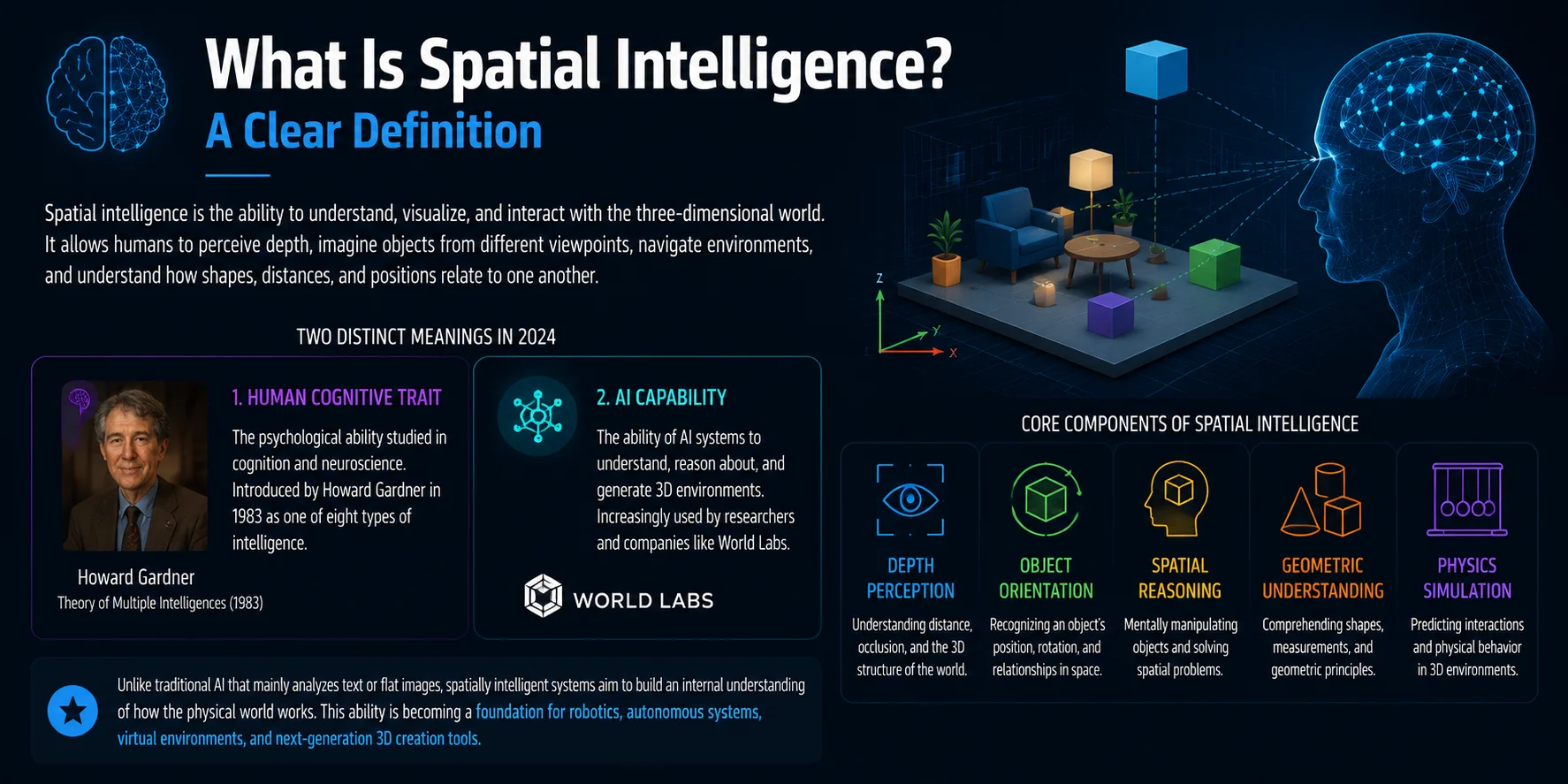
Spatial intelligence is the ability to understand, visualize, and interact with the three-dimensional world. It allows humans to perceive depth, imagine objects from different viewpoints, navigate environments, and understand how shapes, distances, and positions relate to one another. In psychology, spatial intelligence is widely associated with the ability to mentally manipulate objects and reason about space.
The concept was introduced as one of the eight types of intelligence in Howard Gardner’s theory of multiple intelligences published in 1983. Gardner described spatial intelligence as the capacity to recognize patterns in space, create mental images, and transform those images through thought or action.
Today, “spatial intelligence” has two closely related but distinct meanings. The first refers to human cognitive ability studied in psychology and neuroscience. The second refers to an AI capability: systems that can understand, reason about, and generate 3D environments. This newer usage has become increasingly common among AI researchers and companies developing world models, including World Labs.
For AI systems, spatial intelligence involves several core abilities: depth perception, object orientation, spatial reasoning, geometric understanding, and physics-based interaction. Unlike traditional AI that mainly analyzes text or flat images, spatially intelligent systems aim to build an internal understanding of how the physical world works. This ability is becoming a foundation for robotics, autonomous systems, virtual environments, and next-generation 3D creation tools.
How Humans Develop Spatial Intelligence
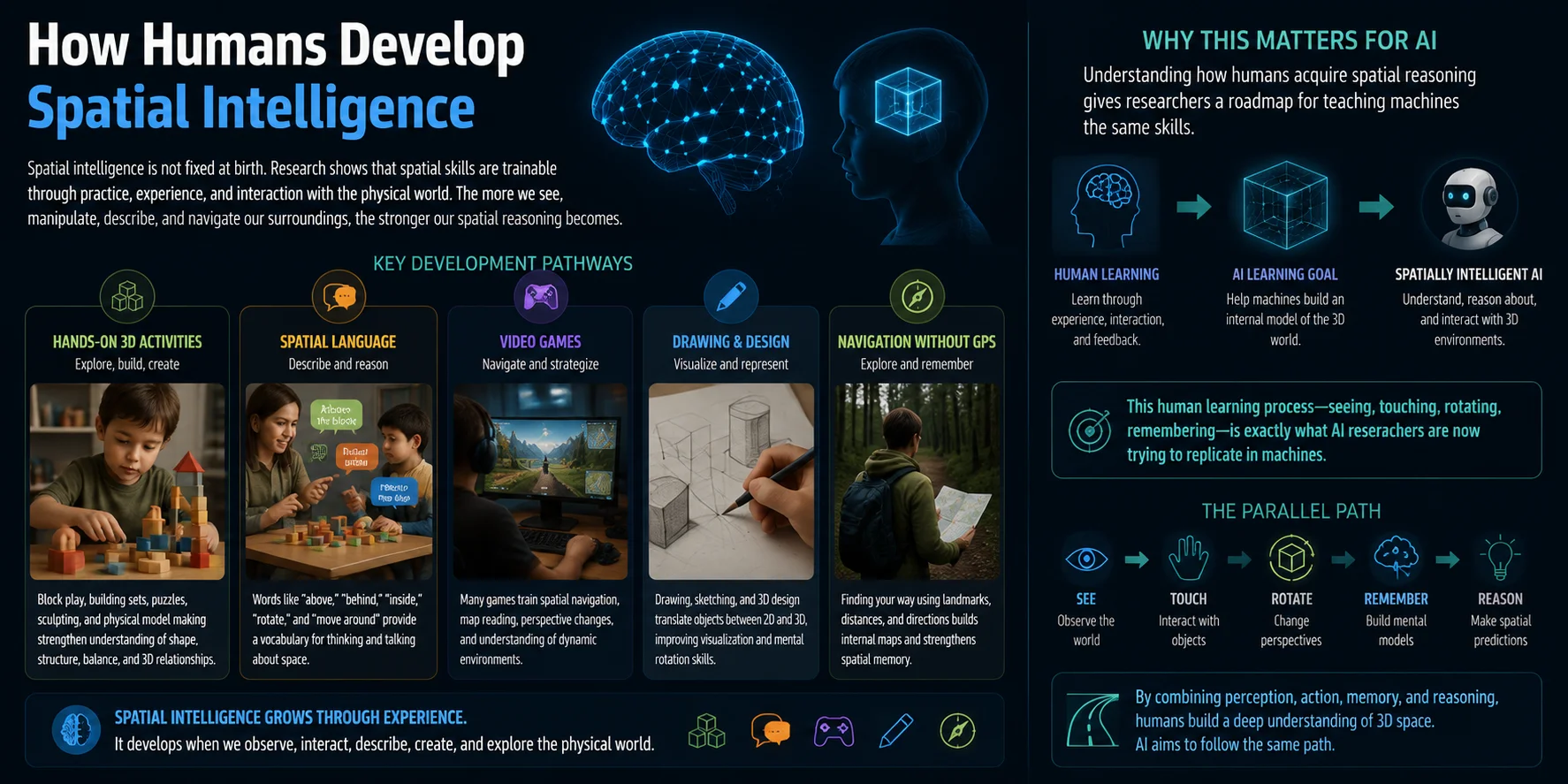
Spatial intelligence is not a fixed ability that humans are simply born with. Research in developmental psychology suggests that spatial skills can be improved through experience, practice, and interaction with the physical world. Instead of developing automatically, spatial reasoning grows as people repeatedly observe objects, manipulate them, and learn how different elements relate to one another.
One of the most important development pathways is hands-on 3D exploration. Activities such as building with blocks, assembling objects, sculpting, drawing, and creating physical models help people understand shape, scale, rotation, and structure. Spatial language also plays a major role. Words such as “above,” “behind,” “inside,” “rotate,” and “move around” give people a framework for describing and reasoning about three-dimensional relationships.
Other experiences strengthen spatial thinking as well. Video games can train navigation, perspective changes, and environment awareness. Drawing helps translate 3D objects into 2D representations, while exploring environments without relying entirely on GPS encourages people to build internal maps and understand physical spaces.
This learning process shows that spatial intelligence develops through a combination of perception, action, memory, and reasoning. Humans do not understand the world only by looking at images; they learn by interacting with objects and testing predictions about how things behave.
This human learning process — seeing, touching, rotating, remembering — is exactly what AI researchers are now trying to replicate in machines. Building AI with stronger spatial intelligence requires more than recognizing objects in images; it requires developing a deeper understanding of how objects exist, move, and interact within a three-dimensional world.
Why Spatial Intelligence Has Been AI's Blind Spot
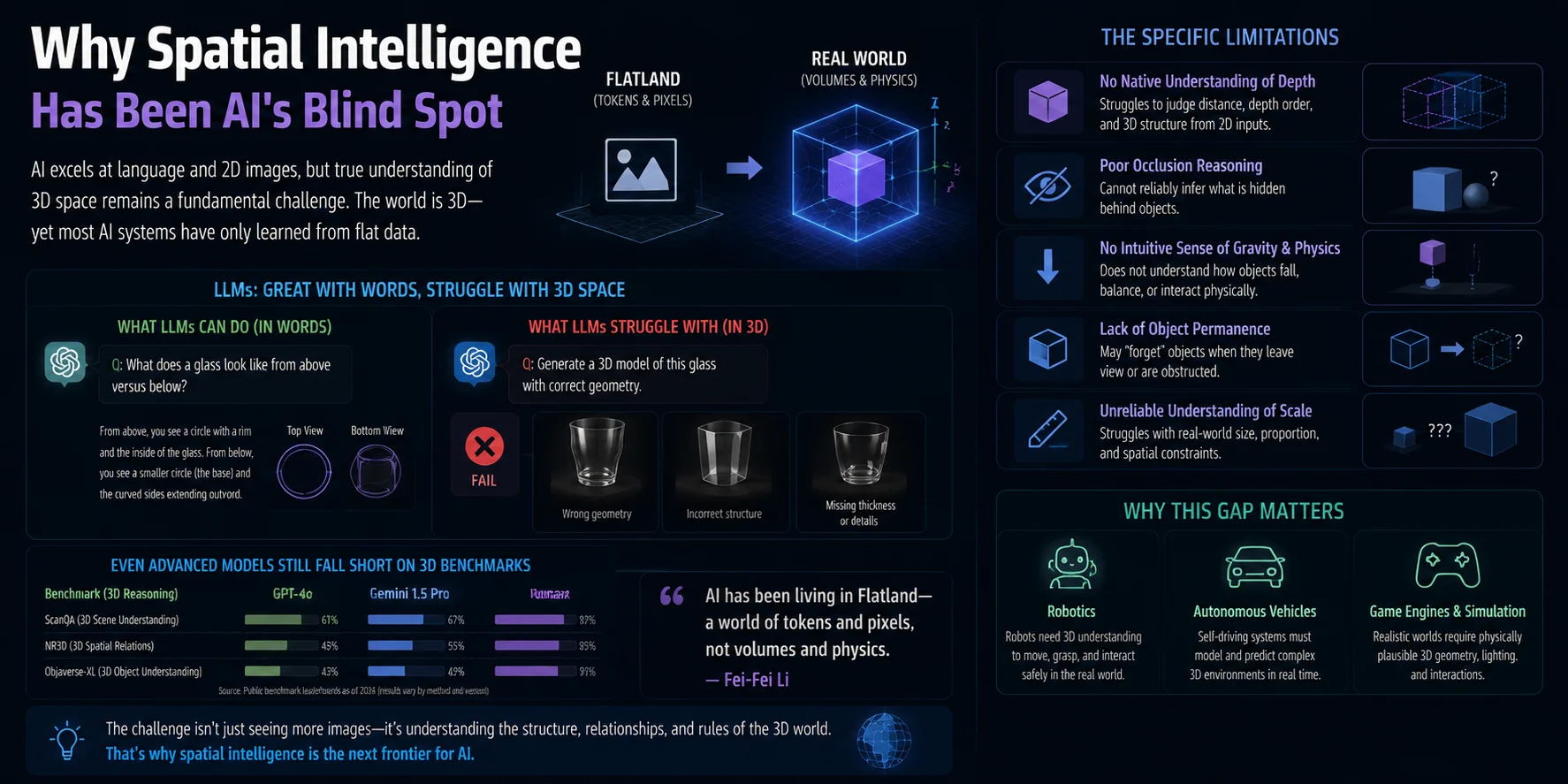
Modern AI systems have achieved remarkable results in language and image understanding, but three-dimensional space remains a major challenge. Large language models can describe a cube, explain its properties, or answer questions about its shape, yet they often struggle with true spatial reasoning. For example, an AI can describe what a glass looks like from above or below, but generating a physically accurate 3D model of that glass requires understanding its volume, thickness, hidden surfaces, and how light interacts with its material.
The core problem is that many AI systems were built around patterns in text and pixels rather than direct experience of the physical world. They do not naturally understand concepts that humans learn through interaction, such as depth, occlusion, gravity, object permanence, and scale. A person knows that a chair remains a chair when viewed from behind, understands that a hidden object still exists behind another object, and can estimate whether something will fit into a space. These abilities are much harder for AI systems to reproduce.
Models such as GPT-4o and Gemini have significantly improved AI’s ability to analyze images and understand visual information, but they still face difficulties on many 3D spatial reasoning tasks. Recognizing objects in a picture is different from building an internal model of how those objects exist and behave in the real world.
Fei-Fei Li has described this limitation by saying that AI has been “living in Flatland” — a world dominated by tokens and pixels rather than volumes, environments, and physical interactions. Moving beyond Flatland is essential because many future technologies depend on spatial understanding. Robots need to navigate and manipulate real spaces, autonomous vehicles must predict complex 3D environments in real time, and game engines require believable worlds where objects follow physical rules.
The challenge is not simply teaching AI to see more images. It is teaching machines to understand the structure, relationships, and rules of the three-dimensional world itself. This is the foundation behind the growing push toward spatial intelligence and world models.
World Models — The Breakthrough Enabling Spatial AI
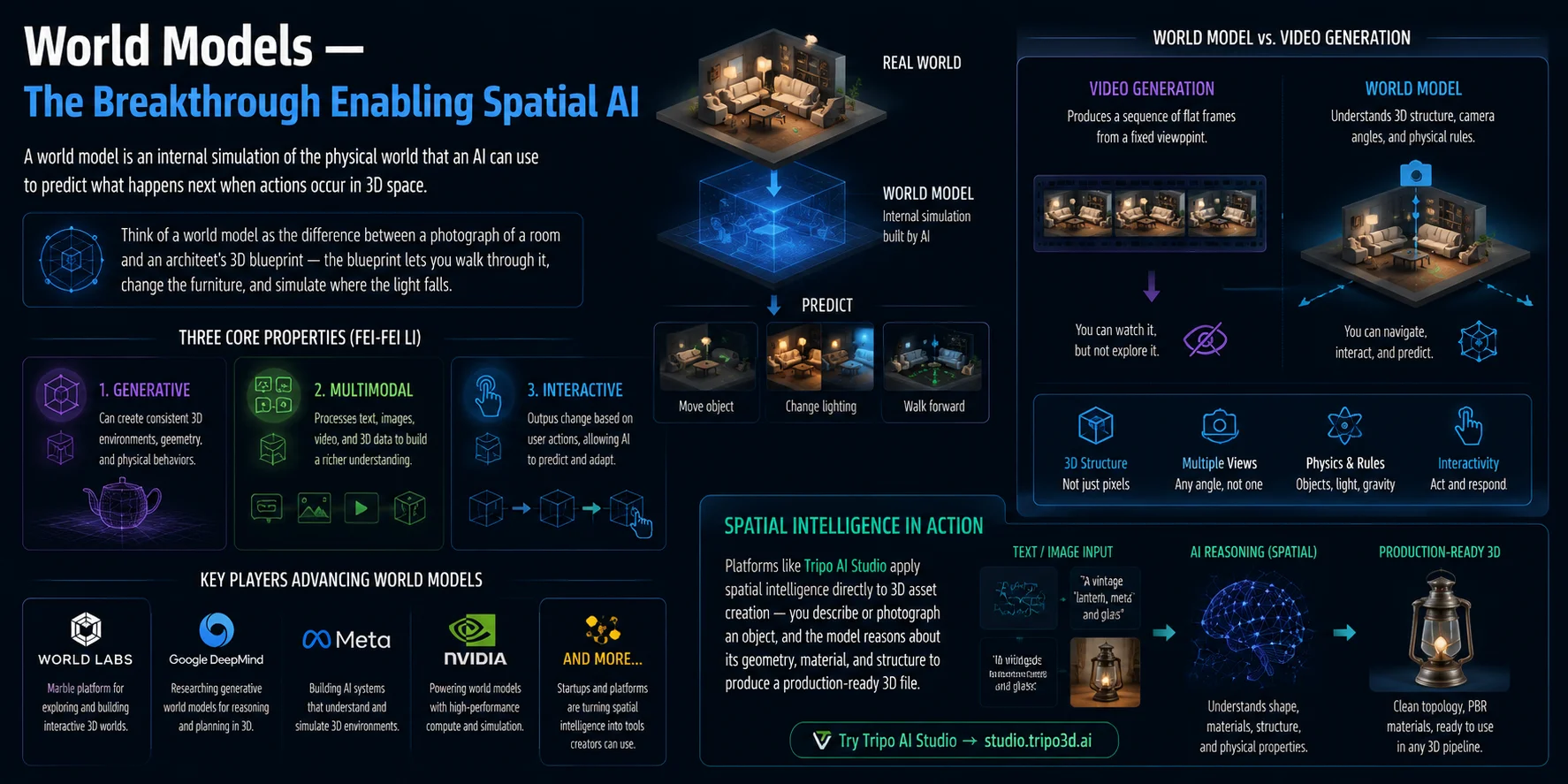
A world model is an AI system that builds an internal simulation of how the physical world works. Instead of only recognizing objects or generating individual images, a world model attempts to understand relationships between objects, environments, movement, and cause-and-effect. It can use this internal representation to predict what may happen when actions occur in a 3D space.
A simple way to understand the difference is to compare a world model with a photograph. A photograph shows what a room looks like from one viewpoint, but an architect’s 3D blueprint contains information about the room’s structure. With the blueprint, you can walk through the space, move objects, change the lighting, and predict how the environment will behave. A world model aims to provide AI with that deeper level of understanding.
According to Fei-Fei Li’s vision for spatial intelligence, effective world models need three key properties. First, they are generative — they can create consistent 3D environments, geometry, and physical behaviors rather than only analyze existing data. Second, they are multimodal — they can combine information from text, images, video, and 3D data to build a richer understanding of the world. Third, they are interactive — the generated world should respond to user actions, allowing AI systems to predict outcomes and adapt in real time.
Several major technology companies are developing world-model approaches, including World Labs with its Marble platform, Google DeepMind, Meta Platforms, and NVIDIA. These efforts aim to create AI systems that can understand environments for robotics, simulation, autonomous systems, and creative applications.
World models are also different from traditional video generation. A video generator creates a sequence of flat frames that look convincing from a specific viewpoint. A world model focuses on the underlying 3D structure, camera relationships, and physical rules. The difference is that you can explore and interact with a world model instead of simply watching it.
This same idea is becoming practical in 3D creation. Platforms like Tripo AI Studio apply spatial intelligence directly to asset generation — users can describe or photograph an object, and the system analyzes its geometry, materials, and structure to create a production-ready 3D model. As world models continue to develop, spatial intelligence is moving from a research concept toward tools that creators can use in everyday workflows.
Spatial Intelligence in Action — Real-World Applications
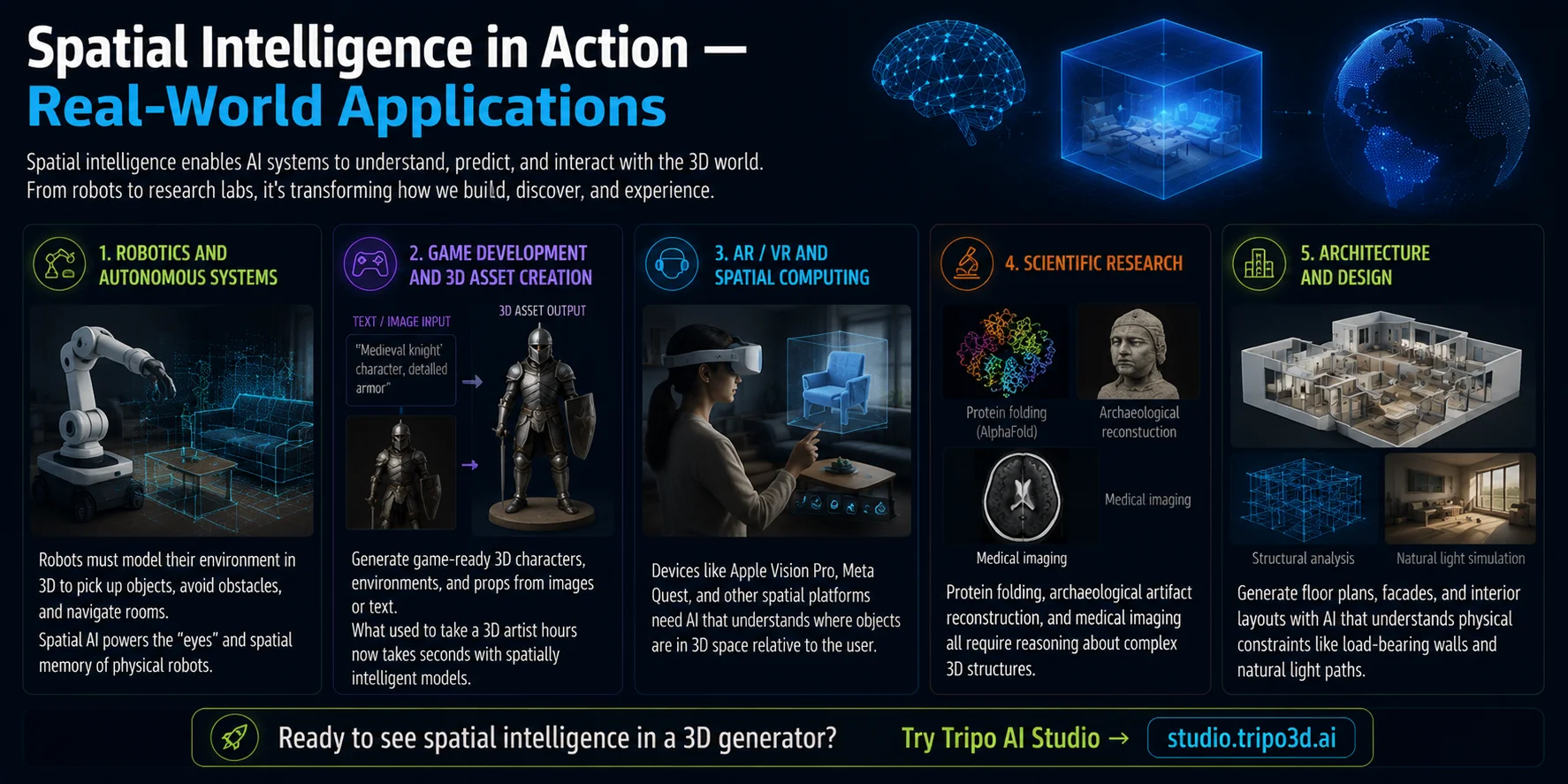
Spatial intelligence is moving from a research concept into practical systems that need to understand, predict, and interact with the three-dimensional world. Unlike traditional AI that mainly processes text or images, spatial AI focuses on how objects exist, move, and relate to each other in physical environments.
Robotics and autonomous systems are among the most important applications. Robots need spatial intelligence to understand their surroundings, recognize object locations, avoid obstacles, and perform tasks such as picking up items or navigating complex spaces. In these systems, spatial AI provides the “eyes” and spatial memory needed to interact safely with the real world.
Game development and 3D asset creation represent another major application area. Spatially intelligent models can generate 3D characters, environments, and props from text descriptions or reference images. Tasks that once required hours of manual modeling can now be accelerated into minutes or seconds, helping creators quickly build prototypes, game worlds, and digital assets.
AR, VR, and spatial computing also depend heavily on this technology. Devices such as Apple Vision Pro and Meta Quest need AI systems that understand the user’s position, surrounding objects, and the relationships between digital content and the physical environment. Accurate spatial understanding enables more realistic mixed-reality experiences.
In scientific research, spatial intelligence helps solve complex 3D problems. Examples include protein structure prediction, archaeological artifact reconstruction, and medical imaging analysis, where understanding shape and geometry is essential for discovery and decision-making.
Architecture and design are also being transformed by spatial AI. Instead of only generating visual concepts, future systems can consider real-world constraints such as room dimensions, structural requirements, lighting conditions, and material relationships when creating floor plans, buildings, and interior layouts.
As spatial intelligence continues to improve, it will become a foundation for both physical and digital creation. Ready to see spatial intelligence in a 3D generator? Try Tripo AI Studio and explore and explore how AI can transform ideas into usable 3D assets.
How to Improve Your Own Spatial Intelligence
Spatial intelligence is not just an ability you are born with — it is a skill that can be strengthened through deliberate practice. Whether you are a designer, developer, artist, or simply want to improve your understanding of the physical world, activities that train visualization and mental rotation can improve your spatial reasoning.
1. Build and assemble things Hands-on construction activities such as LEGO, 3D puzzles, model kits, and woodworking train your brain to understand how individual parts connect and how objects exist as complete structures. Moving pieces around physically creates a stronger connection between visualizing and manipulating space.
2. Learn to sketch in 3D Drawing isometric views, technical sketches, and simple perspective studies forces you to imagine objects from different angles. This practice improves your ability to mentally rotate shapes and represent depth on a flat surface.
3. Use spatial language intentionally Words such as “above,” “behind,” “inside,” “rotate,” “parallel,” and “perpendicular” are more than descriptions — they help organize spatial memory. Regularly explaining object positions and relationships strengthens spatial reasoning.

4. Play spatial video games Games such as Minecraft, Portal, and CAD-based simulation environments require players to navigate, construct, solve spatial puzzles, and understand changing viewpoints. These activities provide repeated practice with 3D problem-solving.
5. Practice with 3D software Working directly with 3D tools develops the same mental rotation skills involved in spatial reasoning tests. Modeling objects in Blender or generating and editing assets with platforms like Tripo AI Studio help you understand geometry, scale, perspective, and structure through hands-on creation.
6. Navigate without GPS sometimes Building mental maps of real-world environments is one of the oldest forms of spatial training. Remembering routes, landmarks, and distances strengthens your ability to visualize spaces internally.
Improving spatial intelligence is ultimately about interacting with the world in more active ways — seeing, building, rotating, creating, and predicting how objects exist in three-dimensional space.
Frequently Asked Questions
What is an example of spatial intelligence?
Reading a map and knowing which way to turn, assembling furniture from a diagram without confusion, rotating a 3D shape in your mind to check if it fits through a door — these are all spatial intelligence in action. In AI, a system that can generate a 3D model of a chair from a single photo is demonstrating machine spatial intelligence.
What famous person has spatial intelligence?
Fei-Fei Li, Stanford professor and co-founder of World Labs, has made spatial intelligence her research focus and is widely credited with framing it as "AI's next frontier." Historically, architects like Frank Lloyd Wright and engineers like Nikola Tesla are cited for exceptional spatial reasoning.
What is a high spatial IQ?
Spatial IQ is typically measured by tests like mental rotation tasks or block design. A score above the 75th percentile is considered above average; above the 90th is considered high. More practically, people with high spatial IQ tend to excel in engineering, surgery, architecture, and 3D art.
What jobs require spatial intelligence?
Architecture, civil and mechanical engineering, surgery, air traffic control, game design, 3D modeling, urban planning, and geology all rely heavily on spatial reasoning skills. With the rise of spatial AI tools, 3D artists and technical directors are also increasingly working alongside AI systems that process 3D space.
How is spatial intelligence different from visual intelligence?
Visual intelligence is about processing what you see (color, pattern, form); spatial intelligence adds reasoning about relationships in 3D space — position, orientation, and movement. You can have strong visual memory without strong spatial rotation ability.
Can spatial intelligence be improved in adults?
Yes. Multiple studies show that spatial skills are trainable at any age through practice — 3D modeling, technical drawing, navigation tasks, and even certain video games all measurably improve spatial reasoning in adults.
What does "spatial intelligence in AI" mean?
It refers to AI systems' ability to understand, reason about, and generate 3D environments — not just process 2D images or text. World models, 3D generators like Tripo AI, and spatial computing platforms like Apple Vision Pro all rely on machine spatial intelligence.
How does Tripo AI use spatial intelligence?
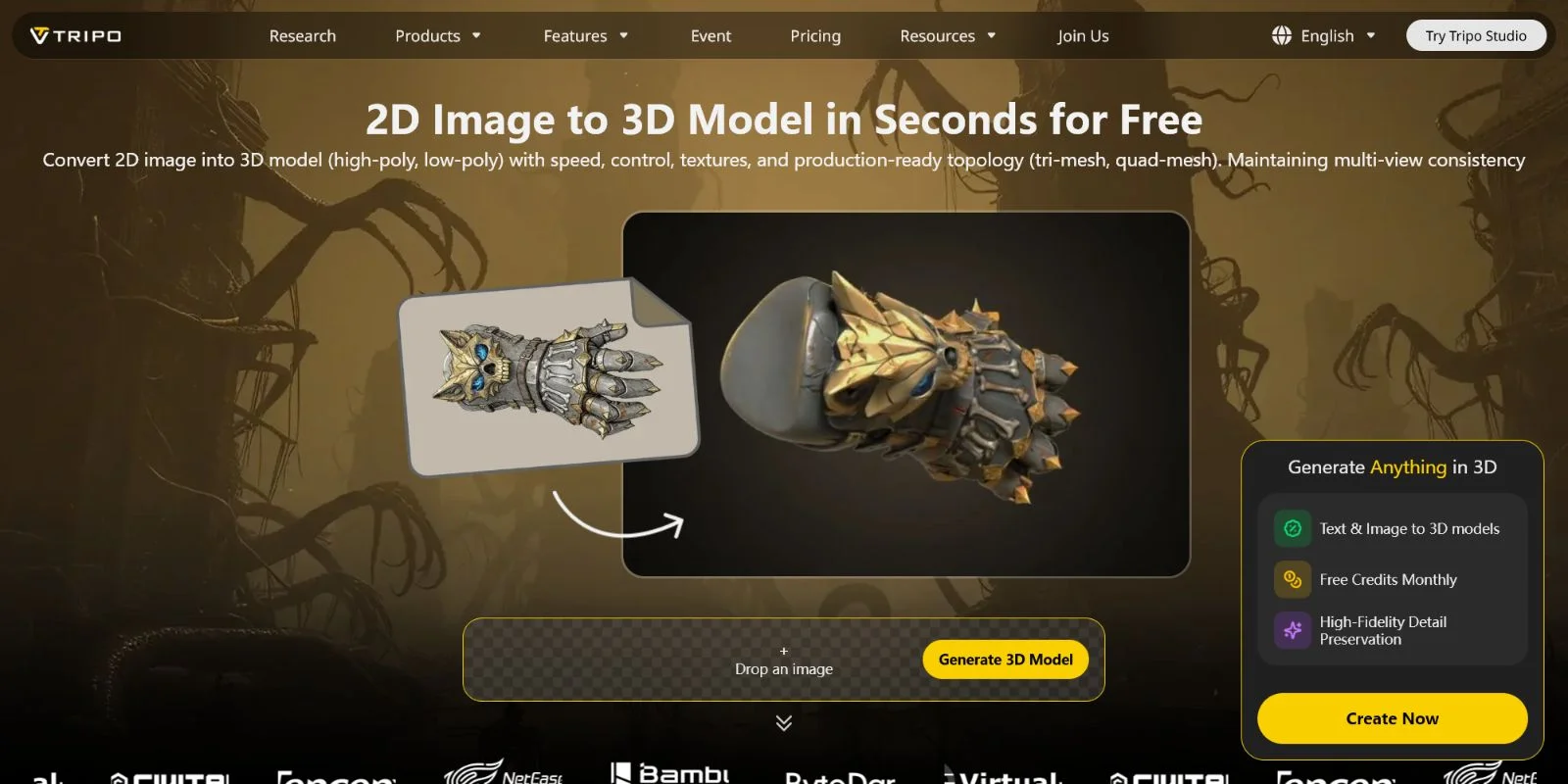
Tripo AI's generation models are trained to understand 3D geometry, surface normals, and spatial relationships between parts of an object. When you upload a photo or type a description, the model reasons about the 3D structure — depth, volume, topology — and outputs a production-ready mesh with PBR textures. This is applied spatial intelligence: perceiving 2D input and reconstructing the 3D world it implies.
Conclusion
Spatial intelligence is no longer just a concept from psychology textbooks — it is becoming a core capability that separates AI systems that understand the 3D world from those limited to patterns in text and pixels. As world models advance and 3D AI tools become more accessible, spatial reasoning will become an essential skill for both humans and machines creating and interacting with digital environments.
If you want to experience spatial intelligence in real 3D creation, generate production-ready models from text or images with Tripo AI Studio. Explore Tripo AI Pricing to find the right plan for your creative workflow and production needs.