Do You Need to Know 3D Modeling? (Honest Answer for 2026)
- You do not need 3D modeling knowledge to create assets today.
- AI tools can help beginners create first-pass 3D models without learning manual modeling first.
- Clear direction, visual judgment, and basic 3D concepts help you evaluate and improve AI-generated results.
- Tripo AI can generate a starting 3D model from text or images without first mastering manual modeling.
No, you do not need to know 3D modeling before you begin creating 3D assets. Traditional workflows require practice with modeling, UVs, materials, topology, and export settings, and those skills still matter for professional control. AI tools have changed the entry point: beginners can generate starting models from text or images, export them, and then inspect or refine them for games, design, education, or 3D printing.
What Does “Knowing 3D Modeling” Actually Mean?
“Knowing 3D modeling” is not one single skill. It usually means understanding a full production process for creating usable 3D assets.
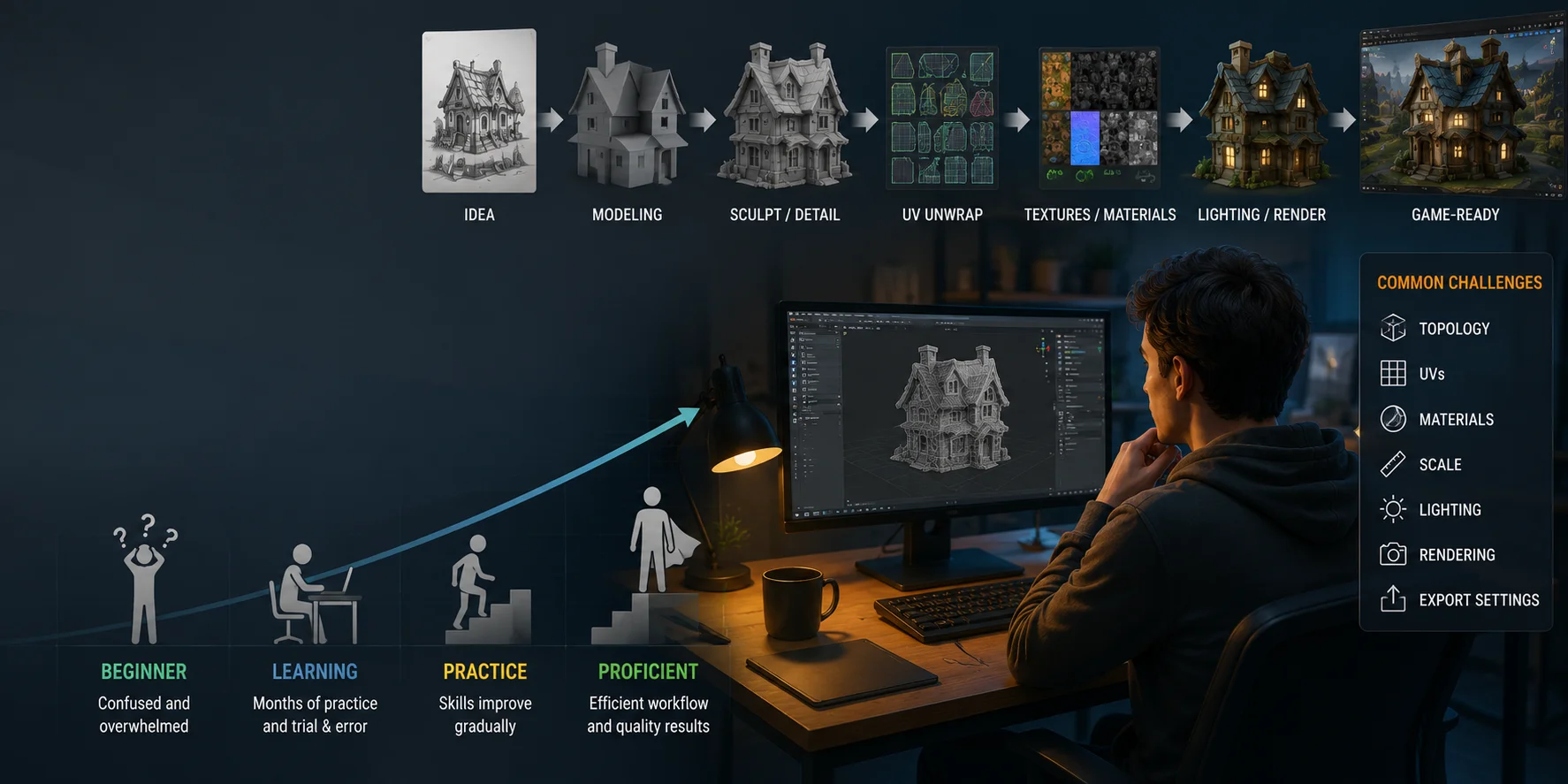
At the basic level, it includes polygon modeling: building objects from vertices, edges, and faces. It may also involve digital sculpting, hard-surface modeling, topology cleanup, UV unwrapping, texture painting, material setup, lighting, rendering, rigging, and export preparation.
That is why beginners often feel overwhelmed. They are not just learning a software interface; they are learning how a model moves from idea to finished asset. Even a simple chair, sword, creature, or product may require several skills before it looks good and works correctly in another program.
How Professionals Learn 3D Modeling
Professional 3D artists build skill through repeated practice in form, topology, UV maps, textures, rigging, optimization, and production workflows. The pace varies by prior experience, project scope, feedback quality, and how consistently someone practices.
What Beginners Typically Struggle With
Beginners often struggle with topology, UVs, materials, scale, lighting, rendering, and export settings. These technical hurdles are why AI-assisted workflows are attractive to new creators.
When You Actually Need 3D Modeling Skills
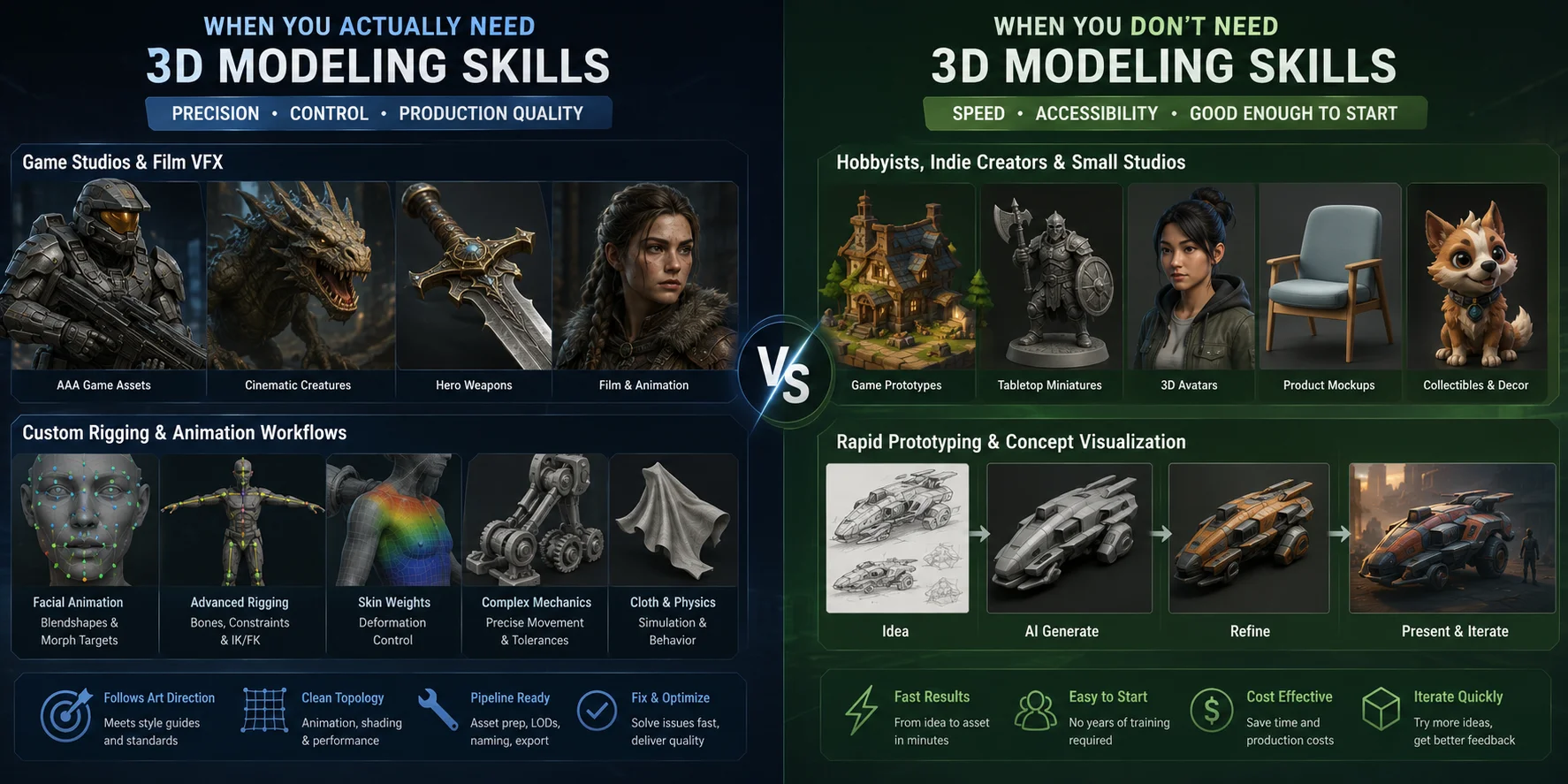
You still need traditional 3D modeling skills when a project requires precision, control, and production-level consistency. AI can help with drafts and variations, but it does not fully replace professional 3D work.
Game Studio Pipelines and Film VFX
If you want a professional role in game art, film, animation, or VFX, 3D modeling is still worth learning seriously. Studios need artists who can follow art direction, match style guides, build clean topology, prepare animation assets, and fix issues.
AI can generate first drafts, but production pipelines still need human control. Film creatures, hero weapons, cinematic characters, AAA assets, and precise hard-surface models must meet strict standards.
Custom Rigging and Animation Workflows
Traditional skills also matter for custom rigging, facial animation, morph targets, cloth behavior, or complex mechanical motion. AI tools can create meshes and sometimes add basic skeletons, but detailed animation still requires knowledge of bones, weights, constraints, deformation, and engine compatibility.
For customized characters, animation-heavy assets, or exact mechanical movement, 3D fundamentals give you better control.
When You Don’t Need 3D Modeling Skills
You do not need full 3D modeling skills for many creative and practical uses. If your goal is quick assets, concept visualization, design prototypes, or simple models, AI tools can remove much of the traditional learning barrier.
This is especially true when speed matters more than perfect topology or studio-level polish.
Hobbyists, Indie Creators, and Small Studios
Hobbyists, solo developers, educators, marketers, and small studios often value a fast starting point more than full production control. For prototypes, miniatures, social visuals, avatars, mockups, collectibles, or print decorations, AI-generated models can be useful first passes.
You may still need to review output, adjust scale, or clean small issues, but you do not need to master polygon modeling, UV unwrapping, or sculpting before creating something useful.
Rapid Prototyping and Concept Visualization
Designers, founders, product managers, and students can use AI 3D tools to communicate ideas quickly. Instead of learning a full manual workflow before testing an idea, you can describe an object, generate a starting model, and use it for feedback, pitches, or early testing.
AI changes the question from “Can I model this manually?” to “Can I generate a usable version quickly, then refine it?”
Can You Teach Yourself 3D Modeling?
Yes, you can teach yourself 3D modeling. Free software, official documentation, structured lessons, and community feedback make a self-directed path possible.
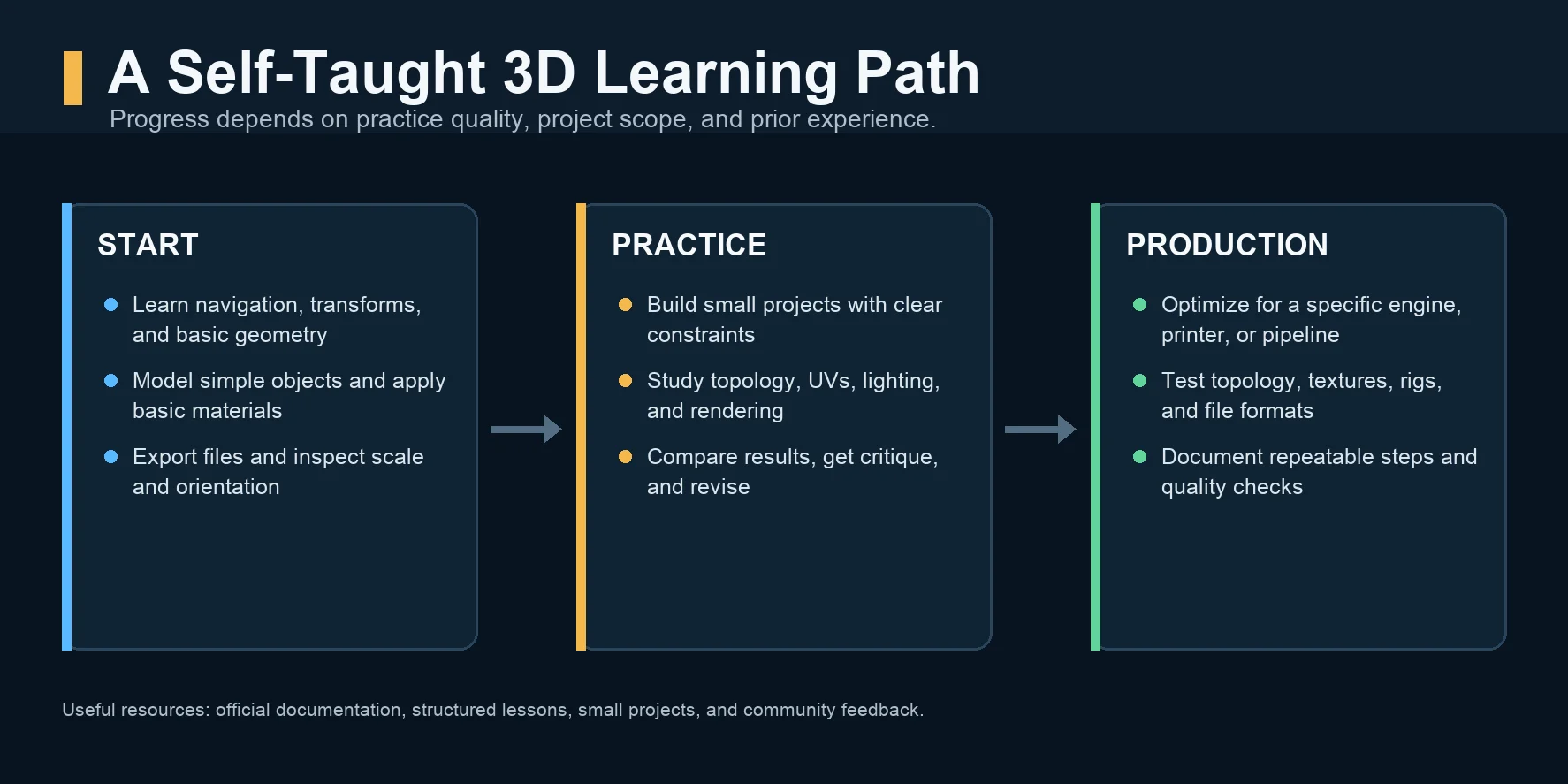
Learning still takes time, and there is no universal schedule. Basic navigation may come quickly, while clean, reliable assets require repeated projects, critique, and revision.
Free Resources to Learn
Start with free 3D software and its official documentation, then add structured lessons and project-based tutorials. Community critique can help you identify topology, proportion, lighting, and export problems that are easy to miss alone.
Start with simple objects such as cups, crates, tables, tools, and low-poly props. Avoid realistic characters, vehicles, or complex hard-surface models at first because they require advanced topology and workflow knowledge.
A Better Way to Set Learning Milestones
Begin with navigation, transforms, simple geometry, basic materials, and exporting a small object.
Next, complete small projects that add UVs, lighting, cleaner topology, and a clear target such as a game engine, renderer, or printer.
Move toward production work only after you can test scale, topology, textures, rigs, and file formats against the requirements of the target workflow. Progress should be measured by repeatable results, not a fixed number of days.
Will 3D Modeling Be Replaced by AI?
No one can predict exactly how much of 3D work AI will automate, but the workflow is already changing. AI can accelerate drafts, variations, and some repetitive steps, while people still provide creative judgment, art direction, technical problem-solving, and production control.
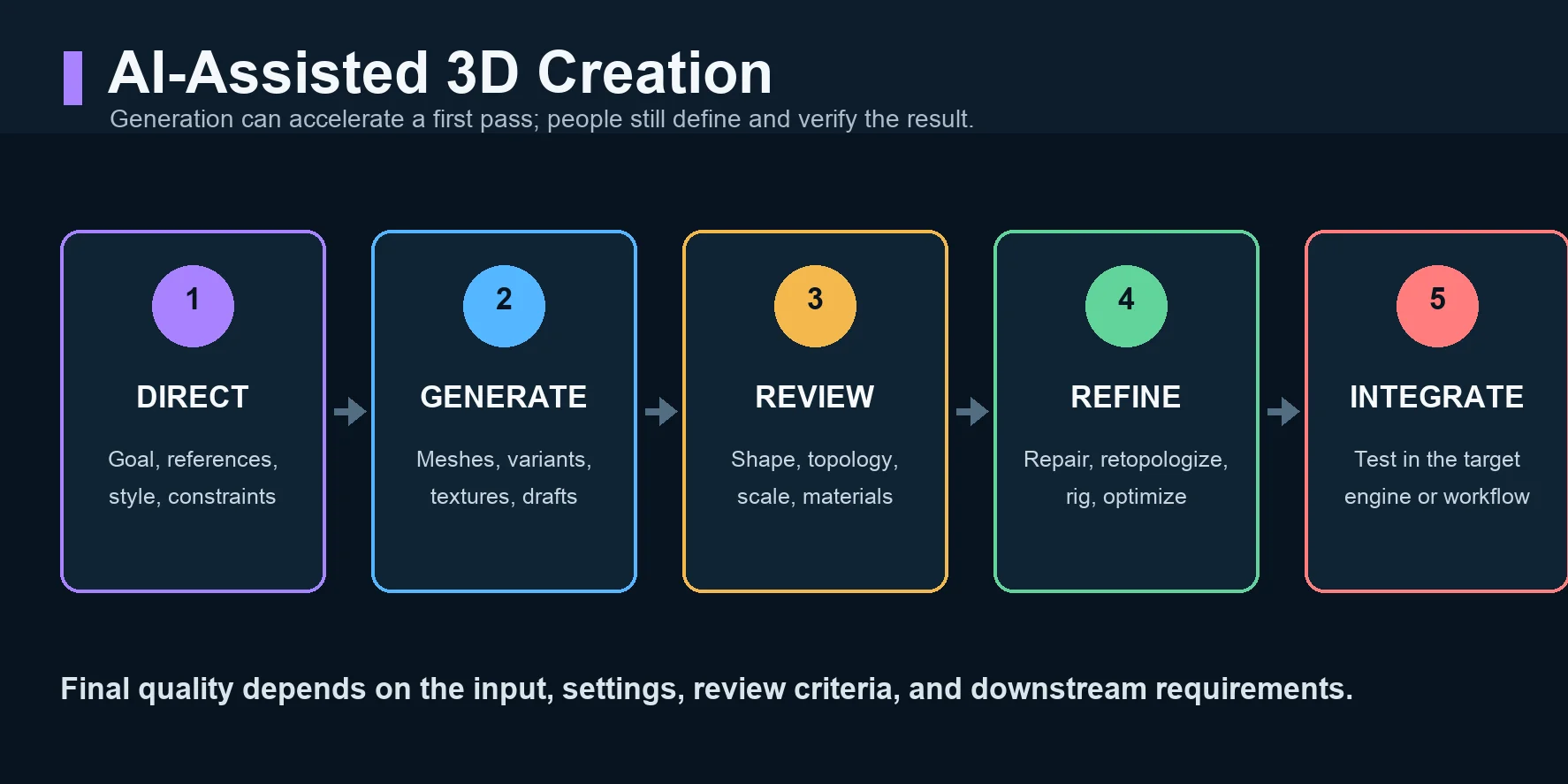
AI Handles Asset Generation; Artists Handle Direction
AI can generate models, variations, textures, and quick drafts. Artists and technical teams still decide whether outputs match the project’s style, quality bar, technical requirements, and final use case.
In an AI-assisted workflow, the human role includes directing, selecting, inspecting, refining, optimizing, and integrating assets into the target pipeline.
The New Skill Stack: Prompting Plus 3D Fundamentals
A practical beginner skill stack combines clear prompting, visual judgment, basic 3D concepts, and choosing tools that fit the target workflow.
You do not need to master every modeling technique before creating 3D assets. But understanding scale, topology, textures, file formats, and exports helps you get better AI results and avoid workflow problems.
Is 3D Modeling or Coding Harder?
3D modeling and coding are difficult in different ways. 3D modeling is visual, spatial, and artistic: you work with form, proportion, lighting, materials, and how objects look from every angle. Coding is logical and systematic: you work with rules, structure, and debugging.
Which one feels harder depends on how you think. Visual thinkers may find 3D modeling more natural, while analytical thinkers may prefer coding. Both have steep learning curves and improve with practice.
How Tripo AI Lowers the Entry Barrier
Tripo AI lets creators begin with a text prompt or reference image instead of manually building every surface. Current official guidance says generation typically takes about 10 seconds to 2 minutes depending on complexity; the result should still be inspected and refined for its intended use.
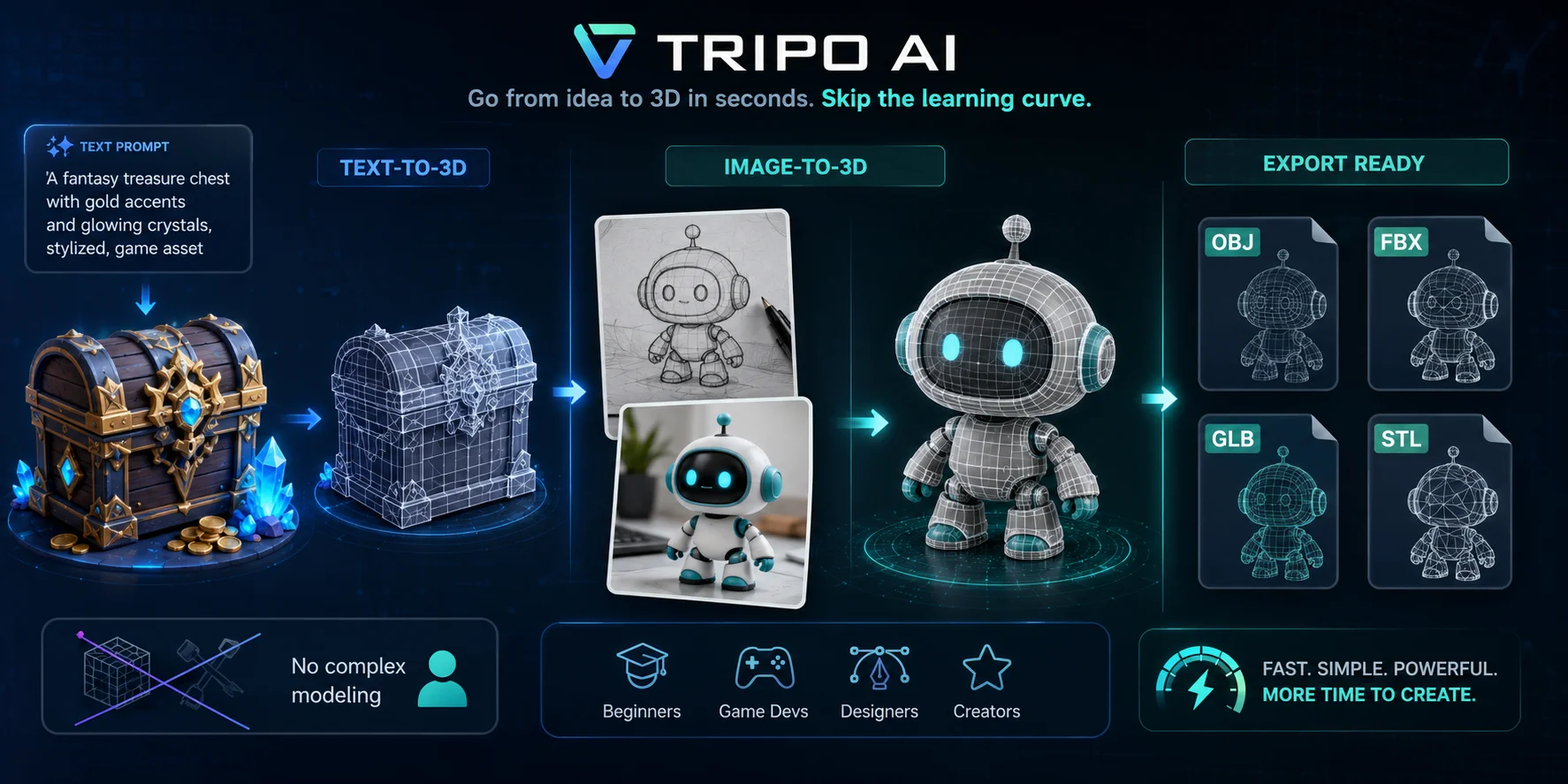
This gives beginners, game developers, designers, educators, and creators a faster way to produce a starting asset. You can export the model, test it in the target workflow, and use Tripo or other 3D tools to refine issues such as topology, scale, texture, rigging, or printability.
Text-to-3D: Describe Your Model, Get a Mesh
With text-to-3D, you describe the object, such as “a stylized fantasy treasure chest with gold trim” or “a cute robot mascot with rounded shapes.”
Tripo AI generates a 3D mesh from that description. You can adjust prompts, create variations, and choose the best version.
Image-to-3D: Turn a Reference Into a Starting Model
If you already have a drawing, product photo, sketch, or concept image, image-to-3D is often even more useful. Upload the reference, and Tripo AI converts the visual input into a 3D model.
This works well for visual creators. A game developer can turn concept art into a first-pass model, a designer can create a reviewable product object, and a teacher can create a 3D asset to inspect before classroom use.
Supported Export Formats for Games and 3D Printing
A 3D model is valuable only if it can move into your workflow. Tripo currently lists six export formats: GLB, USD, FBX, OBJ, STL, and 3MF.
FBX is commonly used in animation and game pipelines, while GLB is convenient for compact real-time and web delivery. STL carries geometry for 3D printing; inspect and repair the mesh before slicing when the project requires a printable solid.
Is It Worth Learning 3D Modeling in 2026?
Yes, learning 3D modeling is still worth it if your goal is a professional career in game art, film, animation, product visualization, industrial design, or VFX. Traditional skills give you control, precision, and flexibility.
But if your goal is to create 3D content quickly, AI tools may be the more efficient starting point. You can generate usable models, test ideas, and build confidence first.
Career Path vs. Creative Output
The right path depends on your goal. If you want to become a professional 3D artist, learn the fundamentals: modeling, topology, UVs, materials, rigging basics, optimization, and production workflows.
If you want creative output — game prototypes, visual content, product mockups, educational models, or 3D printing ideas — start with AI. You can always learn traditional modeling later to customize and polish results.
It is not either-or. AI gives you speed, while 3D knowledge gives you control. Together, they create a stronger workflow.
Frequently Asked Questions
Will 3D modeling be replaced by AI?
No one can know the exact extent of future automation. AI already helps with rapid generation, variation, and first-pass models, while professional workflows still require art direction, topology review, rigging, cleanup, and integration.
Can I teach myself 3D modeling?
Yes. Free software, official documentation, structured lessons, and community feedback can support a self-taught path. How long it takes to produce consistent work depends on your starting point, project scope, practice, and feedback.
Is 3D modeling or coding harder?
It depends on your background. 3D modeling is visual and spatial, while coding is logical and systematic. Many people find one easier based on how they naturally think.
Is it worth learning 3D in 2026?
Yes, especially for game art, VFX, animation, or product visualization careers. For fast content creation, AI tools like Tripo AI offer a quicker path, while basic 3D concepts improve results.
Conclusion
You do not need traditional 3D modeling skills before creating your first 3D content. AI tools let beginners generate starting models from text or images before they learn a full manual workflow.
Basic 3D knowledge still helps you judge quality, fix issues, choose formats, and understand usability.
Your path depends on your goal. For a 3D art career, learn the fundamentals. To create now, start with AI. Try Tripo AI to start a text-to-3D or image-to-3D generation, then inspect and refine the result for your workflow.