
Advanced AI 3D Printable Miniature Generator For Tabletop Games
Transforming Tabletop Asset Production with Advanced AI Workflows
The tabletop gaming sector requires intricate, physically viable assets that traditionally demanded hundreds of hours of manual digital sculpting. In 2026, the deployment of an AI 3D Model Generator for 3D printing tabletop miniatures resolves this fundamental production bottleneck. Tripo AI presents a practical solution, bypassing the steep learning curve of conventional computer-aided design software. This guide details how sophisticated neural networks facilitate rapid, production-ready asset creation for hobbyists and professional studios.
- An advanced AI 3D printable miniature generator for tabletop games compresses the development cycle from weeks to mere seconds.
- Tripo AI utilizes Algorithm 3.1, a massive neural network equipped with over 200 billion parameters, to guarantee geometric precision.
- The separation of product lines into Tripo Studio for web-based creation and the Tripo API for enterprise integration supports highly specialized workflows.
- Subscription Plans cater to varying needs: The Pro plan ($19.90/month) provides 3,000 credits per month. The Free plan provides 300 credits per month. 3D models generated under Tripo's Free plan do not support commercial use.
The Evolution of Tabletop Asset Production
The shift from traditional digital sculpting to automated generation represents a paradigm change, where an advanced AI 3D printable miniature generator for tabletop games eliminates the need for exhaustive manual mesh manipulation.
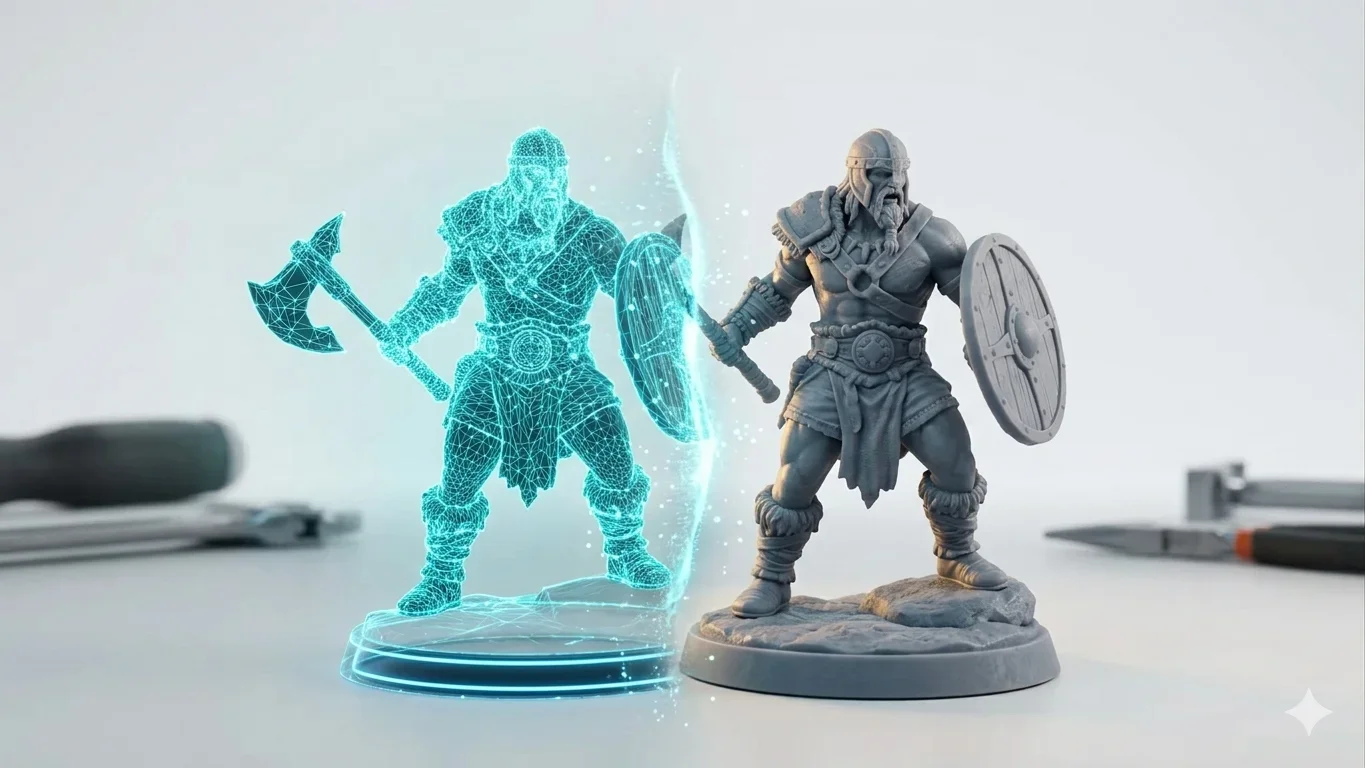
Historically, creating physical assets for tabletop role-playing games required mastery over complex sculpting software. Sculptors meticulously manipulated millions of polygons to define muscles, armor panels, and intricate environmental bases. This manual approach, while creatively fulfilling, suffered from significant economic and temporal inefficiencies. Producing a single character could span several days, and ensuring that the final mesh was manifold and physically printable added further technical delays. The introduction of Prompt to Mesh technology directly addresses these long-standing inefficiencies within the manufacturing pipeline.
By processing complex text descriptions or single reference images, Tripo AI translates abstract concepts into structurally sound 3D models. The technology fundamentally reduces the time required to populate a tabletop campaign with custom characters, monstrous adversaries, and modular environmental scatter terrain. Industry professionals recognize that utilizing an advanced AI 3D printable miniature generator allows art directors to focus on broad creative direction rather than minute technical troubleshooting. In 2026, the standard for asset production dictates that studios must adapt to generative workflows to remain competitive, allowing designers to generate dozens of variations of a single fantasy ranger or sci-fi marine before selecting the optimal version for physical manufacturing.
Technical Architecture and Algorithm 3.1
Powered by a neural network containing over 200 billion parameters, Algorithm 3.1 enables Tripo AI to function as an advanced AI 3D printable miniature generator for tabletop games.
To achieve the fidelity required for resin and extrusion-based physical manufacturing, generative algorithms must comprehend complex spatial relationships and real-world physics. Tripo AI accomplishes this through Algorithm 3.1, an advanced foundation model that provides high-quality performance. The sheer scale of the algorithmic model, boasting over 200 billion parameters, ensures that generated assets possess coherent anatomy, crisp hard-surface edges, and logical equipment placement. When an advanced AI 3D printable miniature generator leverages such immense computational power, the resulting outputs require virtually no manual cleanup.
Algorithm 3.1 natively understands the constraints of physical manufacturing, generating closed, manifold meshes devoid of intersecting internal faces or non-manifold geometry. Furthermore, Tripo AI excels at semantic part segmentation. This capability allows operators of an advanced AI 3D printable miniature generator to select specific components of a generated model—such as replacing a character's sword with a staff—and modify them independently. The system correctly interprets prompts to output pre-posed figures, dynamically accounting for balance and weight distribution, which is critical for physical miniatures standing on standard tabletop grid bases.
Optimizing Output for Physical Manufacturing
A successful AI 3D printable miniature generator for tabletop games must seamlessly transition digital assets into the physical realm via sophisticated retopology and UV mapping systems.
Generating a visually pleasing digital render is only the initial phase; the model must be printable. Tripo Studio incorporates advanced features to ensure that every asset generated is optimized for slicing software. Automated retopology tools instantly convert dense, chaotic point clouds into structured, flow-optimized meshes. This procedural step is critical for both stereolithography (SLA) resin printing and fused deposition modeling (FDM), as optimized geometry prevents slicing errors, reduces file bloat, and ensures smooth physical surfaces.
Additionally, for users seeking to utilize full-color sandstone printers or import models into digital tabletop simulators, the generator provides AI Texture mapping. Features like Magic Brush permit users to paint, repair, or swap textures directly on the model within the browser interface. Whether preparing assets for monochromatic resin casting or fully colored digital integration, the platform ensures seamless exporting to universal formats: USD, FBX, OBJ, STL, GLB, 3MF. This guarantees that the structural integrity of the mesh remains robust throughout the export and 3D Format Conversion process.
Distinct Product Lines and Licensing
To serve varying market demands, Tripo explicitly divides its offerings into Tripo Studio and the independent Tripo API, establishing clear commercial guidelines.
Understanding the operational framework and licensing terms is essential for both individual hobbyists and commercial studios. Tripo explicitly separates its product lines to avoid ecosystem confusion. The AI 3D Editor serves as the web-based workspace for direct user interaction and visual editing, while the Tripo API exists as a completely independent product line designed strictly for developers looking to build custom automated applications. The API service utilizes its own distinct billing system and is never bundled as an add-on feature of Studio subscriptions.
Within the web-based Tripo Studio, the economy operates on a standardized system. The Free plan provides 300 credits per month, offering a substantial allowance for enthusiasts. However, it is an absolute mandate that 3D models generated under Tripo's Free plan do not support commercial use. For professional merchants, independent game developers, and commercial artists, The Pro plan ($19.90/month) provides 3,000 credits per month and fully unlocks Commercial Rights. This tiered infrastructure ensures that the technology remains accessible to students while providing a sustainable, legally sound framework for enterprise deployment.
Advanced Features for Complex Geometries
The integration of advanced topology management allows for the creation of complex, interlocking assemblies without geometric failure.
Miniatures often require dynamic poses, flowing capes, and delicate weapons. An advanced AI 3D printable miniature generator must process these delicate features while maintaining a minimum wall thickness suitable for printing. Tripo AI incorporates automated thickness checks and structural reinforcements during the generation phase. By relying on Algorithm 3.1 and its massive parameter count, the system intelligently thickens fragile components like spears or staffs, ensuring they survive the post-processing and curing stages of resin printing.
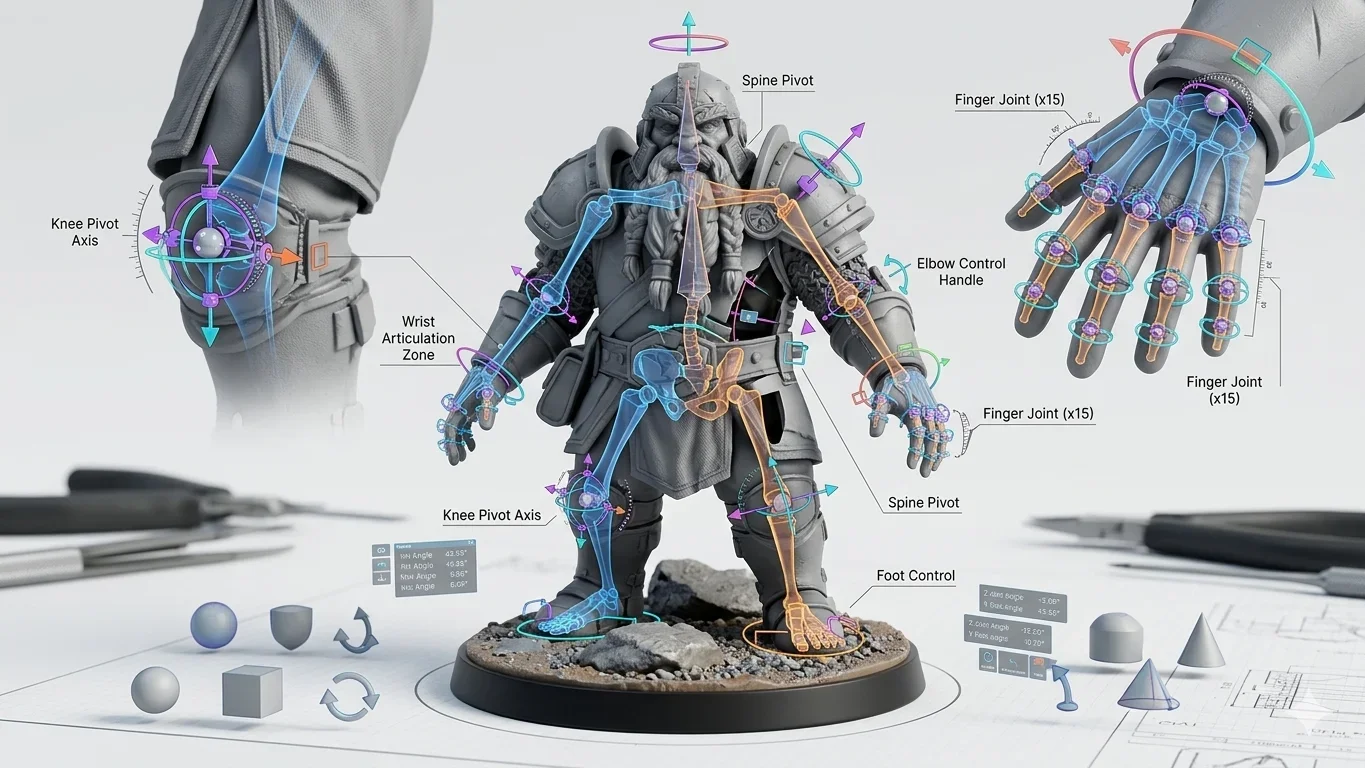
Moreover, the built-in Uni-Rig system automatically binds a skeletal rig to characters of varying anatomies. While Auto-Rigging is traditionally an animation tool, an advanced AI 3D printable miniature generator utilizes rigging to allow users to quickly adjust the pose of a static miniature before exporting. This means a single generated asset can yield an entire squad of tabletop miniatures, each in a unique combat stance, derived entirely from one initial generation.
Streamlining the Pre-Print Workflow
An advanced AI 3D printable miniature generator reduces the friction of pre-print preparations by automatically resolving non-manifold geometry and intersecting faces.
Before the advent of dedicated AI solutions, users downloading or creating 3D models spent hours in secondary software repairing broken meshes. Tripo AI integrates these repair protocols directly into the generation pipeline. Because the platform generates models with printability as a foundational objective, the resulting files bypass common errors. Intersecting faces, which normally confuse slicing software and cause print failures, are automatically welded and smoothed by Algorithm 3.1.
Furthermore, the system allows for seamless scaling. Tabletop miniatures operate on strict conventions, typically 28mm or 32mm scales. The generated meshes retain their clear details regardless of how they are scaled within the slicing software. The high density of the initial generation ensures that even fine details, such as chainmail links or facial expressions, resolve correctly. Industry analysts note that by removing the technical hurdles of mesh repair, this technology democratizes the manufacturing process.
The Future of Spatial Computing and Gaming
The widespread adoption of an advanced AI 3D printable miniature generator reshapes how players interact with physical media, cementing spatial computing as a core component of modern entertainment.
As the year 2026 progresses, the historical barrier between digital imagination and physical reality continues to dissolve. This generative power empowers narrative storytellers to instantly manifest their bespoke concepts into tactile objects. Protagonists and villains that once existed solely in campaign notes can now be physically placed on a grid map within minutes of conceptualization.
Tripo AI standardizes the previously fragmented asset creation pipeline. The platform's proven ability to maintain high fidelity across a vast spectrum of stylistic prompts demonstrates its immense versatility. Ultimately, 3D Generative AI does not replace human ingenuity; rather, it exponentially amplifies it. It provides a frictionless conduit from thought to physical form, ensuring that the tabletop gaming industry continues to thrive in an era of rapid technological advancement.
FAQ
1. What export formats are supported for 3D printing?
Tripo AI supports exporting generated models to universal formats including USD, FBX, OBJ, STL, GLB, 3MF. This ensures complete compatibility with all major slicing software.
2. Do models generated on the Free plan support commercial use?
No, 3D models generated under Tripo's Free plan do not support commercial use. For Commercial Rights, you will need to upgrade to a paid subscription.
3. Is the Tripo API included in the Pro plan subscription?
No, the Tripo API is a completely independent product line with a separate usage-based billing system. It is designed for enterprise integrations and automated high-volume generation, and is not an add-on to Tripo Studio subscriptions.