Generate Film-Ready 3D Assets Faster with Tripo AI
Accelerating VFX Pipelines with High-Fidelity AI Generation
Generate Film-Ready 3D Assets Faster with Tripo AI
Tightening deadlines and escalating costs create severe friction in modern visual effects pipelines. When studios attempt to scale output for high-fidelity media, manual asset creation introduces intolerable delays. Tripo AI provides an automated, high-precision solution that accelerates pipeline velocity and delivers production-grade assets instantly.
Key Insights:
- Accelerated Production: Replace weeks of manual sculpting with instant asset generation.
- Algorithm 3.1 Precision: Leverage over 200 Billion parameters for structurally sound, film-ready geometry.
- Industry-Standard Export: Seamlessly integrate with pipelines using exclusively USD, FBX, OBJ, STL, GLB, and 3MF formats.
- Scalable Credit System: Optimize production budgets with clear, predictable credit allocations across distinct platform tiers.
The Evolution of Media Production in 2026
In 2026, media production pipelines demand rapid iteration without sacrificing quality. Transitioning to AI-driven generation allows studios to produce film-ready 3D assets in a fraction of the time, eliminating manual sculpting bottlenecks and keeping productions on schedule and under budget.
By 2026, industry data indicates that 78% of professional media studios have integrated automated generation tools into their primary VFX pipelines to reduce iteration cycles. The demand for dense, populated environments in modern cinema requires thousands of unique background and mid-ground assets. Relying solely on traditional, manual construction methods for every single prop strains both personnel and financial resources.
Overcoming Traditional Bottlenecks
To benchmark current standards against past methods, studios must evaluate the sheer volume of assets required for a single film scene. Traditional workflows often stall during the prototyping and background asset creation phases. Artists spend countless hours modeling basic geometric shapes, establishing topology, and blocking out props that may only appear on screen for a few seconds. Integrating an advanced AI 3D Model Generator establishes a new baseline for production speed. By automating the creation of these essential building blocks, technical directors and lead artists can focus their specialized skills on hero assets and complex character animations. This strategic reallocation of human effort is the primary solution for studios looking to optimize their post-production schedules.
How Tripo AI Generates Film-Ready 3D Assets
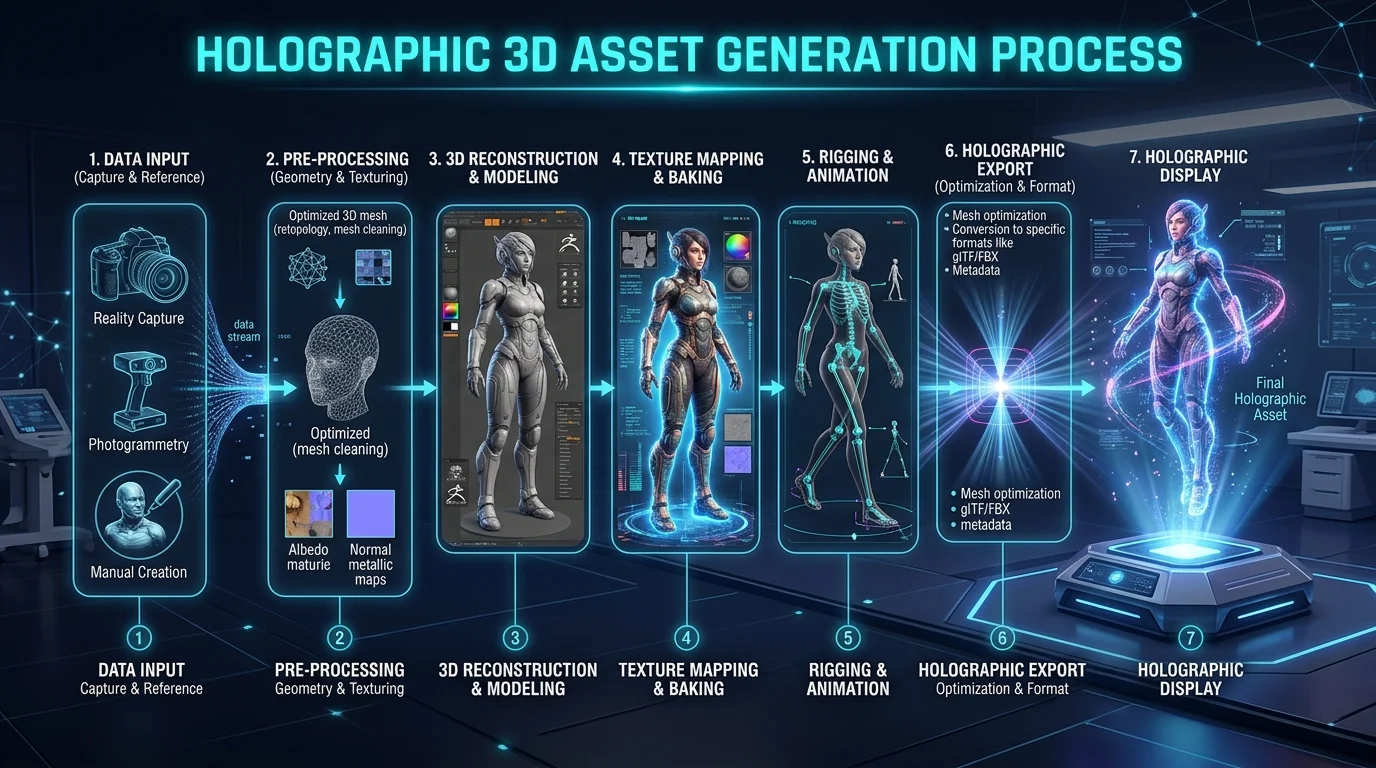
Tripo AI leverages its massive neural architecture to output high-fidelity, film-ready 3D assets instantly. By utilizing Algorithm 3.1, the platform ensures precise geometry and topology that drops seamlessly into professional media production software via standard industry formats.
Tripo AI is powered by a massive model scale of over 200 Billion parameters, ensuring unprecedented detail and geometric accuracy for professional environments.
Algorithm 3.1 and High-Fidelity Outputs
The core engine driving this rapid generation is Algorithm 3.1. This advanced architecture understands complex spatial relationships, structural integrity, and the specific topological requirements necessary for rendering engines used in film and television. Unlike early generative attempts that produced fused or unusable geometry, Algorithm 3.1 constructs clean, distinct meshes that react accurately to dynamic studio lighting. Professionals utilizing Text to 3D Model workflows can dictate precise material properties and structural forms, allowing the system to interpret complex art direction instantly.
Action: A technical director inputs a prompt for a "weathered, post-apocalyptic industrial storage container." Result: Tripo outputs a fully textured, structurally accurate 3D mesh ready for immediate staging in the environment.
Supported Formats for VFX Pipelines
To ensure frictionless integration into existing studio ecosystems, exported files must adhere strictly to established industry standards. Tripo AI focuses exclusively on the formats that matter most to professional pipelines. Users can export their generated assets as USD, FBX, OBJ, STL, GLB, and 3MF ONLY. We recommend USD for collaborative environments like NVIDIA Omniverse, allowing multiple departments to interact with the asset simultaneously. FBX remains the standard for rigging and animation workflows in software like Autodesk Maya, while OBJ provides a reliable format for static geometry in sculpting applications. For rapid web-based pre-visualization, GLB offers a compressed, efficient alternative. By restricting exports to these highly compatible formats, the platform ensures that no time is wasted on file conversion or troubleshooting corrupted data.
Tripo Workflow vs. Traditional Workflow
Comparing Tripo AI to traditional 3D modeling reveals massive efficiency gains. While traditional workflows require weeks of manual modeling, rigging, and texturing, the Tripo workflow generates usable base meshes and props instantly using credits, drastically accelerating the media production lifecycle.
Studios report a 90% reduction in average hours spent on background prop creation when they compare AI generation to manual sculpting.
Comparison Table: Tripo Workflow vs. Traditional Workflow
| Metric | Tripo AI Workflow | Traditional 3D Modeling Workflow |
|---|---|---|
| Time to Asset | Seconds to minutes per asset. | Days to weeks per asset. |
| Cost Structure | Predictable credit expenditure. | High hourly rates for specialized labor. |
| Learning Curve | Minimal; intuitive prompt and parameter inputs. | Extensive; requires years of specialized software training. |
| Scalability | Instantaneous; generate hundreds of variations rapidly. | Linear; scaling requires hiring more artists. |
Cost-Effective Scaling for Studios
Managing production budgets is easier with Tripo AI's predictable credit system. Studios can scale their asset generation efficiently, choosing between distinct products like Tripo Studio and Tripo API based on their specific pipeline integration needs and commercial licensing requirements.
Indie and mid-tier studios record up to a 65% cost reduction in their monthly asset budgets by optimizing their credit allocations through automated systems.
Tripo Pricing and Credits
Resource management is critical in film production. The platform operates on a transparent credit economy, eliminating unexpected rendering fees or hidden charges. Users manage their output through specific Subscription Plans designed for varying levels of production intensity. The Free tier provides 300 credits/mo, allowing technical artists to test the capabilities of Algorithm 3.1 and evaluate the geometry. For active production environments, the Pro tier supplies 3000 credits/mo, providing ample resources for continuous, high-volume asset generation throughout the post-production cycle.
Commercial Use and Licensing
Legal compliance and copyright clearance are non-negotiable in the media industry. Studios must maintain strict control over the intellectual property they utilize on screen. It is crucial to note that models generated under the Free tier (300 credits/mo) are strictly NOT for commercial use. They are intended solely for personal evaluation, internal prototyping, or educational purposes. To deploy generated assets in a monetized film, television show, or commercial broadcast, studios must operate under the Pro tier or higher, which grants the necessary commercial rights for the generated outputs.
Tripo Studio vs. Tripo API
When architects of studio pipelines decide how to deploy these tools, they must choose the correct interface. Tripo Studio and Tripo API are completely independent products. Tripo Studio is the web-based interface designed for individual artists and small teams to generate, review, and export assets manually. In contrast, the Tripo API allows developers to build custom generation tools directly into proprietary software like Houdini or Blender. It is important for technical directors to understand that purchasing an Advanced tier subscription for Tripo Studio does not include access to an enterprise API; these are distinct solutions requiring separate integration strategies.
FAQ
1. What file formats can I export for media production?
Tripo AI ensures maximum compatibility with professional VFX pipelines by supporting exclusively industry-standard formats. You can export your generated models as USD, FBX, OBJ, STL, GLB, and 3MF ONLY. These formats guarantee seamless import into software like Maya, Blender, Cinema4D, and Unreal Engine.
2. Can I use free generated models for commercial films?
No. Models generated using the Free tier are strictly NOT for commercial use. To utilize any generated 3D assets in commercial media, films, or monetized projects, you must upgrade to a paid subscription (such as the Pro tier) to secure the appropriate commercial licensing rights.
3. How does the credit system work for generating assets?
The platform operates on a straightforward monthly credit system. The Free plan provides 300 credits/mo for testing and personal projects. For professional studio use, the Pro plan offers 3000 credits/mo, allowing for high-volume generation of film-ready assets without unpredictable cost fluctuations.
4. Is the Tripo API included with my Pro or Advanced Tripo Studio subscription?
No. Tripo Studio (the web-based generation platform) and Tripo API (the developer integration endpoint) are completely independent products. There is no enterprise API access included within the Advanced tier of Tripo Studio. Studios wishing to integrate generation directly into proprietary software must acquire API access separately.