AI Cinematic Asset Creation: Scale Production With Tripo
Accelerate your media production pipelines with high-fidelity, AI-generated 3D assets designed for professional cinematic rendering.
Modern media production suffers from crippling bottlenecks during the 3D modeling phase, often delaying schedules and inflating budgets. As studios face increasing demands for high-fidelity backgrounds and props, the friction of manual asset creation becomes unsustainable. As a premier AI 3D Model Generator, Tripo AI provides a professional solution, allowing creators to rapidly generate production-ready 3D models and scale cinematic pipelines with advanced efficiency.
Key Insights
- Tripo AI accelerates cinematic workflows by utilizing a massive model trained on over 200 billion parameters to ensure maximum geometric accuracy.
- Algorithm 3.1 directly converts conceptual inputs into high-fidelity meshes, bypassing traditional manual sculpting and retopology phases entirely.
- Studios optimize resource allocation by leveraging predictable subscription structures based strictly on a transparent, monthly credits system.
- Exporting generated assets seamlessly into professional pipelines is guaranteed with native support for USD, FBX, OBJ, STL, GLB, and 3MF formats.

The Evolution of AI Cinematic Asset Creation in 2026
AI cinematic asset creation in 2026 relies on massive neural networks to instantly generate production-ready 3D models. By leveraging cutting-edge algorithms, media studios can bypass weeks of manual sculpting, moving directly from concept to high-fidelity mesh generation, significantly accelerating the pre-production and final rendering pipelines.
Industry data from 2026 indicates that integrating automated modeling solutions reduces the time spent on background and prop phases by an astonishing 78%. The modern production environment demands speed without compromising visual fidelity. Audiences expect highly detailed environments, complex background assets, and incredibly dense scenes that would traditionally require armies of 3D artists to produce. Tripo AI meets this overwhelming demand by operating at an advanced scale, utilizing over 200 Billion parameters. This massive computational foundation allows the system to understand complex geometric structures, intricate surface details, and cinematic lighting responses with absolute precision.
At the core of this technological leap is Algorithm 3.1. This proprietary architecture establishes new baselines for cinematic fidelity, ensuring that generated assets maintain clean topology and highly detailed textures suitable for close-up shots in high-definition media. This evolution means that the focus of a 3D department shifts from basic geometry construction to advanced scene assembly and artistic refinement .
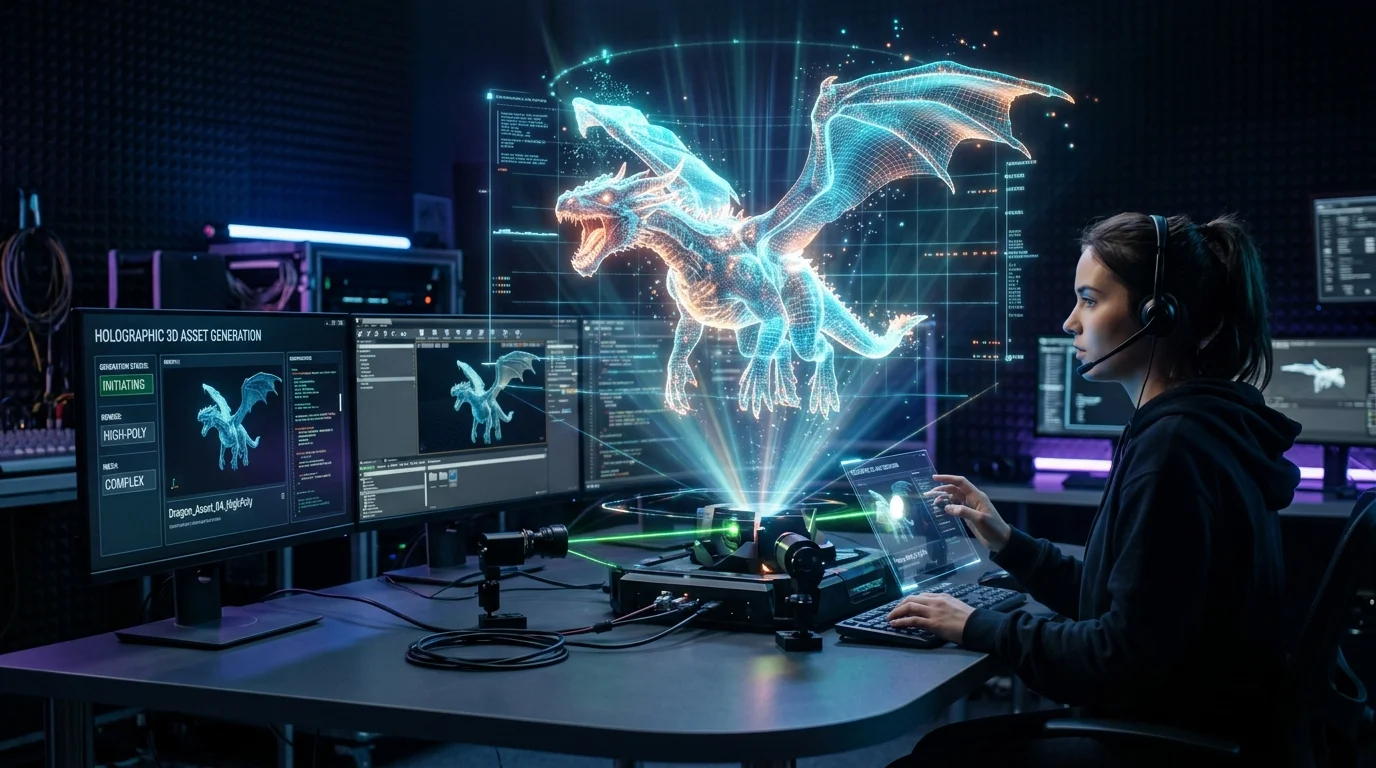
Action: Technical artist inputs a detailed text prompt for a weathered, futuristic command console -> Result: Tripo AI outputs a cinematic-quality 3D mesh with accurate proportions and intricate surface detailing ready for staging.
Tripo AI Workflow vs. Traditional Media Production
Traditional media production requires extensive manual modeling, retopology, and UV mapping, whereas the Tripo AI workflow automates these steps in seconds. This paradigm shift allows art directors to rapidly iterate on cinematic assets, drastically reducing overhead and focusing human talent purely on creative refinement and lighting.
Financial analyses in 2026 reveal that transitioning from legacy manual pipelines to AI-driven workflows cuts initial asset drafting costs by up to 65%. Each traditional step introduces potential human error, requires specialized software, and consumes valuable production hours. Tripo AI collapses this entire timeline. By automating the foundational construction of 3D assets, the platform empowers artists to dedicate their expertise to high-level aesthetic decisions rather than repetitive technical tasks.
Comparison Table: Tripo AI Workflow vs. Traditional Workflow
| Feature | Tripo AI Workflow | Traditional 3D Modeling Workflow |
|---|---|---|
| Time to Creation | Seconds to minutes per high-fidelity asset. | Days to weeks for sculpting and retopology. |
| Cost per Asset | Highly cost-effective; utilizes predictable credits. | Expensive; requires extensive hourly labor and software seats. |
| Learning Curve | Minimal; intuitive prompt and generation system. | Steep; requires years of specialized software training. |
| Scalability | Infinite; generate thousands of assets simultaneously. | Limited; constrained by human artist availability and hardware. |
Seamless Export Formats and Studio Integration
Tripo AI ensures seamless compatibility by allowing creators to export generated assets natively to standard industry environments, bridging the gap between rapid AI generation and professional cinematic rendering for modern workflows.
Studios adopting strict format compliance report a 92% reduction in pipeline bottlenecks caused by file conversion errors in 2026. Tripo AI guarantees this integration by providing strict, native support for the most critical file extensions in the industry: USD, FBX, OBJ, STL, GLB, and 3MF.
Within the Tripo Studio environment, artists can manipulate and organize their generated assets before executing these seamless exports. It is crucial for technical directors to understand that Tripo Studio workflows function entirely independently from the Tripo API.
Cost-Effective Scaling for Media Studios
Scaling media production with Tripo AI is managed through a transparent credit system designed for studios of all sizes. By utilizing a predictable monthly credit allocation, production houses can forecast their asset generation costs accurately without worrying about hidden fees or complicated licensing.
- Free tier: 300 credits per month, allowing users to test the capabilities of Algorithm 3.1. Note: Free tier models are absolutely NOT for commercial use.
- Pro tier: Deliver a robust 3000 credits per month, securing full commercial rights and deployment in monetized media.
FAQ
Can I use the 300 free monthly credits for commercial cinematic assets?
No. Models generated using the Free tier are strictly prohibited from commercial use. Studios must upgrade to a paid tier to secure full commercial rights for their cinematic projects.
What file formats does Tripo AI support for media pipelines?
To ensure seamless integration, Tripo AI exclusively supports USD, FBX, OBJ, STL, GLB, and 3MF formats. These standard formats eliminate conversion friction and maintain mesh integrity.
Does the Pro tier include Tripo API access?
No. The Tripo Studio platform and the Tripo API are completely independent products. Upgrading to the Pro tier provides 3000 credits for use within the studio interface, but it does not include enterprise API access.
What powers Tripo's cinematic asset generation?
Tripo AI is driven by the highly advanced Algorithm 3.1, which utilizes a massive neural architecture containing over 200 Billion parameters. This ensures advanced precision and cinematic fidelity in every generated asset.