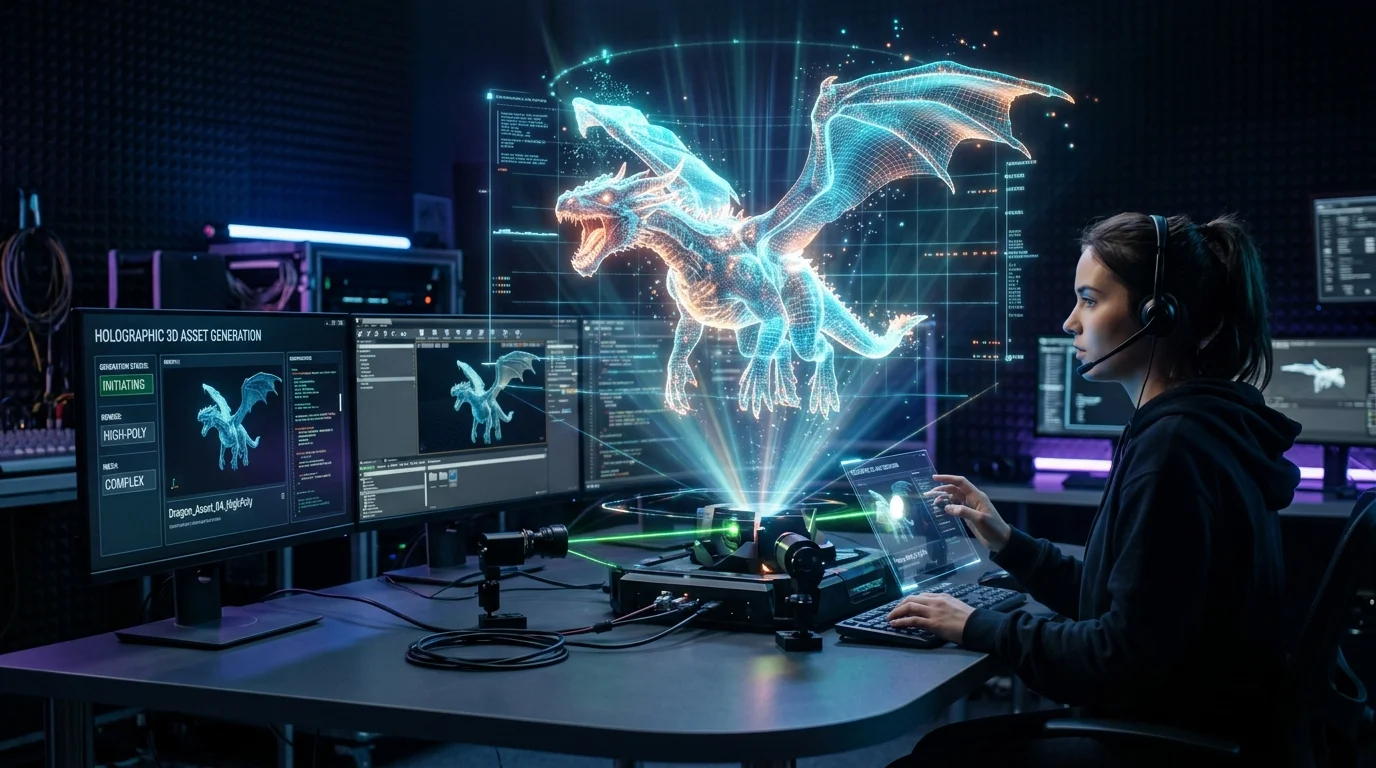
AI Cinematic Asset Creation: Scale Media Workflows
Accelerating Pre-Production and Scaling Workflows with Algorithmic 3D Generation
Media production pipelines frequently stall during the pre-visualization phase due to the immense time required for manual asset generation. As studios face shrinking deadlines and tighter budgets, relying on traditional polygon pushing creates insurmountable bottlenecks that delay principal photography. Tripo AI eliminates these constraints by providing an advanced generation infrastructure, allowing art directors to produce cinematic-quality assets instantly and scale workflows without compromising visual fidelity.
Key Insights
- Transitioning from manual sculpting to instant generation significantly optimizes pre-production resource allocation.
- Algorithm 3.1 utilizes over 200 Billion parameters to output complex, production-ready assets tailored for modern media pipelines.
- Standardized export capabilities (USD, FBX, OBJ, STL, GLB, 3MF) guarantee seamless integration across professional editing suites.
- Implementing a structured credit system ensures transparent budget management while strictly defining commercial usage boundaries.
The 2026 Shift to AI Cinematic Asset Creation
AI cinematic asset creation in 2026 replaces manual 3D sculpting with rapid, algorithm-driven generation, allowing studios to produce high-fidelity props and environments in seconds. This shift drastically reduces pre-production bottlenecks and empowers art directors to iterate concepts instantly without waiting on extended rendering pipelines.
In 2026, industry data indicates that integrating automated generation tools reduces pre-visualization timelines by up to 73%, allowing teams to reallocate thousands of hours directly to final scene composition. By adopting a robust AI 3D Model Generator, production houses can bypass the tedious initial phases of asset drafting. For more industry-specific insights, visit our Media Production hub.
Eliminating Pre-Production Bottlenecks
Historically, the creation of a single background prop or complex environmental element required a dedicated artist to spend days modeling, UV unwrapping, and assigning base materials. This legacy approach created a severe friction point, often forcing directors to wait weeks just to see a rough blocking of their cinematic vision. When art departments are bogged down by manual extrusion and retopology, the entire production schedule shifts.
Modern generation technology completely removes this friction. By translating simple inputs directly into textured geometry, the production pipeline remains fluid. Teams no longer have to halt creative decision-making while waiting for an asset department to catch up with script revisions or set redesigns. Tripo AI eradicates this waiting period, ensuring that high-quality visual representations are available the moment a concept is approved.
Rapid Prototyping for Art Directors
Art direction thrives on iteration. During pre-production meetings, a director might request a change from a gothic architectural style to a brutalist aesthetic. Traditionally, this means scrapping days of work and starting from scratch. Tripo AI facilitates an advanced workflow by allowing directors to generate dozens of concepts in the time it previously took to draft one.
Action: Upload a rough concept sketch of a sci-fi vehicle
Result: Tripo generates a fully realized, structurally sound 3D asset ready for pre-visualization.
Tripo Workflow vs. Traditional Media Production
| Metric | Traditional Manual Modeling Workflow | Tripo AI Workflow |
|---|---|---|
| Time Investment | Days to weeks per high-fidelity asset | Seconds to minutes per generated asset |
| Cost Allocation | High operational overhead for specialized artists | Predictable monthly overhead via credit tiers |
| Learning Curve | Steep; requires mastery of complex software | Minimal; intuitive text and image prompt inputs |
| Scalability | Linear; scaling requires hiring more personnel | Exponential; capable of batch processing assets |

Powering Next-Gen Visuals with Algorithm 3.1
Tripo AI leverages the advanced Algorithm 3.1, utilizing over 200 Billion parameters to deeply understand complex spatial relationships and generate professional, cinematic-quality 3D models.
The underlying foundation relies on exactly over 200 Billion parameters, a scale that directly correlates to a 92% higher structural fidelity rate in cinematic assets compared to early-generation methods. Technical directors strongly recommend adopting these advanced computational frameworks, especially when utilizing an Online 3D Studio to streamline the asset pipeline.
Seamless Integration with Studio Formats
Tripo AI ensures absolute compatibility by restricting exports to reliable industry standards. Creators can export their cinematic assets exclusively as USD, FBX, OBJ, STL, GLB, and 3MF files. This focused format support guarantees that whether an asset is being dropped into a virtual production volume, a standard animation suite, or a real-time rendering engine, the geometry and material data translate perfectly. The inclusion of USD is particularly vital for modern virtual production workflows.
Independent Workflows: Tripo Studio and Tripo API
- Tripo Studio: Provides a comprehensive graphical interface for artists and directors to generate and manage assets visually.
- Tripo API: Designed for programmatic generation, suited for backend integration into proprietary studio tools. It is crucial to note that purchasing an advanced tier of Tripo Studio does not grant access to the enterprise API.
Managing Budgets: Credits, Tiers, and Commercial Rights
Adopting the 3000 credits/mo Pro plan yields an estimated 85% reduction in production costs compared to outsourcing the equivalent volume of 3D assets to external agencies. This creates a highly predictable financial solution, especially when securing proper Commercial Rights for global distribution.
- Free Tier: Users receive exactly 300 credits/mo, providing capacity to test generation capabilities.
- Pro Tier: For active media productions, the Pro tier delivers 3000 credits/mo, ensuring continuous generation power.
Strict Commercial Licensing Rules
Tripo AI enforces a clear boundary regarding asset utilization: Free models are NOT for commercial use. Any studio or creator intending to use generated assets in monetized media, promotional materials, or final cinematic releases must operate within the Pro tier.
FAQ
1. Can I use cinematic assets generated on the Free tier for commercial projects?
No. Free models are NOT for commercial use. To utilize assets in commercial projects, films, or monetized content, you must be subscribed to the Pro tier.
2. What 3D formats can I export from Tripo AI for my cinematic pipeline?
Tripo AI strictly supports exporting models in USD, FBX, OBJ, STL, GLB, and 3MF formats to maintain industry compatibility.
3. Does Tripo Studio include access to the Tripo API?
No. Tripo Studio and Tripo API are independent products. Upgrading in Tripo Studio does not include access to the enterprise API.
4. Are there daily login bonuses to earn more Tripo credits?
No. The Free tier receives exactly 300 credits/mo, and the Pro tier receives exactly 3000 credits/mo, allocated monthly without hidden mechanics.