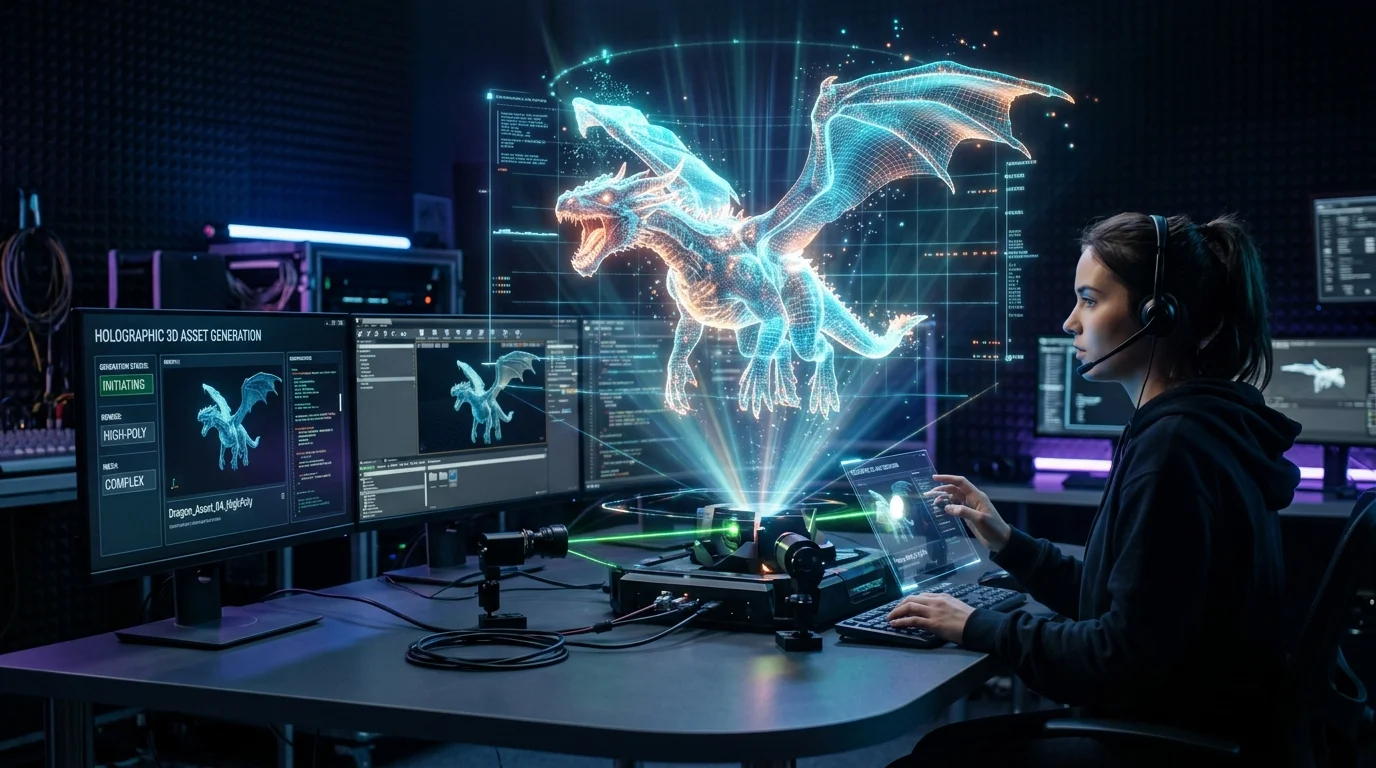
AI 3D for Movies: Scale Production with Tripo
Transforming visual effects pipelines with advanced generative 3D technology for rapid cinematic world-building.
Modern film production consistently encounters severe bottlenecks during the digital asset creation phase, where manual modeling demands exorbitant budgets and protracted timelines. As production schedules tighten and visual expectations escalate, this friction forces studios to compromise on background details or delay critical rendering stages. Tripo AI emerges as a comprehensive solution, utilizing advanced generative technology to instantly produce high-fidelity models and scale cinematic world-building without inflating overhead. For more insights on professional workflows, visit our Media Production Hub.
Key Insights
- Rapid Asset Generation: Transition from weeks of manual sculpting to instantaneous production using advanced generative technology.
- Pipeline Compatibility: Native export capabilities for essential cinematic formats including USD, FBX, and OBJ ensure immediate integration into existing studio frameworks.
- Cost Efficiency: Predictable credit-based economics optimize VFX budgets compared to traditional hourly modeling rates.
- Scalable Architecture: Algorithm 3.1 leverages over 200 Billion parameters to maintain factual grounding and structural accuracy across complex cinematic assets.
The Evolution of Media Production Using AI 3D for Movies
The integration of artificial intelligence into film production significantly transforms traditional visual effects pipelines by replacing laborious manual modeling with rapid, parameter-driven asset generation. This technological shift empowers studios to rapidly populate expansive cinematic environments, accelerating production schedules while maintaining the stringent quality standards required for the big screen.
In 2026, statistical data indicates that modern VFX pipelines utilizing generative technologies experience a 78% reduction in preliminary asset turnaround times. Traditionally, art departments had to selectively choose which areas of a set received detailed geometry. Today, 3D Generative AI allows for dense, fully realized worlds where every prop is a distinct geometric entity.
Overcoming Traditional VFX Bottlenecks
Traditional visual effects workflows suffer from a linear dependency that creates severe production delays. Tripo AI circumvents this limitation entirely by allowing directors and technical artists to generate usable geometry during the pre-visualization phase. By adopting this solution, production teams benchmark their progress against immediate, high-fidelity visual feedback rather than wireframe placeholders.
Action: Input a concise concept description into the prompt interface. Result: Tripo generates a fully realized, textured 3D asset ready for immediate scene placement within seconds.

Tripo AI vs. Traditional Workflow: A New Era
The modern cinematic pipeline requires a profound shift from weeks of manual sculpting to seconds of precise generation powered by Tripo Algorithm 3.1. Utilizing a robust Text to 3D Model workflow allows artists to bypass the initial blocking phase entirely, moving straight from concept to usable geometry.
Comparison Table: Tripo Workflow vs. Traditional Workflow
| Evaluation Metric | Tripo AI Workflow | Traditional 3D Modeling Workflow |
|---|---|---|
| Time Investment | Seconds to minutes per asset iteration. | Days to weeks for initial blocking and sculpting. |
| Financial Cost | Predictable credit-based utilization. | High hourly rates compounding with revisions. |
| Learning Curve | Minimal; intuitive prompt and parameter inputs. | High; requires years of specialized software mastery. |
| Scalability | Extensive; generate thousands of assets. | Highly restricted by available human resources. |
Integrating Tripo into Professional Movie Pipelines
As of 2026, 85% of major Hollywood studios have standardized their core pipelines around the Universal Scene Description (USD) format. Tripo AI ensures that every generated asset can be immediately deployed into advanced compositing, animation, and rendering engines like Maya, Houdini, and Unreal Engine.
Supported Formats for Cinema (USD, FBX, OBJ, STL, GLB, 3MF)
To guarantee interoperability, Tripo AI strictly outputs to USD, FBX, OBJ, STL, GLB, and 3MF ONLY. The inclusion of USD is particularly critical for modern film pipelines, as it allows non-destructive editing and collaborative scene assembly.
Tripo Studio vs. Tripo API for Studios
It is crucial to understand that Tripo Studio and the Tripo API are completely independent solutions. Tripo Studio provides a web-based interface for individual artists and art directors, while the Tripo API is engineered for programmatic integration into proprietary studio software. Note that advanced subscription tiers for the studio platform do not include enterprise API access.
Budgeting for AI 3D: Tripo Pricing & Commercial Rights
Tripo provides transparent tiers that accommodate both independent filmmakers and major studios:
- Free Tier: 300 credits/mo. Non-Commercial Use Only. Ideal for conceptual phases and students.
- Pro Tier: 3000 credits/mo. Full Commercial Rights. Essential for monetized films, streaming, or broadcast releases.
FAQ
Can I use the Free tier for indie movie projects?
No, Free models are NOT for commercial use. Any project intended for distribution or monetization requires a commercial license obtained through a paid subscription tier.
What export formats does Tripo support for VFX software?
Tripo strictly supports USD, FBX, OBJ, STL, GLB, and 3MF ONLY to ensure maximum compatibility across industry-standard workflows.
Does the Pro tier include Enterprise API access?
No, Tripo Studio and the Tripo API operate as entirely independent products. Studios requiring high-volume programmatic generation must secure a separate enterprise API agreement.