PLA vs ABS: Which 3D Printing Filament to Use (2026)
TL;DR
- PLA is best for easy, detailed, low-warp prints such as miniatures, organizers, prototypes, and indoor decor.
- ABS is better for tougher parts exposed to heat, impact, repeated flexing, or mechanical stress.
- PLA softens near 60°C, while ABS remains stable at much higher temperatures but requires more controlled printing conditions.
- Use PLA on most open-frame printers; use ABS with a heated bed, enclosure, and proper ventilation.
- Choose based on the part’s working environment, then generate or source a model before preparing it for print.
PLA and ABS are the two most common 3D printing filaments, but they suit different jobs. PLA is easier to print, cheaper, and ideal for visual models and beginners. ABS is tougher and far more heat-resistant, making it the choice for functional, load-bearing, or high-temperature parts.
Quick Verdict - PLA or ABS?
Choose PLA for easy printing, visual quality, prototypes, display models, and indoor projects. Choose ABS for tougher functional parts, heat exposure, impact resistance, and acetone-smoothed finishes.
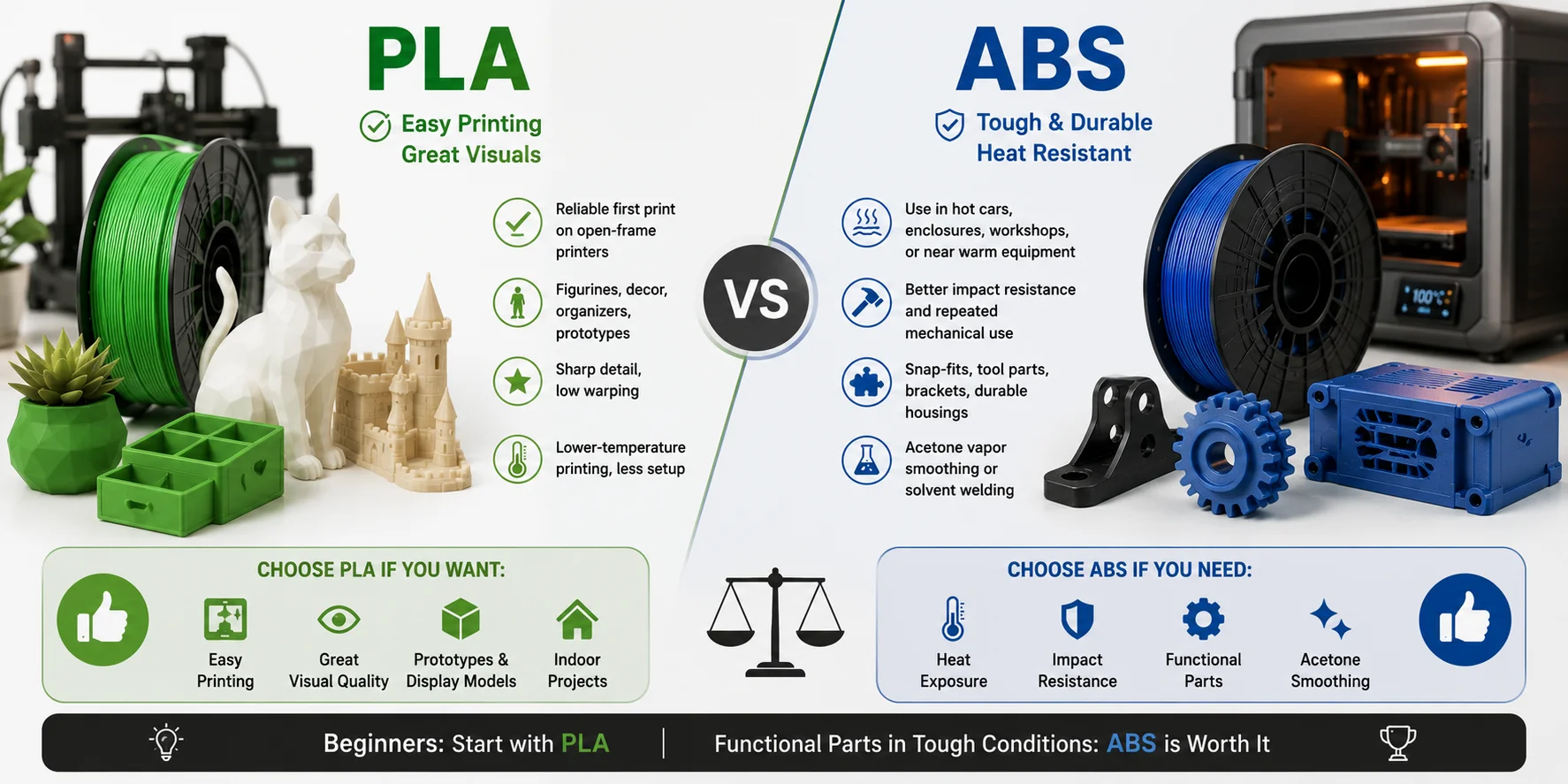
Use PLA when you want:
- a reliable first print on an open-frame printer;
- figurines, miniatures, decor, organizers, or prototypes;
- sharp detail and low warping;
- lower-temperature printing with less setup.
Use ABS when you need:
- a part that may sit in a hot car, enclosure, workshop, or near warm equipment;
- better impact resistance and repeated mechanical use;
- snap-fits, tool parts, brackets, or durable housings;
- acetone vapor smoothing or solvent welding.
For most beginners, PLA is the right first spool. For functional parts exposed to heat or repeated stress, ABS is often worth the extra effort.
What Is PLA?
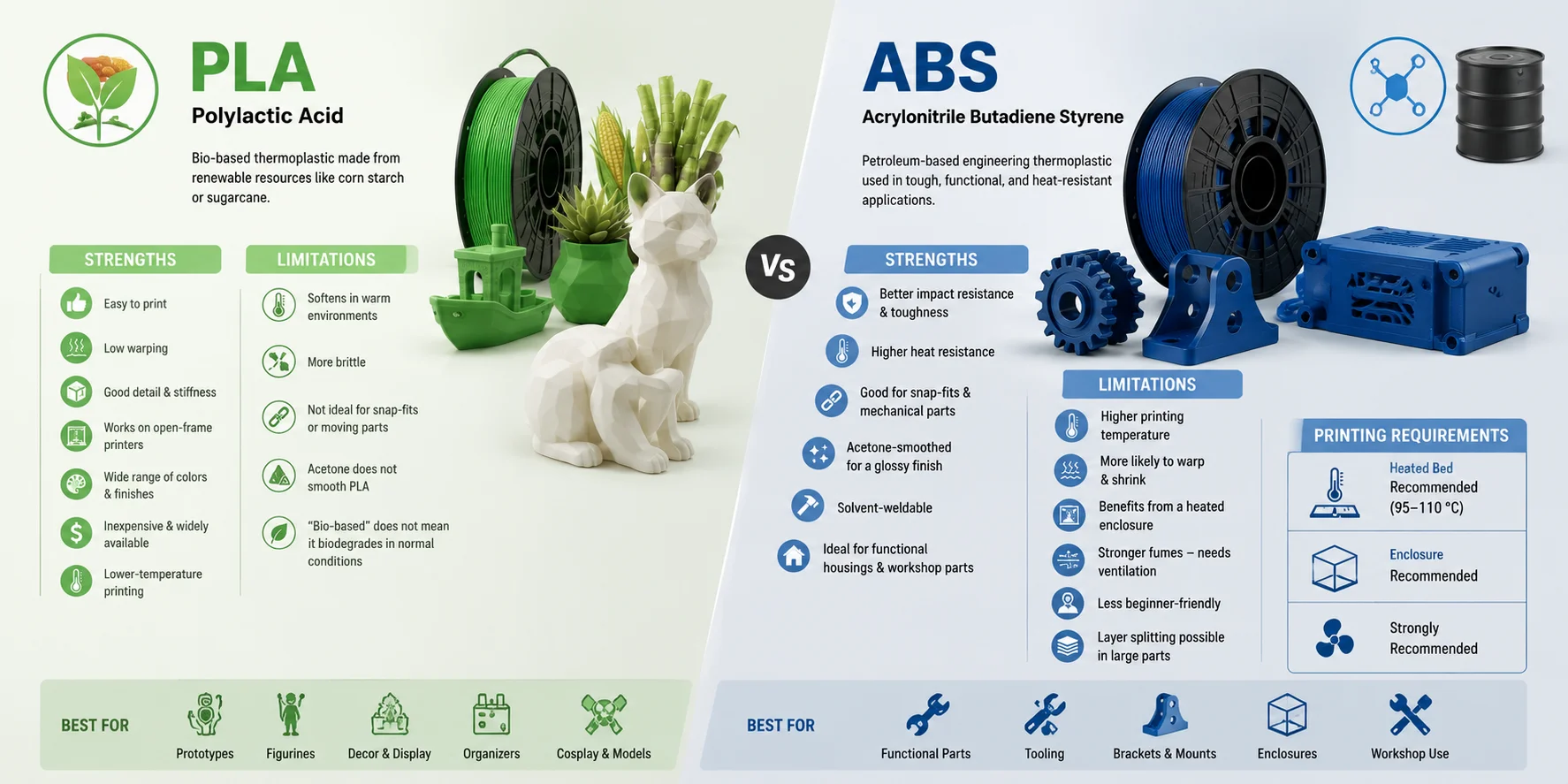
PLA stands for polylactic acid. It is a thermoplastic commonly made from renewable feedstocks such as corn starch or sugarcane-derived sugars.
For desktop 3D printing, PLA is popular because it melts at relatively low temperatures, adheres well to many build plates, and has a low tendency to warp or shrink while cooling.
PLA is often the easiest filament for a new user because it usually works well without a heated enclosure. It can produce sharp details, crisp edges, smooth surfaces, and a broad range of colors, including matte, silk, marble, sparkle, wood-fill, and multicolor variants.
PLA strengths
- Easy to print on most consumer FDM printers.
- Low warping compared with ABS.
- Good stiffness and detailed reproduction.
- Usually suitable for open-frame printers.
- Broad color and finish selection.
- Often inexpensive and widely available.
- Lower-temperature operation than ABS.
PLA limitations
- It can soften or deform in warm environments.
- More brittle than ABS under impact or repeated flexing.
- Less suitable for snap-fits, moving joints, and high-heat parts.
- Acetone does not smooth PLA effectively.
- “Bio-based” does not mean it will reliably break down in normal home, landfill, or outdoor conditions.
PLA is excellent when appearance, ease, and predictable printing matter most. It is less suitable when a part must absorb shocks, flex repeatedly, or survive elevated temperatures.
What Is ABS?
ABS stands for acrylonitrile butadiene styrene. It is a petroleum-based engineering thermoplastic widely used in consumer products, appliances, automotive components, protective housings, and durable molded parts.
ABS is valued in 3D printing because it is tougher and more heat-resistant than standard PLA. It handles impacts better, can flex slightly before breaking, and is more appropriate for functional parts that will be handled, dropped, clipped, or exposed to moderate heat.
The trade-off is print difficulty. ABS contracts noticeably as it cools, which creates warping, corner lift, layer splitting, and cracking if the part cools unevenly. It typically needs a heated bed, stable ambient temperature, and preferably an enclosed printer.
ABS strengths
- Better impact resistance and toughness than PLA.
- Higher heat resistance.
- More suitable for snap-fits and mechanical parts.
- Can be acetone-smoothed for a glossy finish.
- Can be solvent-welded with compatible ABS slurry or acetone-based methods.
- Better suited to enclosed functional housings and workshop parts.
ABS limitations
- Higher printing temperature.
- Stronger tendency to warp and shrink.
- Usually benefits from a heated enclosure.
- Produces more noticeable fumes and requires ventilation.
- Less beginner-friendly than PLA.
- Can show layer splitting in large parts or in drafty rooms.
ABS is not automatically stronger in every measurement, but it is generally tougher and more practical for parts that must have impact, heat, or repeated mechanical stress.
PLA vs ABS: Side-by-Side Comparison
| Category | PLA | ABS | Practical Choice |
|---|---|---|---|
| Strength & toughness | Stiff with good tensile performance, but relatively brittle. | Less rigid, but tougher and more impact-resistant. | Choose ABS for clips, snap-fits, housings, and repeated loading. |
| Heat resistance | Softens at roughly 55–65°C. | Glass transition is typically around 95–105°C. | ABS is better for hot cars, enclosures, and warm equipment. |
| Print temperature | Usually 190–220°C. | Usually 210–250°C. | ABS requires higher and more stable temperatures. |
| Bed and enclosure | 0–60°C bed; enclosure usually optional. | 90–110°C bed; enclosure strongly recommended. | PLA suits open printers; ABS benefits from enclosed machines. |
| Ease of printing | Beginner-friendly and forgiving. | More demanding due to shrinkage and cooling sensitivity. | PLA is the easier default choice. |
| Warping | Low to moderate. | High, especially on large flat parts. | ABS needs draft protection and stable chamber temperature. |
| Fumes and safety | Milder odor, but ventilation remains necessary. | More noticeable emissions; ventilation or filtration is important. | Neither is emission-free; ABS needs stricter air management. |
| Finish and post-processing | Clean detail; suitable for sanding, priming, and painting. | Can also be solvent-welded and acetone-vapor smoothed. | PLA often looks better directly off the bed; ABS is better for glossy smoothing. |
| Density | About 1.2–1.3 g/cm³. | About 1.0–1.1 g/cm³. | ABS is generally lighter at the same volume. |
| Cost | Usually low-cost and widely available. | Similar spool price, but higher setup and failure costs. | PLA usually has a lower total cost for casual printing. |
| Biodegradability | Bio-based, but not reliably biodegradable outside industrial conditions. | Petroleum-based and non-biodegradable. | Neither should be treated as disposal-free. |
| Typical applications | Decor, miniatures, prototypes, organizers, and indoor accessories. | Brackets, enclosures, tools, snap-fits, and heat-exposed parts. | Choose by operating conditions, not material popularity. |
PLA is generally stiffer, while ABS is generally tougher. PLA performs well under stable loads but may crack under impact or repeated flexing; ABS is more suitable for mechanically stressed parts.
Heat is the clearest dividing line. PLA can deform near 60°C, while ABS retains shape at substantially higher temperatures. For hot cars, electronics housings, or workshop fixtures, ABS is usually the safer option.
Printability is the trade-off. PLA has low shrinkage and is reliable on open-frame machines. ABS shrinks more during cooling, so it is more prone to warping, corner lift, and layer separation without a heated bed and enclosure.
Strength and Durability: Which Is Stronger?
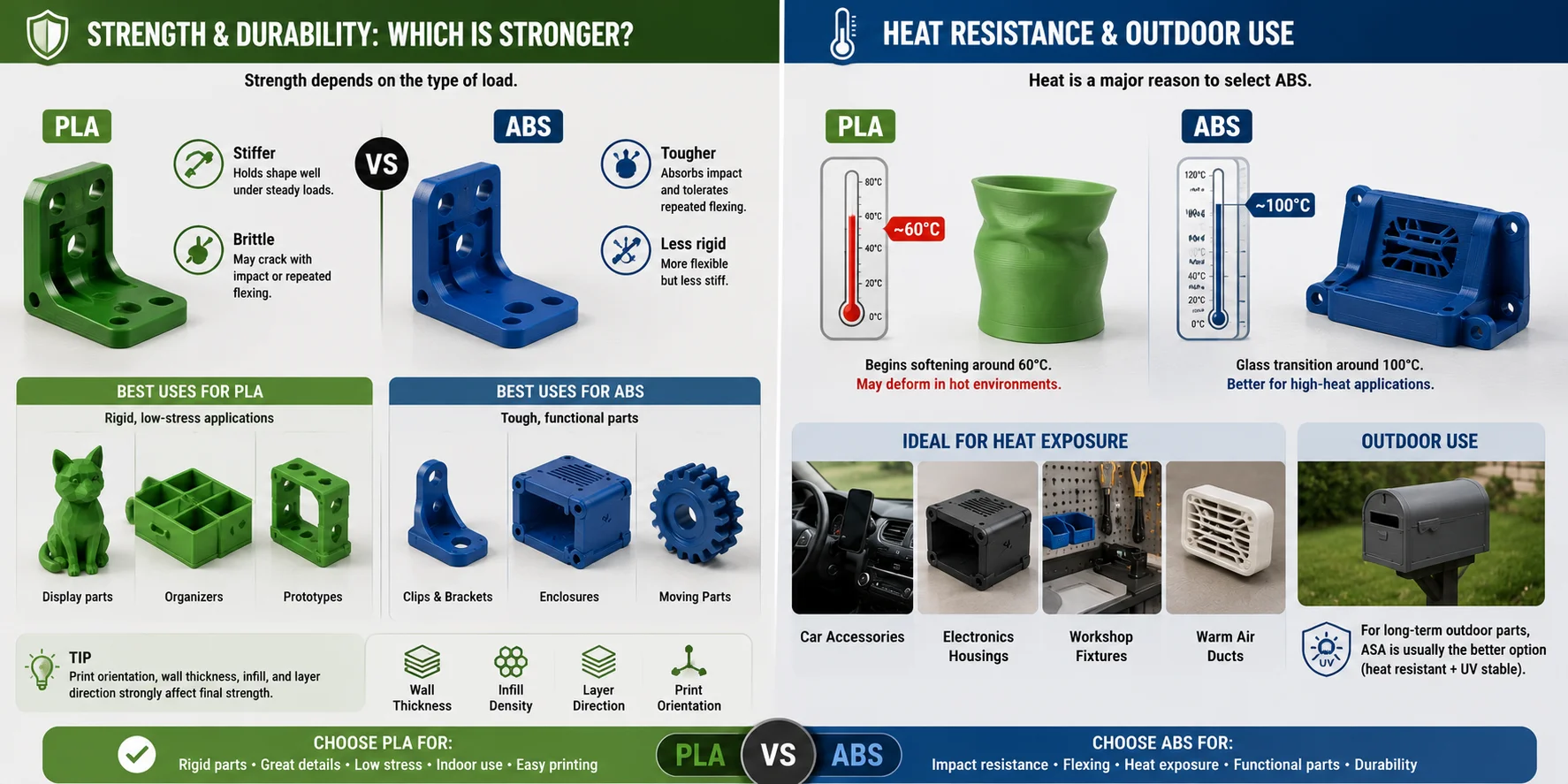
“Stronger” depends on the type of load.
PLA is typically stiffer and performs well under steady tensile loads, so it holds shape effectively in rigid, low-impact applications. However, it is comparatively brittle and may crack when dropped, flexed repeatedly, or used in snap-fit designs.
ABS is less rigid but tougher. It absorbs impact and tolerates repeated flexing better, making it more suitable for clips, brackets, enclosures, tool accessories, snap-fit lids, and moving parts.
In practice, use PLA for rigid display parts, organizers, and low-stress prototypes. Choose ABS when the part will be handled frequently, flexed, dropped, or mechanically loaded. Print orientation, wall thickness, infill, and layer direction still strongly affect final strength.
Heat Resistance and Outdoor Use
Heat is a major reason to select ABS.
Standard PLA can begin softening around 60°C, so it may deform inside a parked car, near electronics, behind sun-exposed glass, or close to warm machinery. ABS has a substantially higher glass-transition temperature, often around 100°C, giving it a wider operating margin.
Choose ABS for car accessories, electronics housings, workshop fixtures, warm air ducts, and parts exposed to repeated heat cycles.
For long-term outdoor use, ABS is not always ideal because UV exposure can degrade it. ASA is usually the better option for permanent outdoor parts because it offers similar heat resistance with stronger UV stability.
Printability: Ease, Warping, and Equipment
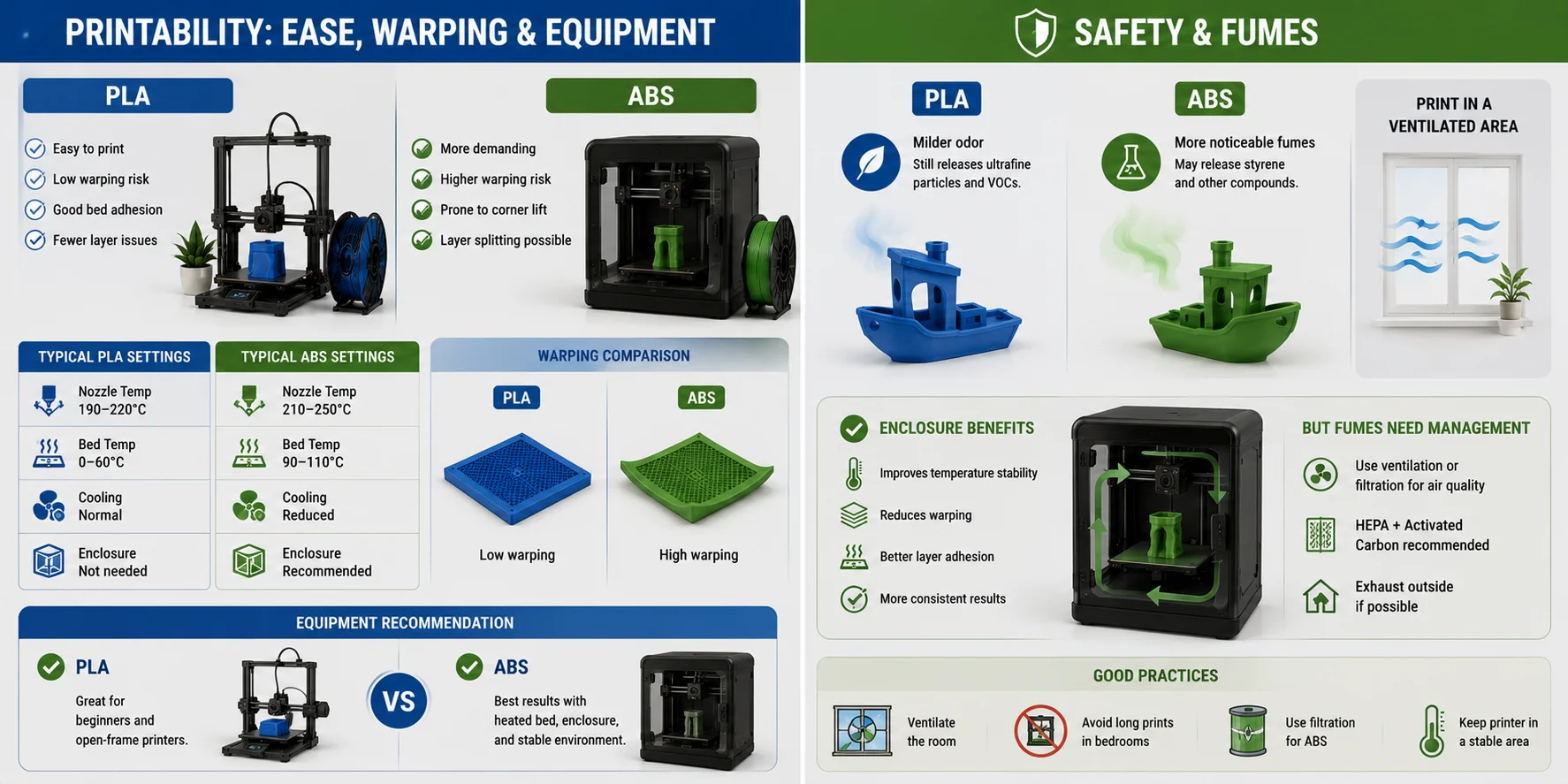
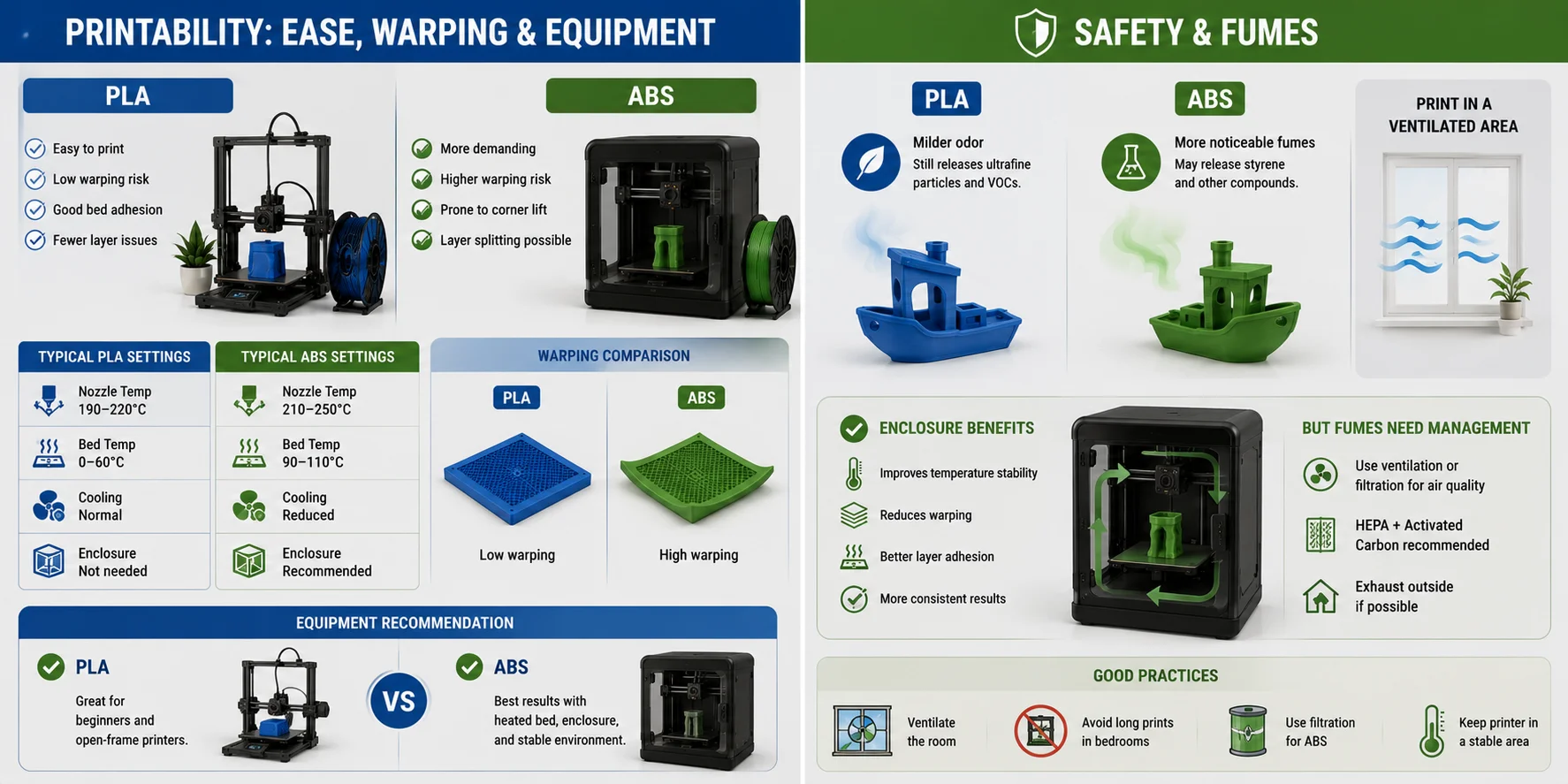
PLA is easier to print because it shrinks less during cooling. It has lower warping risk, better bed adhesion, and fewer layer-separation issues on common desktop printers.
A typical PLA setup uses a nozzle temperature of about 190–220°C, a bed around 0–60°C, normal part cooling, and no enclosure. It is well suited to open-frame printers.
ABS generally requires a nozzle temperature of 210–250°C, a heated bed around 90–110°C, reduced cooling, stable ambient conditions, and preferably an enclosure. Its higher shrinkage can cause warping, corner lift, and layer splitting, particularly on large flat parts.
For beginners or open-frame machines, PLA is the practical default. ABS becomes more reliable when the printer has a heated bed, draft protection, and enclosure control.
Safety and Fumes
Both PLA and ABS should be printed in a ventilated area.
PLA usually has a milder odor, but heated filament can still release ultrafine particles and volatile compounds. ABS produces more noticeable emissions, including styrene-related compounds, so ventilation and filtration are more important.
Avoid printing for long periods in bedrooms or small enclosed rooms. For ABS, use a ventilated enclosure or a filtration system designed to address particles and volatile compounds. An enclosure improves print quality but does not provide complete fume control unless it includes suitable filtration or exhaust.
Finishing and Post-Processing
PLA and ABS can both be sanded, primed, painted, and assembled.
PLA often prints with cleaner detail, so it may require less finishing. It can be sanded and painted, but acetone does not effectively smooth its surface.
ABS offers more finishing options. It can be sanded, painted, solvent-welded, and acetone-vapor smoothed. Vapor smoothing can reduce visible layer lines and produce a glossy surface, making ABS useful for props, cosmetic housings, helmets, and product-style prototypes.
Acetone is flammable and can soften edges, reduce detail, or alter dimensions. Use controlled conditions, proper ventilation, and test prints before treating final parts.
Cost Comparison
PLA and ABS are usually available at similar spool prices, with PLA often slightly cheaper and more widely stocked.
Total cost depends on more than filament price. PLA generally has lower practical cost because it prints more reliably, needs less tuning, and works without specialized equipment.
ABS may increase total cost through enclosure requirements, failed prints, adhesion aids, longer warm-up time, ventilation, and reprints caused by warping or layer separation.
Choose PLA when printing decor, prototypes, organizers, miniatures, and indoor hobby parts. Choose ABS when the part must survive heat, impact, or repeated mechanical use and the printer setup can support it.
When to Choose PLA vs When to Choose ABS
This is the practical decision section.
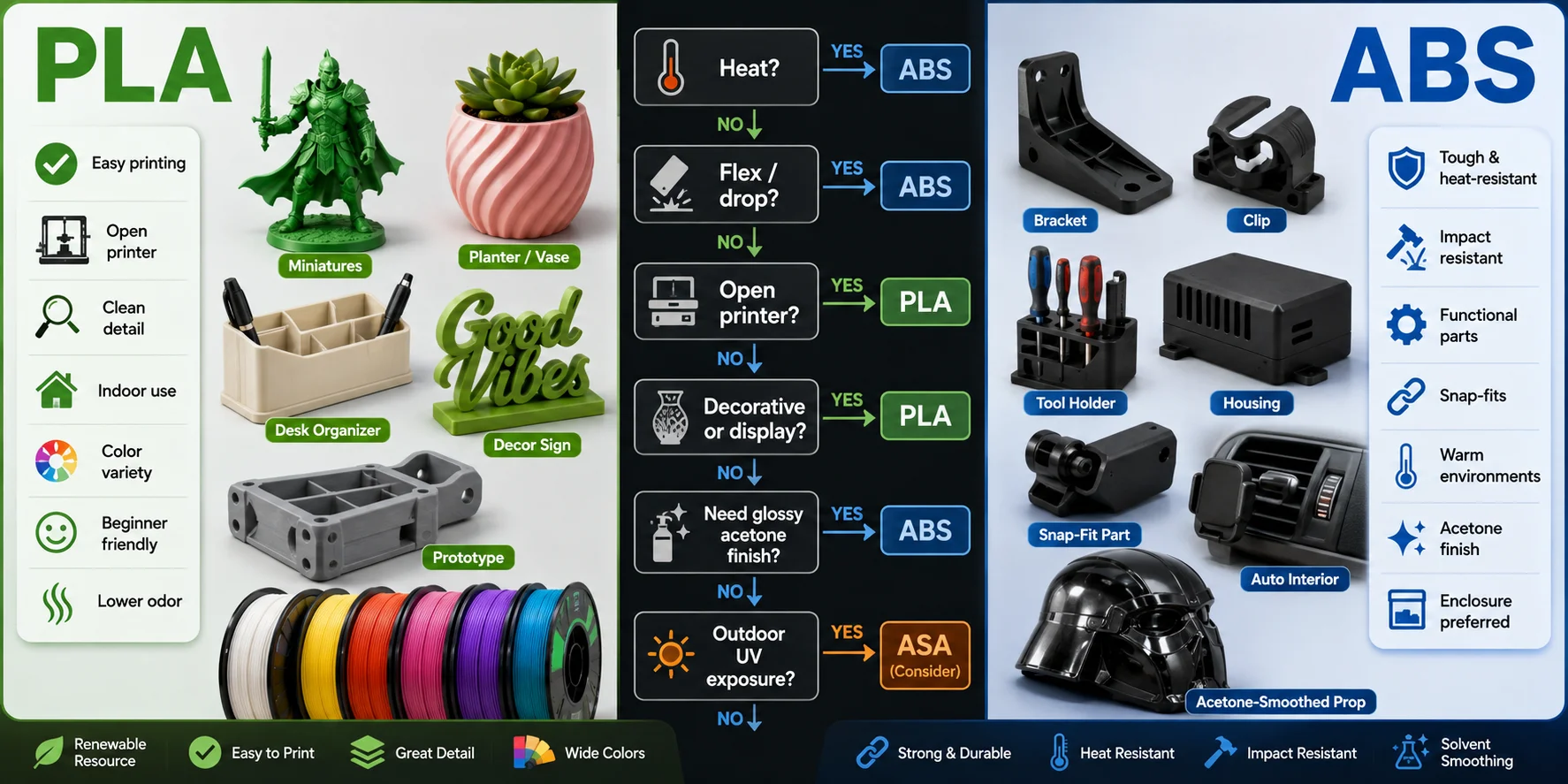
Choose PLA for:
- Prototypes and display models because it prints reliably and shows detail cleanly.
- Figurines and miniatures because it works well with fine geometry and color-focused designs.
- Beginners and open-frame printers because it does not require an enclosure for most prints.
- Indoor organizers and desk accessories because they usually face low heat and low impact.
- Planters, vases, decor, and signs because appearance matters more than toughness.
- Low-ventilation hobby spaces because PLA generally has a milder odor, though ventilation is still recommended.
- Fast functional test prints because it is easier to print, revise, and reprint.
- Projects where color variety matters because PLA is available in many specialty finishes.
Choose ABS for:
- Functional mechanical parts because ABS handles impact and repeated use better.
- Snap-fits and moving joints because toughness matters more than stiffness.
- Car interiors and warm environments because PLA may soften around 60°C.
- Tool holders, brackets, clips, and housings because these parts benefit from higher heat tolerance and impact resistance.
- Parts that need acetone smoothing because ABS can achieve a glossy, blended finish.
- Large durable props when you have an enclosure and need a more resilient material.
- Parts likely to be dropped or flexed because ABS is less likely to crack suddenly.
- Workshop accessories where the environment is warmer, rougher, or more mechanically demanding.
A simple decision tree
- Will the part sit in a hot car, enclosure, or near heat?
Choose ABS. - Will the part be flexed, clipped, dropped, or repeatedly handled?
Choose ABS. - Do you have an open printer and want a reliable result today?
Choose PLA. - Is the object mainly decorative, visual, or low-stress?
Choose PLA. - Do you need a smooth acetone-vapor finish?
Choose ABS. - Do you need outdoor UV resistance for months or years?
Consider ASA rather than either PLA or standard ABS.
How About PETG, TPU, and ASA?
PLA and ABS are not the only choices, but this article stays focused on their direct comparison.
PETG is often the practical middle ground: easier to print than ABS, tougher and more heat-resistant than PLA, but sometimes stringier. TPU is for flexible parts such as grips, bumpers, gaskets, and wearable accessories. ASA is often the better outdoor alternative to ABS because it offers better UV resistance.
For a wider guide to material selection, see our 3D printer filament types guide.
Frequently Asked Questions
Which is better, ABS or PLA?
Neither is universally better. PLA is better for easy printing, detail, indoor use, and beginner-friendly projects. ABS is better for heat resistance, impact resistance, snap-fits, and functional parts that need to survive tougher conditions.
Does ABS look better than PLA?
PLA often looks better directly from the printer because it produces clean detail and has less warping. ABS can look better after finishing because acetone vapor smoothing can reduce layer lines and create a glossy surface.
Why use PLA instead of ABS?
Use PLA when you want a simpler, lower-temperature, lower-warping material that works well on common open-frame printers. It is especially useful for prototypes, decor, miniatures, organizers, and indoor low-stress parts.
What are the disadvantages of ABS filament?
ABS is harder to print than PLA because it warps and shrinks more. It usually needs a heated bed and enclosure, produces more noticeable fumes, may require better ventilation, and can fail through corner lift or layer separation if cooling is uneven.
Is PLA or ABS stronger?
PLA is usually stiffer and can hold its shape well under steady loads, but it is more brittle. ABS is generally tougher and better for parts that may be dropped, clipped, flexed, or used repeatedly.
What temperature should I use for PLA vs ABS?
PLA commonly prints around 190–220°C with a bed at 0–60°C. ABS usually needs a hotter nozzle around 210–250°C, a 90–110°C heated bed, and more stable ambient conditions.
Does ABS need an enclosure?
ABS can print without an enclosure on some small parts, but an enclosure is strongly recommended. It helps reduce drafts, warping, corner lift, and layer splitting by keeping the part warm while it cools.
Is PLA or ABS better for outdoor use?
ABS handles heat better than standard PLA, but it is not always the best long-term outdoor material because UV exposure can degrade it. For permanent outdoor parts, ASA is often a better choice than either PLA or standard ABS.
How does PETG compare with PLA and ABS?
PETG sits between PLA and ABS for many users. It is usually easier to print than ABS and tougher than PLA, but it can be stringier and may need more tuning for clean surfaces.
Can you use PLA or ABS in a 3D pen?
PLA is usually the easier and safer-feeling choice for most 3D pen users because it melts at a lower temperature and has a milder odor. ABS can work in compatible 3D pens, but it needs higher heat and better ventilation.
Conclusion
PLA is the practical choice for easy, detailed, low-warp indoor prints. ABS is the better choice when the part must withstand heat, impact, or repeated mechanical use.
Start with the job requirements, then select the material. Once the design is ready, use Tripo AI Image to 3D to generate a custom model from a prompt or image, then prepare and export it for PLA or ABS printing in Tripo AI Studio.