ASA vs ABS: Which Filament Is Better for 3D Printing?
TL;DR
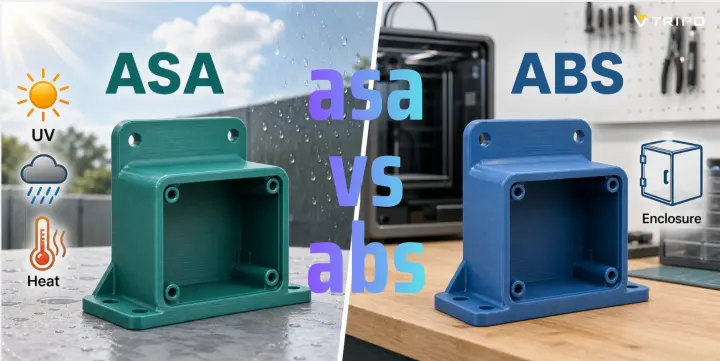
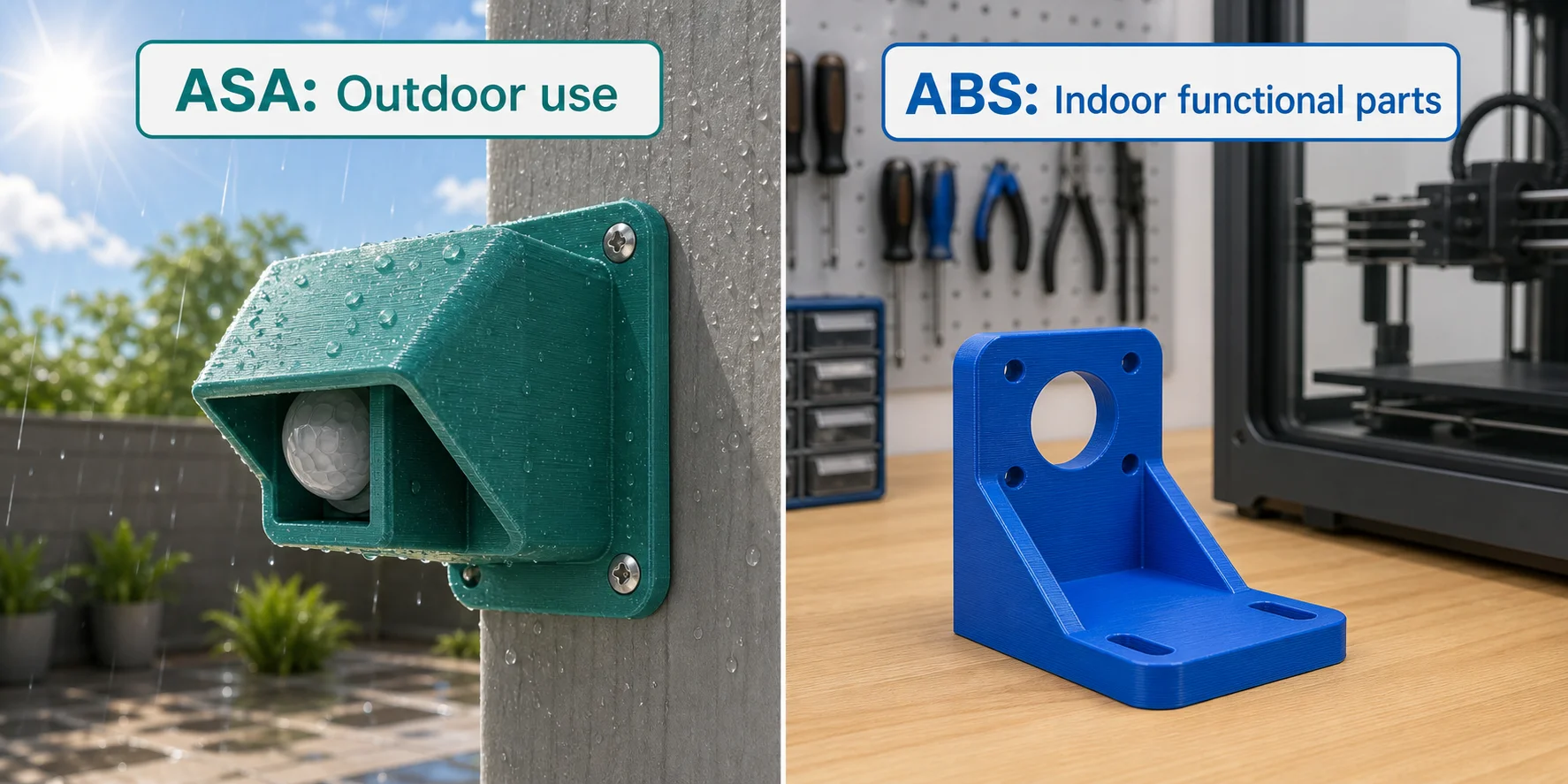
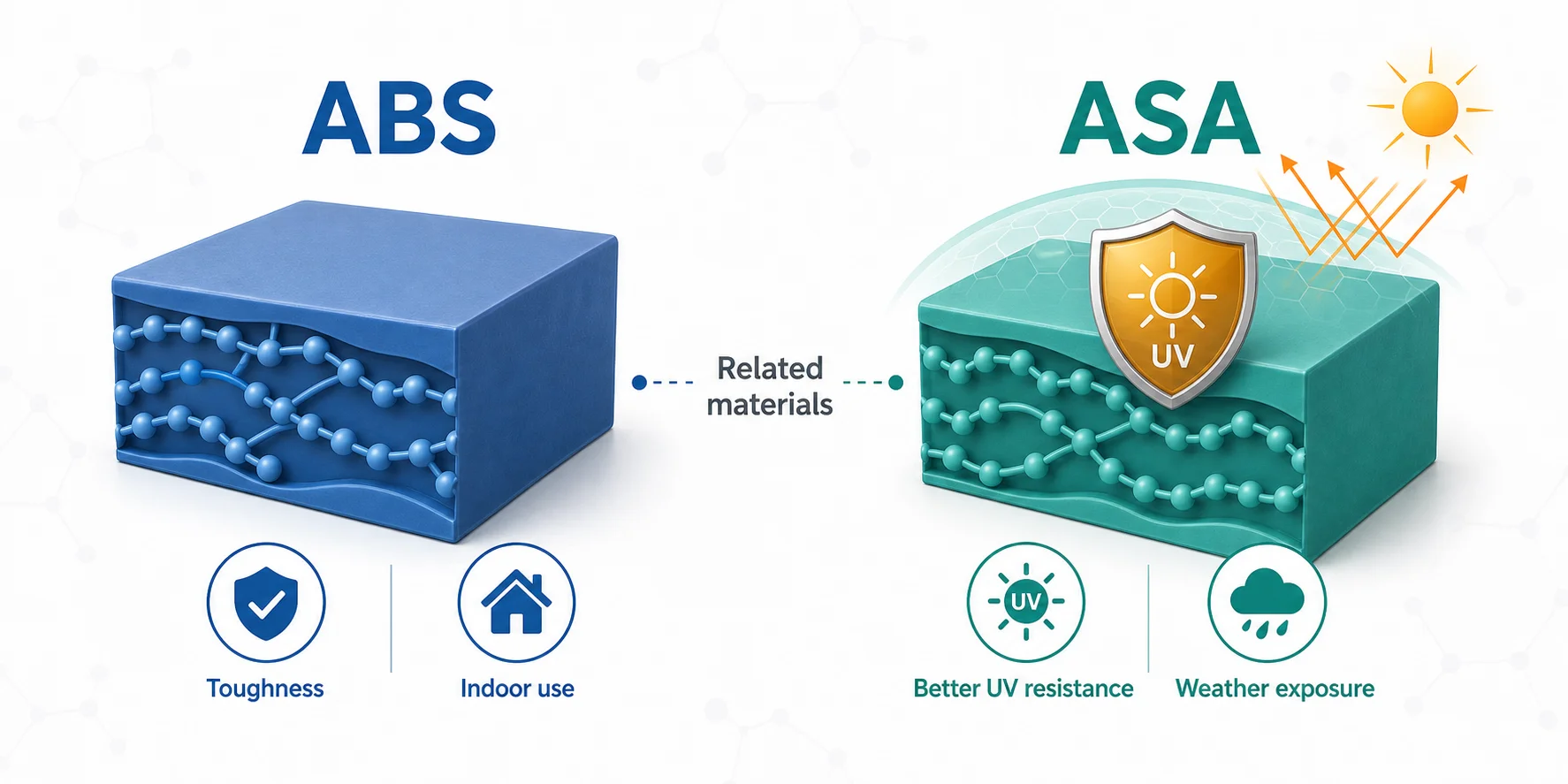
- ASA vs ABS comes down to environment. ABS is the older, more common engineering filament: tough, heat-resistant, easy to sand, and useful for indoor functional parts. ASA is closely related to ABS but uses a different rubber component that gives it much better UV and weather resistance.
- Use ABS when you need a low-cost, familiar material for indoor brackets, housings, prototypes, and parts that may be post-processed. Use ASA when the part will live outside, sit near sunlight, face rain, or needs to keep its color and strength under UV exposure.
- Both materials are harder to print than PLA or PETG. They need a heated bed, stable temperatures, good ventilation, and ideally an enclosed printer. If your model starts as a concept, sketch, or reference image, tools such as Tripo can help you create the geometry first, but the material choice still depends on heat, weather, load, and finish.
Introduction
ASA and ABS often appear in the same conversation because they share a family resemblance. Both are styrene-based thermoplastics used for functional 3D printed parts. Both can handle more heat than PLA. Both can warp if printed in a cold room. Both can produce fumes, so ventilation matters.
The difference is what happens after printing. ABS is useful indoors, but it tends to yellow, fade, and become brittle under long UV exposure. ASA was developed as a more weather-resistant alternative. That makes ASA a better fit for outdoor housings, car accessories, garden fixtures, sign parts, and exposed brackets.
If you are designing a part before choosing the filament, it helps to define the environment early. A clean model from Tripo HD Model may give you the detail you need for a prototype, but ASA vs ABS is decided by where the finished print has to work.
This guide compares ASA and ABS for 3D printing, including strength, UV resistance, print settings, warping, finishing, cost, and practical use cases.
What Is ABS Filament?
ABS stands for acrylonitrile butadiene styrene. It is one of the classic engineering plastics and has been used for decades in injection-molded products, appliances, automotive trim, toys, housings, and consumer goods.
In 3D printing, ABS became popular because it offers better heat resistance and impact toughness than PLA. It can be sanded, drilled, glued, painted, and smoothed with acetone vapor. That makes it useful for prototypes and functional parts where surface finishing matters.
The downside is print difficulty. ABS shrinks as it cools. That shrinkage can cause corner lifting, layer splitting, and warping, especially on larger parts. A heated bed helps, but an enclosure is often the real difference between a reliable ABS print and a frustrating one.
ABS also produces noticeable fumes during printing. Use ventilation and follow the filament maker's safety guidance.
What Is ASA Filament?
ASA stands for acrylonitrile styrene acrylate. It was developed as an alternative to ABS with improved weather resistance. The big change is that ASA uses an acrylate rubber component instead of the butadiene rubber used in ABS.
That chemistry gives ASA better resistance to UV light, outdoor exposure, color fading, and environmental stress. In practical 3D printing terms, ASA is often described as "ABS for outdoors,"though that phrase simplifies the details.
ASA has good toughness, decent heat resistance, and a surface finish similar to ABS. It can be used for outdoor brackets, electrical enclosures, automotive accessories, drone parts, garden hardware, signage, and other parts that see sunlight.
It is not beginner material. ASA can warp, it prefers an enclosure, and it also requires ventilation. But when outdoor durability matters, it is often worth the extra care.
ASA vs ABS: Key Property Differences
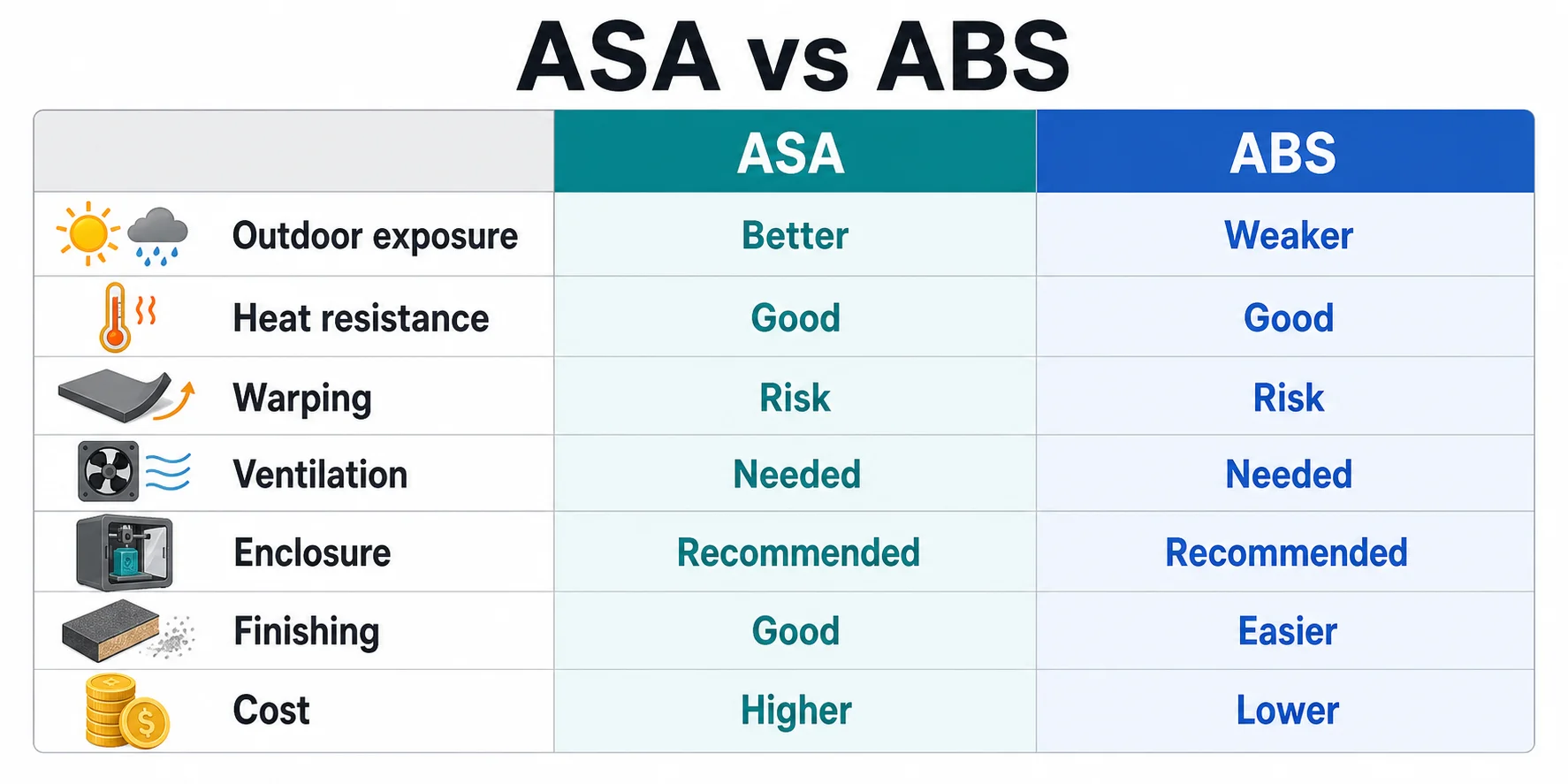
ASA vs ABS is not a simple "better or worse"comparison. They overlap heavily, but each material has a clearer use case.
ABS is more available, often cheaper, and widely understood. Many slicer profiles, printer guides, adhesives, and post-processing tutorials are built around ABS. If you are making indoor parts and already know how to print ABS, there may be no reason to switch.
ASA is the better choice when weather is the main enemy. UV exposure can degrade ABS over time. ASA handles outdoor exposure better and tends to retain color and mechanical properties more reliably in sunlit environments.
Printability is close. Some users find ASA slightly easier than ABS, while others find it just as demanding. Brand, printer, enclosure, part size, and chamber temperature matter more than the label alone.
ASA vs ABS vs PETG — Full Comparison
PETG belongs in this comparison because it is the easier functional filament many users consider before moving to ASA or ABS. It cannot match ASA outdoors or ABS in solvent finishing, but it prints with less warping and usually needs less thermal control.
| Property | ASA | ABS | PETG |
|---|---|---|---|
| Best environment | Outdoor and UV-exposed parts | Indoor functional parts | General indoor use and light outdoor duty |
| UV resistance | Excellent | Poor to moderate | Moderate, formulation dependent |
| Heat resistance | Good | Good | Moderate |
| Impact behavior | Tough | Tough | Tough with more flex |
| Warping risk | High | High | Low to moderate |
| Enclosure | Strongly recommended | Strongly recommended | Usually optional |
| Bed temperature | Commonly 90 to 110°C | Commonly 90 to 110°C | Commonly 70 to 90°C |
| Post-processing | Sanding, painting, some solvent methods | Sanding, painting, acetone smoothing | Sanding and painting, limited solvent smoothing |
| Odor and ventilation | Ventilation required | Ventilation required | Lower odor, ventilation still advisable |
| Typical cost position | Usually higher than ABS | Usually the least expensive of the three | Often between ABS and ASA |
| Best fit | Outdoor housings, vehicle accessories, exposed brackets | Prototypes, indoor housings, workshop parts | Accessible functional prints and open printers |
Strength and durability
ABS is known for toughness. It can absorb impacts better than brittle materials such as standard PLA, and it is useful for parts that need to survive handling, vibration, or occasional drops.
ASA is also tough and can perform similarly in many printed parts. The advantage shows up over time outdoors. A bracket printed in ABS may start strong but weaken after months of UV exposure. ASA is designed to resist that kind of weathering.
For load-bearing parts, material choice is only half the story. Layer orientation, wall count, infill pattern, nozzle temperature, chamber temperature, and cooling all affect final strength. A poorly printed ASA part can be weaker than a well-printed ABS part.
UV and weather resistance
This is the main reason to choose ASA.
ABS can degrade under UV light. Outdoor exposure may cause fading, yellowing, chalking, and brittleness. Paint or coatings can help, but they add another step and may wear over time.
ASA is much better for outdoor use. It resists UV exposure, moisture, and general weathering more effectively than ABS. That makes it a good candidate for:
Outdoor sensor housings.
Garden clips and brackets.
Automotive trim or accessory parts.
Drone shells and mounts.
Exterior signage.
RV or boat accessories.
Outdoor camera mounts.
If the part will see sunlight regularly, start by considering ASA.
Heat resistance
Both ASA and ABS handle heat better than PLA. That makes them suitable for parts near electronics, warm enclosures, vehicle interiors, and workshop fixtures.
Do not treat either material as automatically high-temperature. A dark printed part inside a hot car can still be a challenging environment. For extreme heat, materials such as polycarbonate, nylon blends, or higher-temperature engineering filaments may be better.
For many everyday functional parts, ASA and ABS sit in a useful middle ground: more heat resistant than PLA, easier to print than true high-temperature polymers.
Print Settings Comparison
Exact settings depend on the filament brand, printer, and part geometry, but the typical ranges are similar.
| Setting | ASA | ABS | PETG reference |
|---|---|---|---|
| Typical nozzle range | 240 to 260°C | 230 to 260°C | 220 to 250°C |
| Typical bed range | 90 to 110°C | 90 to 110°C | 70 to 90°C |
| Enclosure | Strongly recommended | Strongly recommended | Usually optional |
| Part cooling | Low or off for most of the print | Low or off for most of the print | Low to moderate |
| Draft sensitivity | High | High | Lower |
| Bed adhesion aid | Brim often useful | Brim often useful | Usually part dependent |
Treat these as starting ranges rather than universal profiles. The filament manufacturer's settings take priority, and large parts often need more chamber stability than small test pieces.
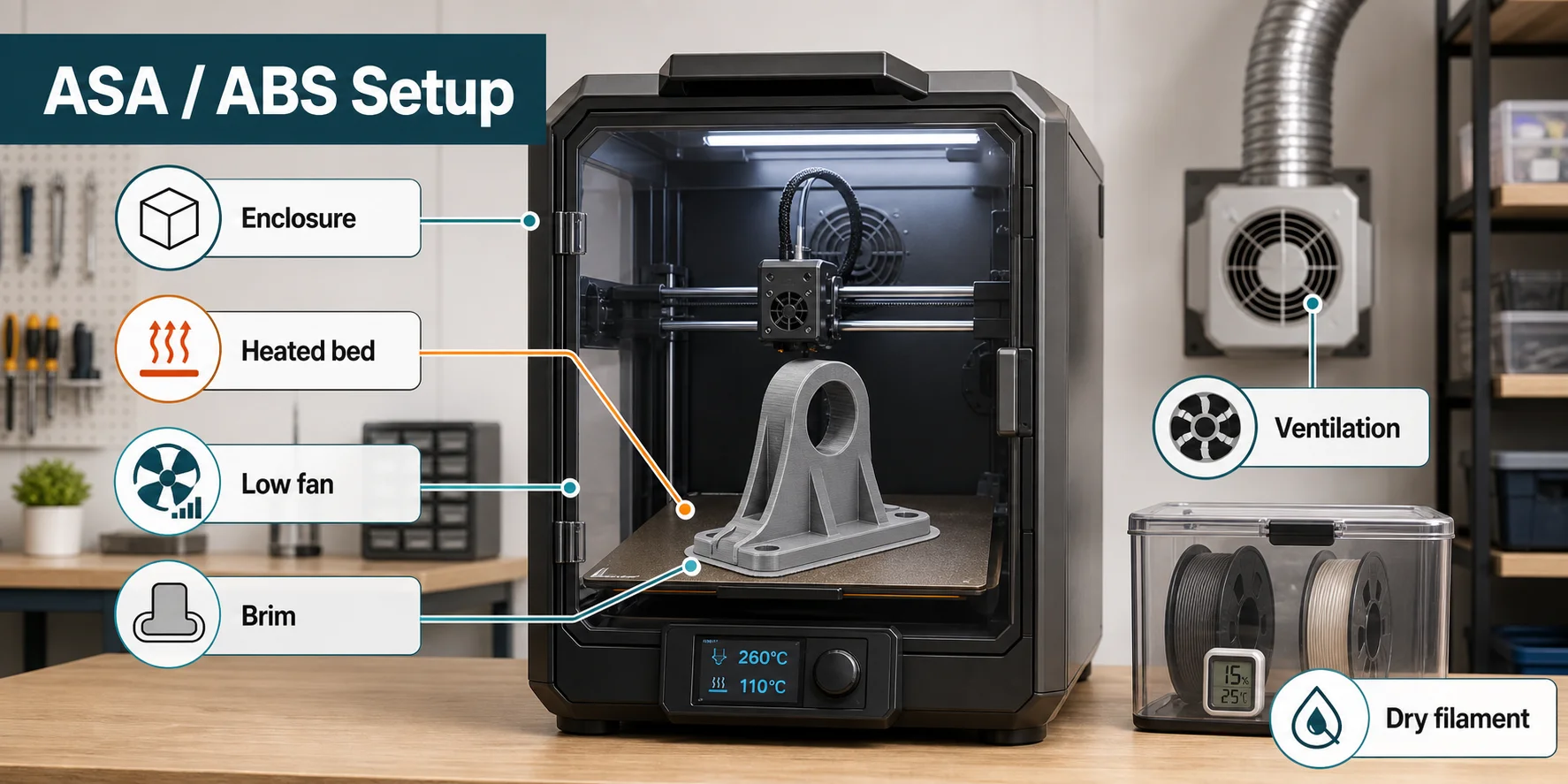
Both benefit from:
An enclosed printer.
A clean build surface.
Minimal part cooling.
A brim or raft for large footprints.
Dry filament.
Stable room temperature.
Good ventilation.
For larger parts, enclosure temperature is critical. If the lower layers stay warm while the upper layers cool too quickly, internal stress can split the print. This is why tall ABS and ASA parts often fail without an enclosure.
Warping and bed adhesion
Warping is the tax you pay for printing ABS and ASA.
Both materials shrink as they cool. If the print cools unevenly, corners can lift from the bed or layers can split. Large flat parts are especially prone to trouble.
To reduce warping:
Use an enclosure.
Preheat the chamber if your printer supports it.
Use a heated bed.
Clean the build surface.
Add a brim.
Avoid drafts.
Reduce or disable part cooling.
Use rounded corners where possible.
Split very large designs into smaller assemblies.
Design helps. A part with sharp corners and a huge flat base is more likely to warp than a part with rounded edges, ribs, and smaller contact areas.
Surface finish and post-processing
ABS is popular because it post-processes well. It sands cleanly, accepts filler primer, and is known for acetone vapor smoothing. That can produce a glossy molded look, though acetone smoothing also changes dimensions and softens fine detail.
ASA can also be sanded, painted, and smoothed, but behavior varies by formulation. Some ASA filaments respond to acetone-like smoothing, while others are less predictable. Always test on a scrap part first.
If your part needs a polished cosmetic finish, ABS may be easier to work with simply because there is more established guidance. If the part needs to stay outdoors without paint, ASA has the stronger argument.
When to Use ASA vs ABS
The simplest decision rule is location. Choose ASA for parts that must retain their properties and appearance in sunlight or weather. Choose ABS for indoor parts when lower material cost, established profiles, or acetone smoothing matters more than UV resistance.
When should you use ASA?
Use ASA when the printed part needs outdoor durability.
Good ASA projects include:
Outdoor electronics housings.
Solar sensor mounts.
Garden irrigation clips.
Vehicle interior or exterior accessories.
Bike or scooter parts exposed to weather.
Outdoor signage letters.
Camera and light mounts.
Drone shells.
Exterior brackets.
ASA is also a smart choice when color retention matters. A black ABS part may survive outdoors for a while, but colored ABS can fade noticeably. ASA is more reliable when the visual finish is part of the job.
When should you use ABS?
Use ABS when the part will live indoors and you want a tough, heat-resistant, post-processable material.
Good ABS projects include:
Workshop jigs.
Electronics housings.
Robot parts.
Tool holders.
Appliance repair parts.
Prototype enclosures.
Parts that need sanding and painting.
Fit-check models before injection molding.
ABS is also useful when cost matters. It is widely available and often cheaper than ASA. If your printer is already tuned for ABS and the part does not need weather resistance, ABS remains a practical material.
Cost Comparison
ABS usually has the lowest spool price because it is widely produced and sold by many filament brands. ASA commonly costs more. PETG often sits between them, although specialty grades can reverse that order. Regional availability, color, additives, and spool size matter more than a single advertised price.
Spool price is only the first cost. ASA and ABS both benefit from an enclosure, a heated bed, ventilation, and enough energy to keep the print warm. Failed corners, split layers, and discarded large prints can cost more than the difference between two spools. PETG may be cheaper overall on an open printer because it is less prone to thermal failure.
Service life changes the calculation outdoors. A cheaper ABS bracket that fades or becomes brittle may need replacement, while ASA can justify its higher purchase price by lasting longer under UV exposure. For indoor prototypes and parts that will be painted, ABS often remains the economical choice.
Designing ASA or ABS Parts with Tripo
ASA and ABS do not forgive weak geometry. Thin clips, sharp internal corners, unsupported tall walls, and oversized flat bases can make printing harder. Before you choose the filament, check the model.
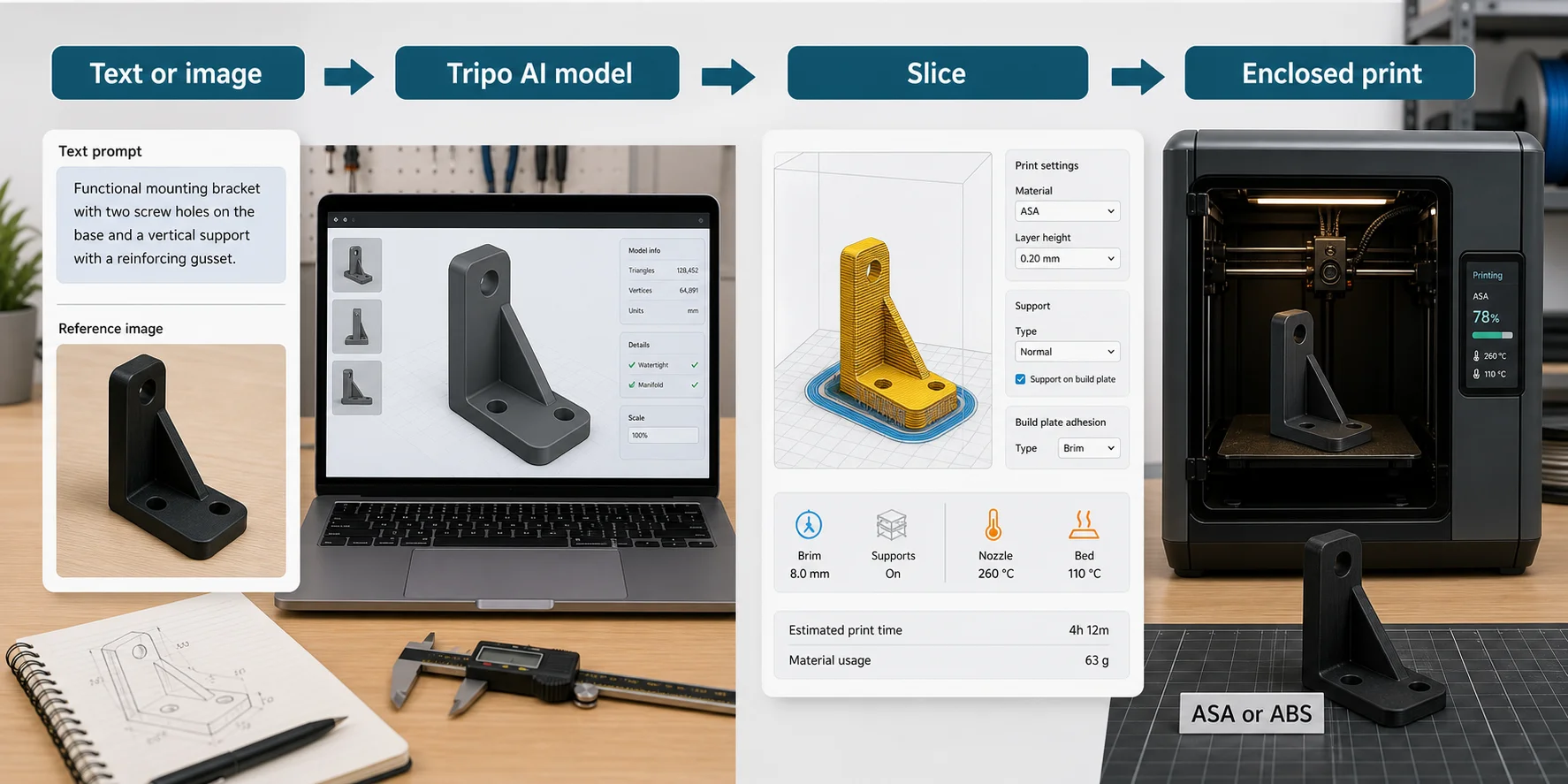
A practical workflow looks like this:
Idea → Text Prompt or Image → Generate Model in Tripo → Review Geometry → Improve if Needed → Export → Slice for ASA or ABS → Print in an Enclosure → Test Fit and Durability
Start with the use case. Is the part indoors or outdoors? Will it sit in sunlight? Will it face heat, vibration, or moisture?
Use text when you are describing a new object from scratch. Use Tripo Image-to-3D when you have a reference object, sketch, or product photo and want the starting model to follow that shape.
Review the geometry before slicing. Check wall thickness, overhangs, sharp corners, holes, mounting points, and areas that may warp.
Improve the model if needed. For functional parts, clean silhouettes and printable geometry matter more than unnecessary surface detail.
Export the model and slice it for your material. ASA and ABS usually need different profiles from PLA or PETG, especially for temperature, fan speed, brim, and chamber control.
Print, test, and revise. Functional ASA and ABS parts often improve after one or two iterations.
Common Mistakes to Avoid
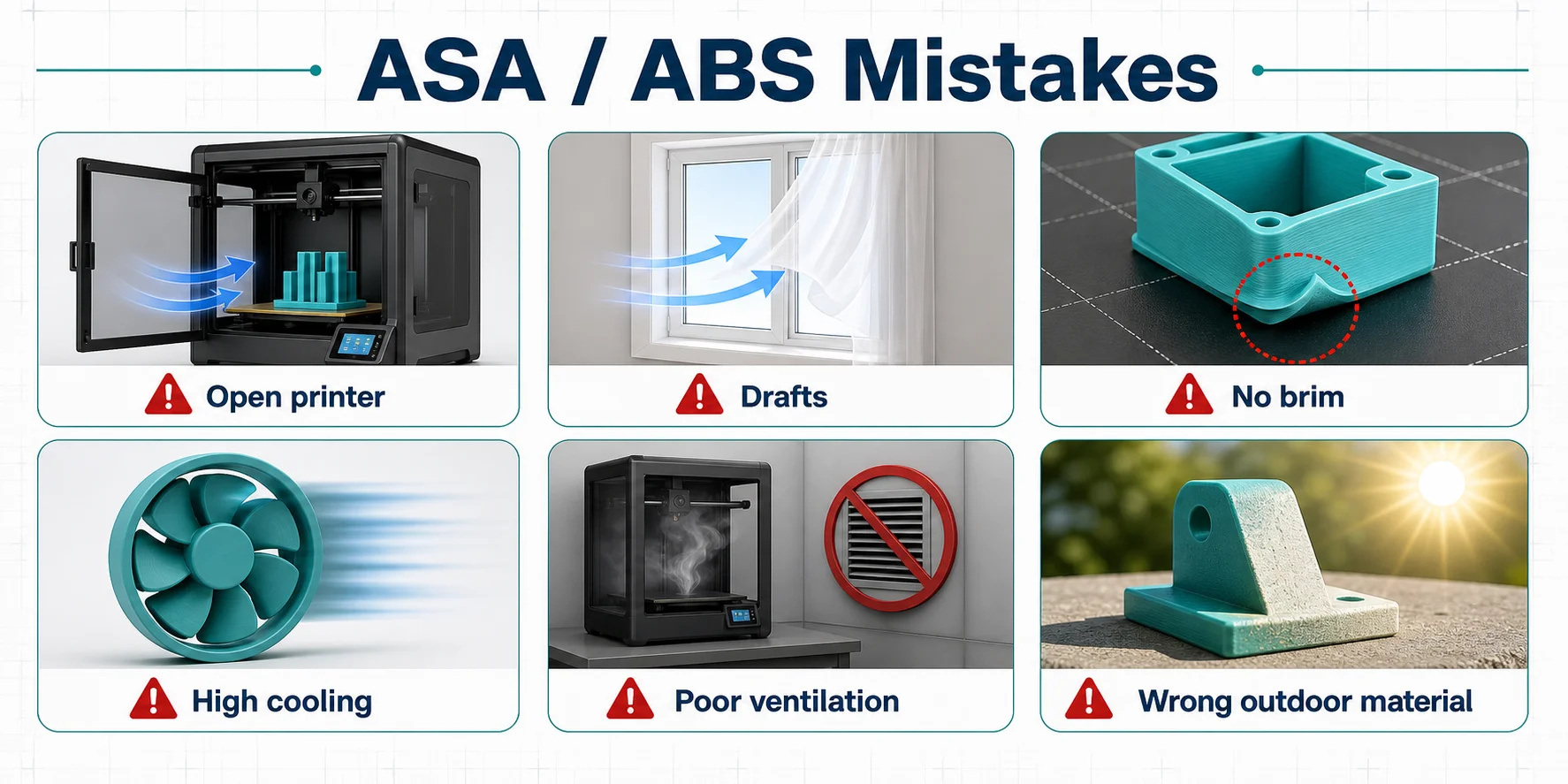
Do not print ASA or ABS in an open, drafty room and expect perfect results. Small parts may work, but larger parts usually need an enclosure.
Do not use too much cooling. Strong part cooling can cause layer splitting and warping.
Do not skip ventilation. Both materials can produce fumes during printing.
Do not choose ABS for outdoor parts just because it is cheaper. UV exposure is a real weakness.
Do not assume ASA prints exactly like PLA. It needs higher temperatures, better bed adhesion, and more thermal control.
Do not design huge flat parts if you can split them or add stress-relief features.
Do not compare materials using weak prints. Tune the profile before judging strength.
Frequently Asked Questions
ASA vs ABS: which is stronger?
They are broadly similar in strength for many 3D printed parts. ABS is known for impact toughness, while ASA offers similar functional performance with better UV and weather resistance. Print quality and layer bonding can matter more than the small material difference.
Is ASA better than ABS?
ASA is better for outdoor parts because it resists UV and weathering more effectively. ABS is often better when cost, availability, and familiar post-processing are the main concerns.
Is ABS easier to print than ASA?
They are close. Some printers handle one better than the other. Both need a heated bed, stable temperatures, good adhesion, ventilation, and preferably an enclosure.
Does ASA warp like ABS?
Yes. ASA can warp, especially on large parts or open printers. Use an enclosure, heated bed, brim, clean build surface, and low fan speed.
Can ASA replace ABS?
For many outdoor and functional parts, yes. ASA can often replace ABS when UV resistance is needed. For low-cost indoor parts or acetone-smoothed prototypes, ABS may still be the simpler choice.
Is ASA safe to print indoors?
ASA should be printed with good ventilation, just like ABS. Use an enclosure and exhaust or room ventilation according to your printer and filament maker's guidance.
Can ABS be used outdoors?
ABS can be used outdoors for temporary or protected parts, but it is not the best long-term outdoor material. Sunlight can cause fading and brittleness. ASA is usually the better choice.
Can you acetone smooth ASA?
Some ASA filaments can be smoothed with solvent methods, but behavior varies. ABS is more commonly associated with acetone vapor smoothing. Test before using solvent smoothing on a final ASA part.
Which is better for car parts, ASA or ABS?
For parts exposed to sunlight, ASA is usually better. For interior parts away from UV exposure, ABS may work well. Heat, load, mounting method, and safety requirements still matter.
How does Tripo help with ASA vs ABS projects?
Tripo helps create or iterate the 3D model before printing. The ASA vs ABS decision comes later, when you choose the filament based on outdoor exposure, heat, strength, surface finish, and printer setup.
Conclusion
ASA vs ABS is mostly a question of where the part will live. Choose ASA for outdoor prints, sunlight, rain, and long-term weather exposure. Choose ABS for indoor functional parts, prototypes, lower material cost, and familiar sanding or smoothing workflows.
Neither material is as easy as PLA. Both need heat control, bed adhesion, ventilation, and thoughtful design. If the model has thin walls, sharp corners, or a large flat base, fix those issues before blaming the filament.
For custom brackets, housings, outdoor accessories, or prototype parts, you can start the geometry in Tripo Studio, export the model, and then tune the print around ASA or ABS depending on the environment.