Imagining 3D Worlds: Tripo AI × NYU IDM
A hands-on creative technology workshop exploring how AI-generated 3D connects with real-time worlds, motion capture, virtual production, interactive web experiences, and 3D printing.
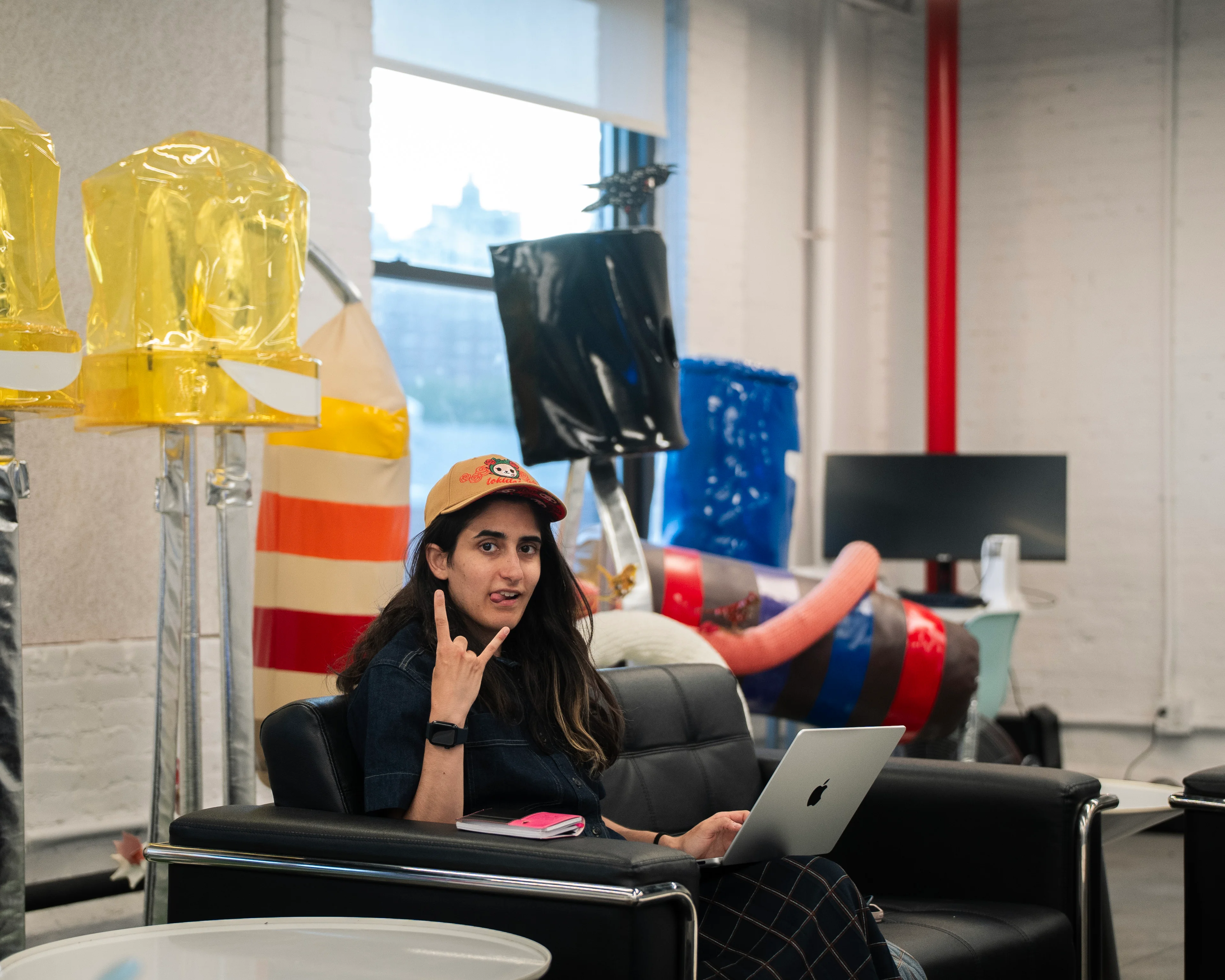
On June 24, 2026, Tripo AI and NYU Tandon Integrated Design & Media came together at NYU Tandon @ The Yard in Brooklyn for Tripo AI × NYU IDM: Build 3D Worlds with AI.
The hands-on workshop explored how images, prompts, and early creative concepts can be transformed into 3D assets, then carried into real production workflows across games, XR, virtual production, motion capture, interactive storytelling, web experiences, and physical fabrication.
The event was coordinated by Todd Bryant, Director of Production at NYU Tandon School of Engineering. Winslow Porter, Volumetric Technology Researcher at NYU Tandon, led the NYU-side workshop session and introduced projects developed by the team. Representing Tripo AI, Aiko Dai, Global Marketing Manager for Tripo AI in the US, introduced Tripo’s AI 3D technology, creative workflows, and Education Program before joining the final project review.
In his opening remarks, Todd highlighted how quickly the NYU team had moved from early ideas to objects that could be printed, rigged, placed in Unreal Engine, or experienced through the web. He also reflected on how rapidly the quality of AI-generated assets had improved, moving from distant background elements toward assets that could play a more central role in a scene.
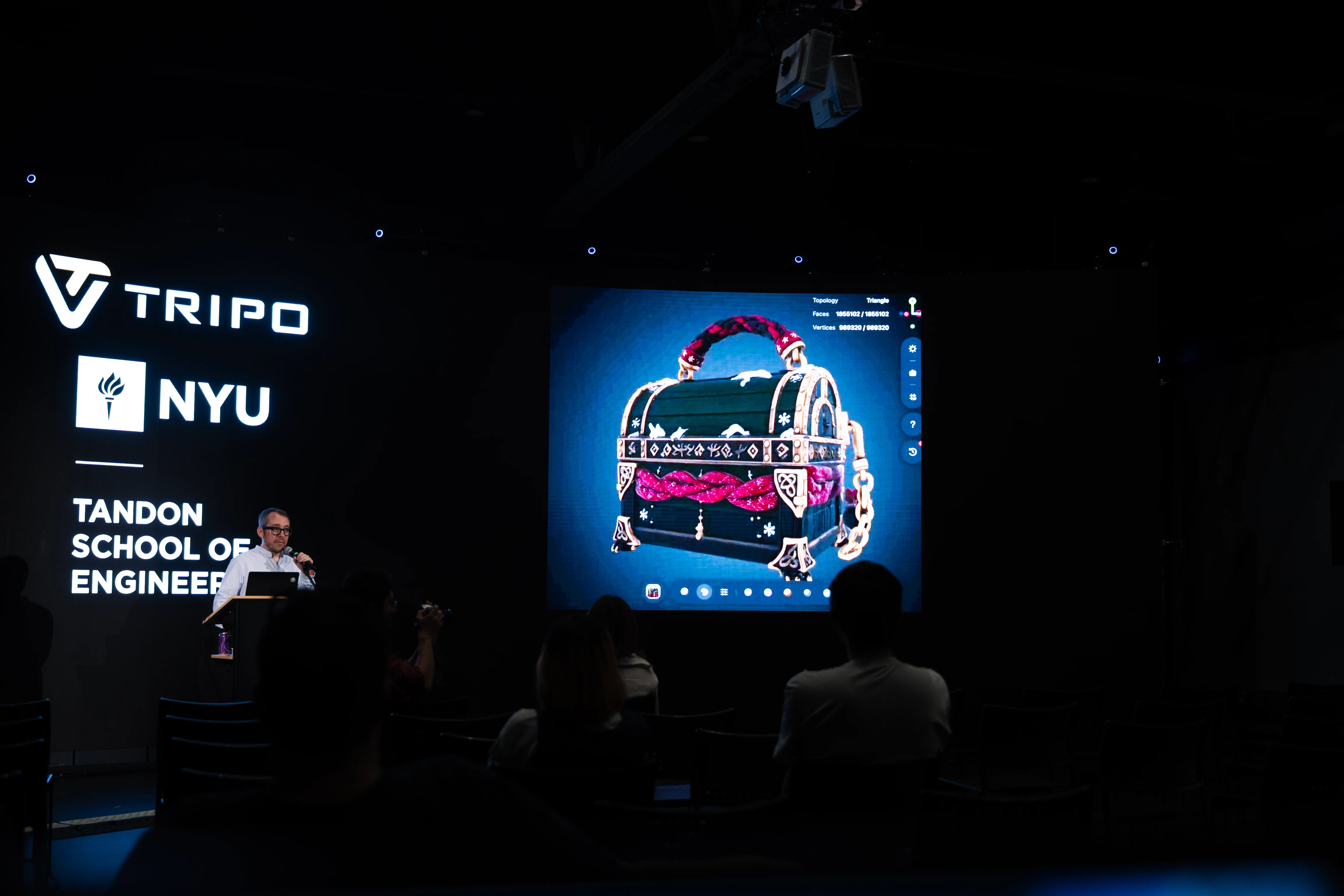
From an Idea to a Usable 3D Asset
3D plays an increasingly important role across games, animation, film, XR, product design, virtual production, cultural projects, and interactive media. Yet creating a usable 3D model through traditional workflows can still require several tools, specialized skills, and significant production time.
During the workshop, Aiko introduced how Tripo allows creators to begin with a text prompt, a photograph, a sketch, or a concept image and generate a 3D model that can continue into a broader creative pipeline.
Depending on the project, the generated asset can be refined, textured, simplified, rigged, animated, or exported into environments such as Unreal Engine, Unity, Blender, Web 3D, and XR platforms.
The workshop also introduced two different Tripo model directions. H3.1 supports highly detailed assets for characters, cultural objects, sculpture, 3D printing, and design prototypes, while Smart Mesh focuses on faster, cleaner, and lower-poly outputs for games, UGC, mobile experiences, XR, and the web.
Aiko emphasized that Tripo is designed as part of a creative workflow, rather than as a single generation button. The generated model can become the starting point for further design, interaction, storytelling, animation, and technical production.
Four AI 3D Workflows Demonstrated by the NYU Team
Before the hands-on creation session, NYU graduate assistants introduced several projects developed with Tripo during the days leading up to the workshop.
Each project connected AI-generated 3D with a different production environment, showing how one creative starting point could move into real-time engines, motion capture, the web, or physical fabrication.
From Character Concept to Unreal Engine and Motion Capture
One workflow began with stylized character concepts, which were transformed into 3D assets using Tripo and prepared for real-time production.
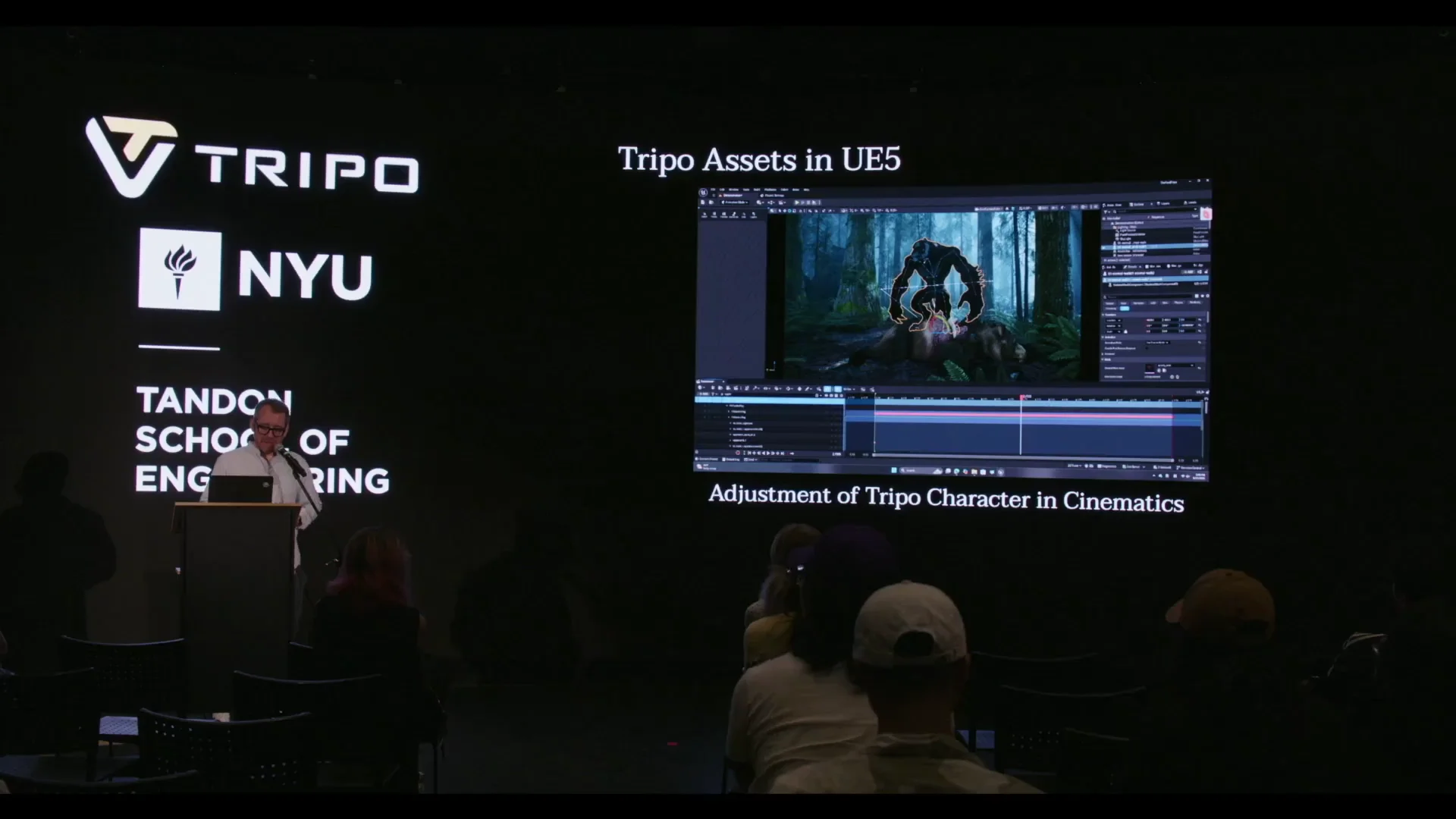
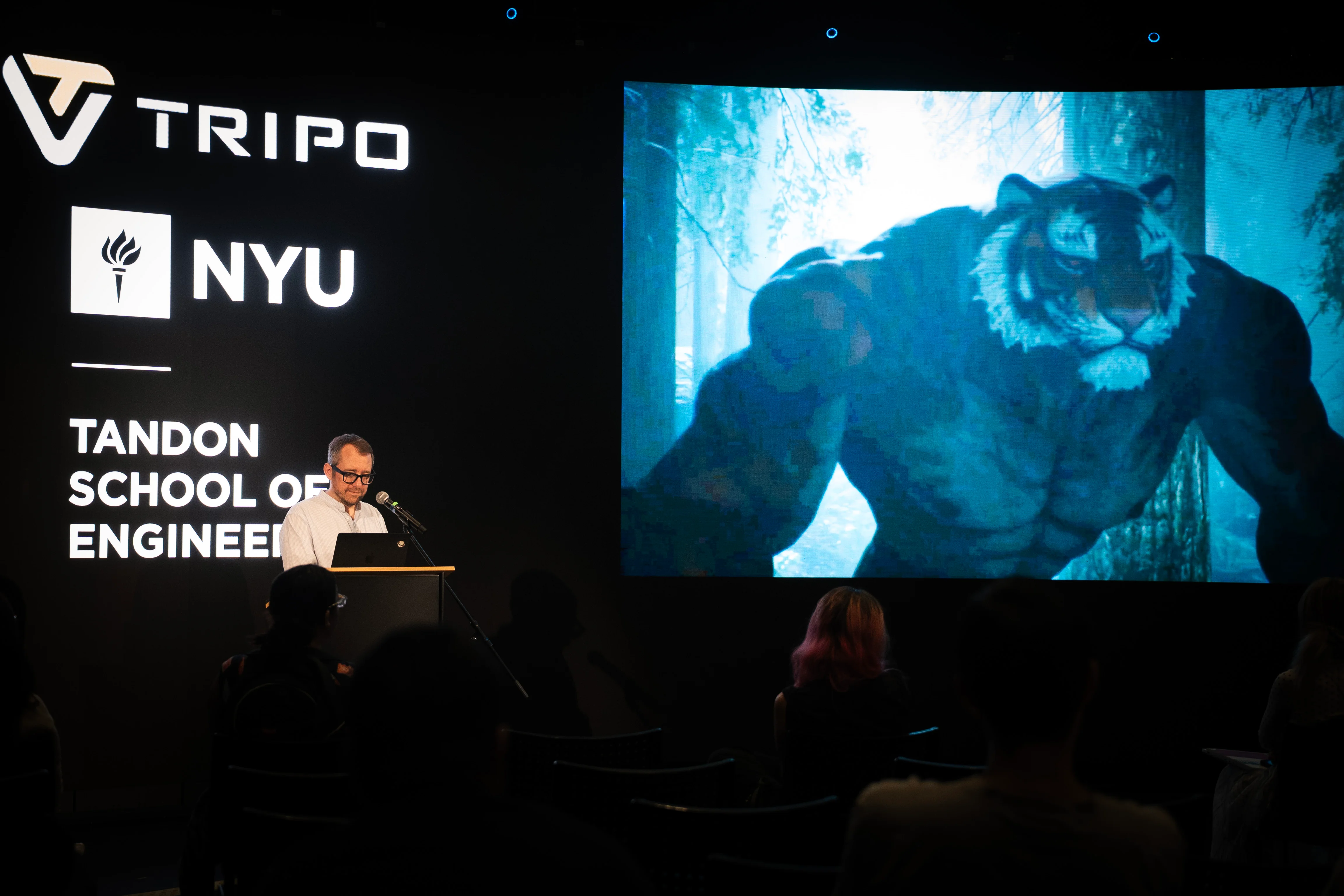
The NYU team demonstrated how generated characters could be rigged, animated, and brought into Unreal Engine. Once inside the engine, the characters could be placed in custom environments, tested under different lighting conditions, and developed into cinematic sequences.
The team also explored motion capture workflows using systems such as OptiTrack and Captury. Motion data could be applied to generated characters, allowing static concepts to become performance-ready digital characters.
Several of these demonstrations were developed within a few hours or over the course of a day. Todd noted that similar concept, modeling, rigging, and animation workflows would previously have required significantly more production time.
Turning Digital Models into Physical Objects
The workshop also explored how an AI-generated model could move from the screen into the physical world.
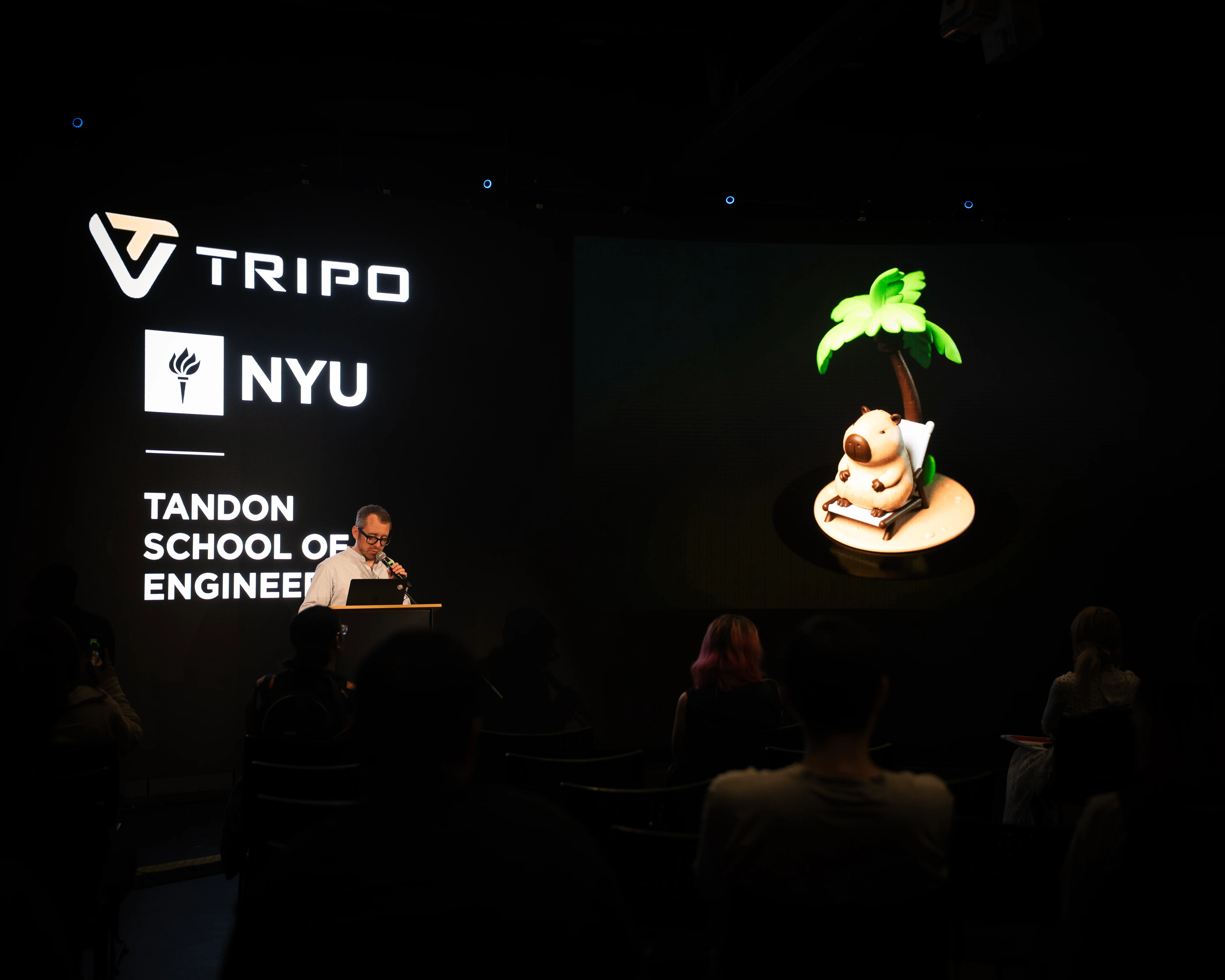
NYU team members used Tripo-generated assets as the starting point for multicolor 3D printing with Bambu and Prusa printers. The workflow included preparing the model, separating components or colors, checking supports and overhangs, processing the file in slicing software, and producing a physical object.
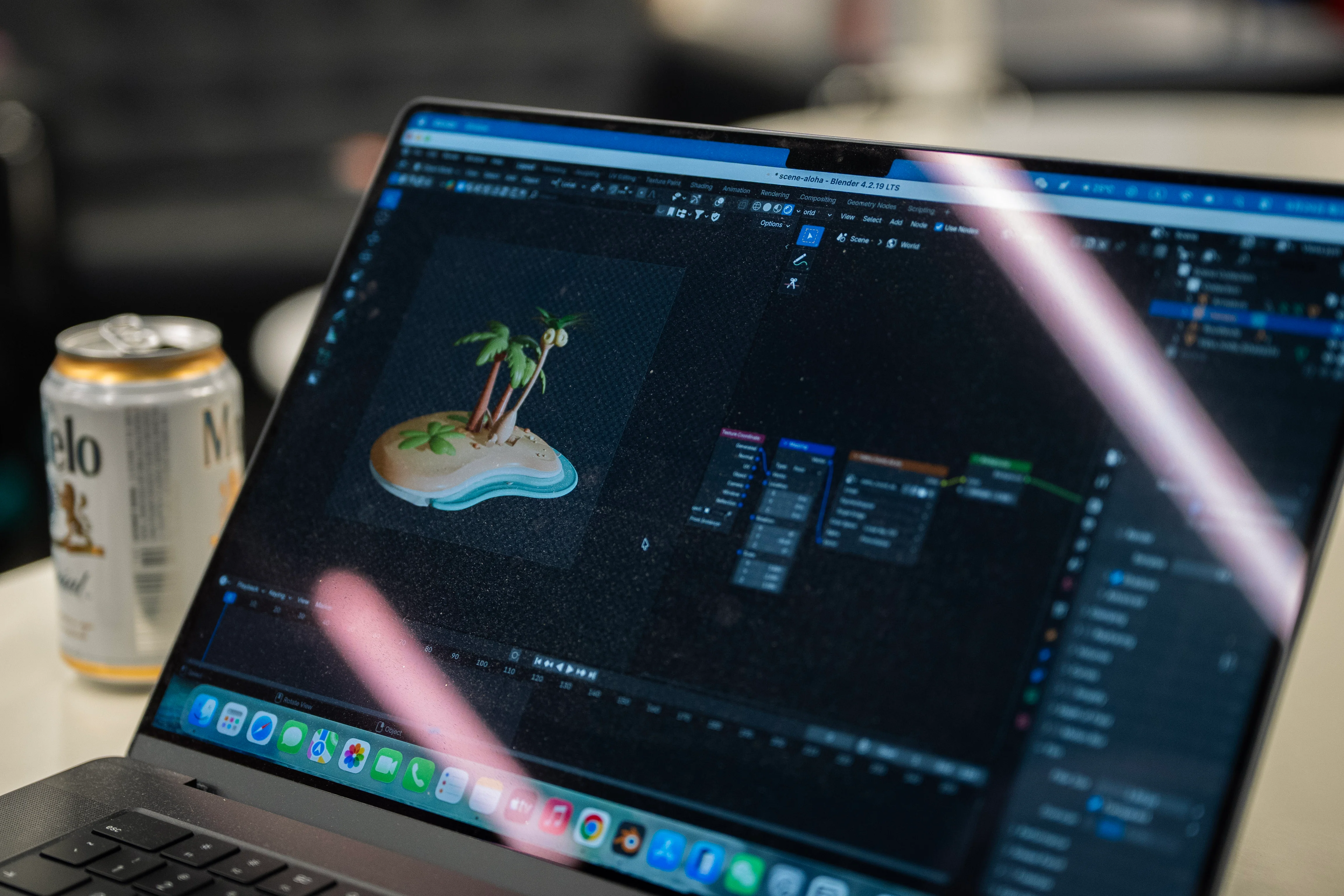
The examples included stylized characters, decorative objects, a lamp concept, and a capybara relaxing beneath a palm tree.
The projects showed how students working in product design, fabrication, sculpture, or physical computing could move more quickly from an early idea to an object they could hold, test, display, and continue refining.
Building an Interactive World for the Web
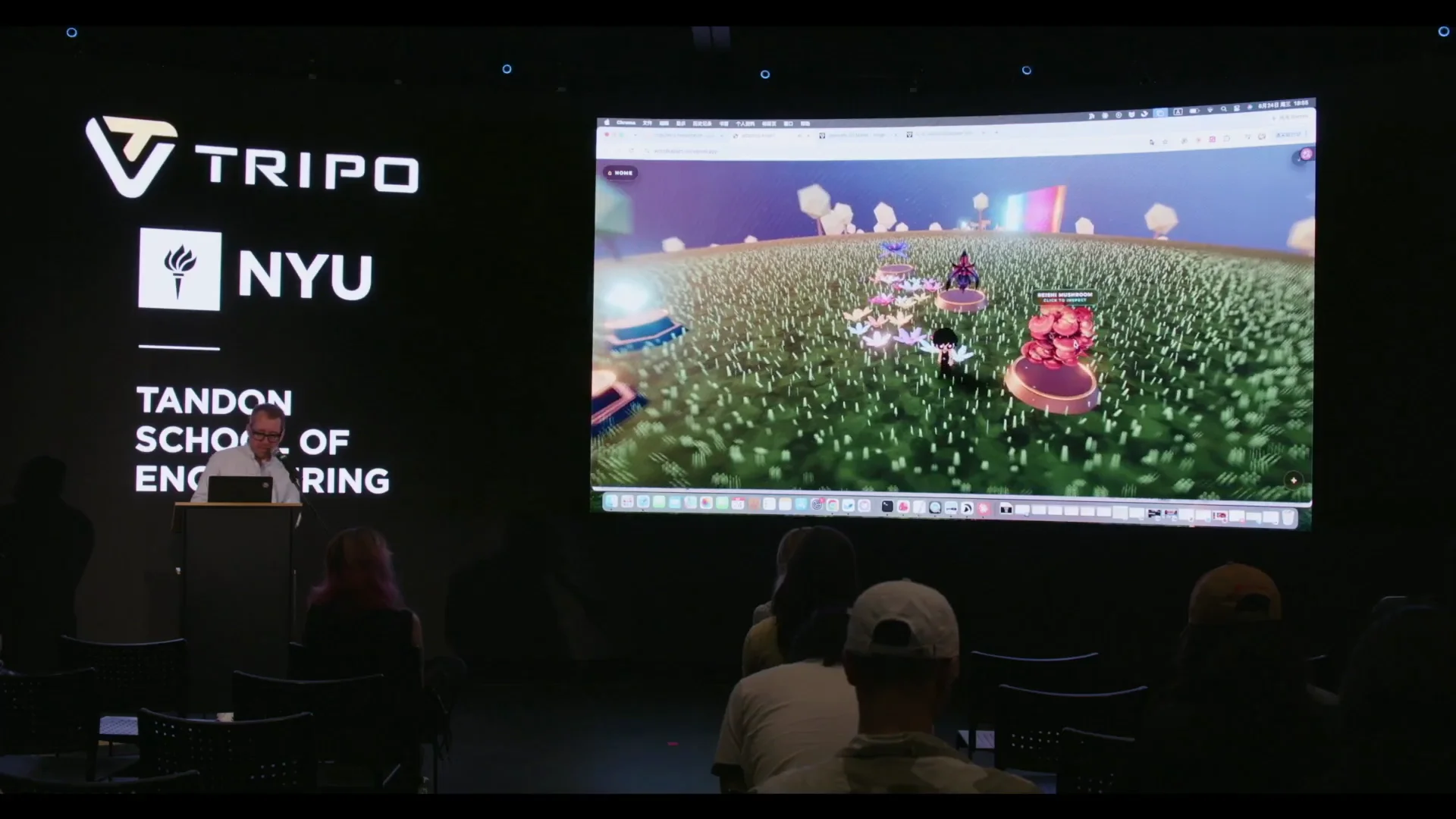
Another NYU project used Tripo-generated assets to build an interactive 3D web environment.
The workflow connected Tripo with Three.js, creative coding tools, GitHub, and Vercel. The finished experience could be accessed through a browser on a phone or laptop, allowing participants to enter the world, move through the environment, view generated objects, and experience integrated audio.
During the presentation, attendees were invited to scan a QR code and open the experience directly on their own devices.
The project demonstrated how AI 3D can support students working across creative coding, interaction design, sound, web development, and digital storytelling, including those who may not come from a traditional 3D modeling background.
When the project creator was asked how long the experience had taken to build, the answer surprised the room: approximately one day. Todd reflected that a similar experience could previously have required weeks of production.
Connecting AI 3D with Virtual Production
The workshop also featured an ongoing virtual production project from NYU Shanghai, where students used Tripo to create the 3D assets inside their virtual sets.
The project involved six short episodes, each with its own characters, story arc, and visual world. Students drew from personal memories, historical imagery, public art, museum objects, and cultural references when developing their scenes.
One participant used objects inspired by museums and cultural artifacts in Nigeria. Another project drew on public art in Hong Kong. Other scenes incorporated visual references connected to Chinese history and culture.
The NYU Shanghai team explained that one of the most difficult parts of virtual production is often creating the background assets that make a set feel specific to the story. Tripo gave students a faster way to create assets that reflected the worlds, memories, and cultural references they wanted to communicate.
https://youtube.com/shorts/XBiLgQoSo7U?si=f_ggurIwk5KJeJ6_
What Participants Built in One Evening
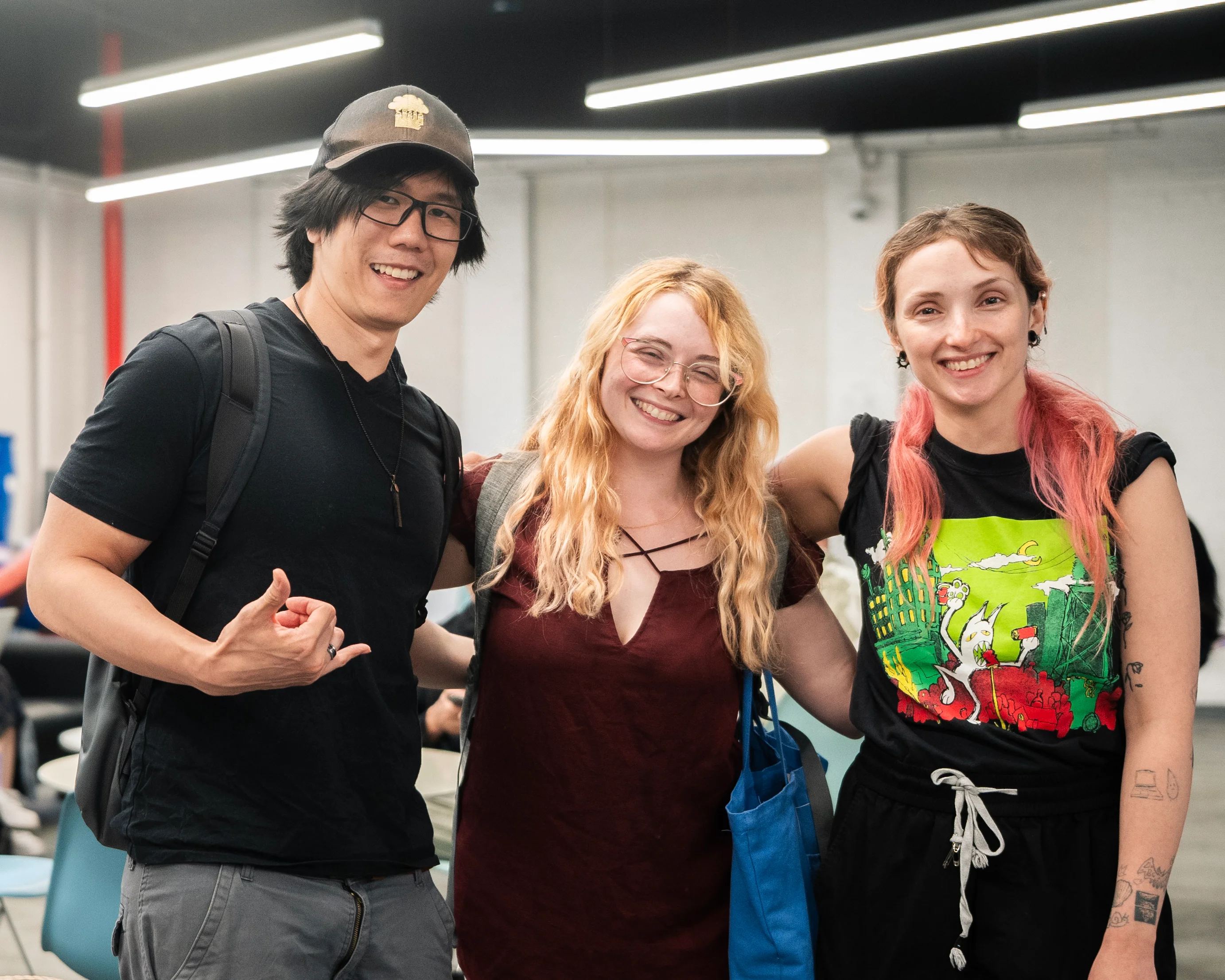
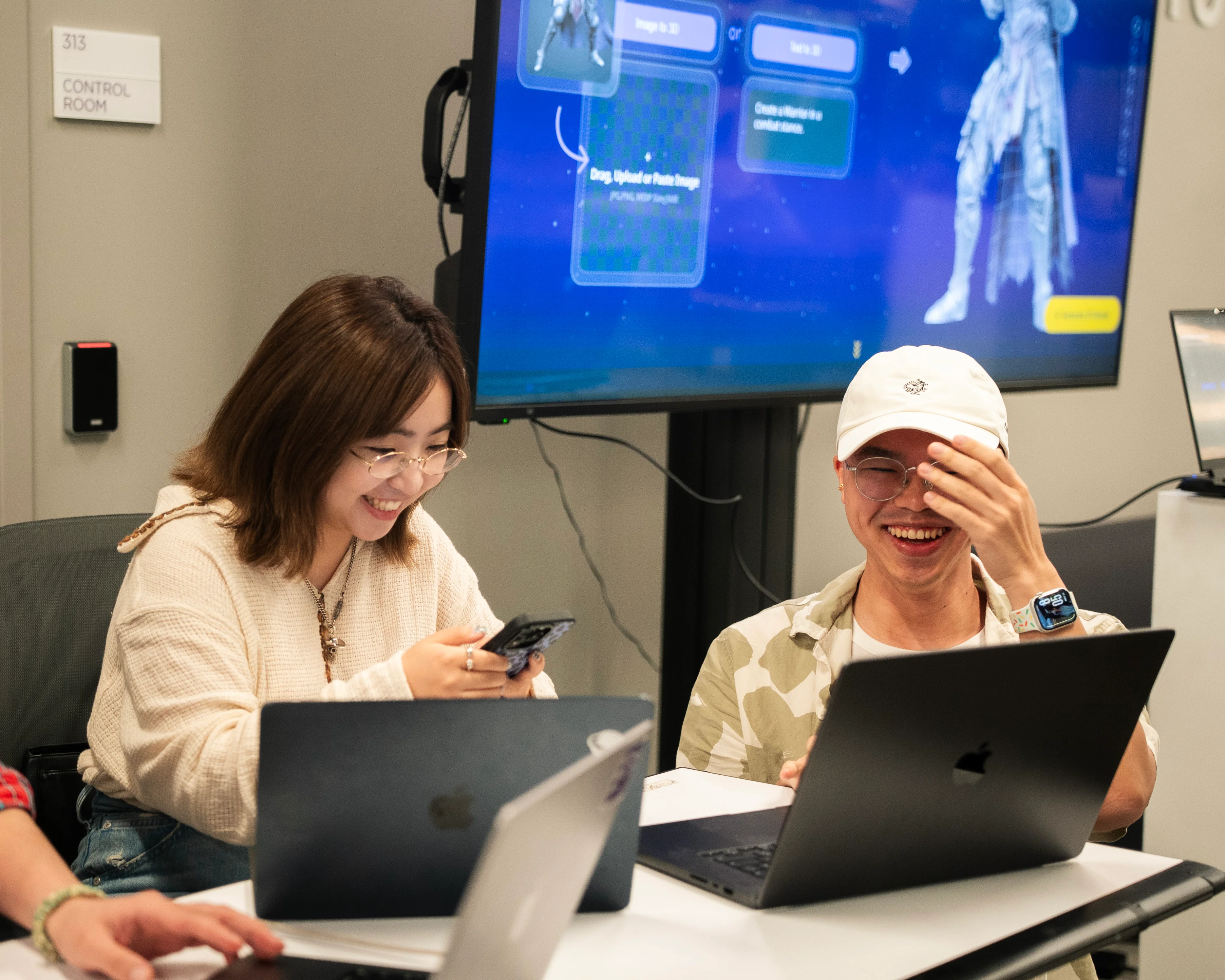
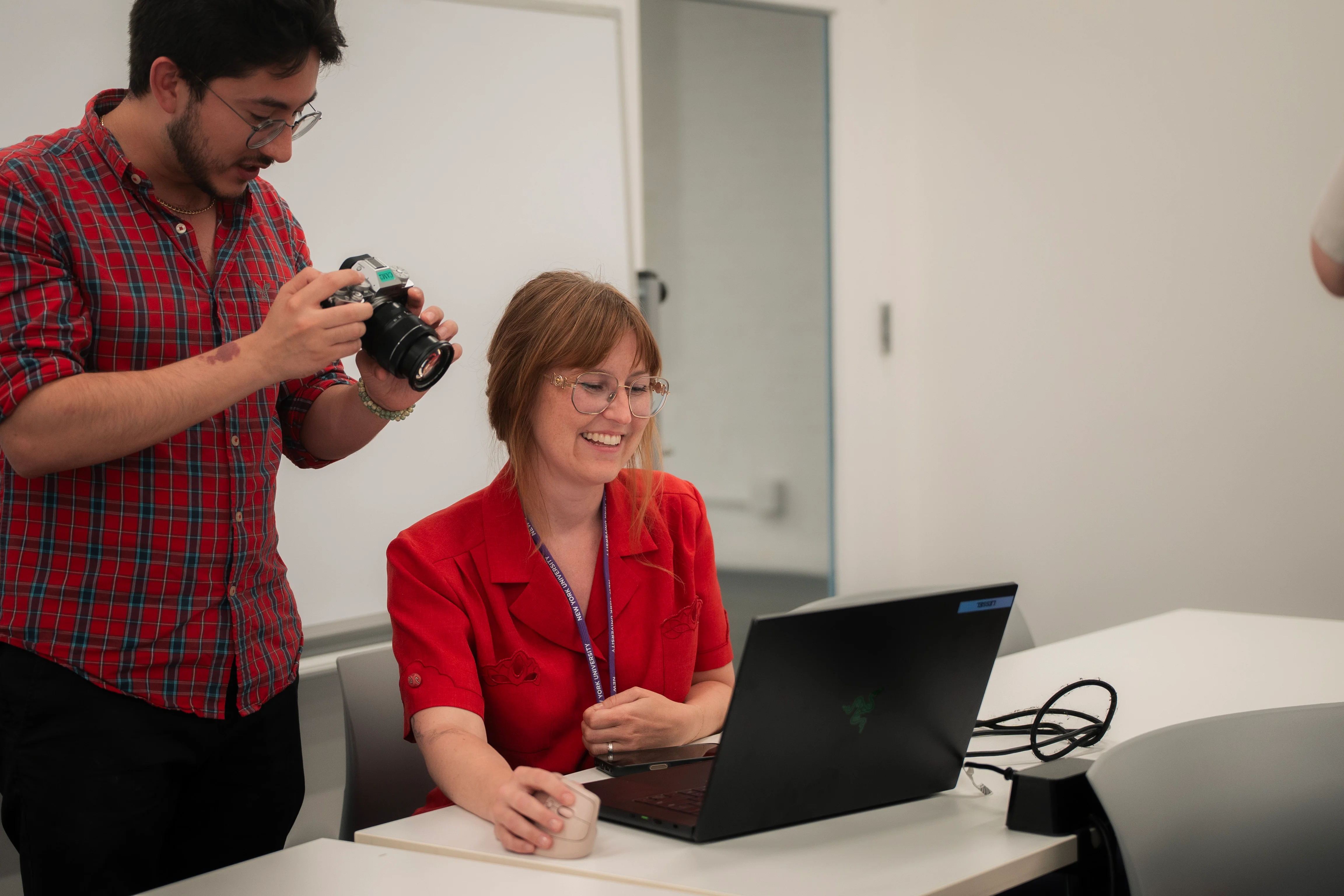
Following the presentations, participants entered a hands-on creation session supported by Winslow, the NYU graduate assistants, and Aiko.
Participants received Tripo access and were free to choose their own creative direction. Some focused on character generation and animation, while others explored games, previs, Unreal Engine, sound, interactive scenes, or models that could later be prepared for 3D printing.
The session concluded with a showcase of the submitted projects across three categories:
- Most Creative
- Most Technical
- How Did You Do That in So Little Time?
The works included animated characters, game experiments, previs scenes, Unreal projects, interactive audiovisual pieces, moving animals, and objects suitable for further printing or production.
Every participant who submitted a project received one month of Tripo Professional access. The three selected projects received six months of Professional access to continue developing their work after the workshop.
A Flexible Starting Point for AI 3D Education
Build 3D Worlds with AI demonstrated one practical way universities can introduce AI 3D through a focused, project-based experience.
A collaboration can begin with a faculty exchange, campus talk, or student workshop. From there, it can grow into course projects, creative challenges, hackathons, student showcases, research experiments, or longer-term teaching collaborations.
Different disciplines may also require different entry points.
Game programs may focus on characters, props, environments, and rapid prototyping. Design students may explore product visualization and physical fabrication. XR teams may need optimized assets for immersive environments. Film and virtual production students may use AI 3D to develop sets, characters, and previsualization scenes. Cultural projects may use 3D to tell stories around local archives, historical imagery, or museum objects.
For Tripo AI, education involves more than providing access or Credits. The wider goal is to help students bring their own ideas, projects, and stories into forms that can be seen, explored, tested, and continued.
Aiko introduced the Tripo AI Education Program as a flexible collaboration model that can begin with a workshop or faculty exchange and gradually move toward event co-creation, Game Jams, course pilots, research, and deeper institutional collaboration.
For Tripo AI and NYU IDM, the workshop was both a working session and a starting point—showing how AI-generated 3D can connect an initial idea with real-time worlds, physical objects, and new forms of interactive storytelling.
At the close of the event, the NYU team expressed interest in continuing to explore what could be built through future activities and new Tripo capabilities.
Bring Tripo AI to Your University
The Tripo AI Education Program works with universities and educators through faculty training, campus talks, workshops, hackathons, course pilots, student projects, research collaborations, and campus showcases.
To explore a collaboration with Tripo AI, contact the Tripo AI Education Team at [email protected]