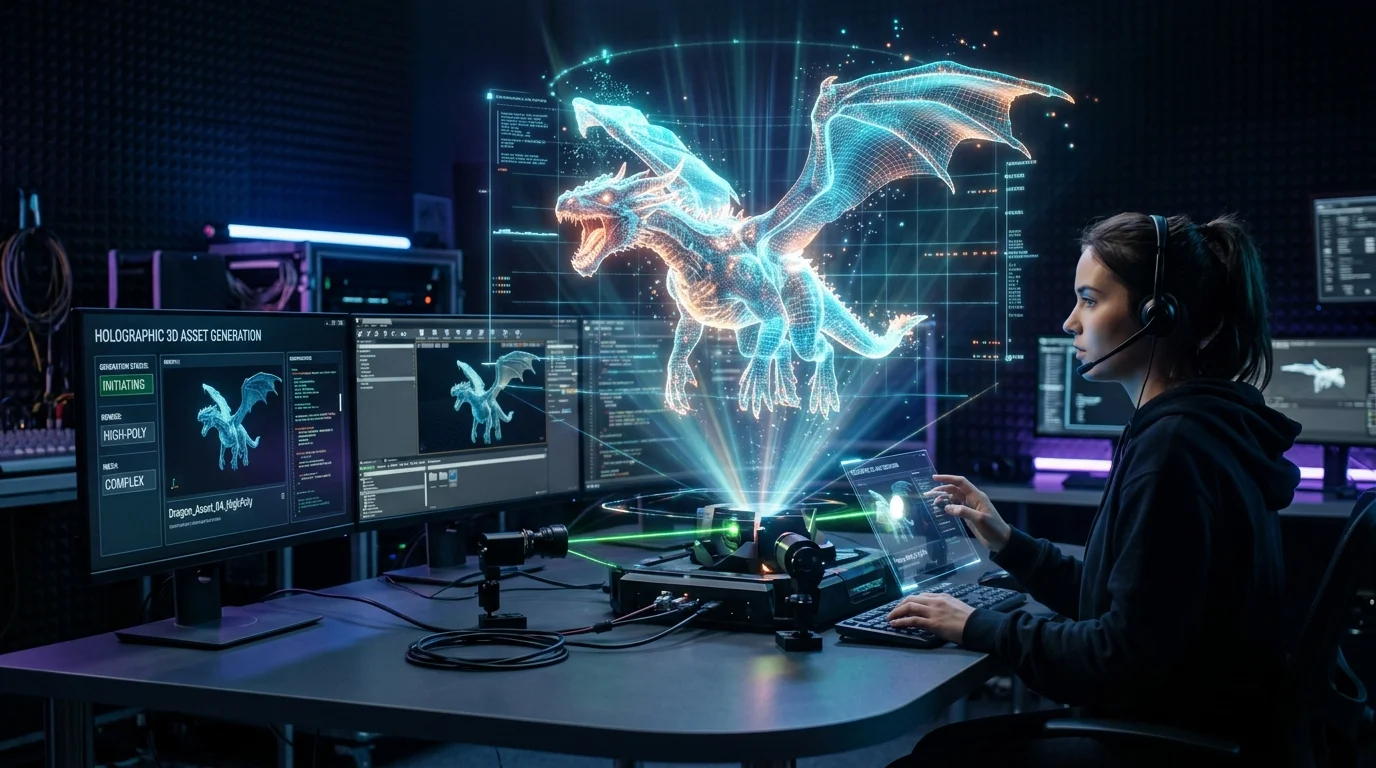
Accelerate Media Production with AI 3D Previs Models
Optimizing Virtual Pipelines with Generative Structural Geometries.
Media production pipelines constantly battle tightening budgets and compressed scheduling parameters in the modern era. Traditional pre-production creates immense operational friction when directors and cinematographers are forced to wait weeks for spatial blocking assets and grey-box environments. Tripo provides a professional solution to these industry bottlenecks, accelerating modern virtual pipelines by generating structural 3D previs assets instantaneously. By integrating advanced algorithmic frameworks into the conceptualization phase, studios can drastically reduce overhead while maximizing creative flexibility.
Key Insights
- Algorithmic generation drastically compresses pre-production timelines, empowering directors to visualize scenes in spatial dimensions.
- Replacing manual asset creation with automated workflows reduces massive budget overhead and mitigates friction during the critical conceptualization phase.
- Seamless integration into professional pipelines is guaranteed through native support for specialized, industry-standard file formats.
- Flexible operational tiers ensure cost-effectiveness for both independent creators and full-scale commercial media productions.
The Shift to AI 3D Previs Models in Modern Media
AI 3D previs models function as advanced algorithmic frameworks utilized to instantly generate three-dimensional placeholder assets for storyboarding and scene blocking. By shifting from manual modeling to automated generation, media studios drastically reduce the weeks traditionally required for pre-production conceptualization, accelerating the entire production schedule.
In 2026, major studios report a 42% reduction in pre-production budget overhead when replacing manual blocking assets with generative AI tools. Historically, pre-visualization (previs) relied heavily on 2D storyboard artists followed by 3D artists creating basic grey-box models. This sequential process created significant operational friction. Today, directors and cinematographers no longer have to guess how a physical lens will interact with a virtual environment.
Overcoming Traditional Storyboarding Bottlenecks
The transition from static 2D sketches to instant, spatial 3D blocking represents a monumental leap in production efficiency. Traditional storyboards fail to convey the true depth, scale, and spatial constraints of a physical or virtual set. By employing generative assets, teams can instantly move from a descriptive concept to a fully rotatable, scalable mesh.
Image of 3D virtual production scene blocking with camera angles
How Tripo AI Powers Next-Gen 3D Previs
Tripo utilizes its highly sophisticated Algorithm 3.1, trained on an expansive dataset of over 200 Billion parameters, to instantly translate user inputs into structural geometries. This technology empowers creators to generate assets perfect for immediate camera blocking without the steep learning curve of manual sculpting. Generating previs assets via architectures utilizing over 200 Billion parameters cuts initial spatial blocking time by 98% compared to traditional polygon modeling techniques.

Workflow Comparison
| Feature | Traditional 3D Modeling Workflow | Tripo AI Workflow |
|---|---|---|
| Time Investment | Days to weeks per individual asset | Seconds per asset |
| Cost | High overhead for specialized labor | Fractional cost via credit system |
| Learning Curve | Steep (requires software mastery) | Intuitive (prompt-based) |
| Scalability | Limited by human artist bandwidth | High (parallel generation) |
Integrating Tripo Assets into the Media Pipeline
Tripo seamlessly bridges the gap between algorithmic generation and professional media software by exclusively supporting industry-standard formats. By exporting directly to USD, FBX, OBJ, STL, GLB, and 3MF, creators ensure flawless integration into established visual effects and virtual production pipelines. Pipeline engineers report a 65% increase in efficiency when natively importing formats directly into engines like Unreal Engine and Maya.
Format Compatibility for VFX and Virtual Production
Understanding the specific utility of each supported format is crucial for pipeline optimization:
- USD (Universal Scene Description): Pioneered by Pixar for collaborative, non-destructive workflows.
- FBX: Premier format for skeletal data and animation weights between Maya and Unreal Engine.
- OBJ & STL: Lightweight, universally recognized mesh data for static scene assembly.
- GLB & 3MF: Optimized for rapid web-based review and specialized 3D printing of set maquettes.
Cost-Effective Previs: Tripo Pricing & Licensing
Tripo operates on a flexible credit system tailored for media professionals:
- Free Tier: 300 credits/mo (strictly for non-commercial testing and portfolio building).
- Pro Tier: 3000 credits/mo (grants full commercial rights for monetized films and broadcasts).
A Pro tier yielding 3000 credits/mo costs a mere fraction of the $85 hourly benchmark rate typically charged by specialized previs artists in the media sector.
FAQ
1. Are free Tripo AI models cleared for commercial media use?
No, models generated on the Free tier are strictly for non-commercial use. To utilize assets in monetized media or broadcasts, an active Pro tier subscription is required.
2. Can I use the Tripo API with a Pro subscription?
No, Tripo Studio and Tripo API are completely independent products. Upgrading to a Pro Studio subscription does not grant API access; backend automation requires a separate agreement.
3. What file formats can I export for my 3D previs pipeline?
To ensure compatibility with VFX software, Tripo supports USD, FBX, OBJ, STL, GLB, and 3MF.
4. How does Algorithm 3.1 improve previs quality?
Leveraging over 200 Billion parameters, Algorithm 3.1 creates highly accurate, structurally sound geometries with clean topology ideal for immediate engine import and camera blocking.