

Research

Building the foundations of interactive worlds that are persistent, multi-agent, and universally authorable — driven by our research in generative 3D and world models.

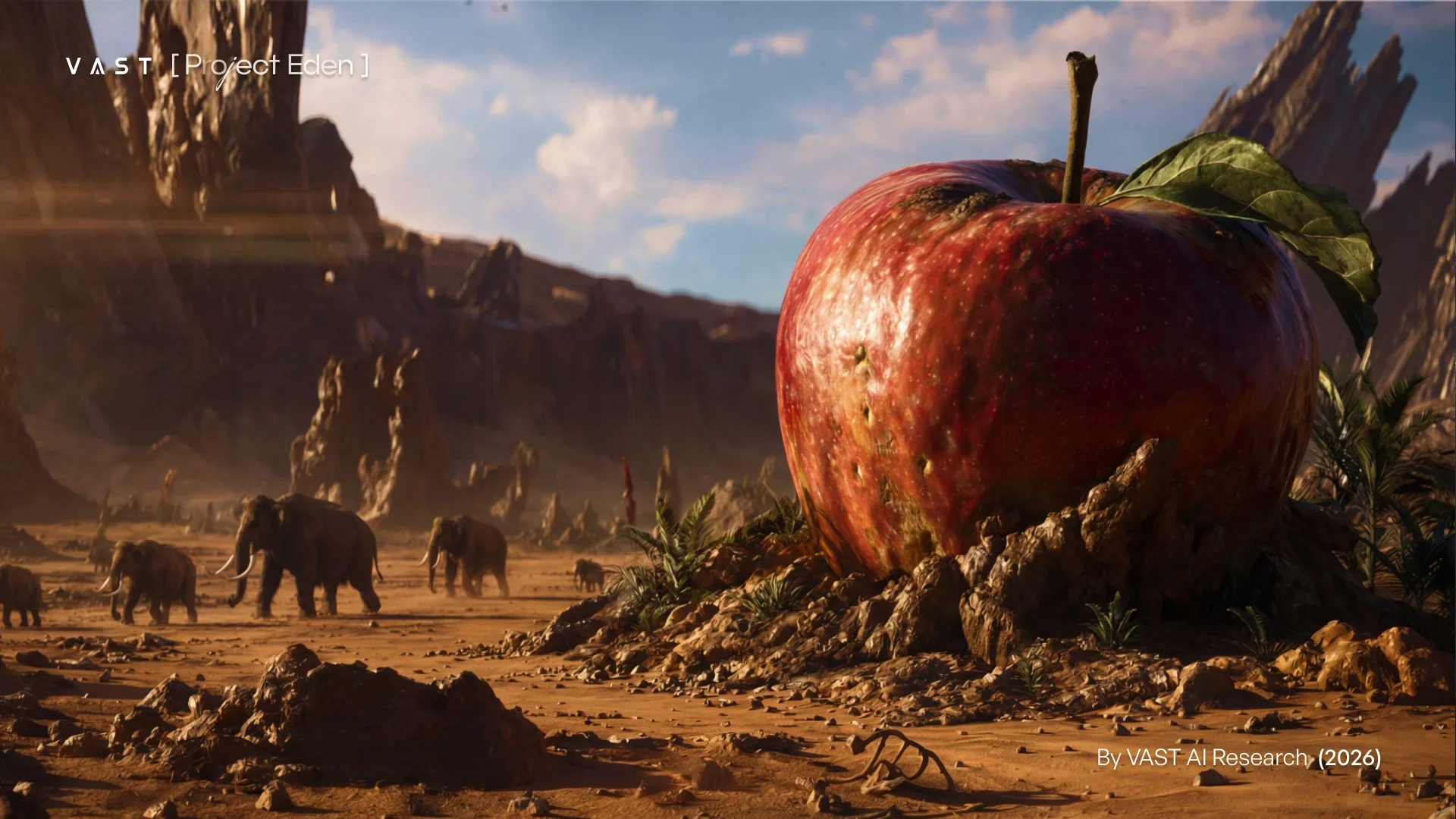
Project Eden

A World Model research preview from VAST AI Research

Learn more

Research from VAST AI

Filter:
May 8, 2026

Generative 3D Gaussians with Learned Density Control

Runjie Yan, Yan-Pei Cao, Peng Wang, Ding Liang, Yuan-Chen GuoSIGGRAPH 2026

TripoSplat introduces Density-Sampled Gaussians (DeG) for fully adaptive, grid-free 3D generation. We achieve differentiable densification by parameterizing primitive centers as samples from a learnable spatial density, optimized directly via a novel render-loss gradient. To model these unstructured sets, our VecSeq diffusion framework resolves permutation ambiguity by anchoring latents to a deterministic 3D Sobol sequence. TripoSplat achieves state-of-the-art single-image-to-3D generation while uniquely enabling variable-resolution decoding from a single compact latent code.

April 9, 2026

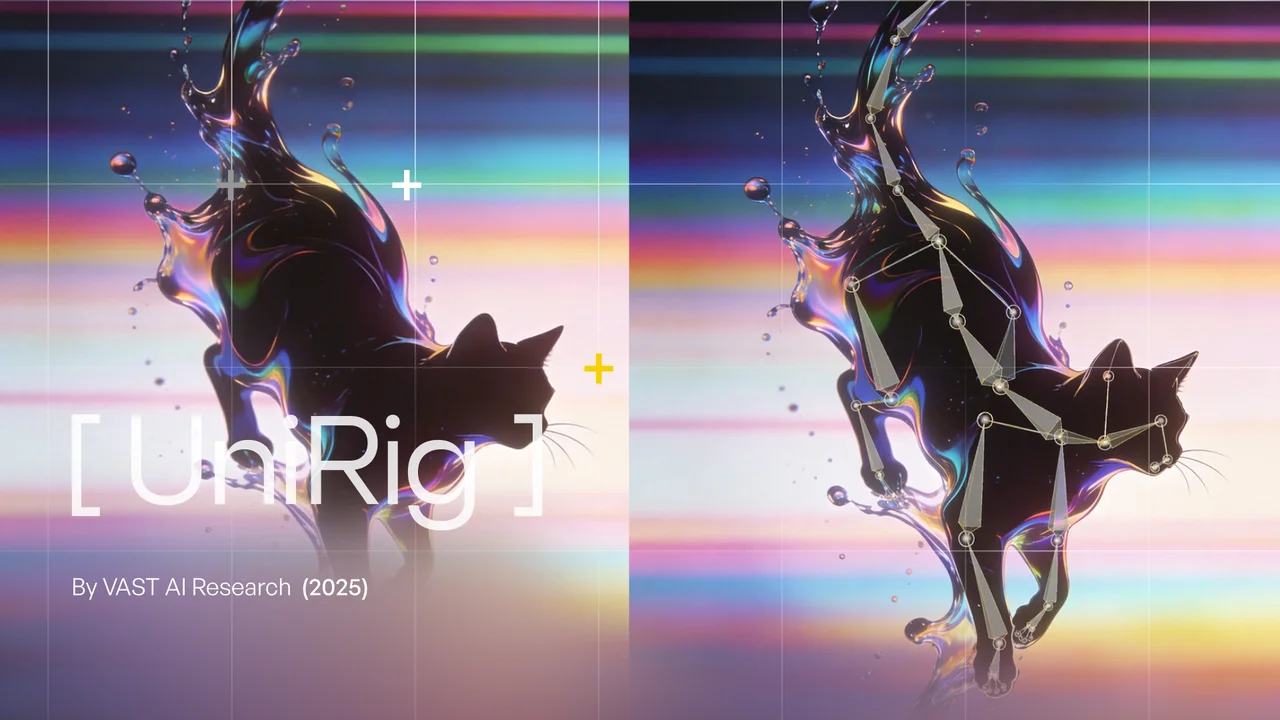
AniGen: Unified S^3 Fields for Animatable 3D Asset Generation

Yi-Hua Huang, Zi-Xin Zou, Yuting He, Chirui Chang, Cheng-Feng Pu, Ziyi Yang, Yuan-Chen Guo, Yan-Pei Cao, Xiaojuan QiSIGGRAPH 2026

AniGen overcomes the brittleness of sequential "generate-then-rig" pipelines by directly generating fully animatable 3D assets from a single image. We achieve this by unifying shape, skeleton, and skinning weights into a shared continuous spatial representation: $S^3$ Fields. To model rigs of arbitrary complexity, we introduce a joint-count agnostic Dual Skin Field, paired with a confidence-decaying skeleton field that explicitly resolves topological ambiguities at kinematic boundaries. By generating these compressed fields via a two-stage structured latent flow-matching architecture, AniGen guarantees intrinsic structural consistency between geometry and articulation. The result is a robust, end-to-end foundation for generating production-ready, instantly animatable characters and objects across diverse categories.

March 2, 2026

FACE: A Face-based Autoregressive Representation for High-Fidelity and Efficient Mesh Generation

Hanxiao Wang, Yuan-Chen Guo, Ying-Tian Liu, Zi-Xin Zou, Biao Zhang, Weize Quan, Ding Liang, Yan-Pei Cao, Dong-Ming YanCVPR 2026 (Highlight)

Autoregressive mesh generation is traditionally bottlenecked by the quadratic compute cost of modeling flattened vertex coordinate sequences. FACE fundamentally resolves this by elevating generation to a higher semantic tier. Through a novel “one-face-one-token” strategy, we encapsulate entire triangle faces into single unified tokens, slashing sequence lengths by a factor of nine. This architectural elegance yields an unprecedented compression ratio of 0.11, doubling the efficiency of prior state-of-the-art without relying on brittle, lossy traversal heuristics. By coupling this highly efficient Autoregressive Autoencoder (ARAE) with latent diffusion, FACE provides a robust, scalable, and compute-efficient foundation for high-fidelity direct mesh generation.

February 4, 2026

SkinTokens: A Learned Compact Representation for Unified Autoregressive Rigging

Jia-Peng Zhang, Cheng-Feng Pu, Meng-Hao Guo, Yan-Pei Cao, Shi-Min Hu

Current auto-rigging methods fail to scale because they treat skinning as a brittle, high-dimensional regression task decoupled from skeleton generation. SkinTokens solves this by compressing sparse skinning matrices into discrete token sequences. This enables TokenRig, an autoregressive framework that jointly synthesizes skeletal topology and surface deformations as a single coherent sequence. Post-trained via reinforcement learning (GRPO) with explicit geometric rewards, TokenRig generalizes robustly to complex, in-the-wild assets. By seamlessly unifying skeleton and skin prediction, the framework achieves up to a 133% improvement in skinning accuracy, establishing a scalable, end-to-end foundation for animation-ready 3D content.

Tripo @ SIGGRAPH 2026

Meet us atLos Angeles Convention CenterCA | July 19–23.

Stay Tuned

Team & Careers

Join our Research Team

We pursue first-principles research in 3D, from spatial reasoning and neural graphics to interactive world models. Our work has been consistently recognized at top venues such as SIGGRAPH, CVPR, NeurIPS, and ICCV, and we have open-sourced 30+ projects to advance the broader community.

We offer competitive compensation, ownership of core technical directions, dedicated large-scale compute, and a focused research culture built for long-term, high-impact work.

View All Openings