MiraLab AI Tests Tripo AI’s Image-to-3D Workflow
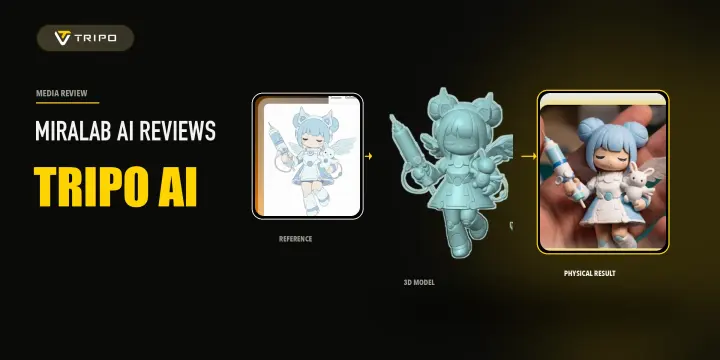
Japanese AI media outlet MiraLab AI recently published a hands-on review of Tripo AI, examining how the platform turns images and ideas into 3D assets.
The reviewer tested Tripo AI with a Pro account, covering its Image to 3D workflow alongside HD Model, Smart Mesh, Segmentation v2, 8K Texture, and Image Gen. The review found that Tripo AI gives creators without extensive 3D modeling experience a practical way to move from a reference image to an editable model. It also examined where AI-generated assets may still require further refinement.
Turning a Single Image Into 3D
MiraLab AI began by testing one of Tripo AI’s core workflows: generating a 3D model from a single image.
After uploading a reference image, the reviewer generated a model within minutes. Tripo AI reconstructed not only the visible front of the subject but also the sides and back that were not shown in the original image. The completed model could then be inspected from different angles and exported for use in other 3D workflows.
This approach gives creators a faster starting point for character concepts, product visualization, game assets, XR content, visual prototypes, and 3D printing. Rather than beginning with an empty scene, users can generate an initial asset and refine it according to their project’s requirements.
Testing Different 3D Workflows
The review went beyond basic Image to 3D generation and explored several tools designed for different stages of production.
HD Model
MiraLab AI tested HD Model for projects that prioritize geometry detail and visual quality. The reviewer found it suitable for detailed characters, mechanical designs, visual artwork, and models intended for closer inspection.
HD Model provides a higher-detail foundation for assets that may later be refined, rendered, or prepared for physical production.
Smart Mesh
Smart Mesh was tested as a faster option for generating structured, lightweight geometry. MiraLab AI highlighted its generation speed and its potential for rapidly prototyping multiple assets.
The resulting topology can support early game development and Web 3D workflows, where creators often need manageable geometry before moving an asset into the next production stage.
Model Segmentation
MiraLab AI also explored Segmentation v2, which divides a generated model into meaningful components.
Separating elements such as a character’s body, accessories, limbs, or equipment can make individual parts easier to edit, replace, print, or reuse. Users can select a simpler or more detailed segmentation result depending on the asset and its intended application.
Textures and Image Generation
The review also examined Tripo AI’s texture tools and integrated Image Gen workflow. Image Gen allows creators to develop reference images before sending a selected result into the 3D generation process.
Users who do not already have a suitable reference image can begin with an idea, generate a clearer visual direction, and then transform it into a 3D asset within Tripo Studio.
MiraLab AI’s Evaluation
MiraLab AI concluded that Tripo AI can make 3D creation more accessible to users without specialized modeling experience.
“Even without specialized knowledge, users can create practical-quality 3D models in a short time.”
The review highlighted the accessibility of the workflow, the speed of generation, and Tripo AI’s ability to reconstruct unseen parts of a subject from limited visual information.
It also recognized the value of combining multiple production tools in one environment. Image generation, 3D generation, mesh creation, segmentation, texturing, and rigging can be combined according to the needs of each project.
Where Further Refinement May Be Needed
The review also discussed the limitations of AI-generated 3D content.
Simple and clearly defined subjects generally produced more reliable results, while highly intricate shapes could require further adjustment. Projects that demand exact dimensions, precise topology, or complete control over every detail may still benefit from additional work in software such as Blender or Maya.
This makes Tripo AI particularly useful as a starting point, prototyping tool, or production accelerator. Creators can generate an initial asset with AI and then decide how much manual refinement the final application requires.
Read the Full MiraLab AI Review
MiraLab AI’s original article includes its complete testing process, generated examples, feature comparisons, and overall assessment of Tripo AI.
Read the full review on MiraLab AI
Bring Your Next Idea Into 3D
Tripo AI helps creators move from an initial visual concept to a usable 3D asset. Whether you are exploring 3D for the first time, developing game content, visualizing a product, or preparing a character for 3D printing, Tripo AI provides an accessible place to begin.