Is PLA Biodegradable? The Honest Answer (2026)
TL;DR
PLA is bio-based, but it only biodegrades reliably in industrial composting facilities with sustained high heat, moisture, oxygen, and microbial activity.
Backyard compost piles, landfills, oceans, and natural environments rarely provide these conditions, so PLA may persist or fragment for years.
"Biodegradable," "compostable," and "bio-based" describe different properties and should not be treated as interchangeable environmental claims.
For 3D printing waste, reduce failed prints, sort scraps by material, reuse usable parts, and use specialist recycling services when available.
Do not place PLA in curbside recycling or green bins unless your local authority explicitly accepts it.
Design digitally before printing to reduce waste; Tripo AI can help turn text or images into 3D starting models for more selective PLA prototyping.
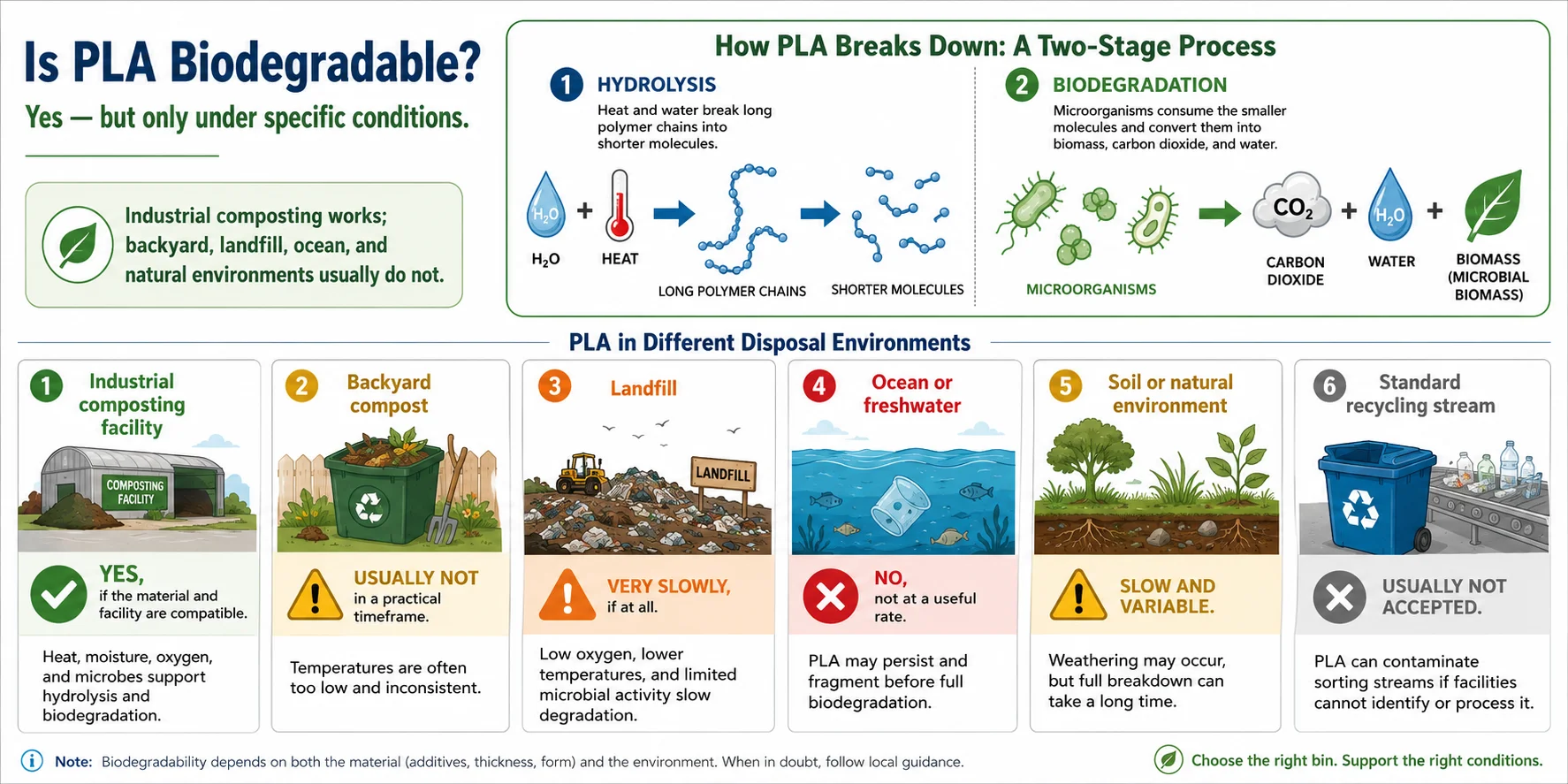
Yes, PLA is technically biodegradable—but only under specific industrial composting conditions (around 58°C / 140°F, high humidity, and the right microbes). It will not meaningfully break down in a home compost bin, a landfill, the ocean, or out in nature, where it can persist for decades.
That does not mean PLA is a bad material. It can be a sensible option for prototypes, educational projects, decorative models, packaging concepts, and low-stress parts. It may also offer advantages over some fossil-based plastics, especially when renewable feedstocks, long product life, low failure rates, and suitable end-of-life systems are part of the picture.
But responsible use starts with accurate language. PLA is not automatically sustainable, not automatically compostable in your city, and not automatically recyclable through normal household bins. Its environmental value depends on the whole lifecycle: how it is produced, how much material is wasted, how long the printed object remains useful, and what happens after you are finished with it.
What Is PLA (Polylactic Acid)?
PLA is a thermoplastic polyester used in packaging, disposable products, medical applications, and, most visibly for makers, FDM and FFF 3D printing filament.
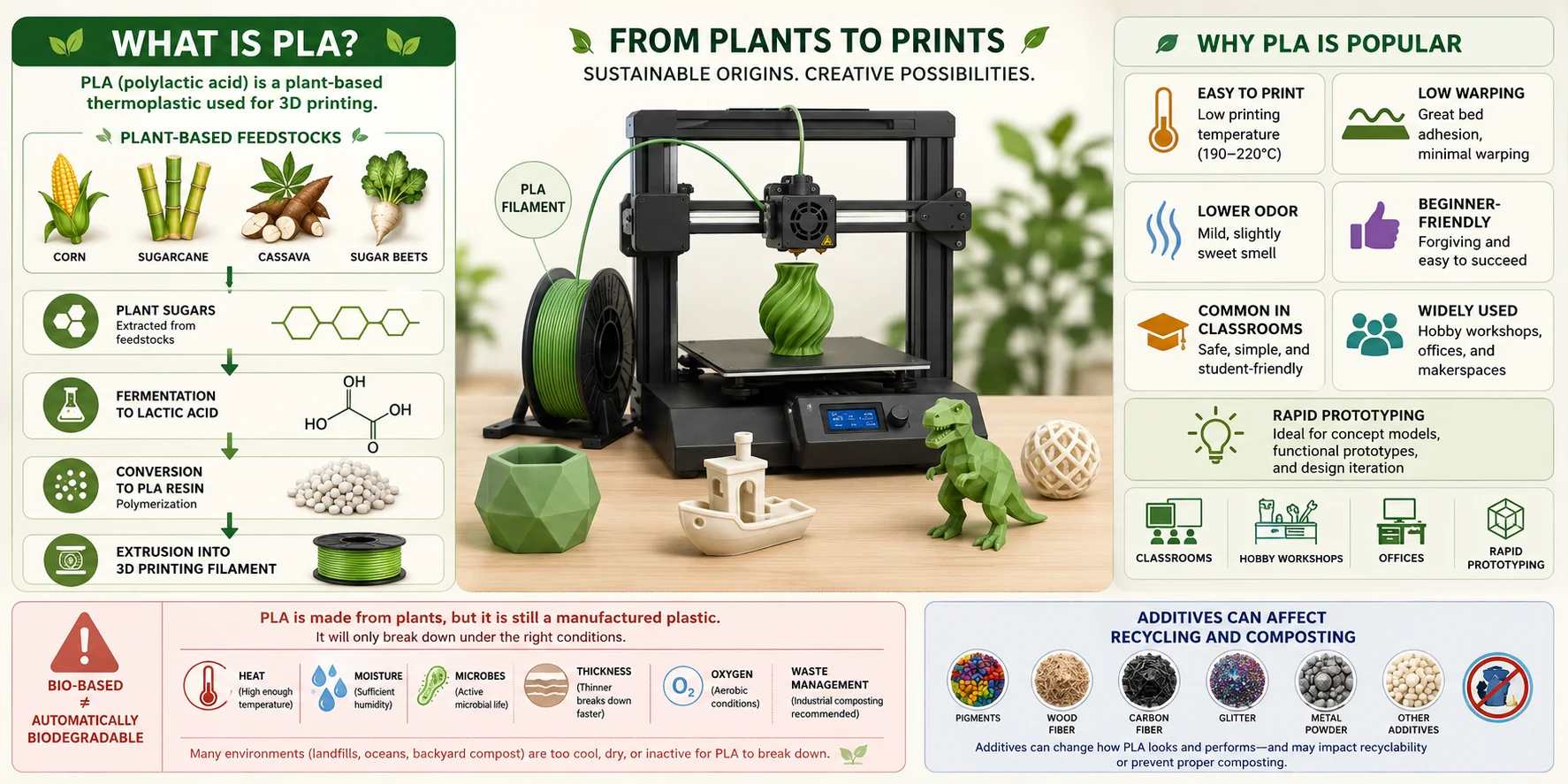
PLA is popular because it is relatively easy to print. It typically melts at lower temperatures than engineering plastics such as ABS or nylon, shows comparatively low warping, and generally produces less noticeable odor during printing. These properties make it a common first filament for beginners and a practical material for classrooms, offices, hobby workshops, and rapid prototyping.
Most PLA begins with agricultural feedstocks. Corn starch, sugarcane, cassava, beet sugar, and other carbohydrate-rich materials can be processed into sugars. Those sugars are fermented to create lactic acid. The lactic acid is converted into lactide, then polymerized into long molecular chains that become PLA resin. Manufacturers can turn that resin into pellets, sheets, molded products, or 3D printing filament.
The fact that PLA often comes from plants is meaningful, but it is easy to misunderstand. A plant-derived material is not automatically harmless at the end of its life. Growing feedstocks requires land, water, energy, fertilizer, transport, and processing. Filament production also involves extrusion, colorants, packaging, shipping, and often additives that change print behavior.
PLA used for 3D printing is rarely just "pure plant plastic." Filaments may contain pigments, impact modifiers, lubricants, nucleating agents, fillers, glitter, wood fibers, metal powders, carbon fiber, phosphorescent compounds, or blends with other polymers. These modifications can improve appearance or performance, but they can also make a material more difficult to recycle, sort, or compost.
The important point is that PLA is bio-based, not magically self-erasing. It remains a manufactured plastic with a specific molecular structure. Whether it breaks down depends on heat, moisture, microbes, object thickness, oxygen, surface area, and the waste-management system available where you live.
Biodegradable vs. Compostable vs. Bio-based: What's the Difference?
The words biodegradable, compostable, and bio-based often appear together on product pages and filament labels. They sound similar, but they answer different questions.
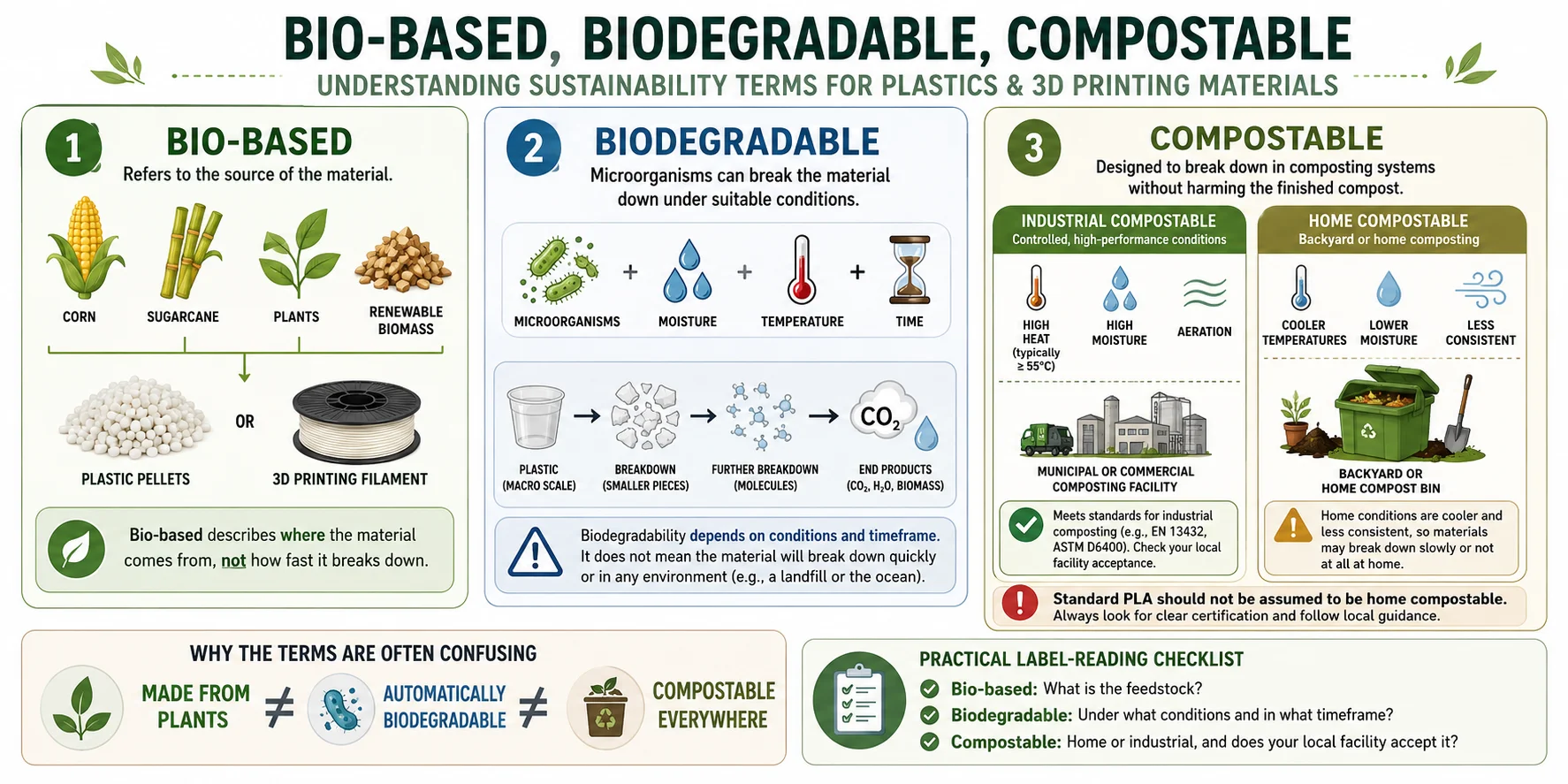
Bio-based describes the source of the material. A bio-based plastic is made partly or primarily from renewable biological resources rather than fossil feedstocks. PLA is commonly bio-based because its starting materials often come from plant sugars. However, "bio-based" says nothing about how quickly the final product degrades after use. A material can be bio-based and still persist for decades.
Biodegradable means that microorganisms can eventually convert a material into simpler substances under suitable environmental conditions. The meaningful question for a consumer is not simply "Can it biodegrade?" but "Will it biodegrade in the place where I am likely to dispose of it?"
Compostable is more specific. Compostable materials are designed to disintegrate and biodegrade in composting systems while producing material that does not harm the finished compost. Compostability claims are usually tied to recognized test standards and certification programs.
Industrial compostability means a material can break down in a controlled commercial or municipal composting system, which maintains high temperatures, active aeration, moisture, mixing, and microbial activity. PLA commonly falls into this category.
Home compostability means a material can break down in much cooler and less controlled backyard compost conditions. This is a higher bar. Standard PLA filament should not automatically be assumed to be home compostable.
A practical way to read labels: Bio-based = what is the feedstock? Biodegradable = under what conditions and in what timeframe? Compostable = in a home system or an industrial facility, and does a local facility actually accept it?
Is PLA Biodegradable? The Honest Answer
Yes, PLA is biodegradable under specific conditions. No, it is not reliably biodegradable in every environment where people throw away plastic. That distinction is the core truth behind most PLA debates.
PLA generally degrades through two stages. First, water and heat help break long polymer chains into shorter molecules through hydrolysis. Then microorganisms can consume those smaller molecules and convert them into biomass, carbon dioxide, water, and other products. PLA is relatively resistant to rapid breakdown at normal ambient temperatures. When it is exposed to elevated heat and moisture, hydrolysis becomes much faster.
The table below gives the practical answer by disposal environment.
| Disposal Environment | Does PLA Break Down Reliably? | What Usually Happens |
|---|---|---|
| Industrial composting facility | Yes, if the material and facility are compatible | Heat, moisture, oxygen, and microbes can support hydrolysis and biodegradation |
| Backyard compost | Usually not in a practical timeframe | Temperatures are often too low and inconsistent |
| Landfill | Very slowly, if at all | Low oxygen, lower temperatures, and limited microbial activity slow degradation |
| Ocean or freshwater | No, not at a useful rate | PLA may persist and fragment before full biodegradation |
| Soil or natural environment | Slow and variable | Weathering may occur, but full breakdown can take a long time |
| Standard recycling stream | Usually not accepted | PLA can contaminate sorting streams if facilities cannot identify or process it |
Industrial composting facilities
Industrial composting is the environment where PLA has its strongest end-of-life case. Commercial facilities can maintain temperatures around the thermophilic range, often near 55–60°C or higher, along with controlled moisture, aeration, turning, and microbial activity. Depending on the material, thickness, certification, and process, PLA may show significant disintegration within weeks and substantial biodegradation over a longer test period.
However, there are two separate questions: (1) Is the PLA material technically industrially compostable? (2) Will your local industrial composting facility accept it? The first does not guarantee the second.
Composting facilities often process food scraps, yard waste, and paper. Some accept certified compostable packaging, while others do not. Thick printed parts are not automatically equivalent to thin certified packaging samples. If you want to compost PLA, confirm that the facility accepts rigid PLA items and ask whether it has size, thickness, certification, or contamination requirements.
Backyard compost
A backyard compost pile is not an industrial composting facility. Home compost can be excellent for organic materials, but it usually does not maintain the high, stable temperature and humidity needed for dependable PLA breakdown. A PLA print in home compost may become dull, brittle, cracked, or partially deformed over time—that can look like biodegradation, but it is not necessarily complete composting.
For most makers, the safe conclusion is simple: do not rely on backyard compost as a disposal route for ordinary PLA filament unless the manufacturer explicitly documents home-compostability performance.
Landfill
Landfills are poor environments for PLA degradation. Waste is compacted, oxygen is limited, temperatures are often lower than industrial composting systems, and moisture distribution is uneven. PLA in landfill may remain for years or decades.
Oceans, rivers, and lakes
PLA should not be considered marine biodegradable. Ocean and freshwater environments are generally too cool for PLA to hydrolyze quickly. A 3D printed PLA part lost outdoors may break into smaller pieces long before it is converted into harmless substances. The same principle applies to rivers, lakes, drainage systems, and beaches. PLA should be treated as solid waste, not as a disposable natural material.
Soil and natural environments
PLA can degrade in soil, but the speed is unpredictable. In warm, moist soil, thin PLA samples may show more visible change than they would in dry or cold soil. The responsible rule is: never treat "biodegradable" as permission to discard PLA outdoors.
How Long Does PLA Actually Take to Break Down?
PLA degradation timelines are often presented as a single number, such as "90 days" or "six months." That is too simplistic. The correct answer is: it depends heavily on the environment and the object itself.
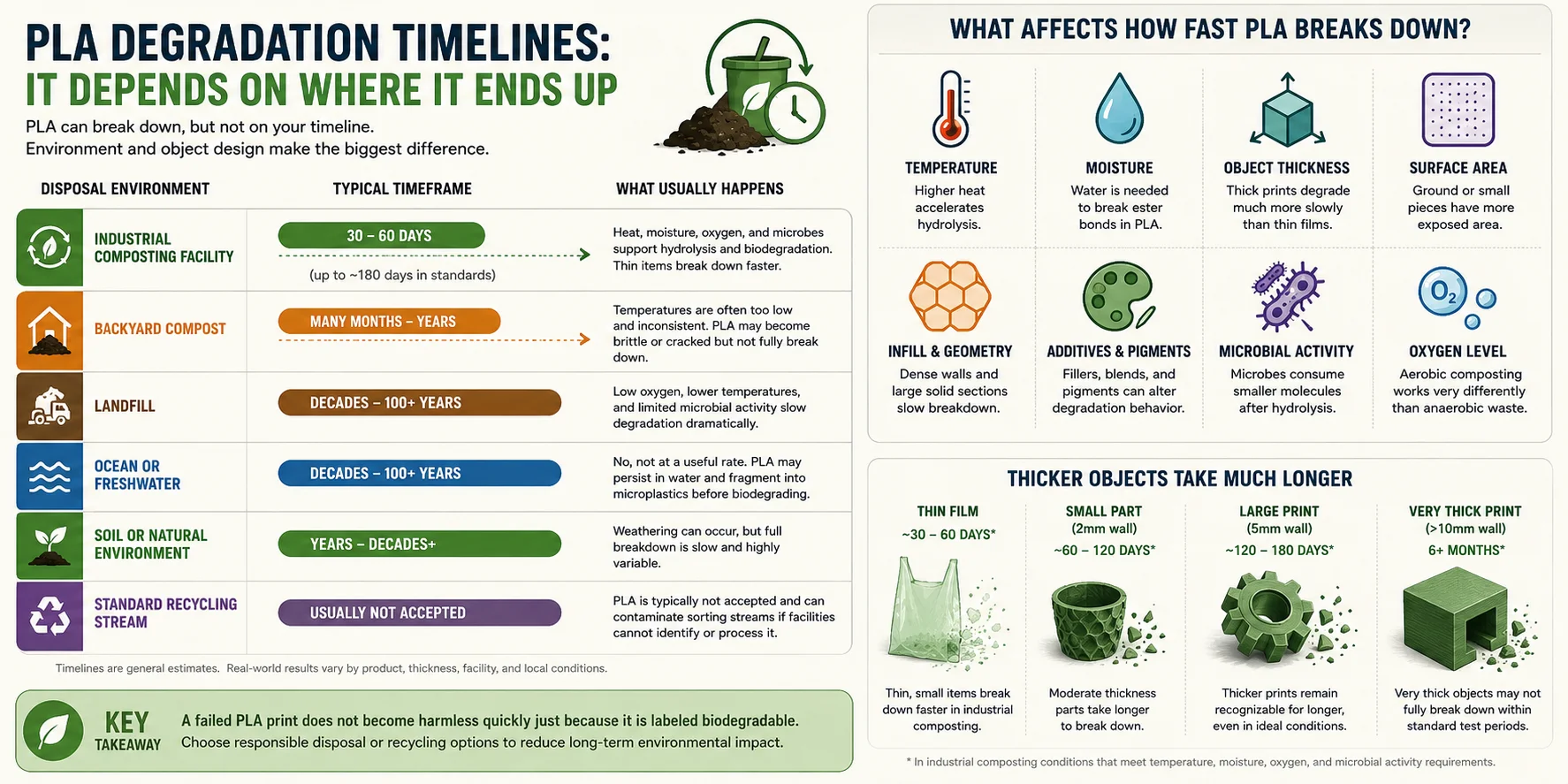
In industrial composting conditions, some certified PLA materials can show substantial disintegration and biodegradation within roughly 30 to 60 days, while compostability standards may evaluate biodegradation and disintegration over longer windows, often up to around 180 days.
In a home compost pile, PLA may remain recognizable for many months or years. In landfill, soil, freshwater, and marine conditions, PLA may persist for many years and potentially much longer—estimates often range from decades to more than a century.
Several factors influence the rate: temperature (higher heat accelerates hydrolysis), moisture (water is needed to break ester bonds in PLA), object thickness (thick prints degrade much more slowly than thin films), surface area (ground material has more exposed area), infill and geometry (dense walls slow breakdown), additives and pigments, microbial activity, and oxygen level.
Why "Compostable" Doesn't Mean "Toss It in Your Backyard"
Most compostable PLA claims refer to industrial or municipal aerobic composting conditions. Home compost systems are useful, but they are inconsistent by comparison. Even a well-managed backyard pile may not stay hot enough for long enough.
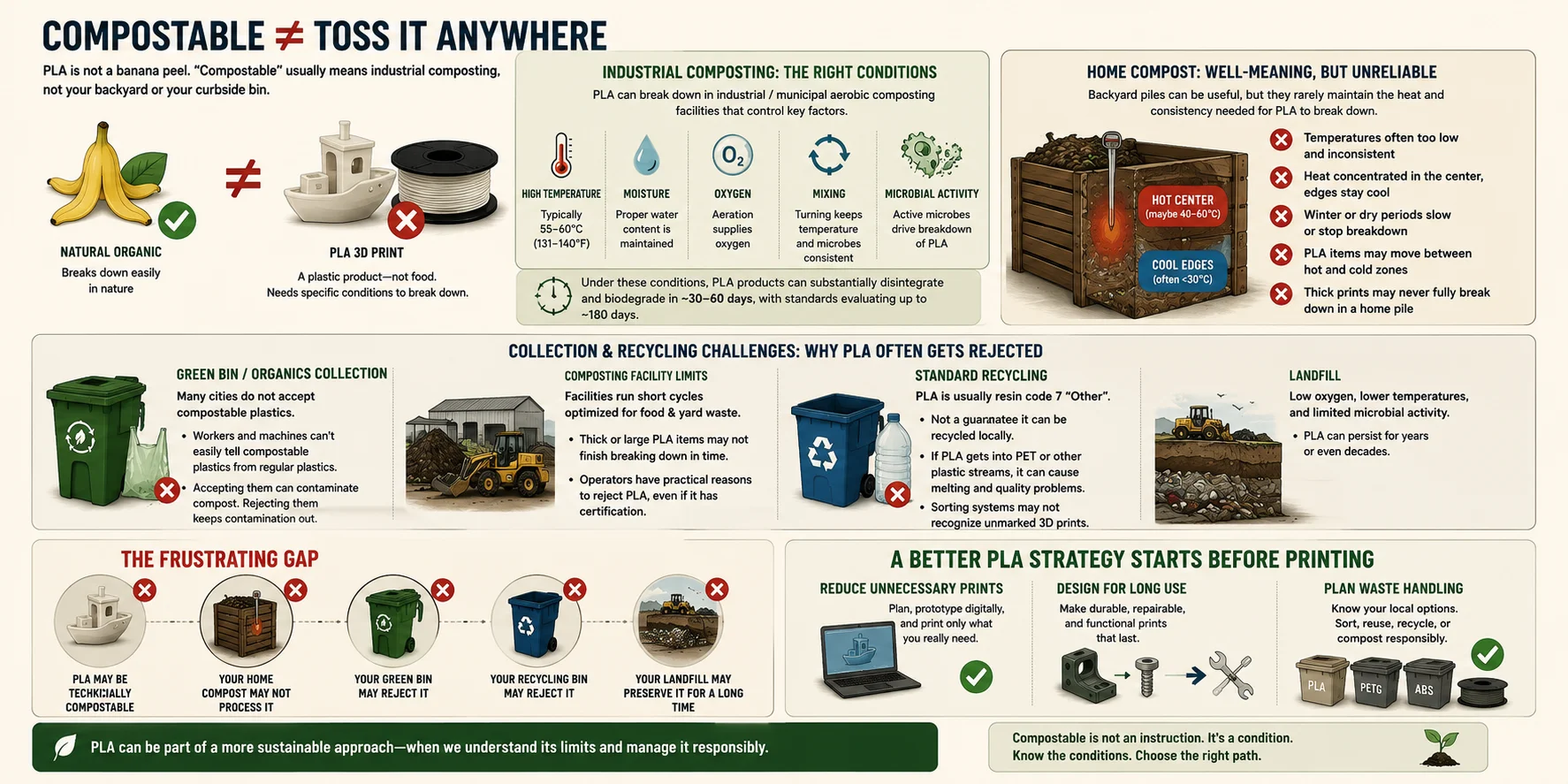
Many cities with green bins do not accept compostable plastics. Workers and sorting equipment cannot always distinguish certified compostable plastic from ordinary plastic. Some composting sites also run on short cycles optimized for food and yard waste. A thick PLA item may not break down fully before the compost is screened and distributed.
Standard household recycling is not automatically better. PLA is often categorized under resin code 7, "Other," which does not mean that local recycling systems can process it. If PLA enters a PET recycling stream, its different melting and processing behavior can create quality problems.
The result is a frustrating gap:
- PLA may be technically compostable.
- Your home compost may not process it.
- Your green bin may reject it.
- Your recycling bin may reject it.
- Your landfill may preserve it for a long time.
This is why a responsible PLA strategy begins before printing. The best environmental choice is often reducing unnecessary prints, designing for long use, and planning waste handling before the scrap bin fills up.
Does PLA Release Microplastics?
PLA can fragment into smaller particles when it is exposed to abrasion, sunlight, mechanical stress, and weathering without the conditions needed for complete biodegradation. "Biodegradable" does not mean "zero microplastic risk." The best way to prevent microplastic release is to keep PLA scraps, failed prints, and support material out of the natural environment in the first place.
What to Do With Scrap PLA: Recycling & Disposal Options for Makers
For 3D printing users, the most sustainable approach is usually to reduce waste before worrying about disposal.
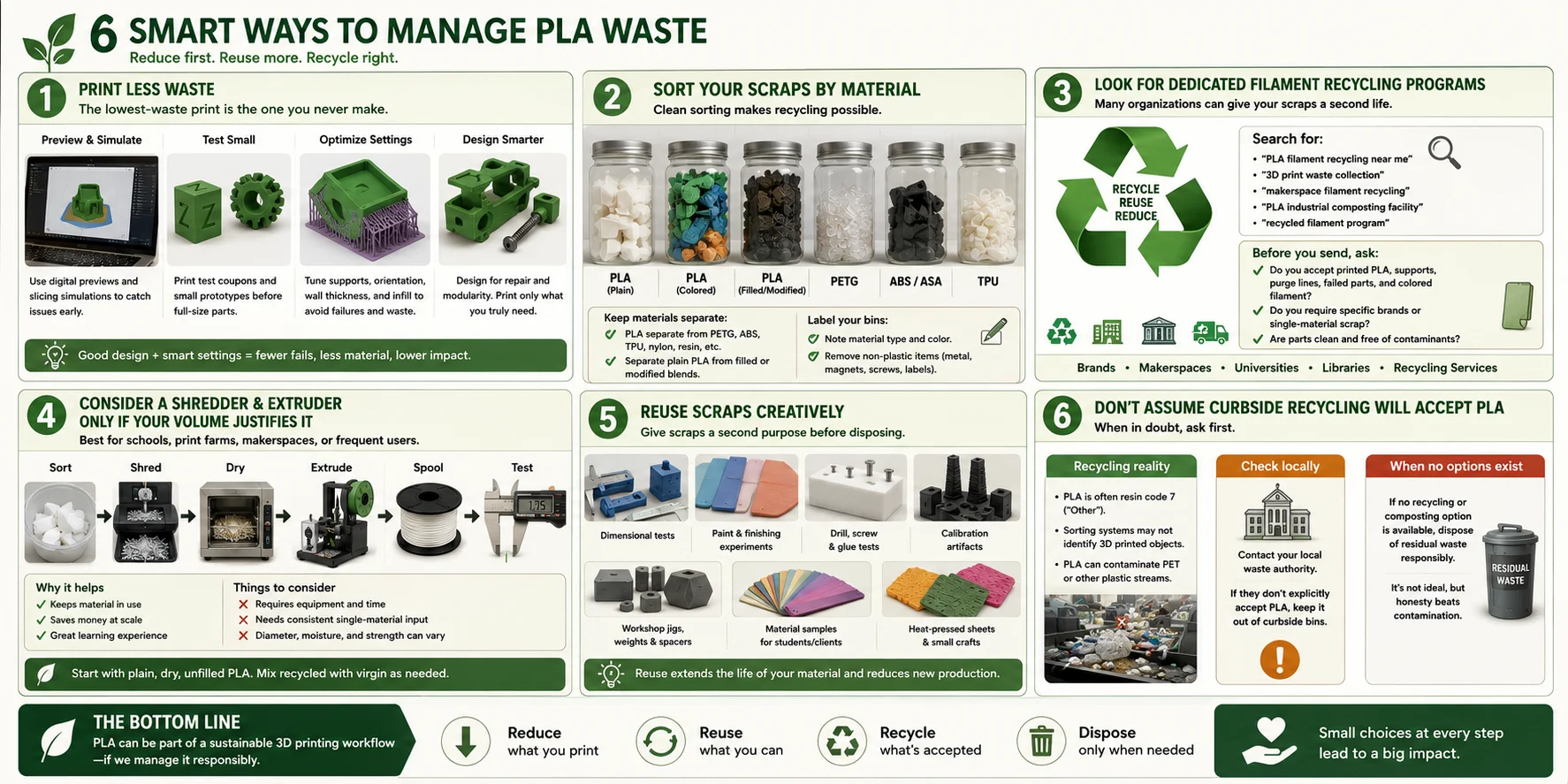
1. Print less waste
Use digital previews, slicing simulations, test coupons, and small-scale prototypes before printing full-size parts. Adjust support settings, orientation, wall thickness, and infill to reduce failed prints and unnecessary purge material. Design parts for repair rather than replacement.
2. Sort your scraps by material
Keep PLA separate from PETG, ABS, TPU, nylon, and resin waste. Separate plain PLA from filled or modified filaments such as PLA-CF, glow-in-the-dark PLA, metal-fill PLA, wood-fill PLA, silk PLA, or unknown blends. Clean sorting makes recycling more realistic.
3. Look for dedicated filament recycling programs
Some filament brands, makerspaces, universities, libraries, and specialist recycling services accept 3D printing waste. These programs may collect PLA scraps and convert them into recycled pellets or filament. Availability varies widely by country and city. Search for terms such as "PLA filament recycling near me," "3D print waste collection," "makerspace filament recycling," or "recycled filament program."
Always ask whether the service accepts printed PLA, supports, purge lines, failed parts, and colored filament. Some programs only accept specific brands or clean, single-material scrap.
4. Consider a shredder and filament extruder only if your volume justifies it
Home recycling systems can shred failed prints and re-extrude filament. This can be useful for schools, print farms, makerspaces, or frequent users with a steady stream of single-material waste. For occasional hobby users, the economics may not work. Recycled filament can vary in diameter, moisture content, color, and mechanical performance.
5. Reuse scraps creatively
Failed prints can still be useful as dimensional test pieces, paint and finishing experiments, drill and screw tests, calibration artifacts, weights or spacers in workshop projects, material samples for students or clients, or melted and pressed sheets for small craft projects.
6. Do not assume curbside recycling will accept PLA
Unless your local authority explicitly says it accepts PLA, do not put loose PLA prints into the normal recycling bin. Unlabeled 3D printed objects are difficult for sorting systems to identify, and mixed plastics can contaminate recycling streams.
PLA vs. PETG vs. ABS: Which Is More Sustainable?
There is no universally "greenest" filament. Sustainability depends on the application, lifespan, waste rate, energy use, recycled content, transport, and local end-of-life options.
| Material | Feedstock | Biodegradable? | Recycling Reality | Strengths | Sustainability Consideration |
|---|---|---|---|---|---|
| PLA | Usually bio-based | Under industrial composting conditions | Limited and location-dependent | Easy printing, low warp, common availability | Renewable source helps, but disposal infrastructure is weak |
| PETG | Usually fossil-based | No | Potentially recyclable, but local access varies | Durable, impact resistant, moisture tolerant | A long-lived part may be more sustainable than repeated PLA replacements |
| ABS | Fossil-based | No | Often requires specialist recycling | Tough, heat resistant, widely used in engineering | Higher printing emissions and more difficult home use; may be appropriate for durable functional parts |
PLA can be a sensible option for low-stress prototypes, educational models, temporary fixtures, decorative objects, and prints where ease of use reduces failed-print rates. PETG may be the better choice for parts that need durability, weather resistance, and repeated use. ABS can be appropriate for high-temperature or mechanically demanding applications.
The best environmental decision is often to match material to function, avoid over-printing, use recycled-content filament where performance allows, and choose a design that stays useful for a long time.
Frequently Asked Questions
Is PLA truly environmentally friendly?
PLA can be preferable to conventional fossil-based plastics in some contexts because it is often made from renewable feedstocks and can be industrially compostable. However, it is not automatically environmentally friendly after disposal. Its real impact depends on production, transport, printing waste, product lifespan, and whether your area has suitable composting or recycling infrastructure.
How long does it take PLA filament to decompose?
Under industrial composting conditions, compatible PLA may show substantial breakdown within weeks to a few months. In backyard compost, landfill, soil, or water, it can persist for years or decades. Thickness, temperature, moisture, and microbial activity make a major difference.
Can I put PLA in my green bin?
Only if your local organics program explicitly accepts PLA or certified compostable plastics. Many facilities do not accept them because they cannot reliably distinguish them from ordinary plastics or because their composting cycle is too short. Check your local waste authority before placing PLA in a green bin.
Does PLA give off microplastics?
PLA can fragment into microplastic-sized particles when it weathers in environments that do not support complete biodegradation. Research on the long-term environmental effects of PLA microplastics is still developing, but PLA should not be littered or treated as harmless outdoors.
Is PLA compostable at home?
Standard PLA filament is not reliably home compostable. Home compost piles rarely maintain the sustained high temperatures (around 55–60°C) that PLA needs to begin hydrolysis. You may notice a PLA print becoming brittle or cracked over time in a backyard pile, but that is weathering, not complete composting.
Is PLA recyclable in regular recycling?
PLA is generally not accepted in standard household recycling streams. It is often categorized under resin code 7 ("Other"), and most curbside sorting facilities cannot distinguish it from conventional plastics. Unless your local authority explicitly states it accepts PLA, keep it out of the recycling bin.
Is PLA biodegradable for 3D printing?
PLA filament can biodegrade under industrial composting conditions, but 3D printed parts are harder to break down than thin certified films or packaging. Thick walls, dense infill, and added pigments or modifiers all slow the process. Reducing failed prints and sorting clean scrap for specialist recycling are more reliable strategies than counting on biodegradation.
Is PETG biodegradable?
No, PETG is not biodegradable. It is a fossil-based thermoplastic that does not break down in composting or natural environments. PETG is generally more durable and moisture-resistant than PLA, which makes it a better fit for functional parts that need a longer service life.
Conclusion
PLA is more nuanced than its reputation suggests. It is bio-based and can be compostable under industrial conditions, but it is not a material that quickly disappears in a backyard pile, landfill, river, or ocean.
The responsible approach is to print less, design parts to last, separate scraps by material, use specialist recycling or composting services when available, and avoid contaminating standard recycling or organics streams. If you design 3D models before printing them in PLA, Tripo AI turns text or an image into a print-ready 3D model in Tripo Studio—so you can prototype digitally and print only what you need.