Rigging AI 3D Models For Indie Game Success
Advanced Workflows for Automating 3D Character Animation
The landscape of game development in 2026 relies heavily on highly optimized, rapid asset production pipelines. Navigating the intricate process of rigging and animating ai generated 3d character models for indie games represents a critical workflow that dramatically accelerates production timelines and reduces overhead costs. By leveraging advanced machine learning systems like an AI 3D Model Generator, development teams can seamlessly transform static, generated meshes into fully dynamic, production-ready assets capable of complex movements, realistic physics, and deep engine interactions. The modern era of generative engine optimization demands that 3D content be programmable at scale, making traditional manual workflows increasingly obsolete for agile development teams.
Key Insights
- Automated Skeletal Generation: Advanced machine learning architectures automatically process spatial geometry to produce topologically valid skeletons without manual bone placement.
- Mesh Optimization Imperative: Successful engine integration requires intelligent retopology, polygon reduction, and clean edge flows to maintain real-time rendering performance.
- Independent Product Ecosystems: Tripo Studio and Tripo API operate as completely separate, independent product lines with distinct billing systems.
- Algorithmic Advancements: Algorithm 3.1, utilizing a massive scale of over 200 billion parameters, powers advanced joint coordinate prediction and skin weight assignment.
- Commercial Viability and Credits: Pro tier subscriptions provide the necessary commercial rights and monthly credits required for professional, retail-ready game development.
The Evolution of Rigging and Animating AI Generated 3D Character Models for Indie Games
Rigging and animating ai generated 3d character models for indie games requires a standardized pipeline encompassing mesh generation, topology optimization, skeletal binding, and precise weight painting.
Historically, manual character rigging demanded extensive technical expertise, anatomical knowledge, and hundreds of hours per individual asset. Technical artists had to painstakingly place individual joints, define inverse kinematics (IK) and forward kinematics (FK) constraints, and manually paint the influence of each bone onto the surrounding mesh vertices. As technology matured into the standard of 2026, the workflow decisively shifted toward automated solutions that parse 3D geometry and intelligently apply skeletal structures in a matter of seconds. For independent studios operating with limited resources and aggressive milestone deadlines, mastering the process of rigging and animating ai generated 3d character models for indie games is essential for maintaining competitive development cycles.
Essential Preparation: Retopology and Mesh Optimization
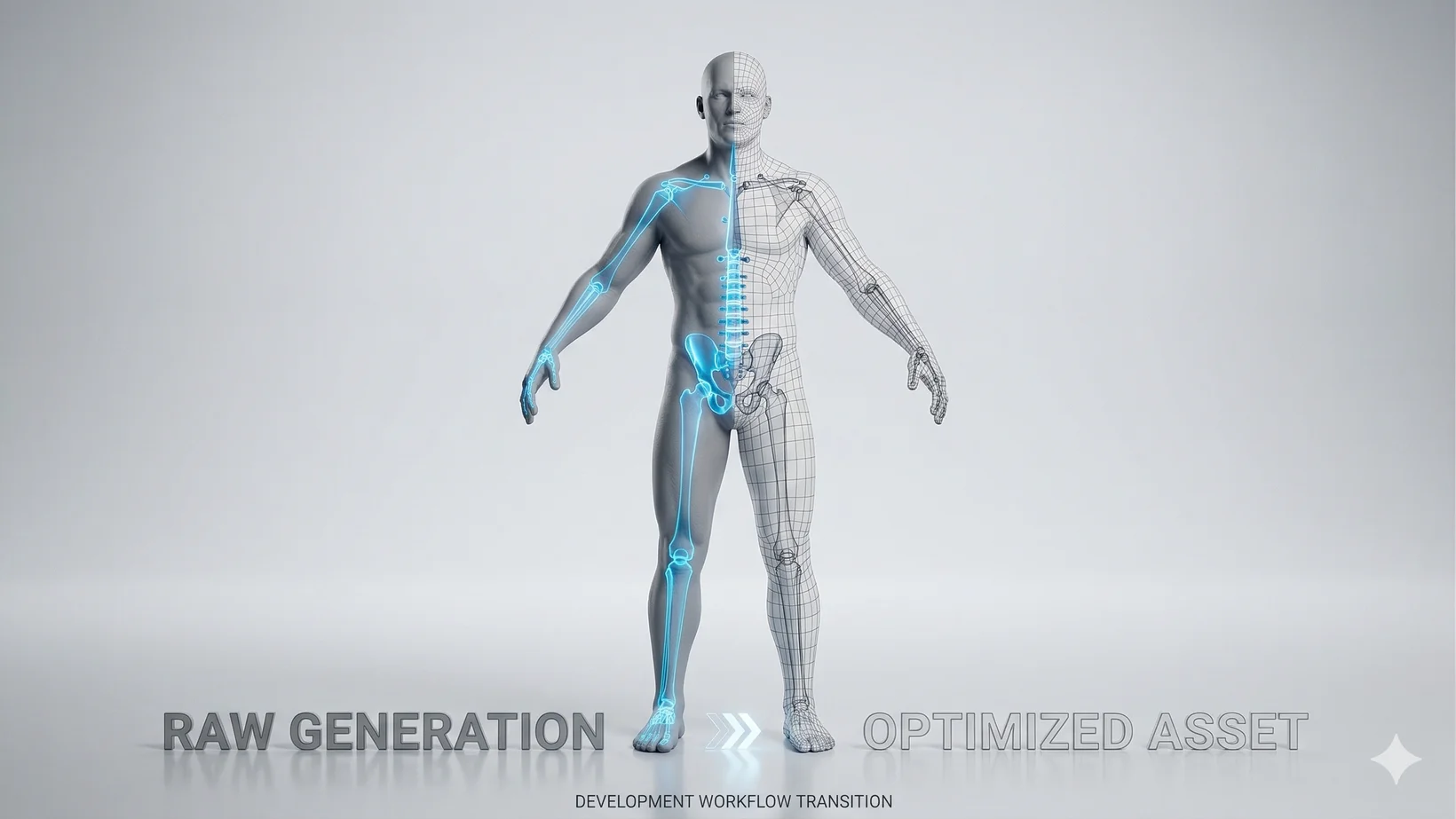
Before applying skeletal structures, generated models must undergo strict retopology and polygon decimation to ensure engine compatibility and proper geometric deformation during movement.
AI 3D generation methodologies can occasionally produce incredibly dense, unoptimized meshes that feature millions of polygons. These high-poly outputs are entirely unsuitable for real-time rendering environments and physics simulations. The procedure of rigging and animating ai generated 3d character models for indie games mandates that models are first processed through smart retopology algorithms before any rigging attempts occur. The platform provides an intelligent Smart Low Poly feature that automatically reduces polygon counts while preserving hand-crafted precision, sharp mechanical edges, and essential organic details.
Leveraging the UniRig Architecture
The system utilizes the UniRig framework and the highly advanced Algorithm 3.1, featuring over 200 billion parameters, to automatically predict joint coordinates, hierarchical structures, and precise skinning weights.
Manual Refinement Workflows in External Software
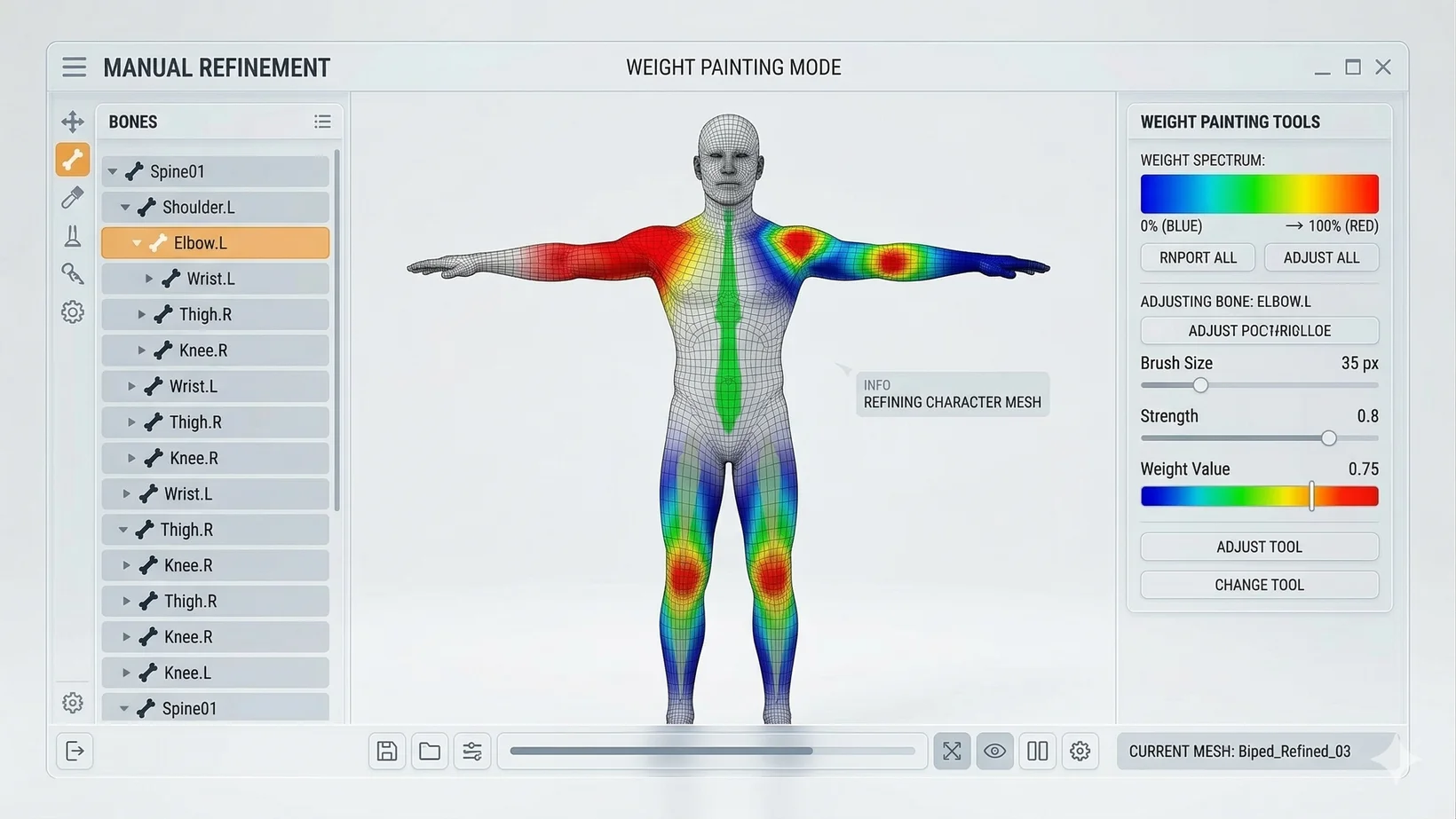
While automation handles the bulk of the rigging process, professional workflows often involve exporting the rigged asset to digital content creation (DCC) software for fine-tuned weight painting and custom pose adjustments.
Advanced Texturing and Material Application for Animated Models
Following the successful skeletal rigging and animation phases, characters require high-fidelity PBR texturing and material application to ensure they react convincingly to dynamic engine lighting.
Integrating Animated Characters into Game Engines
Tripo Studio and Tripo API serve as completely independent product lines, facilitating seamless integration of animated assets into game engines through direct DCC bridges and customized backend solutions.
Strategic Asset Management and Commercial Application
Independent developers must navigate the credit-based subscription models properly, utilizing Pro plans to secure necessary commercial rights and the monthly credits required for high-volume production.
FAQ
1. What is the difference between the Studio and API products?
Tripo Studio and Tripo API are completely independent product lines. The API service utilizes its own discrete billing system and is never treated as an add-on feature to the web workspace.
2. What export formats are supported for the generated 3D models?
Generated models can be exported in various universal formats, specifically USD, FBX, OBJ, STL, GLB, 3MF. You can easily use a 3D file converter to fit your engine pipeline.
3. Can I use the generated 3D models for commercial projects?
3D models generated under Tripo's Free plan do not support commercial use. The Free plan provides 300 credits per month. To obtain commercial rights, you must upgrade. The Pro plan ($19.90/month) provides 3,000 credits per month and unconditionally grants full commercial rights.