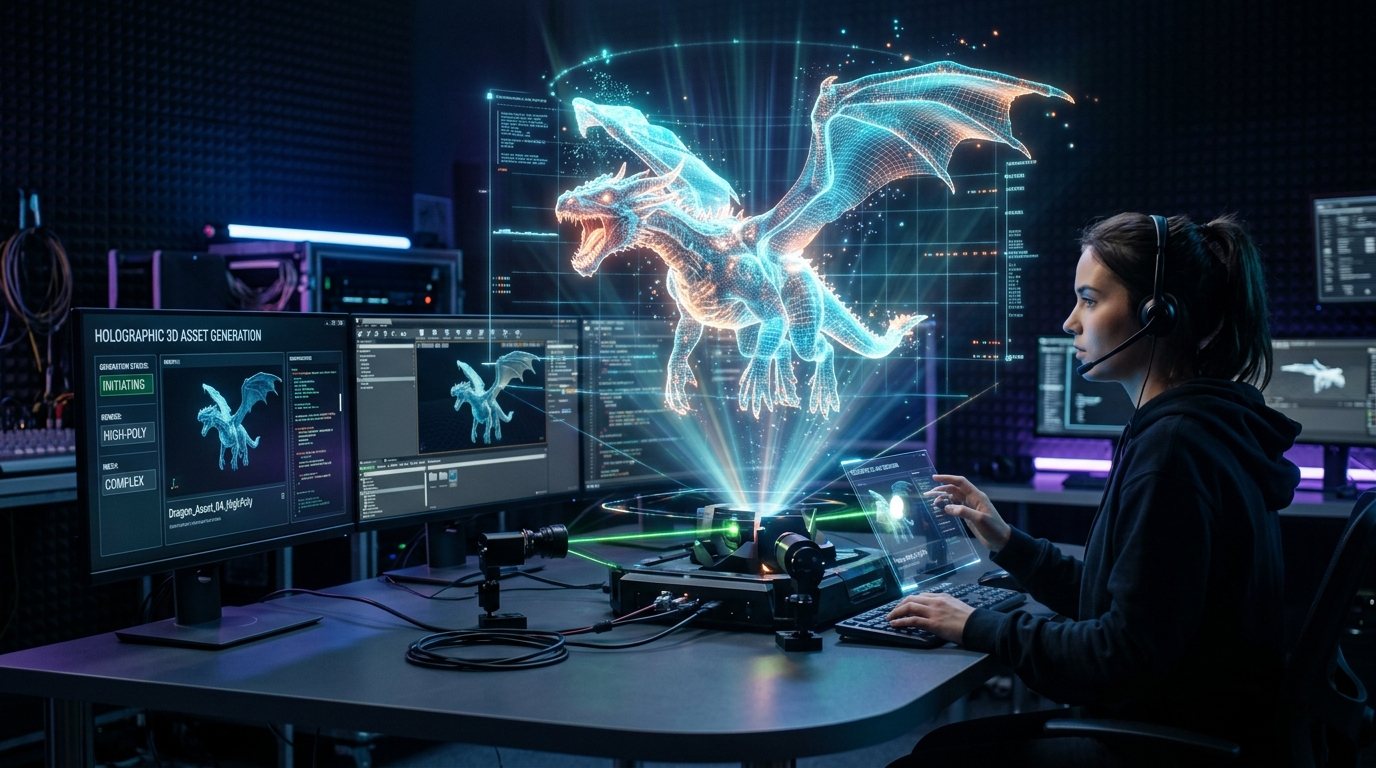
Securing AI 3D Film Assets: Data Security Protocols for Cloud Tools
Advanced Data Protection Frameworks for Cinematic AI Generation Workflows
The rapid adoption of cloud-based artificial intelligence in film production has centralized highly valuable intellectual property into remote servers. As studios process proprietary character designs and environments through off-site compute clusters, the risk of data interception and unauthorized asset duplication escalates exponentially. Implementing rigorous data security protocols ensures that production houses can utilize advanced generative systems without compromising their creative assets.
Key Insights:
- Zero-trust architectures are mandatory for mitigating unauthorized access during cloud-based 3D asset generation.
- Distinct security frameworks must be applied to separate enterprise automation pipelines from individual creator platforms.
- End-to-end encryption and hash verification are critical for protecting 3D files during export to local digital content creation software.
- Continuous auditing and real-time threat detection prevent intellectual property leaks during peak film production cycles.
The Imperative of Data Security in 2026 AI-Driven Film Workflows
As film studios increasingly migrate to cloud-based AI 3D generation, protecting proprietary intellectual property becomes a primary priority. This section outlines the evolution of cyber threats in 2026 and why traditional security measures are insufficient for high-parameter AI models used in modern cinema production.
The transition toward cloud infrastructures for visual effects has fundamentally altered how studios handle proprietary data. Integrating a high-performance AI 3D Model Generator into a production pipeline accelerates asset creation significantly, but it also demands transmitting sensitive concept art and pre-visualization data across external networks. In the current 2026 production environment, cyber threats target these specific transmission vectors, aiming to intercept unreleased film assets before they reach post-production.
Image of cloud-based AI security architecture for film assets
Traditional perimeter defenses, which relied on keeping all data within a physically secure intranet, fail because the processing power required for advanced neural architectures necessitates decentralized, cloud-based environments. Cybercriminals now focus on exploiting vulnerabilities in the transmission phase, attempting to siphon geometry and texture data while it is being routed to external processing nodes. When utilizing Tripo AI for high-fidelity asset creation, the underlying generation algorithms require massive compute power that cannot be housed locally on standard studio hardware. Specifically, running Algorithm 3.1 with over 200 Billion parameters means data must be processed on specialized off-site GPU clusters rather than local workstations.
Core Protocols for Securing Proprietary 3D Asset Generation
Establishing a robust security framework requires a multi-layered approach focusing on data at rest and in transit. Studios must implement zero-trust architectures within their Tripo AI workflows to ensure that every request for 3D model generation is authenticated, authorized, and continuously validated against studio-defined security policies.

End-to-End Encryption for Neural Asset Metadata
Securing the generation process begins with the initial data input. When prompt data, reference images, or skeletal frameworks are uploaded to cloud servers, they must be shielded by Transport Layer Security (TLS) 1.3 or higher. Once the data reaches the processing cluster, end-to-end encryption ensures that even if a server partition is compromised, the neural asset metadata remains completely unreadable to unauthorized parties.
Secure Multi-Tenant Isolation in Cloud AI Environments
Cloud platforms inherently operate on multi-tenant architectures, hosting multiple studios on the same massive physical servers to maximize compute efficiency. To prevent data bleeding or side-channel attacks between concurrent projects, hypervisor-level isolation is mandatory. Security protocols dictate that memory spaces allocated for generating one studio's assets must be cryptographically walled off from all other tenants. This ensures that latent data from a completed generation task is wiped instantly and irretrievably.
Access Control and Identity Management for Studio API vs. Artist Tools
Security protocols must distinguish between automated enterprise pipelines and creative web interfaces. While the Tripo API requires secure token management and IP whitelisting for backend automation, the Tripo Studio tool demands strong multi-factor authentication for individual artists to prevent unauthorized access to sensitive project files and creative assets.
Effective identity management requires recognizing the operational differences between mass-generation systems and individual creation platforms. Enterprise production pipelines typically rely on automated scripts to generate hundreds of background assets simultaneously, whereas individual artists need visual interfaces for detailed character work. These two environments are entirely independent. For instance, the advanced tier designed for the visual AI 3D Editor has no enterprise API access.
Managing API Credentials for Enterprise-Scale 3D Automation
Protocols now mandate the use of short-lived, dynamically rotating access tokens based on OAuth 2.0 standards. These tokens expire within minutes, meaning that even if intercepted, their window of utility is virtually non-existent. Furthermore, API access must be tightly bound to specific, whitelisted IP addresses belonging to the studio's internal servers.
Role-Based Access Control (RBAC) for Collaborative Film Teams
Within visual interfaces used by human operators, Role-Based Access Control (RBAC) limits exposure by operating strictly on the principle of least privilege. In 2026, biometric authentication and hardware security keys have largely replaced SMS-based MFA, providing phishing-resistant identity verification. Integration with the studio's central Single Sign-On (SSO) provider allows IT administrators to instantly revoke access across all cloud tools.
Ensuring Data Integrity During 3D Export and Interoperability
Asset security does not end at generation; it extends to the export phase. Protocols must ensure that file formats such as USD, FBX, and GLB are transferred through secure channels. Digital watermarking and hash verification should be applied to prevent the tampering or unauthorized distribution of assets as they move from Tripo to downstream DCC tools.
The transition of an asset from a cloud generation platform to a local Digital Content Creation (DCC) software represents a highly vulnerable phase in the production pipeline. When executing 3D format conversion or exporting final models for rigging and animation, the data must remain completely intact and secure. Integrating these models into professional software requires handling specific industry-standard file types, including USD, FBX, OBJ, STL, GLB, and 3MF.
Image of secure 3D asset export and hash verification process
Secure Handshake Protocols for USD and FBX Pipelines
USD and FBX are foundational formats for complex film scenes, often containing intricate node hierarchies, rigging data, and multiple material assignments. Because these files are highly complex and often massive in size, their transfer must be carefully protected. Secure handshake protocols dictate that before a cloud server transmits a USD or FBX file to a local machine, both endpoints must cryptographically verify each other's identity.
Integrity Monitoring for Cloud-to-Local Asset Syncing
Once the secure transfer is initiated, integrity monitoring guarantees that the file received exactly matches the file generated. By generating a SHA-256 cryptographic hash for the asset on the server and comparing it against the hash of the downloaded file, studios can instantly detect any data corruption or malicious tampering.
Monitoring and Auditing AI Model Interactions for Compliance
Continuous auditing is essential for maintaining a secure film production environment. By logging all interactions with AI algorithms, studios can detect anomalous behavior that might indicate a data breach.
Real-Time Threat Detection in Generative AI Workflows
Security Information and Event Management (SIEM) systems must be integrated directly into the 3D generation workflow. These systems ingest and analyze log data in real time, looking for anomalous patterns such as sudden spikes in asset generation requests from a single user account. Security Orchestration, Automation, and Response (SOAR) protocols can then automatically sever active sessions.
Compliance Standards for Global Film Data Protection
Major film productions frequently span multiple international studios and vendor facilities, necessitating adherence to strict global data protection regulations. Auditing systems generate comprehensive, tamper-proof reports detailing exactly who accessed which asset, when the generation or export occurred, and where the data was transmitted. Maintaining these logs ensures that studios remain legally compliant while protecting their most valuable digital properties.
FAQ
Q: How do studios secure Tripo API integrations against external data leaks? A: Securing automated integrations requires isolating API traffic from public internet exposure. Studios achieve this by utilizing encrypted, short-lived access tokens rather than static, permanent keys, ensuring that compromised credentials quickly become useless. Furthermore, secure Webhooks are employed to receive generation status updates over HTTPS. ly, restricting API access to strictly defined IP ranges guarantees that even if a token is intercepted, it cannot be utilized from an unauthorized external location.
Q: What protocols protect 3D formats like USD or GLB during cloud transfers? A: Protecting high-value formats during export relies on robust encryption and cryptographic verification standards. TLS 1.3 encryption is applied to the transmission tunnel, rendering the complex geometry and texture data entirely unreadable. To guarantee file integrity upon arrival, SHA-256 hash verification is utilized. The local studio system calculates the hash of the downloaded USD or GLB file and matches it against the server's original hash.
Q: Can security protocols prevent AI-generated assets from being used outside of authorized studio projects? A: Yes, through the implementation of advanced metadata embedding and digital rights management (DRM). Invisible cryptographic watermarks can be baked directly into the geometry topology or the noise patterns of the texture maps during the AI generation pipeline. If an asset is leaked and appears on unauthorized platforms, this embedded DRM data allows the studio to trace the exact generation timestamp and identify the specific user account responsible for the export.