
Retopologizing AI 3D Output for Feature Films
Professional Structural Conversion for Cinematic Deformation Standards
The integration of artificial intelligence into film production visual effects pipelines has drastically accelerated concept generation, but it introduces severe bottlenecks during technical execution. Raw generated meshes frequently feature dense, disorganized triangulation that collapses under complex cinematic animation requirements. Translating these raw conceptual assets into production-ready geometry requires a rigorous retopology workflow that bridges the gap between rapid algorithmic ideation and precise feature film deformation standards. For studios utilizing advanced enterprise 3D generative AI solutions, mastering this structural conversion is essential for maintaining production efficiency.
Key Insights
- Raw algorithmic meshes require immediate structural conversion from dense triangles to clean, subdivision-ready quad topology to support cinematic displacement and rendering.
- Strategic export formats ensure seamless integration between generative platforms and industry-standard digital content creation applications, preserving critical vertex data.
- Implementing precise articulation loops around joints and facial features is non-negotiable for achieving flawless deformation during high-fidelity animation sequences.
- Advanced projection techniques can reduce standard retopology timelines from six hours to under forty-five minutes while preserving original volumetric integrity and silhouette.
Understanding AI 3D Output in a Feature Film Pipeline
Integrating artificial intelligence into visual effects pipelines requires a thorough understanding of raw geometric outputs. While Tripo AI rapidly generates high-density initial meshes, this raw geometry lacks the specific structural organization required for rigorous cinematic high-poly modeling, demanding deliberate structural adaptation to meet strict studio rigging standards.
The Gap Between Raw Generation and Cinematic Deformation
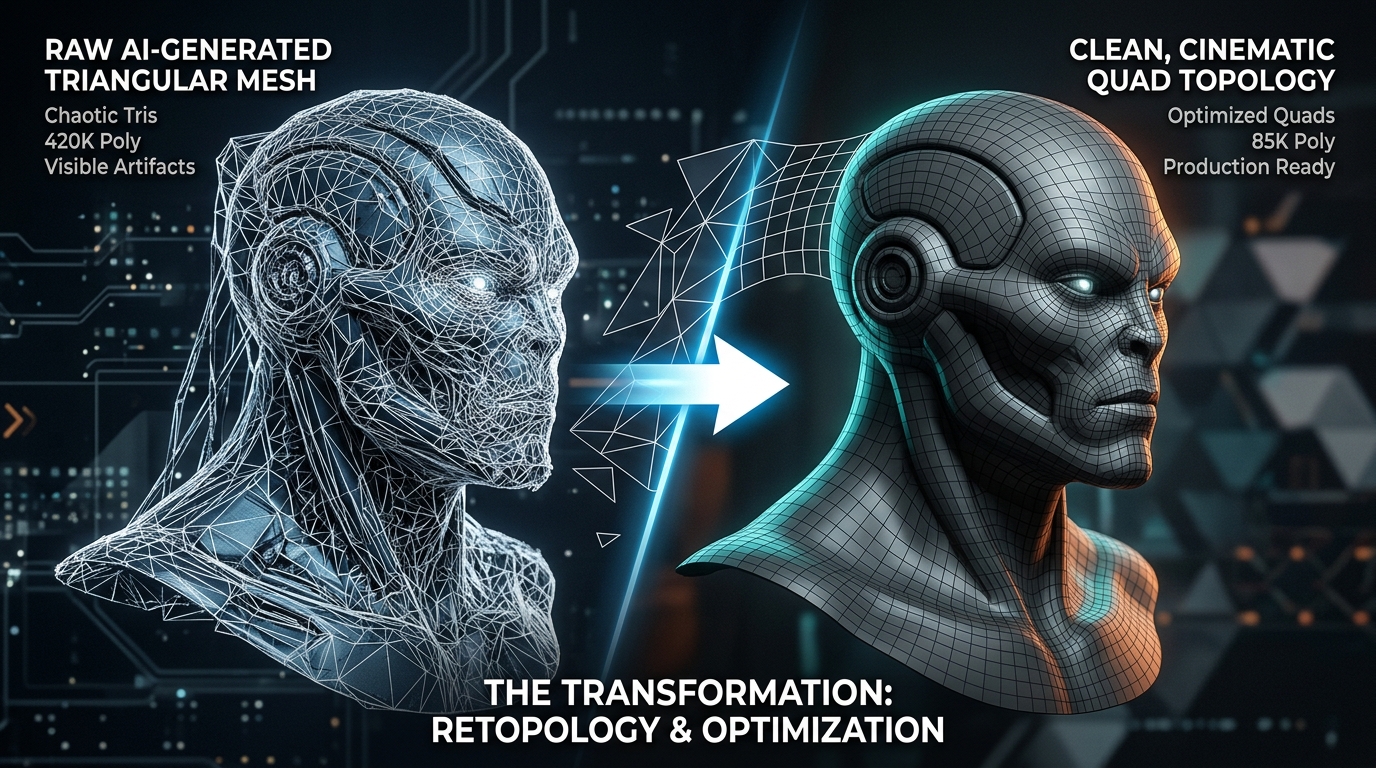
The fundamental disconnect between generative outputs and production requirements lies in the mathematical objective of the initial creation. The process of converting 2D concept images to 3D models prioritizes external visual fidelity and volumetric approximation over internal structural logic. Feature film pipelines demand models that can undergo extreme physical manipulation—stretching, squashing, and bending—without compromising the external surface or causing intersection errors. Raw generated assets consist of arbitrary triangulated clusters. These clusters calculate light and shadow effectively in a static pose but lack the directional flow necessary for predictable movement.
Identifying Edge Flow Anomalies in Tripo Meshes
Because generative systems prioritize surface appearance over structural logic, technical directors must identify and isolate topological anomalies before integration. The core architecture driving these assets, specifically Algorithm 3.1 with over 200 Billion parameters, possesses immense compute power that excels at inferring microscopic surface details and complex silhouettes from minimal input data. However, this deep neural architecture inherently produces procedural geometry characterized by poles and spiral edge loops that disrupt standard UV unwrapping procedures. Technical artists must analyze the mesh density, locating areas where excessive geometric resolution masks underlying structural flaws, such as non-manifold geometry or intersecting faces that will inevitably cause rendering engine failures during final output.
Essential Retopology Workflows for High-Poly Modeling
Converting dense, triangulated algorithmic geometry into clean, quad-based models is a meticulous step-by-step process. By utilizing industry-standard projection workflows, technical artists can rebuild subdivision-ready models that fully support feature film displacement and complex rendering requirements without losing the original generative design.
Exporting from Tripo AI (USD, FBX, OBJ Integration)
The bridge between generation and retopology begins with precise file handling and format selection. The platform supports multiple formats including USD, FBX, OBJ, STL, GLB, and 3MF. For feature film pipelines, USD (Universal Scene Description) and OBJ are the professional choices. USD facilitates non-destructive integration into complex studio environments, retaining hierarchical data, variant sets, and shading network compatibility crucial for large-scale team collaboration. OBJ provides a universally accepted, uncompressed geometric format that transfers high-resolution vertex data perfectly into dedicated retopology applications.
Shrinkwrapping and High-Res Projection Techniques
Manual vertex-by-vertex retopology is highly inefficient in a modern production environment. Technical teams now leverage base mesh adaptation combined with advanced shrinkwrap modifiers to dramatically accelerate the pipeline. Artists import a pre-existing, animation-ready base mesh with correct anatomical edge flow and snap its vertices to the surface of the dense Tripo AI output using tools like Maya's Quad Draw or Blender's Shrinkwrap modifier. By refining this projection methodology, technical departments have successfully reduced total retopology time from a traditional six hours to under forty-five minutes.
Meeting Rigging and Deformation Standards
Achieving cinematic animation requires precise edge flow requirements, particularly around areas of high movement. Establishing proper facial loops and joint articulation topology ensures that the newly retopologized models deform flawlessly when subjected to extreme cinematic animation and complex skeletal controls.
Establishing Proper Articulation Loops for Joints
A character model will inevitably shatter during movement if its topology does not mirror the mechanics of the underlying skeletal system. Biological and mechanical joints require specific concentric edge loops to fold correctly. The industry standard dictates a minimum three-loop system around critical bending points: one loop directly on the pivot, and supporting loops on either side to maintain volume during compression. Even when utilizing automated rigging preparation tools to establish initial weight painting, the underlying geometry must consist of parallel loops that compress seamlessly.
Sub-D Compliance and Micro-Displacement Prep
Feature film rendering engines rely heavily on Catmull-Clark subdivision surfaces (Sub-D) to dynamically smooth models at render time. To function correctly, the retopologized mesh must be entirely quad-based; even a single triangle or N-gon in a highly deformable area can cause severe pinching. Once the base topology achieves full Sub-D compliance, artists proceed to UV mapping and micro-displacement preparation. The high-frequency detail from the original generation is extracted and baked into multi-tile (UDIM) displacement maps, ensuring every pore and scratch translates perfectly to the final cinematic frame.
FAQ
How do I maintain Tripo AI's original volume during manual retopology?
To preserve the exact silhouette and volumetric mass of the original generation, technical artists utilize shrinkwrap modifiers combined with base mesh projection techniques. By enveloping the dense original geometry with a low-poly quad mesh and projecting the vertex data outward, the model retains its core mass while acquiring the necessary animation-ready structure.
Which export format from Tripo is recommended for a VFX retopology pipeline?
For standard digital content creation retopology workflows, USD and OBJ are the most highly recommended formats. USD provides robust, layered scene description capabilities ideal for complex studio pipelines, while OBJ offers a pure, uncompressed geometric format that perfectly retains complex surface details.
Can auto-retopology tools handle AI mesh cinematic deformation requirements?
Current automated retopology algorithms require significant manual edge-loop guidance to support feature film rigging. While they generate clean quads, they lack the anatomical awareness needed to place critical concentric loops around joints and facial features. Human intervention remains essential.