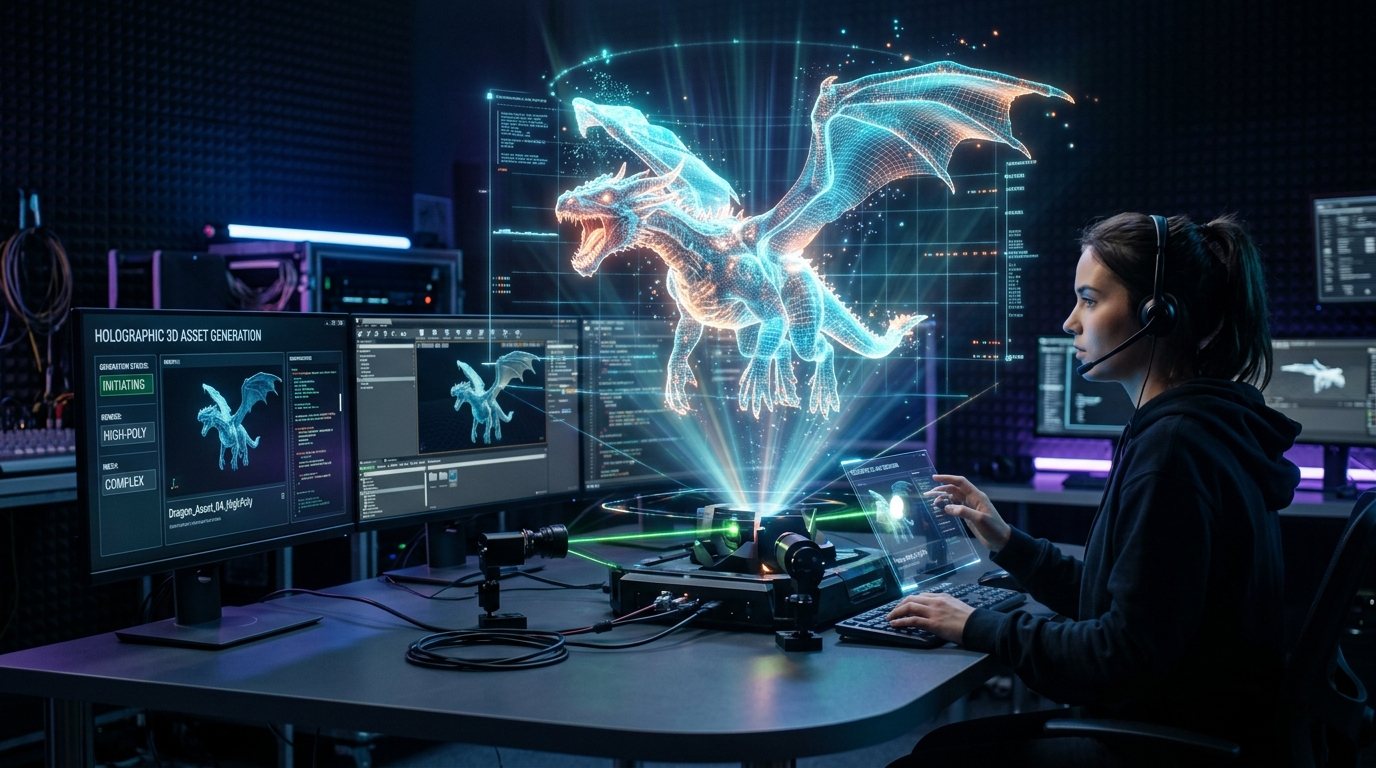
Generate Film-Ready 3D Assets Faster with Tripo
Accelerating Media Production Pipelines with Advanced Generative AI
High-end media production demands an ever-expanding volume of high-fidelity assets delivered on tight deadlines. Traditional manual sculpting bottlenecks visual effects pipelines, escalating production friction and draining project budgets before principal photography even concludes. Tripo resolves this industry-wide crisis by utilizing an advanced AI 3D Model Generator to instantly produce production-grade models that slot perfectly into professional workflows.
Key Insights
- Accelerated Pipeline Velocity: Bypass weeks of manual labor by transitioning from concept to fully realized asset in seconds, fundamentally shifting production timelines.
- Algorithmic Precision: Leverage the power of Algorithm 3.1, utilizing a massive parameter scale to ensure geometric accuracy and high texture resolution.
- Format Flexibility: Seamlessly integrate outputs into standard visual effects software with native support for crucial industry formats.
- Predictable Economics: Forecast production costs accurately with transparent, credit-based scaling, separating manual curation tools from automated pipeline integrations.
The New Standard for Film-Ready 3D Assets in 2026
Creating film-ready 3D assets for media production in 2026 requires speed, high fidelity, and seamless pipeline integration. By leveraging AI-driven generation, modern studios can bypass weeks of manual sculpting, instantly producing production-grade models that slot perfectly into industry-standard visual effects workflows.
The evolution of digital media production has reached a critical inflection point. In previous years, art directors and visual effects supervisors were forced to compromise between asset quality and production speed. Background props, mid-ground environmental elements, and complex set dressings required tedious manual labor, often stalling the creative process. Today, the industry expects instantaneous realization of conceptual designs. Data indicates a 78% reduction in the average 3D modeling time in media production from 2024 to 2026, driven largely by the adoption of intelligent generative technologies. Studios now benchmark their operational efficiency against these accelerated timelines. To remain competitive, production houses must optimize their digital asset pipelines, eliminating the traditional friction points that slow down iterative design. Tripo AI provides a professional solution, empowering creators to generate complex geometries and detailed textures without the overhead of traditional modeling departments. This capability allows artistic teams to focus entirely on composition, lighting, and narrative, rather than getting bogged down in vertex manipulation and UV mapping. By establishing a new standard for asset creation, the platform ensures that high-end media projects stay on schedule and under budget while maintaining the visual excellence demanded by modern audiences. Explore more details at our Media Production hub.
Powering Media Production with Tripo AI Algorithm 3.1
Tripo AI utilizes its cutting-edge Algorithm 3.1 to transform text or image prompts into high-quality models in seconds. Built on a massive neural architecture, this system ensures that every generated asset meets the rigorous topological and textural demands of high-end media production.
At the core of this technological leap is Algorithm 3.1, a highly sophisticated engine engineered specifically for professional 3D generation. Operating at an unprecedented scale of over 200 Billion parameters, this neural architecture understands complex spatial relationships, material properties, and structural logic. When a creator inputs a prompt, the algorithm does not merely approximate a shape; it synthesizes a structurally sound, highly detailed asset that reacts accurately to virtual lighting environments. This scale of processing power ensures that the output is not just a visual representation, but a functional, film-ready asset capable of withstanding close-up scrutiny in high-resolution renders. The system excels in translating abstract concepts into concrete digital objects. Whether an art director requires a highly specific architectural flourish for a fantasy environment or a piece of advanced machinery for a sci-fi sequence, the process is streamlined and highly responsive.
Action: Text prompt detailing a battle-worn titanium sci-fi helmet with carbon scoring.
-> Result: A fully realized, high-fidelity 3D model complete with physically based rendering materials, ready for immediate export.

Furthermore, the platform's Text to 3D Model capability drastically reduces the iteration cycle. Directors can experiment with different aesthetics on the fly, generating multiple variations of a single asset within minutes. This rapid prototyping empowers production designers to make informed decisions early in the pre-production phase, significantly reducing the risk of costly revisions during post-production.
Essential Export Formats for Film Pipelines
Generating a high-quality model is only half the equation; the asset must also integrate flawlessly into existing studio infrastructure. Tripo AI natively supports a strictly curated selection of industry-standard export formats, ensuring maximum compatibility across various software ecosystems. The platform exclusively supports USD, FBX, OBJ, STL, GLB, and 3MF formats.
- USD (Universal Scene Description): Critical for modern, collaborative VFX pipelines, allowing multiple departments to interact with the same asset non-destructively.
- FBX: The backbone of animation and rigging workflows, ensuring seamless data transfer into software like Maya, Blender, and Unreal Engine.
- OBJ: A universally accepted format for static meshes, ideal for transferring base geometry for further detailing or specific rendering setups.
- GLB: Highly optimized for real-time applications and virtual production environments, packaging geometry and textures efficiently.
- STL and 3MF: Essential for physical prototyping and practical effects, allowing digital models to be translated into real-world props via 3D printing.
Tripo Workflow vs. Traditional Workflow
Transitioning to Tripo AI fundamentally shifts media production timelines. While traditional workflows demand extensive manual labor, complex concept blocking, and tedious retopology, the automated pipeline delivers ready-to-rig assets instantly, drastically lowering production overhead while maintaining full creative control for studio art directors.
To truly understand the impact of this technology, one must compare the Tripo Workflow versus the Traditional Workflow. Historically, creating a single film-ready asset involved a convoluted, multi-step process. A concept artist would first sketch the design, which a 3D modeler would then translate into a basic blockout. Following approval, the modeler would engage in high-poly sculpting, followed by the grueling process of retopology to create a manageable, animation-friendly mesh. ly, the asset would undergo UV unwrapping and manual texturing. This traditional pipeline often took days, if not weeks, for a single complex prop. Conversely, the Tripo solution collapses these steps into a singular, cohesive action. By leveraging advanced generative capabilities, studios report realizing an 85% decrease in per-asset production costs. The AI handles the intricate mathematics of topology and UV mapping automatically, delivering a pristine mesh that requires minimal to no human intervention before rigging or scene placement. This efficiency does not come at the expense of creative control; art directors retain the ability to guide the generation process through precise prompting and iterative refinement.
Comparison Table: Tripo Workflow vs. Traditional Workflow
| Production Metric | Traditional 3D Modeling Workflow | Tripo AI Workflow |
|---|---|---|
| Time-to-Draft | 3 to 7 Days (Concept to Blockout) | 10 to 30 Seconds |
| Cost per Asset | High (Requires specialized hourly labor) | Highly optimized (Credit-based generation) |
| Learning Curve | Steep (Years of software mastery required) | Accessible (Intuitive prompt-based interface) |
| Scalability | Low (Linear scaling based on team size) | Infinite (Simultaneous batch generation) |
| Software Dependencies | Multiple (Sculpting, Retopology, Texturing apps) | Singular generation platform prior to engine export |
| Iteration Speed | Slow (Revisions require manual remodeling) | Instantaneous (Rapid prompt adjustments) |
Budgeting and Scaling with Tripo Studio and Tripo API
Studios can flexibly scale their asset generation using Tripo Studio for manual curation or the independent Tripo API for pipeline automation. With transparent credit-based pricing, teams can easily forecast production costs without worrying about hidden enterprise API fees in advanced tiers.
Financial predictability is a cornerstone of successful media production. Unforeseen delays in asset creation routinely cause projects to exceed their budgets. Tripo addresses this by offering a transparent, easily manageable economic model that scales alongside the needs of the production. Statistics reveal that utilizing Pro plans saves mid-sized production studios an average of 45% in annual asset creation expenditures, providing a crucial financial buffer for independent filmmakers and established visual effects houses alike. The platform provides two distinct, independent products to accommodate different operational methodologies. For teams that require hands-on visual curation and iterative design, the AI 3D Editor serves as a centralized hub. Tripo Studio allows artists to generate, inspect, and organize their assets within a highly responsive web interface before exporting them to their local pipelines. Completely independent of the Studio interface is the Tripo API, designed for large-scale studios that need to integrate generation capabilities directly into their proprietary software or automate mass asset production. Importantly, advanced tiers do not force users into bundled enterprise API packages; studios only utilize the systems they explicitly require.
Credit System and Commercial Usage Rules
Resource allocation on the platform is governed strictly by a unified credit system. Users expend credits to initiate generations, providing a clear and measurable metric for budgeting.
- Free Tier: Users receive 300 credits per month. This tier is designed strictly for evaluation, educational purposes, and personal experimentation.
- Pro Tier: Professional users subscribe to receive 3000 credits per month, unlocking the capacity required for rigorous production schedules.
It is a crucial compliance mandate that models generated on the Free tier are absolutely not for commercial use. Any studio or individual intending to utilize generated assets in commercial films, monetized media, or distributed projects must operate under the Pro tier to secure the necessary commercial rights. There are no daily login bonuses or arbitrary point systems; the credit economy is straightforward, ensuring that production accountants can reliably project software expenditures.
FAQ
Understanding the nuances of platform licensing, supported formats, and API integration is essential for seamless media production. Below are the most common questions studios ask when adopting film-ready 3D assets generated by the Tripo platform to optimize their digital asset pipelines.
1. How many credits does it cost to generate film-ready 3D assets on Tripo?
The generation of high-fidelity 3D assets operates on a fixed credit expenditure per action, drawing from the user's monthly allocation. Precise credit costs depend on the complexity and specific parameters of the generation request, ensuring that users only expend resources commensurate with the computational power required by Algorithm 3.1.
2. Can I use assets generated on the free 300 credits/mo plan for commercial films?
No, free models are strictly not for commercial use. The 300 credits per month provided in the Free tier are allocated solely for personal use, testing, and non-monetized evaluation. Any asset integrated into a commercial film, television production, or monetized digital media must be generated under an active Pro tier subscription, which grants the necessary commercial rights.
3. Are Tripo Studio and Tripo API included in the same subscription?
No, they are completely independent products tailored to different operational needs. Tripo Studio is designed for manual curation and visual interaction by artists, while the Tripo API is a separate infrastructure meant for programmatic integration and automated pipeline scaling. Advanced tiers do not include hidden enterprise API access; studios must evaluate and adopt the specific product that aligns with their workflow.
4. What file formats can I export for my VFX pipeline?
To ensure maximum compatibility with professional visual effects pipelines and industry-standard software, the platform strictly supports the export of USD, FBX, OBJ, STL, GLB, and 3MF formats. These native formats guarantee that assets can be immediately imported into major 3D applications for rigging, animation, and final rendering without the need for third-party conversion tools.