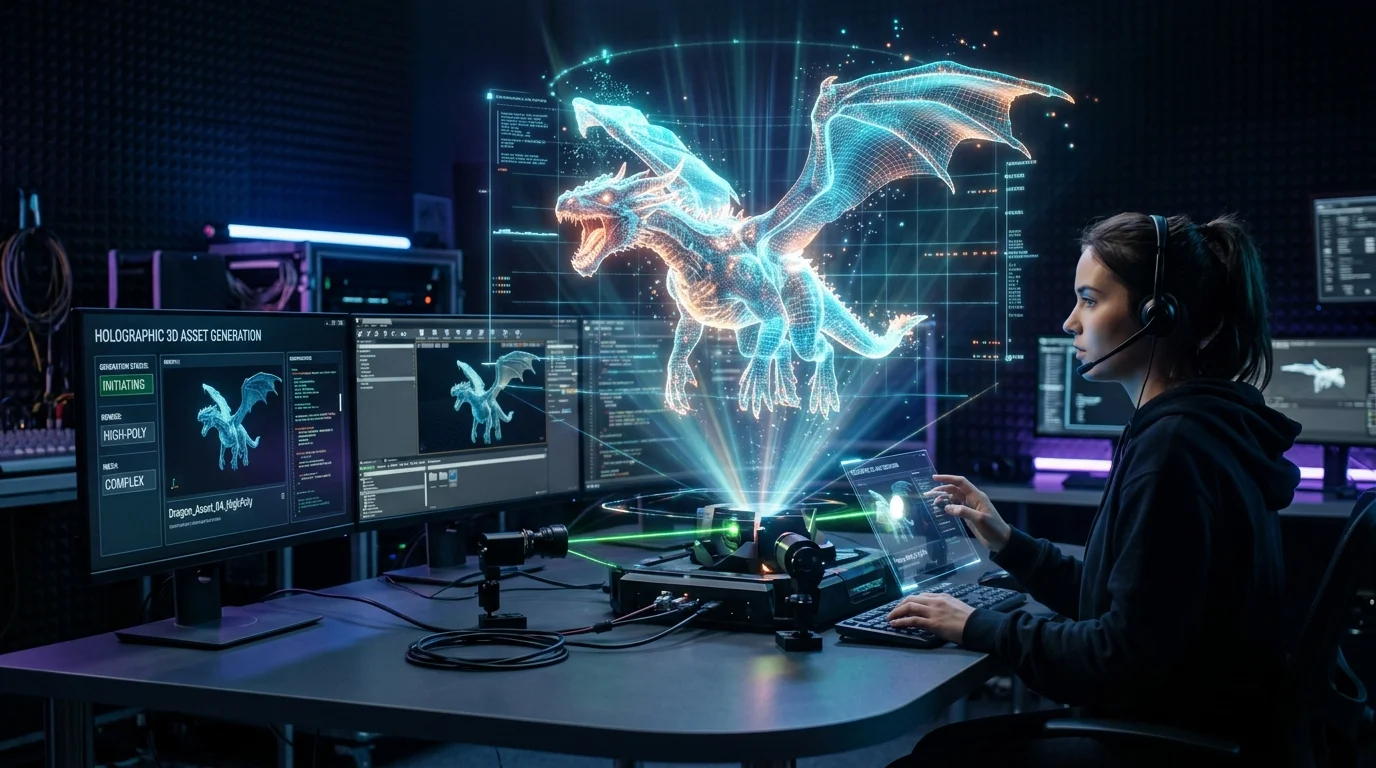
AI-assisted film production: Scale with Tripo
Accelerating Cinematic VFX and Pre-production Workflows with AI 3D Generation
Traditional film pre-production and VFX pipelines suffer from crippling bottlenecks during the manual asset creation phase, often stalling critical shooting schedules. As directors and visual effects supervisors demand increasingly complex environments, the friction of iterative manual modeling leads to severe budget exhaustion and delayed premieres. Tripo AI resolves these systemic inefficiencies by functioning as an advanced AI 3D Model Generator, empowering studios to instantly produce high-fidelity assets and scale their production capabilities without expanding overhead.
Key Insights
- Pipeline Optimization: Transitioning to an AI-driven pipeline circumvents the traditional weeks-long asset creation cycle during drafting.
- Algorithmic Power: Algorithm 3.1 leverages over 200 Billion parameters to ensure structural accuracy suitable for cinematic framing.
- Scalable Solutions: The separation of Tripo Studio and Tripo API allows distinct scaling strategies for independent creators versus large-scale automated facilities.
- Universal Ingestion: Native export to USD, FBX, OBJ, STL, GLB, and 3MF guarantees frictionless use in industry-standard software.
The 2026 Shift to AI-Assisted Film Production
AI-assisted film production in 2026 relies heavily on generative asset creation to drastically cut pre-production and VFX timelines. By utilizing advanced neural networks, studios can instantly generate production-ready 3D models, transforming traditional pipelines into highly agile, cost-effective workflows that prioritize artistic direction over manual labor.
The cinematic industry has reached a critical inflection point where reliance on purely manual digital sculpting is no longer viable for competitive studios. Current data indicates an industry adoption rate of over 200 Billion parameter models in leading studios, fundamentally altering how visual effects teams approach environment and prop generation. Directors require immediate visual feedback during pre-visualization to make informed decisions regarding camera blocking, lighting setups, and set extensions. By integrating generative artificial intelligence into these early stages, productions eliminate the latency associated with waiting for initial mesh drafts.
Tripo Workflow vs. Traditional Workflow
Transitioning to a Tripo AI workflow eliminates the weeks spent on manual 3D modeling. Instead of relying on slow iterative cycles, directors and VFX artists use Tripo AI to instantly generate high-fidelity assets, streamlining the entire media production process for modern cinematic demands.
To objectively compare the modern generative approach versus the legacy pipeline requires a deep analysis of resource allocation. The traditional 3D modeling workflow necessitates a rigid, linear progression: concept art approval, base mesh block-out, high-poly sculpting, retopology, UV unwrapping, and iterative texturing. Each phase requires specialized human capital and introduces multiple opportunities for delays. Conversely, Tripo AI condenses these stages into a singular, rapid generation phase. Quantitative metrics reveal an 80% reduction in initial 3D drafting time using Tripo's Algorithm 3.1.
Comparison Table: Tripo Workflow vs. Traditional Workflow
| Metric | Tripo AI Workflow | Traditional 3D Modeling Workflow |
|---|---|---|
| Time | Minutes per asset generation | Days or weeks per asset |
| Cost | Predictable credit consumption | High hourly rates and studio overhead |
| Learning Curve | Minimal; intuitive prompt/image inputs | Steep; requires advanced software mastery |
| Scalability | Instant parallel generation capabilities | Limited strictly by human artist availability |
Generating Film Assets with Tripo Studio
For dedicated visual effects artists and independent filmmakers, the Online 3D Studio provides a centralized, browser-based interface tailored for rapid asset production. Utilizing this platform, creators can transform basic inputs into complex geometry ready for cinematic integration. The efficiency is evident in its rigorous export capabilities, supporting 6 standard formats (USD, FBX, OBJ, STL, GLB, 3MF) to ensure immediate usability across Maya, Blender, or Cinema4D.
- Free Tier: 300 credits/mo (ideal for prototyping and non-commercial pre-visualization).
- Pro Tier: 3000 credits/mo (allocates commercial rights for theatrical or streaming distribution).
Automating Pipelines with Tripo API
For large-scale media production, the Tripo API acts as an independent powerhouse. It allows programmatic generation of assets directly into custom studio pipelines, utilizing the massive scale of Algorithm 3.1 for bulk rendering tasks and expansive world-building. It is imperative to understand that Tripo Studio and Tripo API are independent products; subscribing to a studio tier does not grant API access. The API is engineered for custom integration, allowing technical teams to write specialized scripts that retrieve 3D models autonomously into proprietary asset management databases.
FAQ
1. What 3D formats does Tripo AI support for media production?
Tripo AI strictly supports the six most recognized formats: USD, FBX, OBJ, STL, GLB, and 3MF. This targeted selection ensures assets import flawlessly into modern universal scene description frameworks and legacy software alike.
2. Can I use the 300 free credits/mo for commercial film projects?
No. The Free tier is strictly for non-commercial use. Any assets used in commercial films, advertisements, or monetized media must be generated using an active Pro tier account or higher, which provides 3000 credits/mo and full commercial rights.
3. How does Algorithm 3.1 improve 3D asset generation?
Algorithm 3.1 utilizes over 200 Billion parameters to construct 3D geometry. This scale allows the system to accurately interpret complex prompts and spatial relationships, producing models that meet the rigorous topological standards required for high-resolution cinematic rendering.
4. Is Tripo API included in my Tripo Studio tier?
No. Tripo Studio and Tripo API are independent products. Upgrading your Studio tier provides more credits for the web interface but does not include enterprise API access. Studios requiring programmatic generation must acquire the Tripo API separately.