AI 3D Generators: Accelerate Indie Film Prop Workflows
Empowering independent film creators with rapid, high-quality 3D asset generation for immersive cinematic environments.
Traditional independent film production constantly battles the friction between ambitious directorial visions and highly restricted art department budgets. Manual asset modeling drains financial resources and labor hours, forcing small visual effects teams to compromise on environmental detail or extend post-production schedules indefinitely. By adopting an advanced AI 3D Model Generator, productions can rapidly convert concept art into high-fidelity meshes, eliminating pipeline bottlenecks and accelerating the entire set-dressing workflow for modern cinema.
Key Insights
- Efficiency Gains: Transitioning from vertex-by-vertex modeling to algorithmic asset generation reduces overall creation time by up to 50%.
- Interoperability: Modern cinematic workflows rely on interoperable formats to move generated assets directly into virtual production volumes.
- Rapid Prototyping: Rapid prototyping capabilities allow art departments to iterate on background props instantly, preserving the primary budget for hero assets.
- Pipeline Consolidation: Integrating automated texturing and smart retopology eliminates the need to cycle through multiple software tools for basic set dressings.
The Bottleneck of Manual Prop Modeling in Indie Cinema
Traditional 3D modeling demands an intensive allocation of labor hours, often consuming disproportionate shares of limited indie budgets. Manual asset creation fundamentally slows down production timelines, necessitating a more agile alternative for small visual effects teams striving to execute ambitious directorial visions in the competitive environment of 2026.
The visual fidelity of modern cinema requires densely populated, highly detailed environments. However, independent studios frequently lack the capital to maintain massive departments of dedicated 3D artists. Historically, modeling a single background prop—such as a weathered science-fiction shipping crate or a period-accurate Victorian streetlamp—required a technical artist to execute a linear, multi-step process. This involved building the base geometry from scratch, sculpting high-resolution details, performing manual retopology, unwrapping the UV coordinates, and painting custom materials layer by layer.
This traditional workflow introduces severe friction into the production schedule. When a director requests a set redesign or a different prop variation during a review session, the manual pipeline struggles to accommodate rapid revisions without incurring substantial overtime costs. The time required to alter a mesh, rebake the textures, and re-import the asset into the scene often leads to creative stagnation. Consequently, independent filmmakers are forced into a difficult compromise: reduce the visual complexity of their scenes, reuse generic stock assets that dilute the unique aesthetic of the film, or sacrifice post-production speed entirely.
The demand for an agile, automated solution has never been more critical. Small visual effects teams require tools that bypass the repetitive technical hurdles of asset creation, allowing them to focus their limited resources on lighting, composition, and animation. By recognizing the inefficiency of manual background prop modeling, studios can begin to adopt methodologies that scale their production value without exponentially increasing their labor overhead.
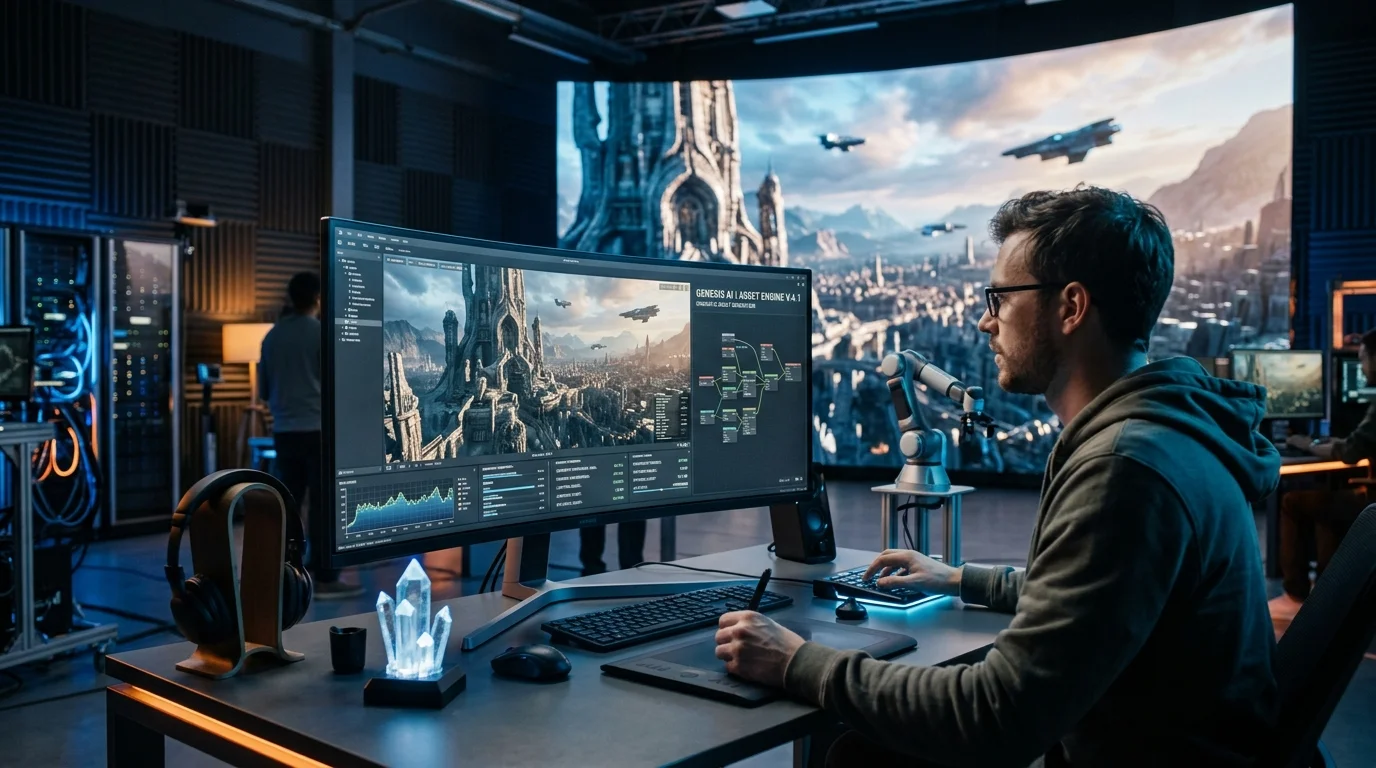
Transitioning to AI-Driven 3D Asset Generation
Replacing manual labor with Tripo AI allows filmmakers to generate complex props from simple text prompts or concept art instantly. This shift from vertex-by-vertex modeling empowers indie creators to build immersive environments rapidly without requiring an expansive department of dedicated 3D artists for background assets.
The evolution of generative artificial intelligence has fundamentally altered the digital asset creation pipeline. Instead of spending days refining a single background object, art departments can now utilize Tripo AI to produce usable geometry in a fraction of the time. This platform accelerates the entire 3D workflow—encompassing modeling, texturing, retopology, and rigging—by up to 50%. By consolidating these processes, technical artists remove the necessity to bounce between multiple software packages just to produce basic environmental elements. By automating the foundational stages of asset creation, visual effects supervisors can redirect their focus toward refining hero props, optimizing scene lighting, and enhancing the overall narrative composition. This transition represents a paradigm shift in how independent films approach world-building, moving from a model of scarcity to one of digital abundance.
From Concept Art to 3D Mesh in Seconds
The initial stage of any cinematic prop begins with concept art. Historically, a 3D modeler would use this two-dimensional reference as an orthographic guide, meticulously extruding polygons to match the silhouette drawn by the production designer. Today, advanced 2D to 3D conversion tools process these concept sketches directly. Production designers simply upload their mood boards, digital paintings, or precise technical drawings into the system. The generation engine interprets the depth, volume, and implied material properties to output a structured, volumetric mesh. This rapid translation from flat concept to 3D object allows directors to visualize physical spacing and camera blocking on digital sets much earlier in the pre-production phase. It completely bypasses the traditional block-out phase, providing a tangible asset that can be placed into a scene for immediate spatial context.
Maintaining Creative Control Over Set Dressings
Automation does not equate to a loss of artistic direction. Directors and production designers maintain strict creative control over the generated set dressings through iterative prompting and parameter adjustments. If a generated prop does not perfectly align with the intended aesthetic, artists can quickly modify the input text or adjust the reference image to generate dozens of distinct variations within minutes. This capability is particularly useful for populating chaotic or organic environments, such as a post-apocalyptic marketplace, a cluttered detective's office, or an overgrown alien forest. In these scenarios, subtle variations in shape, scale, and material condition are required to achieve photorealism and prevent the "copy-paste" aesthetic often seen in low-budget productions. The generative approach allows for countless variations of a single concept, ensuring that every prop feels unique and specifically tailored to the scene's narrative context.
Integrating AI Props into Film Production Pipelines
For artificial intelligence tools to be effective, they must fit seamlessly into established industry workflows. Assets generated by Tripo AI export in professional formats, ensuring native compatibility with standard software like Unreal Engine 5, Blender, and SideFX Houdini for immediate cinematic rendering and physics simulation.
An isolated generation tool holds little value if its outputs cannot interact with industry-standard rendering engines and compositing software. Modern production pipelines demand strict interoperability. Software integration and exporting protocols dictate that generated assets must support formats such as USD, FBX, OBJ, STL, GLB, and 3MF. By adhering to these standardized file types, technical directors can ingest AI-generated props directly into virtual production volumes or traditional post-production composites without requiring extensive file conversion or manual mesh repair. This seamless integration ensures that the speed gained during the generation phase is not subsequently lost during the import and scene-assembly phase.
Seamless Exporting for Unreal Engine and Blender
Virtual production heavily relies on engines like Unreal Engine 5 to project real-time environments onto massive LED volumes. Assets utilized in these environments must be imported with intact UV maps, optimized geometry, and standardized material graphs. Exporting a prop as a USD (Universal Scene Description) or FBX file ensures that the geometry, along with its associated material data, translates accurately into the engine's ecosystem. USD, in particular, has become the backbone of collaborative film pipelines, allowing multiple departments to reference and update assets non-destructively. Similarly, for independent studios utilizing Blender for pre-visualization or SideFX Houdini for procedural scattering and physics, these universal formats guarantee that the generated models behave predictably. Whether an artist is setting up a complex rigid body simulation or dialing in volumetric lighting, the imported geometry maintains its structural integrity.
Refining AI Geometry for High-Resolution Cinematic Shots
Generating the base mesh is only the first step; cinematic applications demand extreme surface fidelity, especially when the camera moves close to an object. This is where advanced neural architectures come into play. Utilizing Algorithm 3.1, which operates on over 200 Billion parameters, the generation engine can interpret complex surface details and output highly accurate topological structures. Once the base geometry is established and the smart retopology is applied, artists can leverage 4K Texture Generation to apply physically based rendering materials. These high-resolution textures ensure that the surface reacts authentically to the cinematic lighting setup. The generated material maps display accurate roughness, metallic properties, and normal displacement, ensuring the prop holds up to the rigorous standards of 4K and IMAX digital projection.
Scaling Production Value with Rapid Iteration
Speed remains the primary advantage of automated generation in indie production. Rapid prototyping allows directors to experiment with set layouts in real-time, drastically reducing post-production revision costs and enabling ambitious world-building on highly constrained micro-budgets without sacrificing overall visual fidelity.
Independent cinema relies heavily on production momentum. The ability to populate a scene, review the composition through the camera lens, and swap out environmental elements in real-time gives directors unprecedented flexibility. Rapid iteration means that if a particular prop creates an unwanted shadow, disrupts the color palette, or fails to complement the actor's performance, it can be regenerated and replaced instantly. This eliminates the traditional multi-day turnaround time for minor asset revisions. Furthermore, managing software and licensing costs is paramount when operating on independent film budgets. Utilizing a credit-based system, creators can access a free tier of 300 credits per month for non-commercial prototyping, while professional licensing scales up to 3000 credits per month for full commercial distribution rights. This specific economic model allows art departments to scale their generation needs exactly according to the production's financial constraints. During the early pre-visualization phase, teams can experiment freely without draining their software budget. Once the production moves into the final rendering phase requiring commercial clearance, the professional tier provides the necessary volume for feature-length asset generation. This scalable, cost-effective approach allows micro-budget productions to achieve the environmental density and visual richness of a major studio production without assuming the associated financial risk.
FAQ
1. How do AI-generated props handle complex textures for high-definition film rendering?
A: Modern generation platforms output fully mapped physically based rendering (PBR) textures, which typically include albedo, roughness, metallic, and normal maps. These textures are specifically designed to interact accurately with ray-traced lighting and global illumination in engines like Arnold, VRay, or Unreal Engine's Lumen. By generating distinct material channels rather than a single baked color texture, the props react naturally to environmental lighting changes, specular highlights, and ambient occlusion. This ensures they blend seamlessly with manually crafted hero assets in high-definition cinematic shots.
2. Can Tripo AI assets be used for physics-based simulations in action sequences?
A: Yes. Because the platform supports exporting in robust, industry-standard formats like FBX and USD, the generated models can be directly integrated into dynamic environments. These formats retain the necessary structural data required for technical artists to apply collision meshes, rigid body dynamics, or automated skeleton setups. This allows the generated props to interact accurately with physics solvers in software like Houdini or Maya, making them highly suitable for destruction simulations, explosions, or complex character interactions during heavy action sequences.
3. Is AI modeling better suited for hero props or background set dressing?
A: Currently, the most strategic application for these tools within a cinematic pipeline lies in massive background variety and set dressing. Generating secondary and tertiary elements—such as scattered debris, background vehicles, generic interior furniture, or distant architectural details—saves hundreds of labor hours. While the technology can generate highly detailed objects, primary hero props that require hyper-specific narrative details, extreme close-up scrutiny, or custom mechanical rigging are typically generated as base prototypes. These prototypes are then handed off to senior 3D artists for manual refinement, ensuring the most critical on-screen elements receive dedicated human craftsmanship while the AI handles the bulk of the environmental volume.