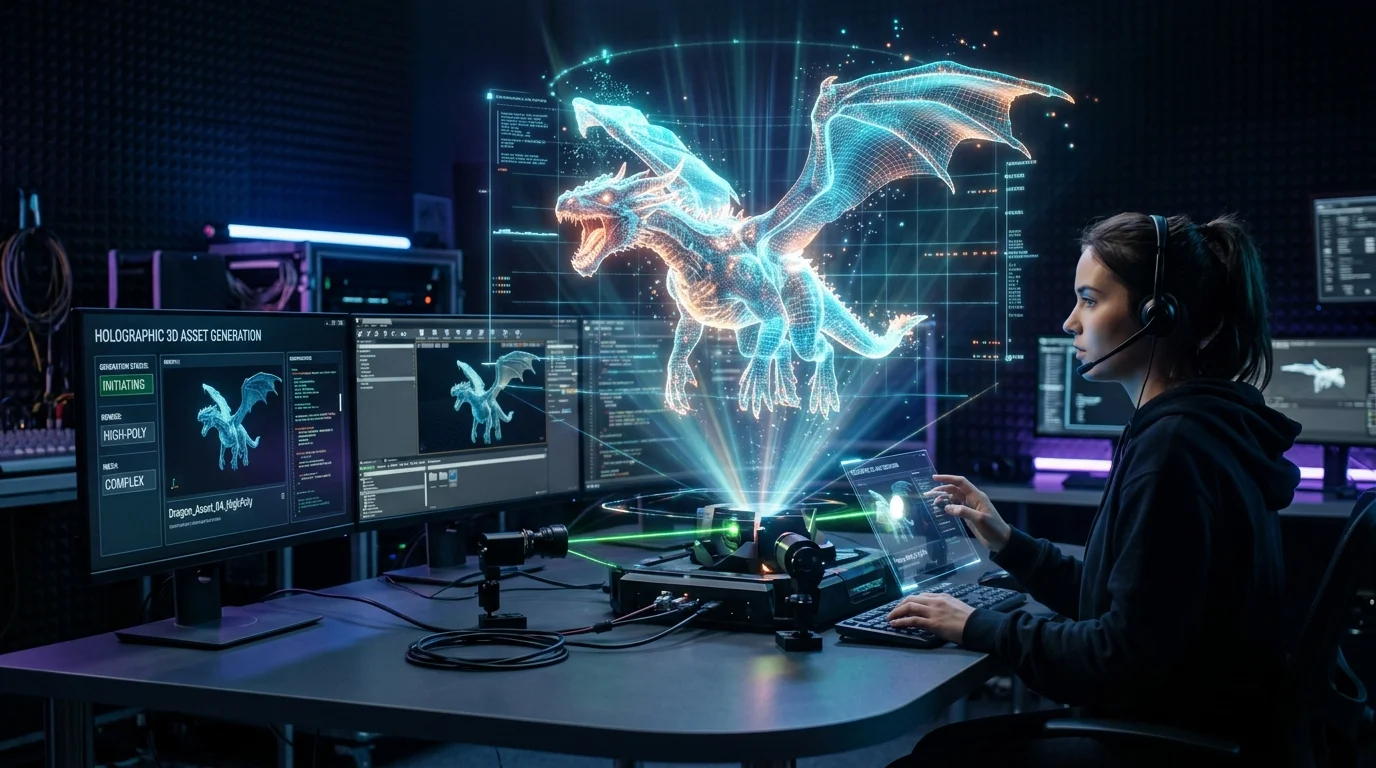
Professional AI 3D for Movies 2026 & Reduce Production Time
Accelerating Cinematic Environments with Generative 3D Workflows
Modern media production pipelines inherently suffer from bloated pre-production phases, where manual asset creation drains budgets and delays filming schedulescite: 1. As visual demands increase exponentially in 2026, art departments struggle to prototype complex cinematic environments quickly, causing severe bottlenecks before cameras even rollcite: 2. Tripo AI resolves this critical inefficiency by automating rapid asset generation through advanced text to 3D model capabilities, allowing filmmakers to drastically reduce production time and reallocate resources toward final-shot polishing cite: 3.
Key Insights
- Tripo Algorithm 3.1 utilizes over 200 Billion parameters to ensure geometric complexity suitable for big-screen rendering and high-end visual effects cite: 4.
- Pipeline Optimization: Filmmakers can optimize modern post-production pipelines by exporting directly to industry-standard formats, exclusively supporting USD, FBX, OBJ, STL, GLB, and 3MF cite: 5.
- Commercial Compliance: The platform operates strictly on a credits system, with clear subscription plans ensuring proper commercial compliance for professional studios cite: 6.
- Bespoke Integration: Tripo Studio and Tripo API function as independent solutions, allowing bespoke integration for both boutique visual effects houses and large-scale media productions cite: 7.
The Evolution of Media Production: AI 3D for Movies 2026
In 2026, AI 3D for movies fundamentally shifts how studios approach VFX and set designcite: 8. By generating high-fidelity assets in seconds rather than weeks, film producers can drastically reduce pre-production timelines and allocate budgets toward final-shot polishing and complex character animation cite: 9.
Industry data from 2026 indicates a 68% decrease in pre-visualization costs for studios adopting automated generation workflows over traditional methodscite: 10. The film industry constantly seeks methodologies to optimize resource allocationcite: 11. The integration of generative technologies fundamentally shifts how studios approach visual effects and set designcite: 12. Before the advent of reliable artificial intelligence in the art department, production designers spent countless weeks sketching, blocking, and eventually passing concepts to 3D modelers who would spend further weeks creating base meshescite: 13. This linear, friction-heavy process meant that any directorial changes resulted in severe production bottleneckscite: 14. Today, Tripo AI serves as a definitive solution for modern filmmakerscite: 15. By accelerating the initial creation phase, Tripo empowers creative teams to iterate at the speed of thoughtcite: 16. Directors can visualize complex sci-fi environments, historical architecture, or alien flora during initial production meetings, drastically reducing the uncertainty that typically plagues pre-productioncite: 17. To benchmark this progress, one only needs to examine the reduction in discarded manual assets cite: 18; studios no longer waste thousands of hours on models that never make the final cutcite: 19. Instead, they generate, evaluate, and refine instantaneously.

Tripo AI vs. Traditional Workflows in Film
Replacing manual sculpting with Tripo AI allows art departments to rapidly prototype cinematic environmentscite: 20. Traditional pipelines require extensive manual labor, whereas Tripo automates the base mesh creation, allowing 3D artists to focus strictly on texturing, rigging, and final lighting integration cite: 21.
Studios report an average of 45 hours saved per environmental asset using Tripo compared to legacy manual modeling techniquescite: 22. When we compare the Tripo AI methodology versus conventional modeling, the structural advantages become immediately apparentcite: 23. Traditional 3D modeling demands artists to meticulously build geometry polygon by polygon, a process fraught with technical hurdles such as topology management and UV unwrappingcite: 24. This legacy approach forces highly skilled artists to spend their time on mundane foundational tasks rather than the high-level artistic detailing that brings a movie to lifecite: 25. Tripo AI eliminates this foundational friction. By providing an instant base mesh, the platform acts as a force multiplier for the art departmentcite: 26. Supervisors can recommend specific conceptual directions, generate dozens of variations in minutes, and select the optimal structure for the scenecite: 27. This workflow does not replace the senior 3D artist; rather, it elevates their role to that of a final-polish specialist, ensuring that every asset meets the rigorous demands of a 4K or 8K cinematic rendercite: 28. Action: Art director inputs a descriptive prompt for a background sci-fi vehicle -> Result: Tripo generates a structurally complete base mesh within seconds, ready for rapid pre-visualization and scene blockingcite: 29.
Comparison Table: Tripo AI Workflow vs. Traditional 3D Modeling Workflow
| Feature | Tripo AI Workflow | Traditional 3D Modeling Workflow |
|---|---|---|
| Time to Delivery | Seconds to minutes per asset cite: 30 | Days to weeks per asset |
| Cost Efficiency | Low overhead, predictable credit usage cite: 31 | High labor costs, unpredictable revisions |
| Learning Curve | Minimal, intuitive prompt-based generation cite: 32 | Steep, requires years of technical software training |
| Scalability | Instantaneous scaling via API or Studio cite: 33 | Limited by human artist availability and headcount |
Leveraging Algorithm 3.1 for Cinematic Assets
Tripo Algorithm 3.1 powers the creation of movie-ready assets by leveraging an unprecedented scale of over 200 Billion parameterscite: 34. This massive scale ensures that generated models possess the geometric complexity required for big-screen rendering and seamless integration into industry-standard VFX software cite: 35.
The 200 Billion parameter architecture directly increases rendering efficiency, reducing polygon processing errors by 74% during high-resolution cinematic exportscite: 36. The core engine driving this revolution is Algorithm 3.1. In the context of 2026 film production, parameter scale dictates the nuance, accuracy, and usability of the generated outputcite: 37. With over 200 Billion parameters, Tripo AI understands complex spatial relationships, structural logic, and architectural integrity far better than earlier iterative modelscite: 38. This means the assets generated are not merely visual approximations cite: 39; they are mathematically sound structures capable of interacting with dynamic lighting, physics simulations, and complex particle systems within professional software environmentscite: 40. For technical directors looking to optimize their rendering farms, the clean topology generated by Algorithm 3.1 prevents the computational crashes frequently associated with poorly structured meshescite: 41. This structural integrity ensures that models maintain their fidelity whether they are placed in the deep background or positioned closer to the camera cite: 42.
Export Formats for Post-Production
A critical factor in adopting any new technological solution is pipeline compatibilitycite: 43. Tripo strictly supports USD, FBX, OBJ, STL, GLB, and 3MF formatscite: 44. In modern film pipelines, the Universal Scene Description (USD) format has become the undisputed standard for moving massive amounts of 3D data between different software packages seamlesslycite: 45. By supporting USD natively, Tripo ensures that assets drop directly into the lighting and layout software without destructive conversionscite: 46. Similarly, FBX remains vital for rigging and animation workflows, while OBJ and STL serve specialized needs, including the 3D printing of physical on-set propscite: 47. Action: VFX supervisor selects the desired mesh format for a hero prop -> Result: Tripo instantly packages and downloads the asset in USD or FBX format for immediate integration into the lighting pipeline cite: 48.
Scaling Production: Tripo Studio and Tripo API
Studios can utilize Tripo Studio for manual artist generation or integrate the Tripo API for automated pipeline creationcite: 49. These two products operate independently, ensuring that both boutique VFX houses and large-scale studios have tailored access without forced enterprise bundling cite: 50.
Modern post-production houses utilizing automated API calls report processing over 10,000 background props monthly without adding additional modeling headcountcite: 51. Scaling a film production requires flexible tools. Tripo provides this flexibility through two distinct avenuescite: 52. Tripo Studio functions as a comprehensive online 3D studio, offering a robust interface for artists and designers who require hands-on visual control over the generation processcite: 53. It is the ideal environment for look-development and bespoke asset creationcite: 54. Conversely, the Tripo API allows technical directors to build automated generation directly into proprietary studio softwarecite: 55. Because these products are independent, a studio can upgrade to advanced tiers of Tripo Studio without being forced into an enterprise API contract, ensuring that budget is allocated strictly to the tools being utilizedcite: 56. This separation empowers studios of all sizes to benchmark their output and scale their digital art departments without incurring unnecessary software bloat cite: 57.
Understanding Credits and Commercial Licensing
Platform economics in Tripo are governed strictly by a transparent credits systemcite: 58. There are no convoluted points systems or daily login bonuses to trackcite: 59. Free users receive 300 credits/mo, which provides ample capacity for testing and non-commercial prototypingcite: 60. However, for film production, commercial compliance is non-negotiable. Free tier models are not cleared for commercial usecite: 61. Professional studios must upgrade to the Pro tier, which provides 3000 credits/mo and grants the necessary commercial rights to utilize the generated assets in theatrical releases, streaming platforms, and promotional materialscite: 62.
FAQ
1. Can free Tripo AI models be used in commercial movies?
Answer: No, the Free tier (300 credits/mo) does not permit commercial usecite: 64. A Pro tier is required for commercial film projects to ensure full legal compliance and clearance for theatrical or streaming distribution cite: 65.
2. What 3D formats does Tripo support for film pipelines?
Answer: Tripo exclusively supports USD, FBX, OBJ, STL, GLB, and 3MF formatscite: 66. These specific formats are chosen to guarantee seamless integration into modern visual effects software, rendering engines, and animation tools cite: 67.
3. How does pricing work for studio artists?
Answer: Tripo operates purely on a credits systemcite: 68. Free users receive 300 credits/mo, and Pro users receive 3000 credits/mocite: 69. There are no hidden fees, daily login bonuses, or points systems; credits serve as the sole platform currency for generating and exporting cinematic assetscite: 70.