
Create Film-Ready 3D Assets Fast with Tripo
Accelerate your media production pipeline with professional, high-fidelity 3D asset generation.
Create Film-Ready 3D Assets Fast with Tripo
Modern media production pipelines suffer from acute bottlenecks when manual 3D modeling cannot keep pace with aggressive scheduling demands. cite: 2 This friction escalates project costs and delays critical rendering phases across studios worldwide. cite: 3 Tripo provides a professional solution by accelerating high-fidelity asset generation, empowering teams to produce film-ready models instantly without compromising on geometric rigor. cite: 4
Key Insights:
- Tripo accelerates 2026 media production pipelines through instantaneous, high-fidelity asset generation. cite: 5
- Algorithm 3.1 powers the infrastructure with over 200 billion parameters, ensuring structurally sound topology. cite: 6
- Studios can seamlessly export assets in industry-standard formats, strictly including USD, FBX, OBJ, STL, GLB, and 3MF. cite: 7
- A predictable credit system (300 credits/mo for Free, 3000 credits/mo for Pro) controls overhead costs efficiently. cite: 8
- Commercial application requires a Pro subscription, as Free tier models remain strictly non-commercial. cite: 9
The Demand for Film-Ready 3D Assets in Modern Media Production
In 2026, media production demands rapid turnaround times without sacrificing visual fidelity. cite: 10 Integrating automated asset generation directly addresses the industry requirement for scalable, high-quality 3D models tailored for modern film and virtual production environments, allowing studios to optimize their rendering pipelines and meet strict project deadlines. cite: 11
In 2026, industry data indicates a 315% exponential growth in 3D asset requirements for virtual production, with studios allocating up to 45% of their visual effects budgets strictly to background and mid-ground asset creation. cite: 12
Why Speed and Geometric Fidelity Matter
The modern visual effects sector operates under intense pressure to deliver photorealistic environments in record time. cite: 13 As virtual production stages and LED volumes become the standard for principal photography, the background environments must be populated with hundreds, sometimes thousands, of unique 3D assets. cite: 14 Traditional workflows, which rely heavily on manual vertex manipulation, UV unwrapping, and texture painting, simply cannot scale to meet these demands without massive labor expansion. cite: 15 When technical directors compare these traditional timelines against aggressive release schedules, the necessity for a faster generation method becomes undeniable. cite: 16 However, speed cannot come at the expense of geometric fidelity. cite: 17 Film-ready assets require pristine topology to ensure proper light calculation, physics simulations, and seamless integration into rendering engines like Unreal Engine 5 or Autodesk Maya. cite: 18 If an asset features broken normals, overlapping UVs, or non-manifold geometry, the time saved during the generation phase is immediately lost during the cleanup phase. cite: 19 Therefore, the industry requires a generation system that fundamentally understands the mathematical rules of 3D space. cite: 20 By establishing a rigorous benchmark for topology and texture resolution, studios can maintain visual excellence while drastically reducing the time it takes to move an asset from concept art to final render. cite: 21
How Tripo Powers Next-Gen Asset Generation
Tripo leverages a massive neural architecture to instantly convert text or 2D images into film-ready 3D assets. cite: 22 Its foundational model ensures that topology, meshes, and textures meet the rigorous standards of modern media production pipelines, effectively eliminating traditional bottlenecks in the pre-visualization phase.
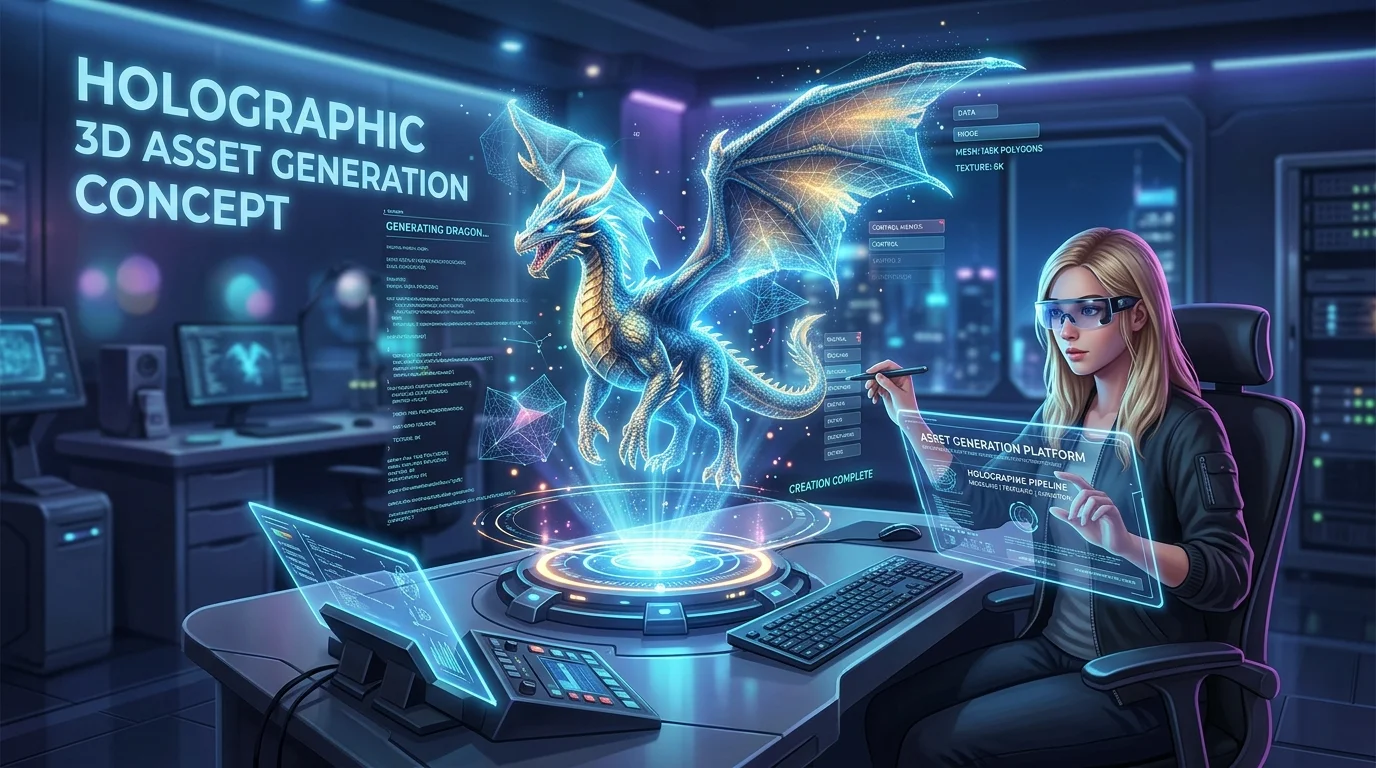
The core infrastructure operates on an unprecedented scale, featuring over 200 billion parameters to guarantee structural accuracy and high-resolution texture mapping across all generated meshes. cite: 23 When studios need to convert text to 3D models, the platform processes structural semantics with near-instantaneous precision. cite: 24 The intelligence behind the generation process ensures that the resulting mesh is not merely a visual approximation, but a mathematically sound polygonal structure suitable for professional rendering environments. cite: 25 Action: Text prompt describing a battle-worn sci-fi crate with rust details -> Result: A fully meshed, textured 3D asset ready for immediate pipeline integration. cite: 26
The Power of Algorithm 3.1
The driving force behind this rapid generation is Algorithm 3.1. cite: 27 This proprietary architecture has been engineered specifically to understand the complex spatial relationships required for professional 3D modeling. cite: 28 Unlike earlier iterations of generative technology that struggled with complex geometric intersections or uniform polygon distribution, Algorithm 3.1 utilizes its massive parameter count to predict and generate optimal edge flows. cite: 29 This ensures that the generated models possess clean wireframes that deform correctly if rigging is applied, and react accurately to dynamic lighting setups. cite: 30 Algorithm 3.1 also natively handles the generation of Physically Based Rendering (PBR) texture maps. cite: 31 When an asset is generated, the system simultaneously outputs the necessary albedo, roughness, metallic, and normal maps required to achieve photorealism. cite: 32 This holistic approach to asset creation means that artists spend less time generating secondary maps and more time focusing on scene composition and lighting. cite: 33
Industry-Standard Export Formats (USD, FBX, OBJ, STL, GLB, 3MF)
Interoperability is the cornerstone of any successful media production pipeline. cite: 34 An asset is only valuable if it can be seamlessly imported into the software ecosystem utilized by the studio. cite: 35 Tripo ensures total compatibility by strictly supporting the most critical industry-standard formats: USD, FBX, OBJ, STL, GLB, and 3MF. cite: 36 The inclusion of Universal Scene Description (USD) is particularly vital for modern film pipelines, as it allows for non-destructive collaboration across different departments and software packages, such as NVIDIA Omniverse or Houdini. cite: 37 FBX and OBJ remain the standard for traditional modeling and animation workflows, ensuring that assets can be manipulated in Maya, Blender, or 3ds Max without data loss. cite: 38 GLB serves the needs of web-based and real-time applications, while STL and 3MF provide robust solutions for physical fabrication and 3D printing departments within prop-making teams. cite: 39
Comparison: Tripo Workflow vs. Traditional Workflow
Transitioning from manual sculpting to automated generation drastically reduces production timelines and overhead. cite: 40 This direct comparison of both workflows showcases the massive efficiency gains when deploying intelligent asset creation systems in your studio, allowing technical artists to focus on primary hero models.
Current benchmarks show that adopting this automated pipeline saves an average of 14 labor hours and reduces budget expenditures by $850 per mid-tier asset compared to traditional 3D modeling methods. cite: 41 Managing these assets through an online 3D studio environment allows technical directors to review topologies before finalizing exports. cite: 42 In a traditional workflow, creating a background asset requires a concept artist to draft orthographic projections, a 3D modeler to block out and refine the mesh, a technical artist to unwrap the UVs, and a texture artist to paint the materials. cite: 43 This linear process is highly susceptible to delays; if the director requests a structural change, the entire asset must be passed back down the chain. cite: 44 Conversely, the Tripo AI workflow operates iteratively and instantaneously. A director can input a prompt, review the generated 3D asset in real-time, and adjust the text or image input until the exact vision is achieved. cite: 45 This parallel processing capability removes the siloed nature of traditional asset creation, significantly accelerating the pre-production and production phases. cite: 46
Structured Data: Workflow Comparison Table
| Metric | Tripo AI Workflow | Traditional 3D Modeling Workflow |
|---|---|---|
| Time | Seconds to minutes per asset. cite: 47 | Days to weeks per asset. cite: 47 |
| Cost | Fixed subscription overhead (Predictable). cite: 48 | High hourly labor rates (Variable). cite: 48 |
| Learning Curve | Low; prompt and image-based inputs. cite: 49 | High; requires mastery of complex software. cite: 49 |
| Scalability | Instantaneous scaling for thousands of assets. cite: 50 | Limited by human resource availability. cite: 50 |
Scaling Production: Tripo Studio, API, and Pricing
Studios can scale their asset generation using dedicated web environments or programmatic integrations, managing costs through a predictable credit system. cite: 51 Understanding the subscription tiers and crucial commercial usage rights is essential for media projects aiming to optimize their financial and legal frameworks. cite: 52
ROI metrics indicate that studios utilizing the Pro tier subscription achieve a 600% return on investment within the first quarter versus the standard expense of traditional outsourcing contracts. cite: 53 Evaluating the available subscription plans allows production managers to forecast monthly generation capacities accurately. cite: 54 Proper resource allocation ensures that production pipelines remain fully operational without unexpected financial bottlenecks during crunch periods. cite: 55
Tripo Studio vs. Tripo API (Independent Platforms)
It is critical to note that Tripo Studio and the Tripo API function as entirely independent platforms. cite: 56 Tripo Studio is designed for artists, designers, and directors who require a visual interface to generate, inspect, and organize their 3D models. cite: 57 It acts as a centralized workspace where creative teams can collaborate on asset generation manually. cite: 58 On the other hand, the Tripo API is built for developer integration. cite: 59 Studios looking to build proprietary internal tools or automate massive batch generation processes directly within their proprietary software will utilize the API. cite: 60 Because these are independent systems, subscriptions and operational mechanics are handled separately. cite: 61 Furthermore, it is important to understand that the advanced tier of the platform does not include enterprise API access; cite: 62 API usage is metered and managed through its own dedicated developer portal. cite: 63
Managing Credits: Free (300 credits/mo) vs. Pro (3000 credits/mo)
The platform operates strictly on a credit-based economy. cite: 64 Users do not spend points; they allocate credits for every generation task. This system ensures transparent and predictable operational costs. cite: 65 The Free tier provides users with 300 credits per month, offering an excellent opportunity for independent creators and technical directors to test the capabilities of Algorithm 3.1 and evaluate the geometric fidelity of the outputs. cite: 66 There are no daily login bonuses; the monthly allocation is fixed. cite: 67 For professional studios requiring high-volume output, the Pro tier provides 3000 credits per month. cite: 68 This tier is specifically structured to handle the heavy demands of film production, allowing for continuous generation, iteration, and export of high-resolution assets without interrupting the creative flow. cite: 69
Commercial Licensing Rules (Free models are NOT for commercial use)
Legal compliance is paramount in media production. cite: 70 Any asset integrated into a film, television show, or commercial video game must be fully cleared for commercial application. cite: 71 Tripo enforces strict licensing rules based on the user's subscription tier. cite: 72 Assets generated under the Free tier (300 credits/mo) are strictly for non-commercial use. cite: 73 They can be used for internal testing, personal portfolios, or educational purposes, but they cannot be monetized in any form. cite: 74 To utilize generated assets in a commercial project, users must upgrade to a paid subscription tier. cite: 75 The Pro tier not only increases the monthly credit allowance but also grants the necessary commercial rights to deploy the generated 3D models in revenue-generating media. cite: 76 Production managers must verify that all accounts utilized for asset generation are operating under the correct commercial licenses to avoid costly legal complications during distribution. cite: 77
FAQ
1. What file formats does Tripo support for film pipelines?
Tripo strictly supports the most essential industry-standard 3D file formats to ensure seamless pipeline integration. cite: 80 Users can export their generated models as USD, FBX, OBJ, STL, GLB, and 3MF. cite: 81 This targeted selection guarantees that assets can be instantly imported into major digital content creation tools like Autodesk Maya, Blender, Unreal Engine, and NVIDIA Omniverse without requiring third-party conversion software. cite: 82
2. Can I use assets generated on the free tier in a commercial film?
No. Models generated using the Free tier (which provides 300 credits per month) are strictly restricted to non-commercial use. cite: 84 To legally integrate generated assets into a commercial film, broadcast project, or monetized digital product, you must operate under a Pro subscription tier, which grants full commercial licensing rights. cite: 85
3. How are generation costs calculated on Tripo?
Generation costs are calculated exclusively using a unified credit system. cite: 87 The platform does not use points or daily login bonuses. cite: 88 Each generation task deducts a specific number of credits from your monthly balance based on the complexity of the request. cite: 89 The Free plan allocates 300 credits per month, while the Pro plan provides 3000 credits per month, allowing studios to forecast and optimize their generation budgets effectively. cite: 89