Optimizing AI Generated 3D Game Assets for Mobile Gaming Performance
Advanced Strategies for Real-Time Rendering on Constrained Hardware
The landscape of interactive entertainment in 2026 demands high efficiency in game development pipelines, particularly for hardware-constrained platforms. Optimizing ai generated 3d game assets for mobile gaming performance has emerged as a critical discipline, bridging the gap between rapid algorithmic creation and strict real-time rendering budgets. By transitioning from manual sculpting to advanced, parameter-heavy AI generation, developers can significantly accelerate production. 3D Generative AI provides a comprehensive ecosystem designed specifically to ensure that algorithmically generated models meet the rigorous topological and texturing standards required for seamless deployment on mobile devices.
Key Insights
- Massive Parameter Scale: Algorithm 3.1 utilizes over 200 billion parameters to generate structurally sound base meshes, minimizing the need for manual cleanup.
- Automated Topology Control: Smart Low Poly tools reduce polygon counts by up to 90% while preserving crucial edge flow for mobile rendering.
- Efficient Material Pipelines: Integrated PBR baking and texture optimization ensure high visual fidelity without exceeding mobile memory limits.
- Separation of Environments: Tripo Studio and the Tripo API operate as completely independent product lines, allowing studios to choose between visual interfaces and programmatic scalability.
- Cost-Effective Asset Generation: Transparent billing structures ensure predictable costs for both independent developers and enterprise studios.
The Fundamental Challenges of Mobile Game Asset Optimization
The primary objective when optimizing ai generated 3d game assets for mobile gaming performance is strictly controlling polygon counts, draw calls, and texture memory to prevent thermal throttling and frame rate drops on constrained hardware architectures.
Mobile devices in 2026 feature powerful graphical processing units, but they remain heavily bottlenecked by battery limitations, thermal constraints, and unified memory architectures. Raw outputs from basic generative models often contain millions of unorganized polygons, chaotic edge flows, and overlapping UV islands. Such messy geometry is fundamentally incompatible with mobile game engines. Rendering engines like Unity or Unreal Engine operating on mobile platforms require highly optimized, continuous meshes to process lighting and physics calculations efficiently.
Leveraging Tripo AI Algorithm 3.1 for Foundational Geometry
Tripo AI utilizes Algorithm 3.1, a foundational model trained with over 200 billion parameters, to generate clean initial geometry that significantly reduces the friction typically associated with optimizing ai generated 3d game assets for mobile gaming performance.
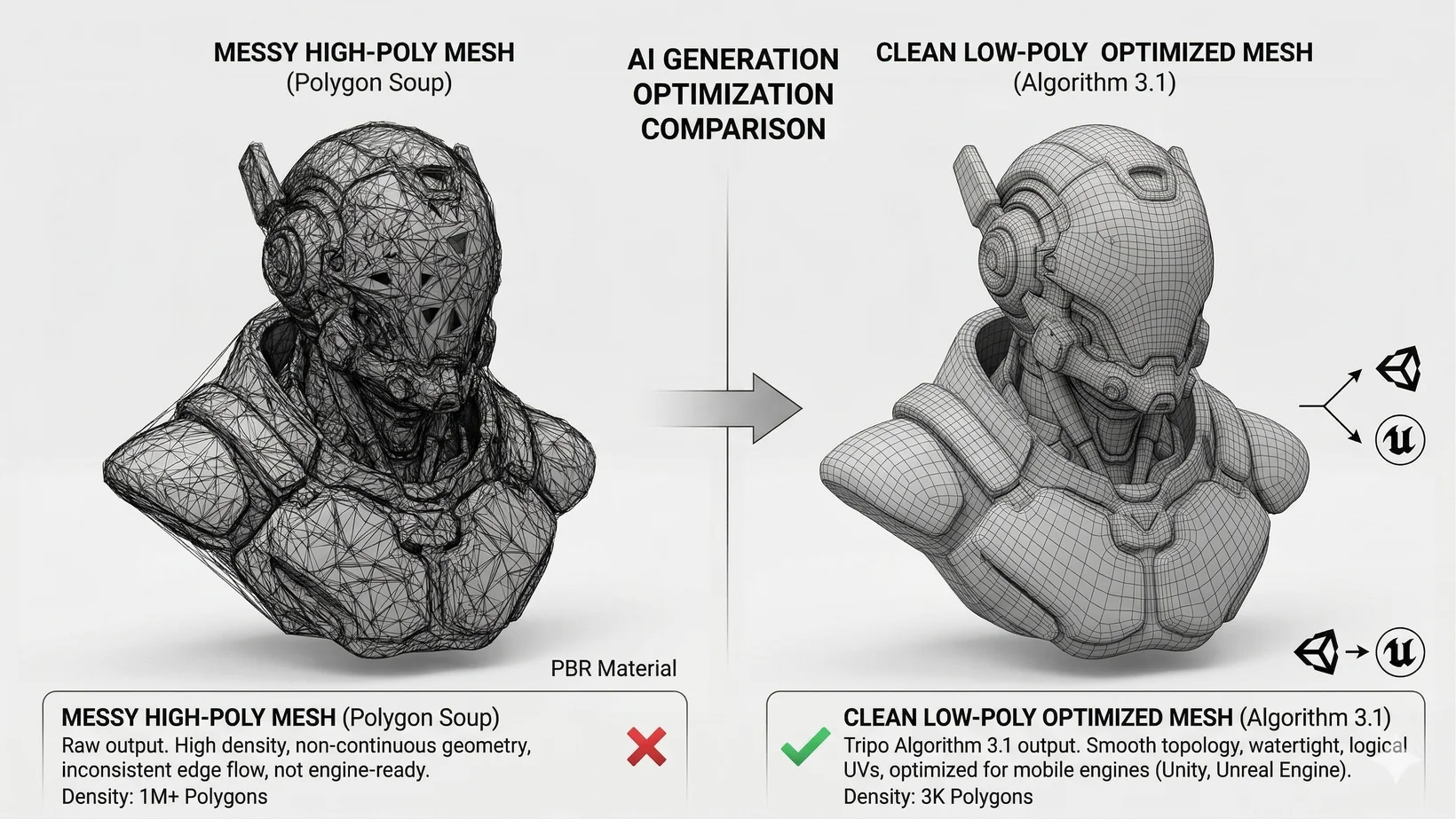
The quality of the final optimized mobile asset is directly proportional to the structural integrity of the initial generated mesh. Legacy generative algorithms frequently produced "polygon soup"—disconnected faces and internal geometry that complicated optimization pipelines. Algorithm 3.1 represents a massive leap forward in spatial understanding. By leveraging over 200 billion parameters, the model inherently understands the structural requirements of 3D forms, producing continuous, watertight meshes devoid of internal intersecting faces.
Smart Retopology and Polygon Reduction Strategies
Automated retopology and intelligent polygon reduction are highly critical steps in optimizing ai generated 3d game assets for mobile gaming performance, allowing complex shapes to be rendered smoothly on mobile graphics processors.
Once a high-fidelity model is generated, it must be systematically reduced to meet mobile polygon budgets. Tripo features a highly advanced Smart Low Poly system designed specifically for this purpose. This system does not simply collapse random vertices; it analyzes the curvature and silhouette of the model to determine where geometry is essential and where it can be safely eliminated.
Advanced Texturing, UV Mapping, and PBR Optimization
Efficient texture mapping, utilizing baked Physically Based Rendering (PBR) materials, guarantees that optimizing ai generated 3d game assets for mobile gaming performance does not result in a loss of visual richness or surface detail.
Modular Segmentation for Granular Performance Control
Segmenting complex models into modular parts allows for granular control over mesh density, which is a highly effective technique when optimizing ai generated 3d game assets for mobile gaming performance.
Auto-Rigging Systems and Animation Pipeline Integration
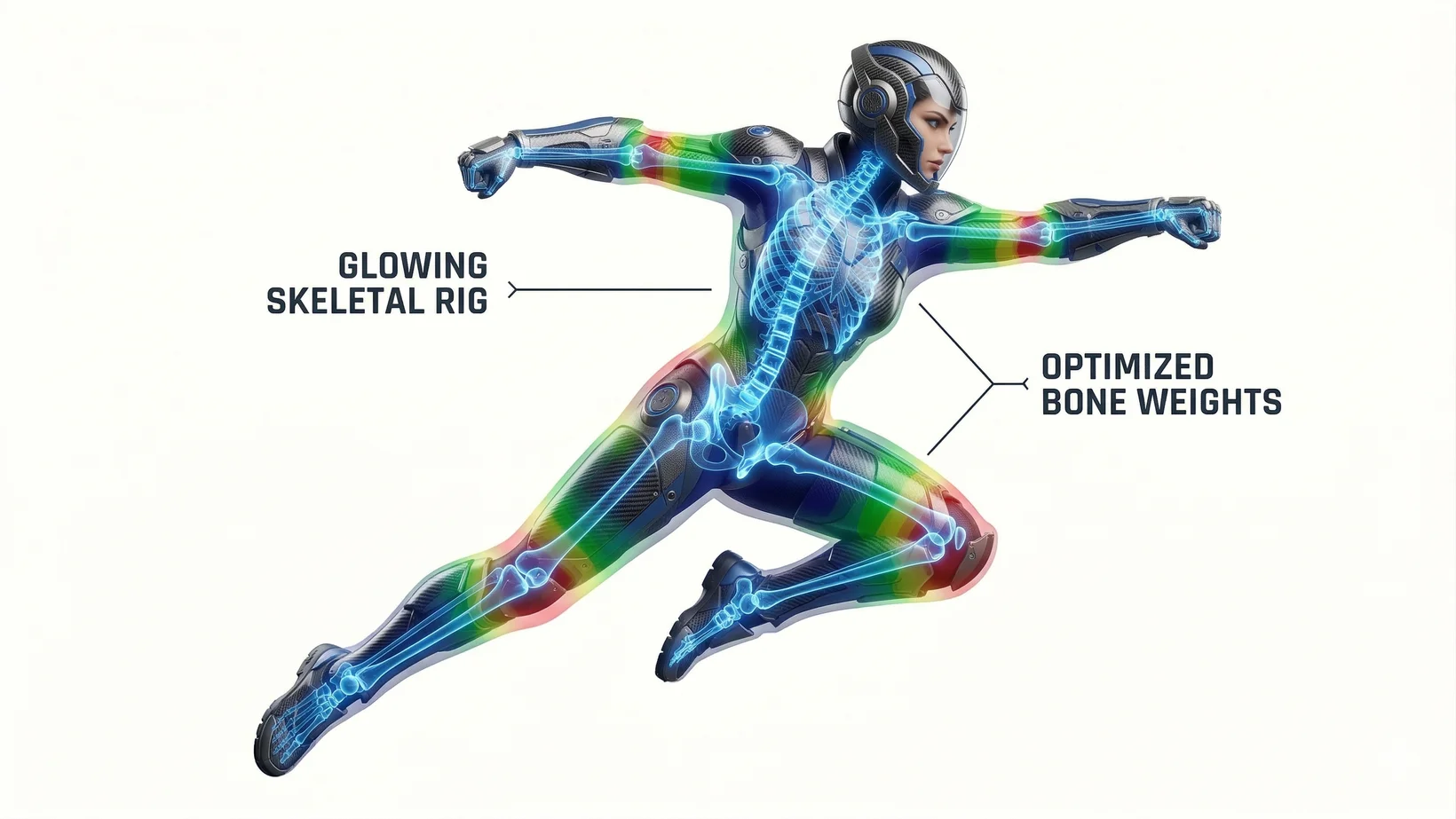
Implementing automated skeletal binding ensures that optimizing ai generated 3d game assets for mobile gaming performance extends beyond static meshes into highly efficient, engine-ready animation pipelines.
Engine Integration via Tripo DCC Bridges
Utilizing direct engine bridges bypasses manual file management, streamlining the final stage of optimizing ai generated 3d game assets for mobile gaming performance by importing assets directly into the development environment.
Scalable Deployment via Tripo Studio and Tripo API
Tripo Studio provides comprehensive visual interfaces for asset refinement, while the completely independent Tripo API allows enterprise developers to programmatically scale the process of optimizing ai generated 3d game assets for mobile gaming performance.
FAQ
1. Can I use the models generated on the free tier for my commercial mobile game?
No. 3D models generated under Tripo's Free plan do not support commercial use. The Free plan provides 300 credits per month intended for non-commercial exploration. For commercial rights, you must upgrade to a paid tier.
2. What 3D export formats are supported for game engine integration?
Assets can be exported in all major industry-standard formats to ensure compatibility with Unity, Unreal Engine, and other DCC tools. Supported formats include USD, FBX, OBJ, STL, GLB, and 3MF.
3. Is the Tripo API included in my Tripo Studio subscription?
No. Tripo Studio and the Tripo API are two completely independent product lines. The API service operates under a separate billing and access system and is not an add-on feature to Studio packages.
4. What makes Algorithm 3.1 different from previous versions?
Algorithm 3.1 is trained with over 200 billion parameters, allowing it to generate highly continuous, structurally sound meshes rather than "polygon soup."