
Optimize LOD Streaming in Game Dev with Tripo AI
Automating 3D Asset Generation and Memory Optimization for Modern Game Engines
Managing memory budgets while maintaining visual fidelity in massive open-world environments introduces significant friction for technical artists.
As player expectations for dense, highly realistic environments rise in 2026, manual decimation and optimization pipelines severely bottleneck production timelines and inflate budgets.
To resolve these critical performance hurdles, developers now implement Tripo AI to automate rapid, high-quality asset generation, ensuring efficient rendering performance and streamlined production scaling.
Key Insights
- Implement robust LOD streaming to drastically reduce VRAM overhead while preserving environmental density.
- Compare Tripo AI's automated generation against traditional manual retopology to benchmark time and cost savings.
- Utilize Algorithm 3.1 to guarantee high-quality base meshes that transition cleanly into lower polycounts.
- Optimize asset pipelines by exporting exclusively to industry-standard formats (USD, FBX, OBJ, STL, GLB, 3MF).
- Scale production sustainably with a clear understanding of the independent Tripo Studio and API ecosystems.
Understanding LOD Streaming in Modern Game Development
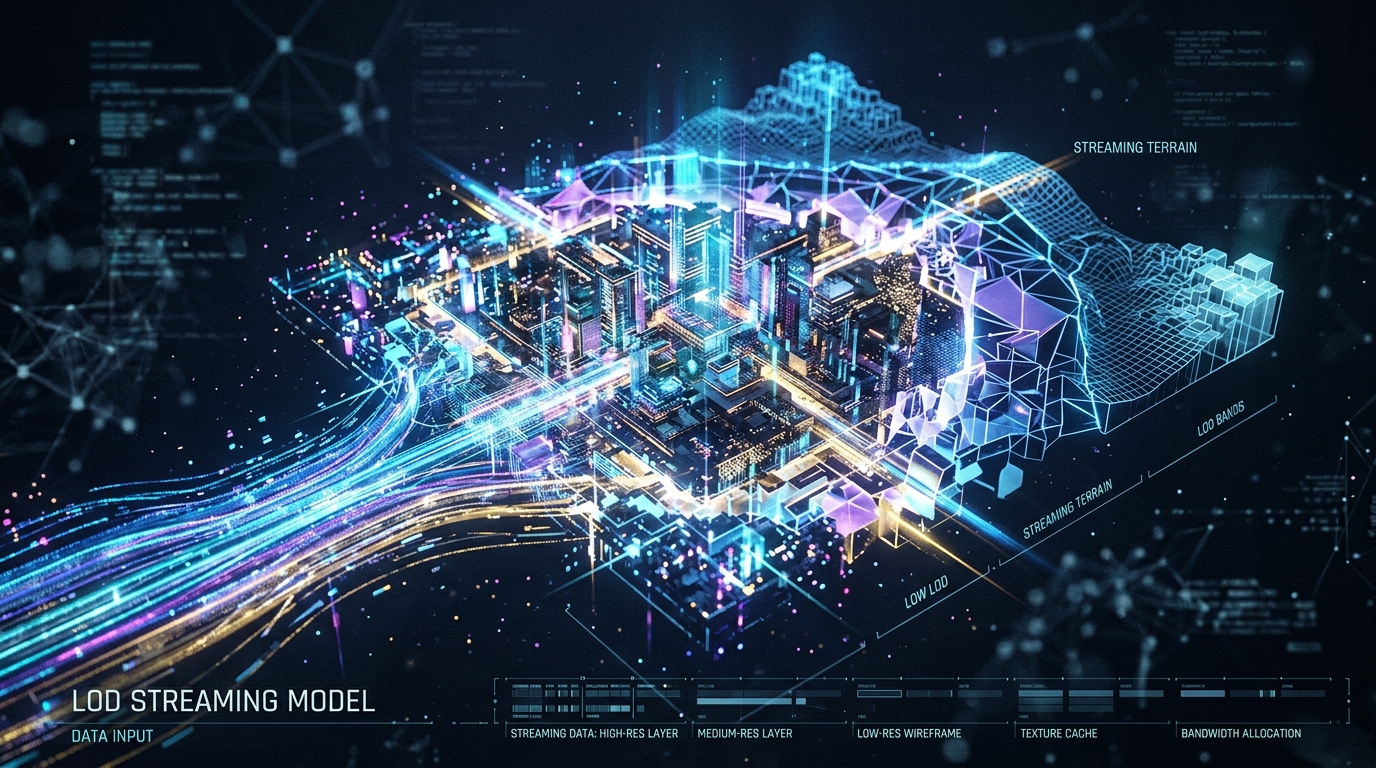
Level of Detail (LOD) streaming dynamically loads varying model resolutions based on camera distance, drastically reducing memory usage and ensuring smooth frame rates in complex game environments.
By substituting high-polygon assets with optimized equivalents at a distance, developers maintain visual integrity without overloading rendering pipelines.
Implementing efficient LOD streaming in next-gen engines yields a proven benchmark of 40-60% average VRAM reduction, stabilizing performance across diverse hardware configurations.
The Mechanics of Real-Time Asset Streaming
Real-time asset streaming operates on the principle of resource economy. In modern game development, rendering every vertex of a highly detailed model when it occupies only a few pixels on the screen is computationally wasteful. LOD streaming systems monitor the spatial relationship between the player's camera and the objects within the frustum. As the distance increases, the engine automatically swaps the high-resolution base mesh (LOD0) for progressively decimated versions (LOD1, LOD2, LOD3).
Why Topology and Polycount Matter for LODs
The success of an LOD streaming system relies heavily on the underlying topology of the 3D assets. Clean edge flow and strategic polygon distribution ensure that when an engine automatically generates lower LODs, the structural silhouette of the object remains intact.
Tripo AI vs. Traditional LOD Generation Workflows
Traditional LOD creation mandates hours of manual decimation and retopology, whereas Tripo AI leverages an expansive neural network to instantly generate optimized 3D assets ready for game engine streaming. This automated solution dramatically accelerates the pipeline, removing tedious manual labor from the technical artist's workload.
Comparison Table: Tripo Workflow vs. Traditional Workflow
| Metric | Tripo AI Workflow | Traditional 3D Modeling Workflow |
|---|---|---|
| Time Allocation | Seconds per base asset | Hours to days per asset |
| Cost Efficiency | Low (managed via credit system) | High (extensive labor hours) |
| Learning Curve | Minimal (prompt-driven interface) | Steep (requires advanced DCC software expertise) |
| Scalability | Instantaneous batch generation | Linear bottleneck based on team size |
| LOD Readiness | Clean topology ready for engine decimation | Requires manual retopology passes |
Exporting and Integrating Tripo Assets for LOD Streaming
Leveraging Algorithm 3.1 for High-Fidelity Geometry
The core of the platform's generation capability is Algorithm 3.1, a highly sophisticated model trained to prioritize geometric coherence and surface integrity.
Supported Formats for Game Engines (USD, FBX, OBJ, STL, GLB, 3MF)
Tripo strictly supports USD, FBX, OBJ, STL, GLB, and 3MF. For LOD streaming, FBX remains the industry standard, carrying the necessary vertex data, normals, and UV coordinates required for accurate rendering and decimation.
Scaling Your Game Dev Pipeline with Tripo
Managing Production Costs: Free (300 credits/mo) vs. Pro (3000 credits/mo)
The Pro tier provides 3000 credits per month, delivering the volume necessary to populate expansive levels with diverse, high-quality props.
Tripo Studio vs. Tripo API Independence
It is crucial to understand that Tripo Studio and the Tripo API operate as entirely independent products. Development teams must choose the ecosystem that aligns with their technical infrastructure.
Commercial Usage Rules
Assets generated under the Free tier (300 credits/mo) are explicitly restricted from commercial use. To legally deploy generated assets within a monetized game, developers must operate under an active paid subscription.
FAQ
1. How does Algorithm 3.1 improve LOD streaming in game development?
Algorithm 3.1 fundamentally improves LOD streaming by generating base meshes with superior geometric accuracy and balanced topology. It ensures that when the engine reduces the polycount, the asset maintains its silhouette and UV integrity.
2. Can I use assets generated on the Free tier (300 credits/mo) in a commercial game?
No. Assets generated using the Free tier are strictly for non-commercial use, such as prototyping or internal testing.
3. What are the recommended export formats from Tripo for LOD streaming?
FBX is highly recommended for traditional game engine LOD streaming, while USD is optimal for collaborative pipelines like NVIDIA Omniverse.
4. Does the Tripo Advanced tier include Enterprise API access?
No. Tripo Studio and the Tripo API are completely independent ecosystems.