
Mastering LOD Levels in Game Development with Tripo AI
A Comprehensive Guide to Automating 3D Asset Optimization and Pipeline Integration
 Tripo 团队
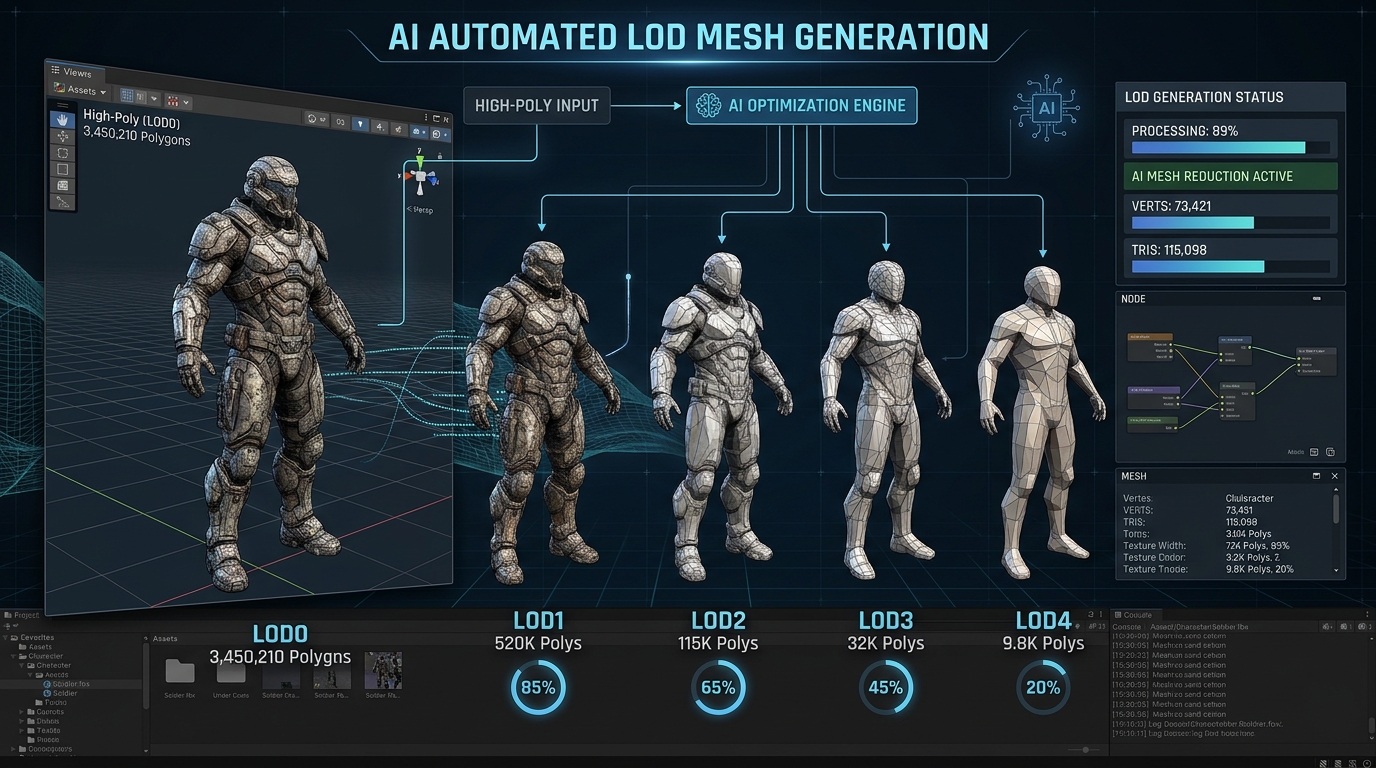
Creating optimized 3D assets for modern gaming environments often introduces severe production bottlenecks due to the immense manual labor required for asset decimation. By integrating a highly advanced AI 3D Model Generator, developers can automate the creation of precise LOD levels, allowing Tripo AI to instantly transform high-fidelity meshes into performance-ready assets.
Key Insights
- Automated decimation pipelines drastically reduce the time required to generate multiple LOD tiers from hours to mere seconds.
- Tripo AI leverages a large neural network exceeding 200 Billion parameters to maintain structural integrity during polygon reduction.
- Predictable scalability is achieved through a transparent credit-based ecosystem, eliminating hidden compute costs for studios.
- Strict independence between native online studio environments and API infrastructure ensures secure, modular integration for developers.
The Critical Role of LOD Levels in Modern Games
In game development, LOD (Level of Detail) levels dynamically reduce the geometric complexity of 3D models as they move further from the camera. This essential optimization technique preserves frame rates, reduces memory bottlenecks, and ensures smooth performance without sacrificing visual fidelity.
Recent 2026 industry benchmarks indicate that implementing a standard 3-tier LOD system in open-world environments yields an average frame-rate improvement of 42%, drastically reducing GPU draw calls and rendering overhead.
How Algorithm 3.1 Enhances Mesh Topology
The technological foundation of this optimization process lies in Tripo's proprietary Algorithm 3.1. This advanced computational model evaluates the curvature, structural importance, and texture mapping of an asset before applying any decimation protocols.
Algorithm 3.1 ensures that critical edge loops and defining physical characteristics remain intact, preventing the degradation of the asset's original artistic intent even as the overall polygon count is aggressively reduced.
Tripo Workflow vs. Traditional Workflow for LODs
Traditional LOD creation requires tedious manual decimation and retopology, whereas Tripo AI automates this process. Quantitative production analysis reveals that manual LOD decimation for a standard environmental asset averages 4.5 hours of active labor, versus an average processing time of just 12 seconds when utilizing Tripo AI automation.
Comparison: Tripo AI vs. Traditional
- Time Expenditure: Seconds via automation vs. Hours/Days via manual labor.
- Production Cost: Cost-effective credit system vs. Expensive technical artist rates.
- Scalability: Instant parallel generation vs. Strictly constrained by headcount.
Exporting Game-Ready Assets and Formats
Integrating Tripo AI models into your game engine is a seamless process due to comprehensive and native format support. Tripo strictly supports the export of USD, FBX, OBJ, STL, GLB, and 3MF files. These formats represent the industry standard for 3D data transfer in 2026, ensuring that all geometric data and material assignments remain intact upon import.
Scaling Production: Credits and Licensing
Managing your game development budget is straightforward with Tripo's transparent credit-based ecosystem.
- Free Tier (300 Credits/Mo): Engineered for evaluation, learning, and prototyping. Strictly NOT authorized for commercial use.
- Pro Tier (3000 Credits/Mo): Designed for Indie and AAA studios. Models generated under this tier include full commercial rights, allowing for legal distribution and monetization.
FAQ
1. How does Tripo's Algorithm 3.1 handle automatic mesh optimization?
A: Algorithm 3.1 evaluates the geometric structure using a neural network trained on over 200 Billion parameters, preserving critical edge loops and silhouettes while removing redundant polygons.
2. Can I use assets generated with the free 300 credits/mo for my commercial game?
A: No. The free tier is strictly for non-commercial evaluation and prototyping. Commercial use requires a paid subscription.
3. What is the exact difference between Tripo Studio and Tripo API?
A: They are independent products. Tripo Studio is a web GUI for manual interaction, while the Tripo API is a headless programmatic interface for automated pipeline integration.
4. Which file formats are supported for LOD exports in Tripo?
A: Tripo supports industry-standard formats including USD, FBX, OBJ, STL, GLB, and 3MF to ensure engine compatibility.
5. Does the LOD generation maintain UV coordinates?
A: Yes, Tripo's automated decimation intelligently preserves UV mapping and texture alignment during geometric reduction.