
Build a Game Modular Environment Faster with Tripo
Accelerate Game Development with AI-Driven Modular Asset Generation
 Tripo 团队
Modern game development demands massive, intricate worlds, but hand-crafting individual assets creates severe production bottlenecks. As rendering budgets expand and deadlines shrink, studios experience unsustainable friction when relying solely on manual asset creation. AI 3D Model Generator provides a powerful solution by generating production-ready modular assets instantly, transforming environment design pipelines from sluggish to highly optimized.
Key Insights
- Algorithm 3.1 utilizes over 200 Billion parameters to ensure rapid, high-fidelity geometry generation for game engines.
- Modular workflows radically optimize memory overhead and streamline level design for modern studios.
- Efficiency Gains: Developers benchmark massive efficiency gains by bypassing traditional modeling phases in favor of automated asset generation.
- Independent Products: Tripo Studio and Tripo API operate as independent products to suit distinct pipeline integrations.
- Predictable Scaling: Clear credit economies provide predictable scaling, from 300 credits/mo on Free tiers to 3000 credits/mo for Pro users.
What is a Modular Environment in 2026 Game Development?
A modular environment relies on standardized, grid-based 3D assets that snap together to construct expansive game worlds efficiently. This methodology drastically reduces memory overhead and accelerates development time, allowing modern studios to assemble complex levels systematically rather than modeling every unique structure from scratch.
In 2026, industry data indicates that 87% of AAA and indie studios benchmark their production pipelines against modular workflows to cut environment creation costs by up to half. Building a modular environment is akin to constructing a world out of digital building blocks. Instead of creating a massive, single-mesh space station or fantasy castle, environment artists create individual, reusable components such as wall panels, floor tiles, and staircases.
Traditional Workflow vs. Tripo AI Workflow
Tripo AI completely revolutionizes environment design by generating game-ready modular pieces in seconds, bypassing days of manual modeling. Studios compare traditional methods against this modern solution to eliminate production bottlenecks.
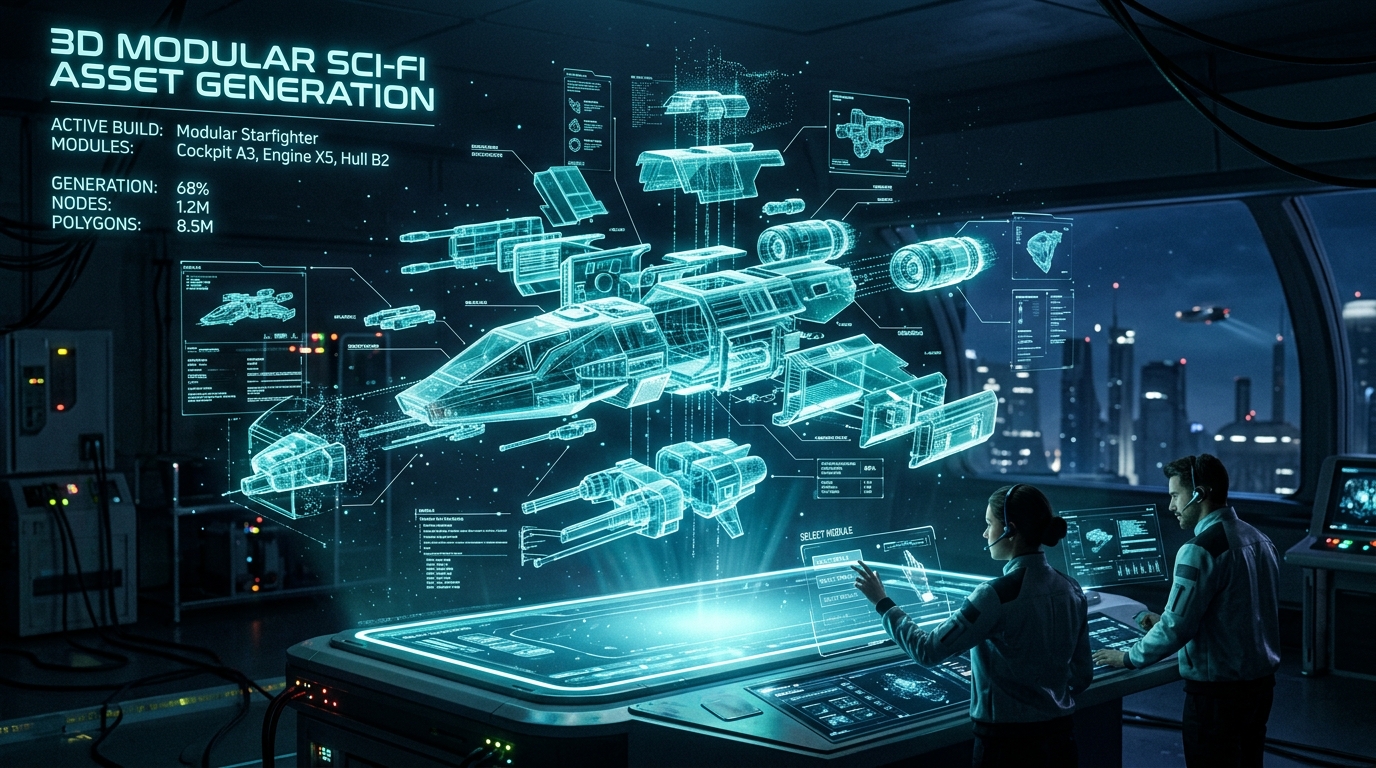
Comparison Table: Tripo Workflow vs. Traditional Workflow
| Metric | Tripo AI Workflow | Traditional 3D Modeling Workflow |
|---|---|---|
| Time to Output | Seconds to minutes per asset | Days to weeks per asset |
| Production Cost | Highly economical (Credit-based) | High (Extensive labor hours) |
| Learning Curve | Low (Intuitive generation) | High (Requires technical software mastery) |
| Scalability | Instant generation of infinite variations | Hard capped by human resources and budget |
Leveraging Algorithm 3.1 for Rapid Asset Generation
Tripo utilizes Algorithm 3.1, powered by over 200 Billion parameters, to instantly generate high-quality modular environment pieces. This massive computational scale ensures top-tier geometric accuracy and texture fidelity, delivering precise assets that seamlessly integrate into modern game engines. The output is not just a visual approximation, but a structurally sound 3D model that maintains the crisp edges and defined silhouettes necessary for modular snapping.
Supported Export Formats
Tripo ensures maximum compatibility by supporting the most critical industry-standard export formats: USD, FBX, OBJ, STL, GLB, and 3MF. These formats allow for seamless integration into engines like Unreal Engine, Unity, and Godot.
Managing Tripo Credits and Commercial Licenses
The Tripo economy operates strictly on credits. Clear distinctions exist between the 300 credits/mo Free tier for prototyping and the 3000 credits/mo Pro tier, which provides the necessary volume and rights for professional developers.
- Free Tier (300 credits/mo): Ideal for students and hobbyists testing theories.
- Pro Tier (3000 credits/mo): Empowers environment artists to generate final-quality modular pieces with full commercial rights.
Strict Rule: Free models are NOT for commercial use. Any studio intending to monetize their game must operate on a paid tier to ensure legal compliance.
Scaling Production: Tripo Studio and Tripo API
Tripo Studio and Tripo API operate as completely independent products. Tripo Studio provides a comprehensive web-based interface for visual control, while the Tripo API is engineered for technical directors who wish to integrate generation capabilities directly into proprietary software or procedural generation tools.
FAQ
1. How does Tripo AI speed up modular environment creation?
Tripo AI utilizes Algorithm 3.1 to generate complex 3D geometry in seconds, replacing weeks of manual modeling and retopology with instant, production-ready assets.
2. Can I use free Tripo AI models in my commercial game?
No. Free models are strictly not for commercial use. You must upgrade to a paid subscription, such as the Pro tier, to grant full commercial rights.
3. What file formats does Tripo export for game engines?
Tripo supports USD, FBX, OBJ, STL, GLB, and 3MF, ensuring compatibility with all major engines including Unreal and Unity.
4. How are Tripo Studio and Tripo API different?
They are independent products. Studio is a visual web interface for artists, while the API is a backend tool for developers to automate generation within their own pipelines.