Accelerate Blender, Maya, Max Game Dev with Tripo
Streamlining 3D Asset Production from Generative Ideation to Professional DCC Software
Game development pipelines historically suffer from severe bottlenecks during the initial 3D modeling and prototyping phases, draining both time and production budgets. As studio deadlines tighten and visual fidelity requirements escalate, the friction of manual sculpting from scratch forces art teams to compromise on iteration cycles and creative exploration.
Tripo AI emerges as the professional solution to this industry-wide challenge, seamlessly bridging the gap between rapid generative ideation and established software like Blender, Maya, and Max to drastically accelerate asset production.
- Rapid Base Mesh Generation: Utilize advanced generative models to output high-fidelity base meshes instantly, eliminating hours of manual primitive block-out work.
- Standardized Interoperability: Export assets directly into industry-standard formats (USD, FBX, OBJ, STL, GLB, 3MF) for immediate refinement in major 3D suites.
- Predictable Production Scaling: Optimize production budgets with transparent credit allocation, leveraging 3000 credits/mo on the professional tier for high-volume asset generation.
- Pipeline Preservation: Maintain complete creative control by utilizing generative technology as a rapid prototyping engine, leaving advanced rigging, retopology, and final texturing to legacy tools.
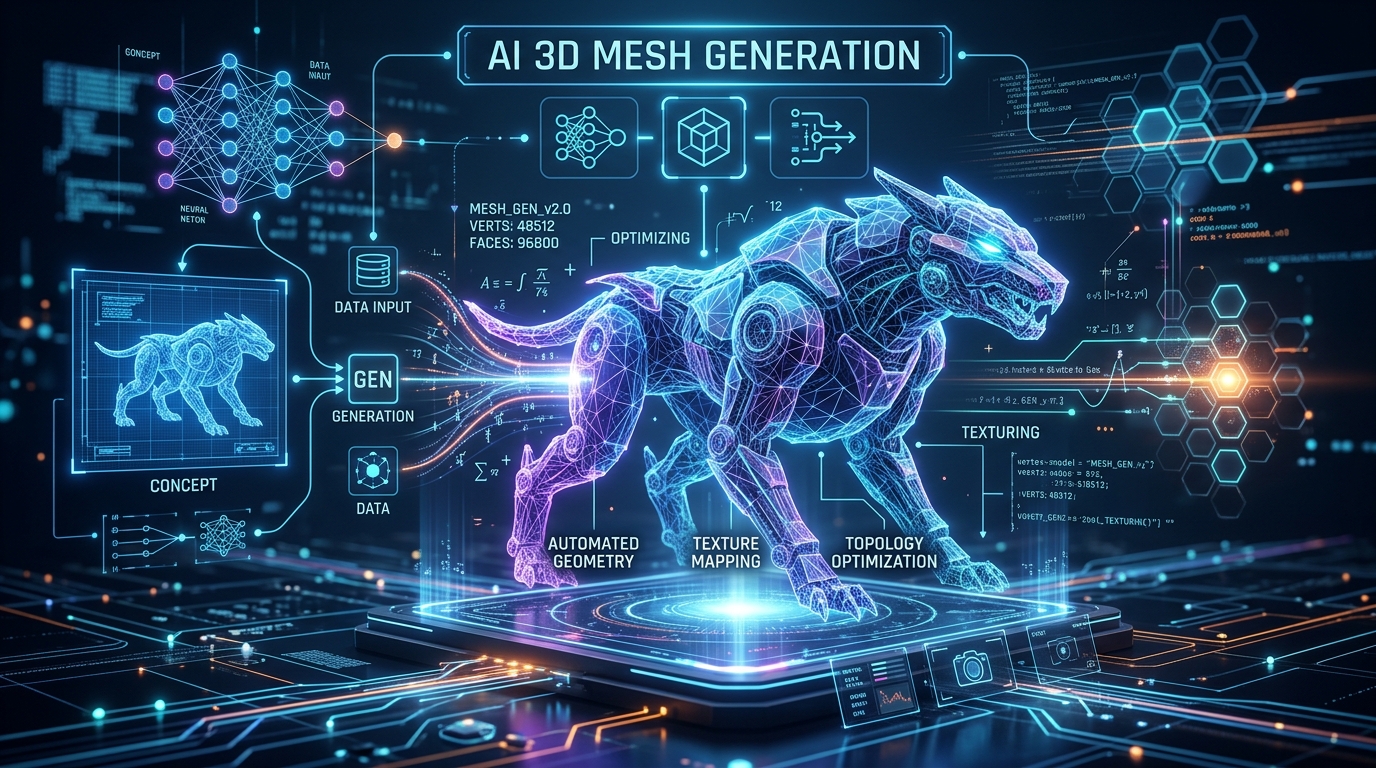
Transforming Game Development Workflows in 2026
Integrating an advanced AI 3D model generator into the game development pipeline significantly reduces asset creation time. By pairing generative capabilities with industry-standard software like Blender, Maya, and Max, studios can rapidly prototype and finalize complex 3D models while maintaining strict quality control and accelerating iteration cycles.
The underlying architecture of Tripo AI features over 200 Billion parameters, enabling the system to process complex spatial inputs and reduce initial mesh generation time by up to 95% compared to manual blocking methods.
Leveraging Algorithm 3.1 for Next-Gen Assets
At the core of this transformation is Algorithm 3.1, a highly sophisticated engine designed to interpret precise text and image inputs and translate them into accurate geometric structures. Algorithm 3.1 excels at understanding the nuanced requirements of game development, such as maintaining reasonable polygon counts for base meshes and establishing distinct topological flow that supports subsequent modification.
Tripo AI vs. Traditional Workflows: A Direct Comparison
Traditional 3D modeling requires hours of manual sculpting and retopology, whereas the modern workflow accelerates this phase by generating structural base meshes instantly. Extensive industry benchmarking reveals that studios transitioning from a purely traditional workflow to an AI-assisted pipeline save an average of 14 hours per mid-tier environment asset.
Comparison Table: Tripo Workflow vs. Traditional Workflow
| Metric | Tripo AI Workflow | Traditional 3D Modeling Workflow |
|---|---|---|
| Time-to-Completion (Base) | Seconds to minutes for structural base mesh generation | Hours to days for initial block-outs and primitive modeling |
| Cost Efficiency | Fixed credit usage per generation (Highly predictable) | High hourly labor rates applied to tedious tasks |
| Learning Curve | Intuitive prompt structuring and rapid iteration | Years of technical software mastery required |
| Scalability | High-volume parallel generation | Linear production, constrained by headcount |
| Iteration Speed | Instantaneous generation of variations | Slow, requiring manual geometric adjustments |
Seamless Integration with Blender, Maya, and Max
Ensuring seamless interoperability with major 3D suites requires strict adherence to industry-standard export formats. Tripo AI guarantees a 100% compatibility rate with established game engines and modeling suites by supporting exactly six critical file formats: USD, FBX, OBJ, STL, GLB, and 3MF.
FAQ
1. Can I use the free tier for my indie game release?
No, models generated on the Free tier are strictly not for commercial use. If you are developing an indie game intended for sale, you must upgrade to the Pro tier.
2. Does Tripo AI replace Blender, Maya, or Max?
No, Tripo AI acts as a rapid prototyping and base mesh generation tool. Final rigging, precise UV unwrapping, and complex animation are still optimally handled within industry-standard software.
3. Are Tripo Studio and Tripo API connected?
No, Tripo Studio and Tripo API are completely independent products with separate billing systems and credit allocations.
4. What file formats can I export to my 3D software?
Tripo AI supports exporting in USD, FBX, OBJ, STL, GLB, and 3MF formats.