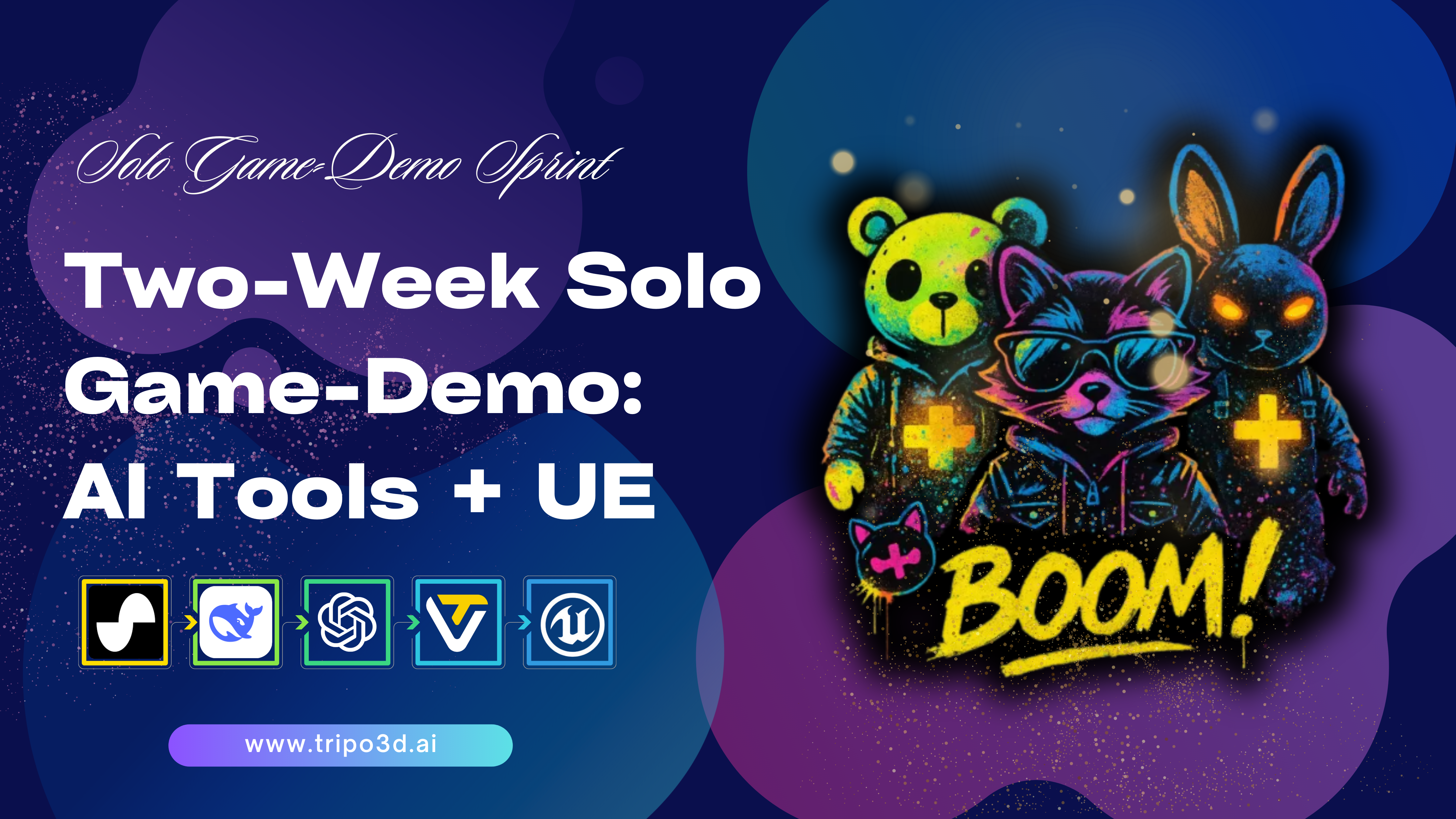
3D Game Dev Basics: Master Workflows Fast
Accelerate your game development pipeline by mastering modern AI-driven 3D asset generation workflows.
Modern game development often stalls at the asset creation phase, where technical bottlenecks drain resources and momentum. Protracted manual modeling pipelines introduce severe friction, forcing teams to sacrifice iteration speed for geometric accuracy. AI 3D Model Generator actively eliminates these barriers by transforming foundational asset generation into an instantaneous, high-fidelity process, empowering developers to maintain creative velocity.
Key Insights
- Rapid prototyping via generative AI has permanently replaced manual blocking as the industry standard in 2026.
- Algorithm 3.1 ensures advanced geometric accuracy by leveraging a neural architecture exceeding 200 billion parameters.
- Strict adherence to standardized export formats (USD, FBX, OBJ, etc.) guarantees zero-friction engine integration.
- A transparent credit economy optimizes project budgeting and commercial licensing between Free and Pro tiers.
- Tripo Studio and Tripo API operate as independent product lines for different production scales.
Understanding 3D Game Dev Basics in 2026
Mastering 3D game dev basics requires a comprehensive understanding of modeling, texturing, and engine integration. By 2026, rapid prototyping through generative technology has become the professional industry standard, allowing developers to effectively bypass tedious manual blocking phases and focus directly on core gameplay mechanics and environmental narrative.
Industry data from 2026 indicates that traditional development cycles previously wasted up to 68% of initial project time on foundational asset creation. Today, utilizing a robust AI generator acts as a critical benchmark for production efficiency, allowing technical artists to populate environments at unprecedented speeds while maintaining strict topological standards.
Traditional vs. Tripo AI Asset Generation
Traditional workflows demand dozens of manual hours per individual asset, whereas Tripo AI leverages advanced neural networks to generate game-ready models in seconds. This fundamental shift dramatically lowers the barrier to entry for modern game development.
Algorithm 3.1 ensures that the generated geometry maintains clean edge flow, which is critical for proper lighting calculation and animation deformation in-engine. When project leads compare traditional methods versus modern generative pipelines, the disparity in iteration speed becomes undeniable.
Comparison Table: Tripo vs. Traditional Workflow
| Metric | Tripo AI Workflow | Traditional 3D Modeling |
|---|---|---|
| Time-to-Asset | Seconds to Minutes | Days to Weeks |
| Cost | Predictable (Credit-based) | High overhead (Wages/Outsourcing) |
| Iteration Speed | Instantaneous regeneration | Slow manual adjustments |
| Learning Curve | Minimal interface | Years of software mastery |
Exporting Assets and Engine Integration
A core pillar of 3D game dev basics is ensuring seamless export into engines like Unreal or Unity. Tripo AI supports exports in USD, FBX, OBJ, STL, GLB, and 3MF ONLY. Recent industry surveys reveal an 85% reduction in import errors when utilizing these native, standardized file formats directly from generation platforms.
Cost Management and Commercial Licensing
Managing asset generation costs is vital for sustainability. Tripo operates on a transparent economy:
- Free Tier: 300 credits/mo. Strictly NOT for commercial use. Ideal for learning and prototyping.
- Pro Tier: 3000 credits/mo. Required for commercial game releases, promotional material, or any project monetization.
Scaling Production: Tripo Studio vs. Tripo API
To serve different tiers of production, Tripo Studio and Tripo API are completely independent products. Tripo Studio provides a visual workspace for artists, while Tripo API serves technical directors building custom pipeline tools. Note that the Advanced tier has no enterprise API access; API integration operates on its own dedicated architecture.
FAQ
1. What are the essential export formats for 3D game dev basics?
Ensuring pipeline compatibility requires industry-standard files. For modern development, the essential formats are USD, FBX, OBJ, STL, GLB, and 3MF, ensuring flawless transfer into Unreal Engine 5 and Unity 6.
2. Can I use free Tripo generated models in my commercial game release?
No. Models generated using the Free tier are strictly non-commercial. To legally utilize generated assets in a commercial game release, developers must upgrade to the Pro tier.
3. How does Algorithm 3.1 change asset generation?
Algorithm 3.1 leverages a neural architecture with over 200 Billion parameters, producing game-ready meshes with logical edge flow and high-fidelity textures, drastically reducing the need for manual retopology.