Exploring the Vibrancy of Life in 3D - Insightful Guide
Welcome to an exciting journey into life in 3D! We explore how the 3D experience changes how we see the world. Digital tech is growing, making virtual and augmented realities part of our daily lives.
Flat designs are old news. Now, 3D visuals grab our attention and make things more fun. People find these new designs more interesting, leading to a more lively life.
A bright color palette and fun design principles are changing how we interact. These ideas, like Humanity, Dimension, and Playfulness, make our world more touchable and fun. They help us live a more colorful life in 3D.
Let's dive into how 3D tools and tech are shaping our future. They're making our daily lives better and creating a more exciting world to live in.

Key Takeaways
- The evolution from flat design to vibrant 3D representations enhances user engagement.
- 3D experiences foster improved interactions and perceptions among users.
- Incorporating immersive elements encourages a deeper connection to technology.
- Visual and tactile dimensions play vital roles in enhancing everyday life.
- Emerging technologies are continuously shaping our understanding of a three-dimensional world.
Introduction to the 3D Experience
The 3D experience is changing how we use technology every day. It lets us dive into immersive living, making connections deeper. This is true for both people and businesses.
Thanks to digital platforms, the 3D experience is key in many fields. It's great for teamwork and creativity.
The 3DEXPERIENCE platform is a big deal, helping over 270,000 customers worldwide. It makes working together easier and faster. It also helps save money and the planet.
By using this platform, companies can work better together. They can make and test products faster. This shows how the 3D experience is changing how we see and interact with the world.
The Emergence of Three-Dimensional Worlds
The journey into three-dimensional worlds started in the 1960s. Pioneering artists used digital technology to create early models. These models are the foundation of today's immersive environments.
Three-dimensional spaces have length, width, and height. They use x, y, and z coordinates. This setup allows for complex designs and artistic expressions.
Throughout history, mathematicians explored three-dimensional space. They found regular polytopes, like the Platonic solids. Artists used these ideas to create immersive environments.

Digital technology and art have merged, leading to new uses. The demand for three-dimensional experiences is growing. This change affects our daily lives, how we interact with digital content, and each other.
| Dimension | Characteristics | Applications |
|---|---|---|
| 3D Graphics | Uses x, y, z coordinates | Video games, animations |
| Spherical Geometry | Volume and surface area calculations | Architecture, design |
| Regular Polytopes | Consists of Platonic solids | Mathematics, art |
| Immersive Environments | Engages users interactively | Virtual reality, augmented reality |
Understanding Immersive Living
Immersive living is a big change in how we see the world. It uses augmented and virtual reality to make life more fun. For example, people learn better in virtual worlds than in real classrooms.
The world of immersive living is growing fast. Over 2,000 companies are using it in entertainment, education, and shopping. Stores that use augmented reality are more popular, with 61% of people wanting to shop there.
Amazon and IKEA are using AR to make online shopping better. This change is making shopping more fun. Immersive living is also changing education, with 86% of students saying it helps them learn more.

Life in 3D: A New Dimension of Experience
Technology has changed our lives a lot. Now, three-dimensional spaces are key in how we talk, work, and hang out. Devices like phones and tablets give us more than just info. They make our experiences more real and fun.
The Influence of Technology on Lifestyle
Today's tech offers many ways to enjoy 3D. For example, Looking Glass displays show 45 to 100 views of 3D media at once. This is more than VR or AR, which only show two views.
Looking Glass displays come in sizes like 16'', 32'', and 65''. They work with regular gaming computers. This makes the tech easy to use for everyone.
How Three-Dimensional Spaces Change Interactions
Three-dimensional spaces make our world more alive. They let us interact in real time, without needing headsets or glasses. Looking Glass systems let many people see 3D content together.
This is great for working together on projects. The Looking Glass Go model even lets you turn 2D images into 3D on your phone. This tech makes our lives more interactive and fun in many ways.

Virtual Reality Lifestyle: Immersive Environments
The idea of a virtual reality lifestyle is changing how we see our world. It uses immersive environments to give us new experiences. These experiences touch our senses in many ways.
Virtual reality lets us step into new worlds. It opens up new ways to talk, learn, heal, and have fun.
Defining Virtual Reality and Its Impact
Virtual reality (VR) takes us into a world made by computers. We can move around and touch things in this world. It's a big change.
VR helps people feel less alone, like seniors who can see family far away. It also makes our brains work better, like remembering things and solving problems. It's good for all ages.
VR is also used in physical therapy. It makes exercises fun and helps people get better faster.
Popular Applications of Virtual Reality in Everyday Life
VR is used in many parts of our lives. Schools use it to make learning fun, like exploring history or science. It helps students learn better.
At work, VR helps people practice skills like speaking in public or working in a team. It's a safe place to try new things.
In healthcare, VR is used in many ways. It helps doctors practice surgery and improves their skills. It also helps people with phobias or PTSD feel better.
VR lets people with disabilities explore and move around. It helps them feel more independent and connected.
| Application | Description |
|---|---|
| Social Connections | Reduces isolation for seniors by enabling virtual visits with family. |
| Cognitive Improvement | Enhances memory and problem-solving through interactive activities. |
| Physical Therapy | Offers engaging exercises for rehabilitation, promoting movement. |
| Education | Immerses students in interactive learning experiences. |
| Surgical Training | Improves surgeon skills with realistic practice environments. |
| Therapeutic Uses | Helps manage chronic pain and assists with mental health treatments. |
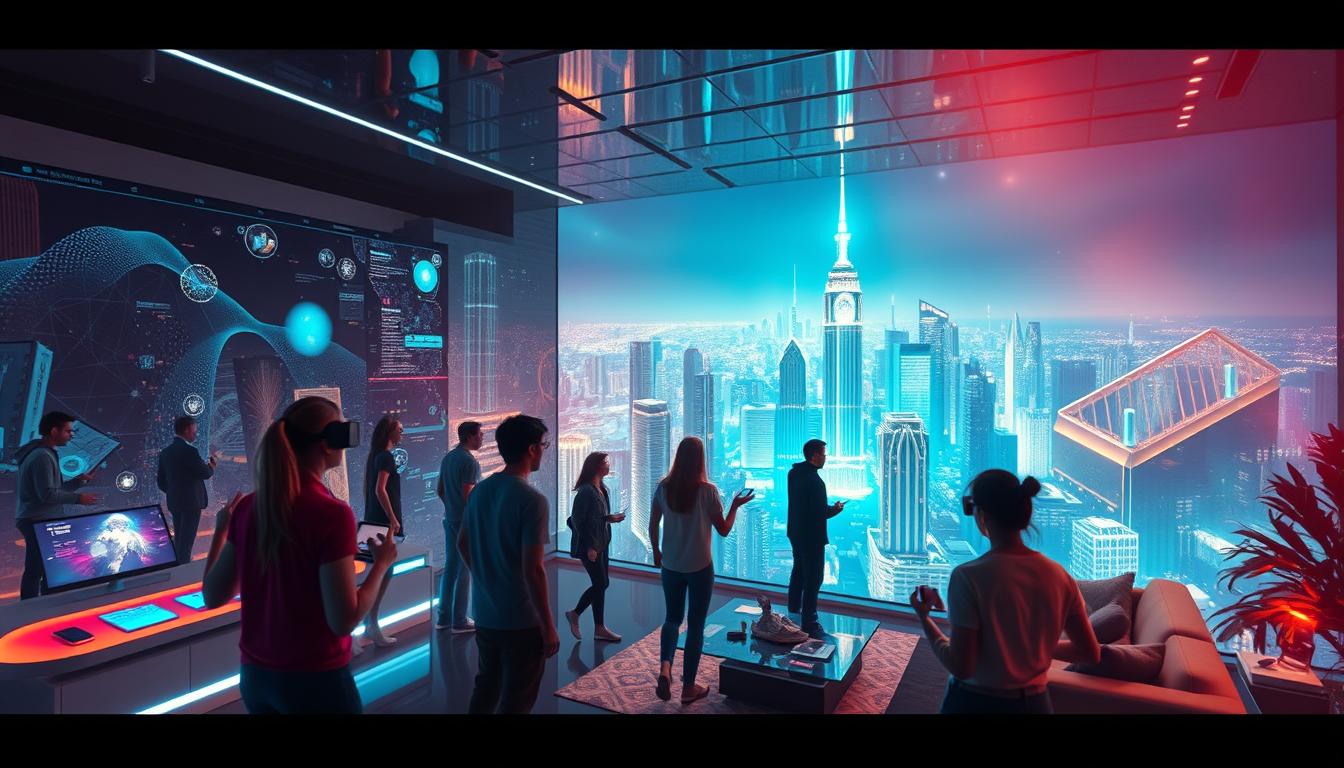
Augmented Reality Experience: Enhancing Reality
The augmented reality experience mixes the real world with digital stuff. It changes how we see and interact with things around us. Users can add info, graphics, and 3D models to real views, making everything more interesting.
It started in 1992 with the U.S. Air Force. Now, it's big in gaming and fun stuff. Games like Pokémon Go show how AR can make real life more fun.
By 2025, AR is expected to be worth about $198 billion. It's growing fast, with a 43.8% increase from 2021 to 2028. Stores are using AR to let customers see products before buying. This has helped stores like IKEA cut return rates by 30%.
AR is also changing education, healthcare, and tourism. Teachers think AR can make learning more fun. It's also helping students remember things better. In healthcare, AR is making surgeries more accurate and saving time.
New devices like Apple Vision Pro glasses are making AR more common. These gadgets will help more people enjoy the benefits of AR. It will make our lives better in many ways.
Exploring Multidimensional Living Spaces
Designing spaces that encourage interaction is key. These areas offer a unique experience, making daily life richer. They invite exploration and creativity, boosting connection and happiness.
Designing Spaces with Depth and Interaction
To create engaging living areas, focus on layered designs. Add adjustable lighting, movable furniture, and clear partitions. This makes spaces change with user needs, letting people make their space their own.
Consider these important factors:
- Layering textures: Different materials add interest and feel.
- Utilizing colors: The right colors can stir emotions.
- Incorporating natural elements: Nature in design improves air and lowers stress.
How Multidimensional Living Influences Daily Life
Multidimensional living spaces change how we live. They encourage movement and teamwork, strengthening social ties. For example, a lively living room boosts family time, while flexible workspaces help people stay productive.
Studies show these spaces make people happier and more creative. This leads to:
- Enhanced well-being: Comfortable spaces reduce stress and increase joy.
- Social connectivity: Shared areas help build friendships and community.
- Increased mindfulness: Engaging spaces make people more present.
Tools and Technologies Shaping Life in 3D
The world of 3D living is changing fast. New technologies are making life more immersive in many areas. The 3D modeling market was worth USD 8.3 billion in 2020. It's growing fast, showing how much people want these new experiences.
3D modeling is key in gaming, healthcare, architecture, and education. In medicine, it helps plan surgeries better. It also makes prosthetics that are cheaper and more comfortable.
Since the 1970s, GPUs have made 3D modeling faster and better. It's used in schools to teach hard subjects. Scientists use it to study climate change.
The entertainment world wants more realistic effects and immersive settings. Tools like Avizo are used in research, but MorphoJ is free for students and researchers. This shows how digital artistry is making a big impact.
In short, more and more industries are using 3D modeling. This is creating a world full of creativity and usefulness. It's changing how we experience life, making new things possible for everyone.
The Future of 3D Experiences in Society
The future of 3D experiences is exciting and fast-changing. Virtual reality (VR) and augmented reality (AR) are getting better. They will change how we interact, learn, and work.
VR started in the 1960s with ideas like Morton’s Telesphere Mask. But it really took off in 2012 with the Oculus prototype. Facebook bought Oculus in 2014, making VR more popular. Now, we have tools like HTC Vive and Samsung VR for new experiences.
Here are some trends we might see:
| Trend | Description | Expected Impact |
|---|---|---|
| Personalized Immersive Experiences | Tailoring content to individual needs and preferences using AI. | Enhanced user engagement and satisfaction. |
| Integration of 5G Technology | Implementation of high-speed networks to reduce latency. | Improved experiences in real-time interactions without delays. |
| Focus on Ethical AI | Addressing privacy and security concerns related to AI. | Stronger consumer trust leading to wider adoption. |
| Education and Training Revolution | Utilizing VR and AR for immersive learning environments. | Improved retention and understanding among learners. |
| Healthcare Advancements | VR for better training in simulations and patient interactions. | Enhanced outcomes and preparedness among healthcare professionals. |
VR and AR will change our lives in big ways. They will make learning and healthcare better. It's important to understand and use these technologies for a better future.
Benefits of Immersion through 3D Technologies
3D technologies do more than just look good. They make learning and talking more fun. Virtual reality (VR) and augmented reality (AR) help us learn better and remember more.
Companies use these technologies to make customers happier. For example, AR events in stores make people more aware of products. This can lead to more sales and loyal customers. VR lets people try out products, like office chairs, in a virtual space.
3D tech is also great for finding the right employees. It helps companies see if someone is a good fit. It also makes training new employees faster and better.
Designing products quickly is another benefit. It lets teams work together better, even if they're far apart. This shows how 3D tech helps in many ways.
| Application | Benefits |
|---|---|
| Customer Engagement | Higher satisfaction and loyalty |
| VR Training | Reduced training time and improved understanding |
| Recruitment | Better candidate assessment |
| Product Trials | Enhanced product knowledge |
| Remote Collaboration | Increased productivity |
Immersive reality is getting better and will soon be in our phones. This shows how useful it is. For more on how VR and 3D tech help in training, check out this resource. It makes our lives richer and changes how businesses work, making our world more connected.
Conclusion
The growth of life in 3D has changed our world a lot. It has changed how we use technology and connect with each other. We now have things like "Tzina: symphony of longing" and 3D food printing.
These things show us a future where we can interact more. They mix our real and virtual worlds, making it easier to share feelings.
Looking to the future, technology will keep changing how we live. Virtual worlds will be a big part of our daily lives. It's important for us to get used to this and use it to be creative and connect more.
By thinking about our own experiences, we can explore this new world of 3D life. It's full of possibilities for us.
As we move into this new world, we should stay open to its possibilities. The future looks bright, with chances to make our lives and communities better with technology.
FAQ
What is a 3D experience?
A 3D experience is like stepping into a world made of digital art. It lets us connect deeper in our fast-paced world.
How has technology influenced immersive living?
Tech has changed our lives by mixing virtual and real worlds. It makes our experiences richer, from learning to playing games.
What are the benefits of engaging with 3D technologies?
Using 3D tech can make learning better and help us work together. It also builds empathy, as shown in many studies.
How do virtual reality and augmented reality differ?
Virtual Reality (VR) takes you into a digital world. Augmented Reality (AR) adds digital stuff to our real world, making it better.
What role does digital art play in 3D experiences?
Digital art is key in making 3D experiences. It lets us express ourselves in new ways, changing how we see and interact with art and reality.
What technologies are used to create 3D and immersive environments?
To make 3D worlds, we use software, platforms, and apps. These tools help us create and enjoy digital art, making it more accessible.
What does the future hold for 3D experiences?
The future of 3D will be more personal, thanks to tech like AR and VR. Artificial intelligence will also make 3D worlds tailored to each person.
How can immersive living influence community interactions?
Immersive living can make communities better by bringing people together. It changes how we feel and live, making our communities happier and healthier.
Advancing 3D generation to new heights
moving at the speed of creativity, achieving the depths of imagination.
 Text & Image to 3D models
 Free Credits Monthly
 High-Fidelity Detail Preservation