Integrated AI 3D Workspace Handling Texture Mapping For Full Color 3D Printing
Streamlining Digital Fabrication with Advanced Texture Mapping Workflows
As the additive manufacturing industry matures into 2026, the demand for high-fidelity physical assets has exposed significant bottlenecks in traditional digital modeling. Achieving an integrated AI 3D workspace handling texture mapping for full color 3D printing has become a comprehensive solution for bridging the gap between concept and fabrication. 3D Generative AI provides the foundational infrastructure that automates both structural generation and intricate surface detailing. By deploying intelligent environments, digital creators and industrial engineers can bypass tedious manual UV mapping and focus entirely on producing deployable physical assets.
Key Insights:
- Massive Scale: The core algorithm operates on over 200 billion parameters, ensuring geometric precision and professional detailing.
- Unified Pipeline: An integrated AI 3D workspace handling texture mapping for full color 3D printing centralizes segmentation, retopology, and texturing.
- Advanced Calibration: Features like Magic Brush provide pinpoint accuracy for surface editing, crucial for detailed physical output.
- Independent Ecosystems: Tripo Studio and Tripo API operate as completely separate product lines to serve distinct individual and enterprise requirements.
- Predictable Resources: Subscription plans are explicitly defined by credits, ensuring transparent scaling for professional deployments.
The Evolution of Digital Fabrication
The demand for accurate, rapid asset generation has shifted the industry away from fragmented software ecosystems toward unified platforms. Historically, creating a physical object from a digital concept required navigating multiple disconnected software environments. A designer would generate base geometry in one application, perform retopology in another, and attempt complex UV unwrapping in yet a third. This disjointed approach is especially problematic for advanced additive manufacturing techniques. A true integrated AI 3D workspace handling texture mapping for full color 3D printing eliminates these fragmented steps by providing an end-to-end environment. An AI 3D model generator addresses this industry-wide inefficiency by unifying the generation, editing, and refinement phases into a single platform. As of 2026, the standard for production-ready assets demands that topology and color data remain intrinsically linked from the moment of generation to the final G-code export. By utilizing an integrated AI 3D workspace handling texture mapping for full color 3D printing, operators ensure that no data is lost during software handoffs.

Algorithmic Foundation: The Power of Algorithm 3.1
Driven by over 200 billion parameters, Algorithm 3.1 delivers state-of-the-art geometric precision and high-definition texture generation. The capability of any generative platform is strictly bound by its underlying architecture. The system operates on a massive foundation model utilizing over 200 billion parameters. This immense scale allows the system to comprehend complex physical structures and intricate surface characteristics simultaneously. The recent transition to Algorithm 3.1 has further solidified this advantage. Algorithm 3.1 ensures that when an integrated AI 3D workspace handling texture mapping for full color 3D printing interprets a text prompt or an image, the resulting mesh is perfectly aligned with its intended physical constraints. Furthermore, Algorithm 3.1 supports the generation of 4K texture generation, ensuring that the color data mapped to the digital mesh translates flawlessly into the physical world. This level of computational power is what separates experimental outputs from assets that are genuinely ready for the rigorous demands of modern additive manufacturing.
Tripo Studio: An Integrated AI 3D Workspace Handling Texture Mapping For Full Color 3D Printing
The AI 3D editor consolidates generation, intelligent segmentation, and mesh refinement into a single web-based application designed for creators. Tripo Studio represents a highly advanced integrated AI 3D workspace handling texture mapping for full color 3D printing. Rather than functioning merely as an asset generator, it acts as a comprehensive command center for digital creators. The platform features Intelligent Segmentation, which automatically divides a generated model into logical, editable parts. This means a complex character or mechanical part can be isolated, adjusted, and reassembled without disrupting the overall mesh integrity. When an integrated AI 3D workspace handling texture mapping for full color 3D printing is deployed effectively, users can apply Smart Low-Poly generation to reduce unnecessary vertices while preserving critical silhouettes. The studio ensures that the exported formats (such as USD, FBX, OBJ, STL, GLB, 3MF via 3D format conversion) retain both their structural watertightness and their rich color data, ready to be read by advanced slicer software.
Precision Texturing and Surface Geometry
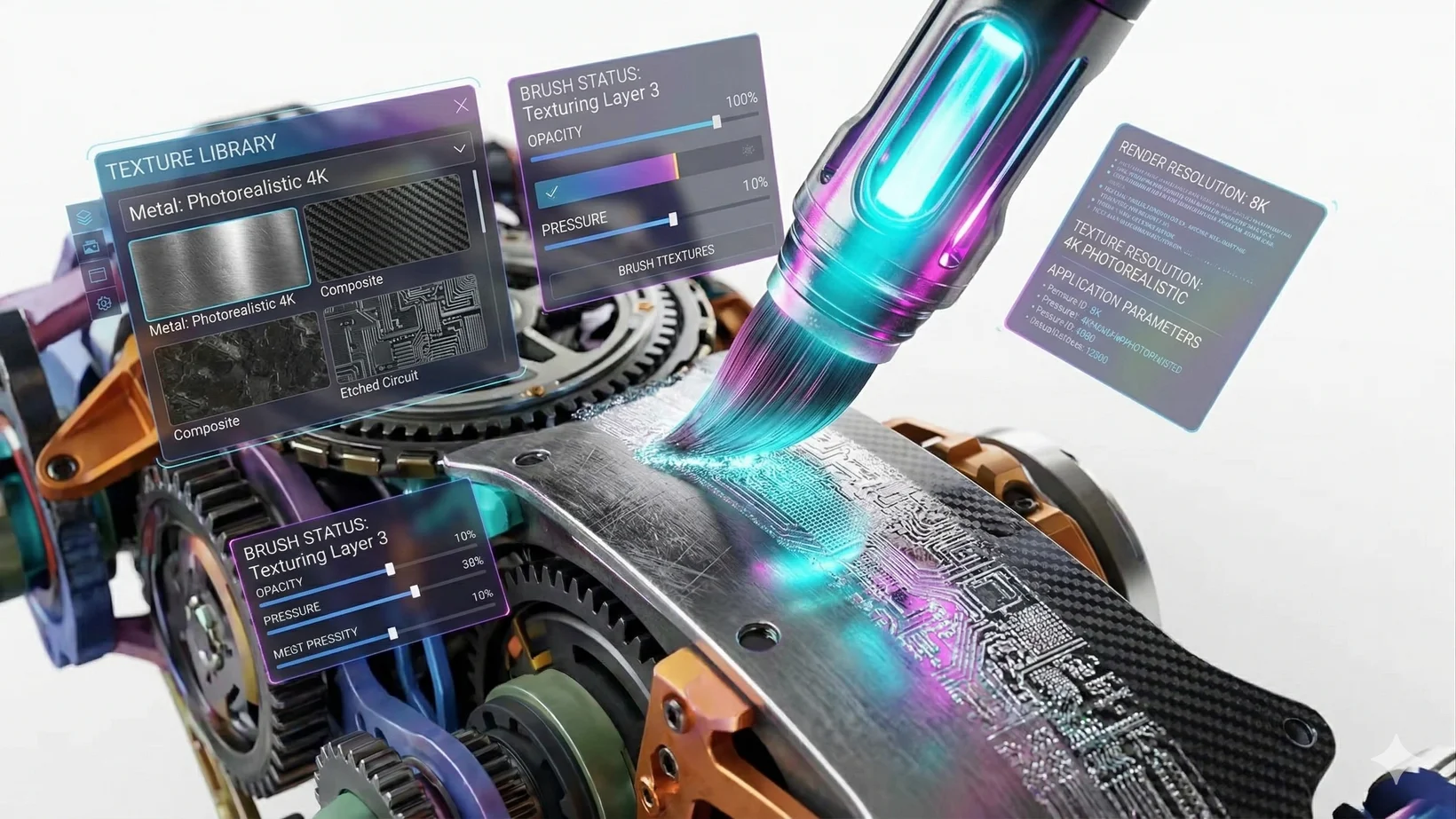
The Magic Brush tool and advanced UV control redefine how color data is applied to printable meshes. The success of any physical output heavily relies on how well the digital color data is applied to the geometry. An integrated AI 3D workspace handling texture mapping for full color 3D printing must provide granular control over surface details. The platform introduces the Magic Brush, a feature that allows users to perform fast, localized material replacements and repairs directly onto the model's surface. Instead of relying on complex node-based material editors, operators can use the integrated AI 3D workspace handling texture mapping for full color 3D printing to paint and correct specific viewpoints instantly. Algorithm 3.1 ensures that these edits are seamlessly integrated into the underlying PBR (Physically Based Rendering) texture maps. This precision is vital; when the model is sent to the printer, the material jetting or color extrusion systems require absolute clarity on where one color ends and another begins.
Replacing Traditional Manual Workflows
By automating mesh repair, topology optimization, and UV mapping, the platform drastically reduces production time compared to traditional manual modeling. Traditional manual workflows are notoriously time-consuming. Sculpting organic forms or designing precise mechanical parts requires years of expertise, and preparing those models for physical production demands even more specialized knowledge. An integrated AI 3D workspace handling texture mapping for full color 3D printing circumvents these hurdles through automation. The system can generate a fully textured base model from a simple text to 3D model prompt in seconds. The integrated AI 3D workspace handling texture mapping for full color 3D printing then automatically ensures the mesh is manifold, thickens vulnerable walls, and resolves inverted normals. This shift means that production times are reduced from weeks to mere minutes. Designers no longer spend hours unwrapping UVs or decimation meshes; instead, they utilize the integrated AI 3D workspace handling texture mapping for full color 3D printing to focus on creative ideation and functional testing.
Scaling Production: The Independent Tripo API
The Tripo API operates as a completely independent product line, providing scalable, programmatic access to generative infrastructure for enterprise systems. While Tripo Studio caters to individual creators and small teams via a web interface, enterprise-level deployment requires a different approach. It is crucial to understand that the Tripo API is a completely independent product line. It is not an add-on or a feature of the Studio platform; it operates with its own distinct infrastructure and billing system. Companies looking to embed an integrated AI 3D workspace handling texture mapping for full color 3D printing into their proprietary software, gaming engines, or industrial manufacturing pipelines utilize the Tripo API. This programmatic access allows platforms to leverage the over 200 billion parameters model and Algorithm 3.1 directly. By separating the API from the Studio environment, the provider ensures that enterprise clients receive dedicated bandwidth, custom SLA agreements, and the ability to automate generation at an industrial scale without impacting the performance of the consumer-facing workspace.
Deployment Strategies: Pricing and Credits
Transparent subscription tiers based on credits ensure scalable resource allocation, with strict guidelines on commercial rights. Resource management within an integrated AI 3D workspace handling texture mapping for full color 3D printing relies on a standardized currency known as credits. We have established clear, predictable pricing structures for the year 2026. The Free plan provides 300 credits per month, allowing newcomers to experience the integrated AI 3D workspace handling texture mapping for full color 3D printing at no initial cost. However, 3D models generated under Tripo's Free plan do not support commercial use. The Pro plan ($19.90/month) provides 3,000 credits per month. This tier unlocks the ability to utilize the generated assets commercially, making it the standard choice for independent studios and designers relying on an integrated AI 3D workspace handling texture mapping for full color 3D printing for their revenue-generating projects. For full details, see Pricing.
FAQ
1. What is the difference between Tripo Studio and Tripo API?
Tripo Studio and Tripo API operate as completely separate product lines. The API is not an add-on to the Studio platform; it has an independent billing and integration system designed for enterprise scaling.
2. How does the pricing model work and what are the credit limits?
The Free plan provides 300 credits per month. The Pro plan ($19.90/month) provides 3,000 credits per month. For more details, please visit our Pricing page.
3. Can I use the models generated for commercial purposes?
3D models generated under Tripo's Free plan do not support commercial use. Commercial rights are unlocked with the Pro plan.
4. What export formats are supported?
The platform supports exporting models via 3D format conversion in USD, FBX, OBJ, STL, GLB, 3MF formats.