
Collaborative AI 3D Workspace for Farm Queues
Optimizing Additive Manufacturing with Advanced Fleet Management Workflows
The modern manufacturing landscape of 2026 demands exceptional efficiency in digital-to-physical production pipelines. A collaborative AI 3D workspace managing 3D printing farm queues serves as the advanced solution for rapid prototyping and large-scale additive manufacturing operations. By leveraging advanced generative models like the AI 3D Model Generator, industrial operators and digital creators can drastically reduce manual mesh repair, streamline slicing preparation, and ensure continuous hardware uptime. This guide explores the critical infrastructure needed to optimize high-volume print operations through intelligent automation.
Key Insights
- Centralized generation and editing within a collaborative AI 3D workspace managing 3D printing farm queues eliminates operational bottlenecks and prevents hardware downtime.
- The integration of Algorithm 3.1 and over 200 billion parameters guarantees clean, manifold meshes ready for immediate slicing.
- Tripo Studio and the Tripo API operate as entirely independent product lines to serve distinct visual and backend programmatic needs.
- Cost efficiency is maintained through rigid quota allocations. The Free plan provides 300 credits per month. 3D models generated under Tripo's Free plan do not support commercial use. The Pro plan ($19.90/month) provides 3,000 credits per month.
- Automated retopology and intelligent segmentation minimize support material usage and accelerate physical production throughput.
Fundamentals of a Collaborative AI 3D Workspace Managing 3D Printing Farm Queues
A collaborative AI 3D workspace managing 3D printing farm queues centralizes model generation, geometry optimization, and fleet allocation into a single unified platform, drastically reducing downtime and manual slicing interventions. In the year 2026, manufacturing centers and rapid prototyping facilities require highly streamlined operations to remain competitive. Traditional workflows involve fragmented software suites for modeling, mesh repair, and slicing, causing severe bottlenecks in high-demand queue environments. By integrating asset generation and editing directly into a collaborative AI 3D workspace managing 3D printing farm queues, production managers achieve seamless transitions from digital concepts to tangible products. 3D generative AI provides an environment where design teams, engineers, and print technicians operate in tandem without friction. The system addresses critical limitations of additive manufacturing, such as non-manifold geometry, improper wall thickness, and unsupported overhangs. This cohesion allows an entire fleet of Fused Deposition Modeling (FDM) and resin printers to maintain maximum continuous uptime. When a collaborative AI 3D workspace managing 3D printing farm queues is deployed, the process of converting raw prompts into text to 3D model assets or image to 3D model references into print-ready USD, FBX, OBJ, STL, GLB, 3MF files takes mere seconds. Consequently, fleet managers experience far fewer print failures, optimizing material usage and labor efficiency. Industry data indicates that utilizing such a workspace reduces the time spent on pre-print validation by eliminating the need for tertiary repair applications. Every asset generated is structurally sound, ensuring that the hardware executes the G-code without interruptions or layer shifts.
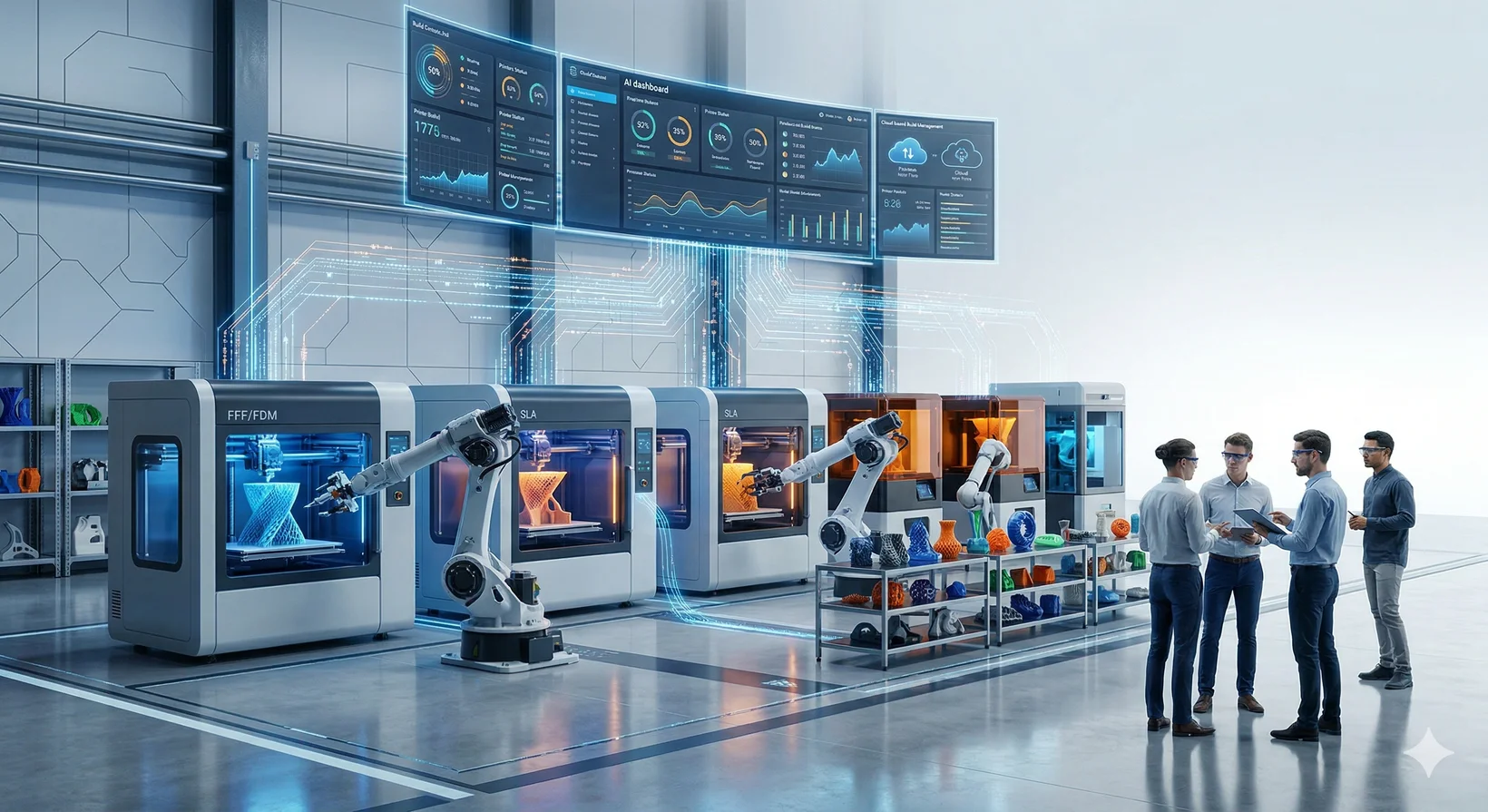
Architectural Advantages of Algorithm 3.1 and 200 Billion Parameters
Driven by Algorithm 3.1 and over 200 billion parameters, the collaborative AI 3D workspace managing 3D printing farm queues ensures high geometric accuracy, generating manifold meshes that eliminate traditional repair delays. Technological maturation in 2026 demands exceptional precision for physical fabrication. The core engine utilizes a massive neural network exceeding 200 billion parameters, enabling the system to holistically understand complex spatial relationships and structural integrities. Algorithm 3.1 represents a definitive leap over previous iterations, moving AI-generated content beyond experimental use cases directly into deployable, production-ready assets. When deployed within a collaborative AI 3D workspace managing 3D printing farm queues, Algorithm 3.1 guarantees that generated components possess the exact wall thicknesses and topological configurations required by specific printing hardware. This immense parameter scale ensures that intricate details, from internal structural gussets to complex interlocking mechanisms, are rendered accurately. By relying on a 200 billion parameter foundation, the collaborative AI 3D workspace managing 3D printing farm queues bypasses the notorious industry issues of intersecting faces and flipped normals, delivering assets that slicer software can interpret without hesitation. High-fidelity geometry means that UV mapping and texturing, while crucial for digital display assets and AI texture generation, are paired perfectly with clean structural meshes for physical output. Furthermore, the sheer scale of the 200 billion parameters allows the AI to output designs that align with real-world physics, greatly assisting the technicians monitoring the extrusion process.
Distinct Product Lines: Tripo Studio vs. Tripo API
Tripo Studio serves as the web-based collaborative AI 3D workspace managing 3D printing farm queues for visual creators, whereas the Tripo API functions as an entirely independent infrastructure product for programmatic queue automation. A common misconception in the manufacturing industry involves conflating visual creator tools with enterprise developer solutions. The AI 3D editor provides a highly interactive visual interface equipped with intelligent segmentation, auto-rigging, and mesh editing. This platform caters directly to designers, artists, and print farm operators who require hands-on, visual manipulation of digital assets before sending them to the printer. Conversely, the Tripo API is a standalone product line with its own distinct billing architecture and operational focus. The API service is never bundled as an add-on feature of Studio subscriptions. For facilities utilizing a collaborative AI 3D workspace managing 3D printing farm queues, the API enables headless generation and the programmatic routing of USD, FBX, OBJ, STL, GLB, 3MF files directly to the manufacturing hardware. While Tripo Studio excels as a visual collaborative AI 3D workspace managing 3D printing farm queues, the independent API handles the backend requests for high-volume, automated production pipelines without requiring manual interface navigation. Farm managers must evaluate their specific workflow requirements; those needing manual intervention and visual adjustments will utilize the Studio environment, whereas fully automated distributed manufacturing hubs will rely exclusively on the API to push files directly into the slicing queues.
Mesh Optimization and Retopology in High-Volume Operations
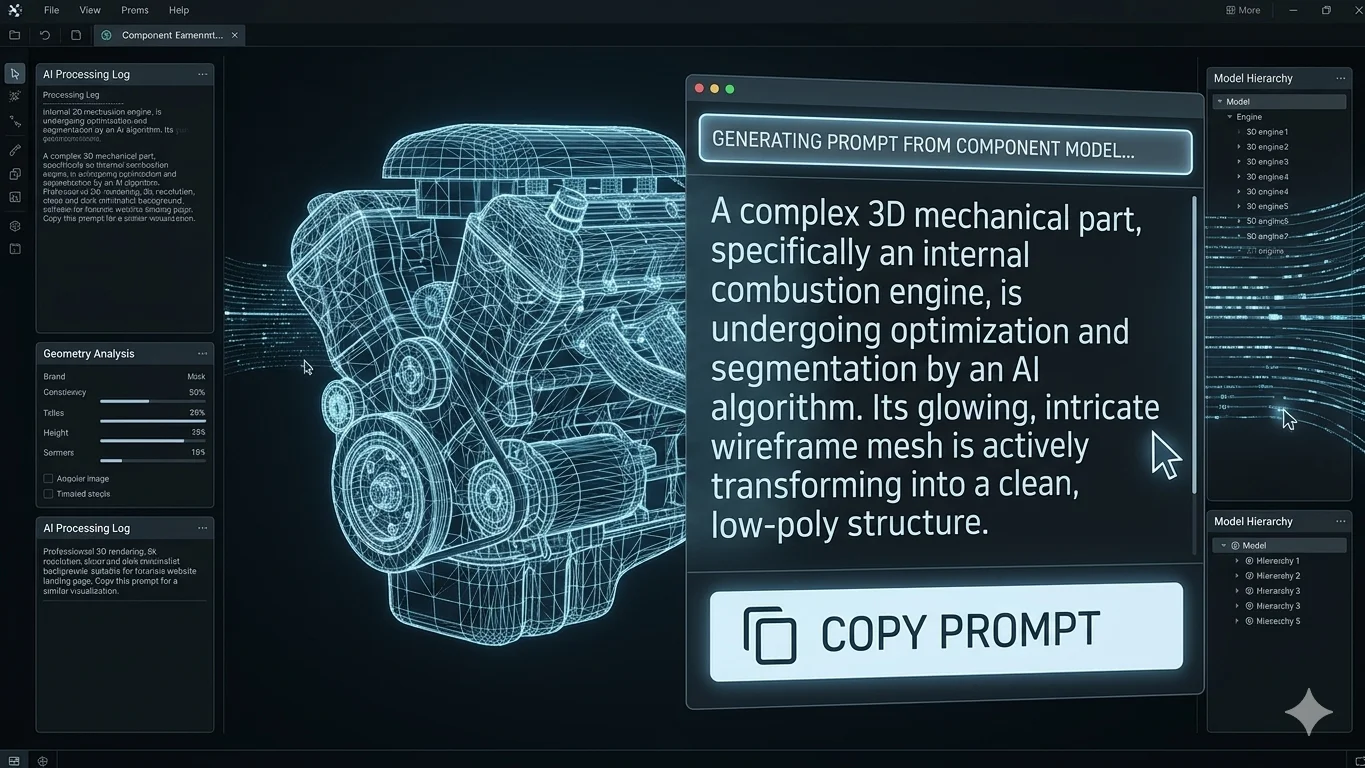
For a collaborative AI 3D workspace managing 3D printing farm queues to be effective, intelligent retopology and part segmentation must occur instantaneously to prepare assets for varying printer tolerances and support structures. High-volume print farms require models that are strictly optimized for both print speed and material conservation. The platform integrates Smart Low-Poly Generation, a feature that decimates high-density meshes into efficient, engine-compatible structures while preserving vital external silhouettes. Within a collaborative AI 3D workspace managing 3D printing farm queues, this retopology ensures that slicer software processes files rapidly, preventing queue stagnation and software crashes. Furthermore, Intelligent Segmentation allows complex objects to be automatically divided into distinct, printable components. This capability transforms a collaborative AI 3D workspace managing 3D printing farm queues by allowing technicians to print individual parts flat on the build plate, drastically reducing the need for support material and improving overall structural strength along the layer lines. Whether preparing a multi-part mechanical assembly or a large-scale architectural prototype, the built-in optimization tools ensure that every file entering the queue is pre-conditioned for additive manufacturing success. The ability to execute semantic-based decomposition into editable modules directly impacts farm throughput. Parts that previously required hours of manual slicing, custom support generation, and orientation adjustments are now seamlessly processed.
Economic Scaling, Quotas, and Commercial Rights
Operational viability within a collaborative AI 3D workspace managing 3D printing farm queues relies on strict cost modeling. The Free plan provides 300 credits per month. 3D models generated under Tripo's Free plan do not support commercial use. The Pro plan ($19.90/month) provides 3,000 credits per month. Managing a fleet of printers requires predictable overhead calculations and clear intellectual property guidelines. The pricing structure enforces a straightforward approach to asset generation and cost scaling. Under the Free tier, the Free plan provides 300 credits per month; however, it is imperative to note that 3D models generated under Tripo's Free plan do not support commercial use. For businesses operating a collaborative AI 3D workspace managing 3D printing farm queues, upgrading to the Pro plan is a practical necessity. The Pro plan ($19.90/month) provides 3,000 credits per month and fully unlocks commercial rights, permitting the legal sale, distribution, and manufacturing of the printed assets. It is critical for enterprise managers to understand that Tripo API usage incurs separate costs completely independent of the Studio subscription. By leveraging this transparent credit system, a collaborative AI 3D workspace managing 3D printing farm queues can accurately forecast monthly generation expenses against expected hardware outputs. Industrial scaling is achieved by matching credit consumption with filament or resin usage, establishing a unified cost-per-part metric for the business.
Advanced Synchronization for Slicing and Farm Allocation
Through advanced ecosystem integration, a collaborative AI 3D workspace managing 3D printing farm queues bridges the gap between raw asset generation and hardware execution by standardizing USD, FBX, OBJ, STL, GLB, 3MF formats and support interfaces. In 2026, the disconnect between digital creation and physical extrusion has been completely addressed. The platform outputs inherently manifold files engineered specifically for compatibility with industry-standard slicing engines, easily convertible via any standard 3D format conversion pipeline. When a collaborative AI 3D workspace managing 3D printing farm queues processes an incoming design request, the platform's clean outputs integrate seamlessly with slicing protocols, allowing technicians to swiftly dictate optimal layer heights, infill densities, and print speeds. This precise synchronization prevents the farm from stalling due to corrupt or non-manifold mesh data. A collaborative AI 3D workspace managing 3D printing farm queues also addresses vital post-processing considerations by generating models that naturally require fewer breakaway supports. Consequently, manual labor associated with support removal and surface sanding is heavily minimized. The end-to-end integration ensures that every digital asset generated transitions smoothly from the virtual workspace to the physical build plate, maintaining continuous momentum across the entire hardware fleet. Features such as automatic scale validation guarantee that components fit exactly within specific printer build volumes.
The Future of Distributed Manufacturing in 2026
As of 2026, a collaborative AI 3D workspace managing 3D printing farm queues acts as the foundational layer of spatial computing and physical asset production, replacing fragmented software ecosystems with end-to-end intelligence. The additive manufacturing sector has moved far beyond rudimentary prototyping into full-scale production. By centralizing the generative capabilities of Algorithm 3.1 and over 200 billion parameters, the system establishes an environment where rapid iteration and physical production occur simultaneously. A collaborative AI 3D workspace managing 3D printing farm queues empowers distributed teams to design, evaluate, and fabricate parts globally without geographical or technical constraints. The elimination of manual modeling bottlenecks allows production facilities to scale operations dynamically in response to real-time market demands. The strict separation of Tripo Studio and the Tripo API ensures that both visual designers and backend system architects have dedicated tools optimized for their specific tasks, avoiding workflow contamination. Ultimately, the adoption of a collaborative AI 3D workspace managing 3D printing farm queues represents a benchmark of modern manufacturing efficiency. It transforms simple textual prompts and image references into physical realities with unprecedented speed, accuracy, and cost-effectiveness, cementing its position as the critical infrastructure for the next generation of digital fabrication.
FAQ
1. What is the primary benefit of using a collaborative AI 3D workspace for farm queues?
It centralizes model generation, geometry optimization, and fleet allocation into a single unified platform, significantly reducing downtime and the need for manual slicing interventions.
2. Are Tripo Studio and Tripo API the same product?
No, they are independent product lines. Tripo Studio is a visual web-based editor for designers, while the Tripo API is a standalone infrastructure product designed for programmatic queue automation.
3. Does the Free plan allow for commercial use of generated 3D models?
No, 3D models generated under the Free plan do not support commercial use. Commercial rights are only unlocked with the Pro plan ($19.90/month).