AI 3D Modeling Tool for 3D Printing with Wall Thickness Adjustment
Streamlining Additive Manufacturing with Professional Volume Control
The transition from a digital concept to a physical object in 2026 demands rigorous geometric precision and structural integrity. A persistent challenge within additive manufacturing is the failure of digital meshes that lack adequate volume depth and exterior shell density. When these flawed models enter slicing software, fabrication failure is virtually guaranteed. An advanced AI 3D modeling tool for 3D printing with wall thickness adjustment fundamentally eliminates these traditional production bottlenecks. 3D Generative AI stands as an advanced generative spatial computing platform, utilizing massive underlying models and automated structural analysis to provide industrial designers and manufacturing engineers with instantly usable, high-strength solid geometry. This comprehensive guide examines the core applications and technical logic of an AI 3D modeling tool for 3D printing with wall thickness adjustment within modern manufacturing pipelines.
Key Insights
- A professional AI 3D modeling tool for 3D printing with wall thickness adjustment automatically identifies fragile zones within a digital model and intelligently increases physical volume to meet mechanical stress requirements.
- The core algorithm utilizes the advanced Algorithm 3.1 architecture, relying on a massive scale of over 200 billion parameters to ensure precise spatial inference and physical viability.
- Product boundaries are strictly defined: Tripo Studio and the Tripo API are completely independent product lines. The API utilizes a separate billing and scheduling system and is never an add-on feature for Studio subscriptions.
- Transparent commercial facts: The Pro plan ($19.90/month) provides 3,000 credits per month. The Free plan provides 300 credits per month. 3D models generated under Tripo's Free plan do not support commercial use. See our Subscription Plans for details.
- A built-in smart retopology engine enables the AI 3D modeling tool for 3D printing with wall thickness adjustment to automatically eliminate non-manifold geometry, outputting fully watertight models in USD, FBX, OBJ, STL, GLB, 3MF formats ready for slicing engines.
The Physics of Additive Manufacturing and Volume Control
A professional AI 3D modeling tool for 3D printing with wall thickness adjustment accurately scans the internal spatial distribution of a 3D mesh, automatically setting and verifying minimum cross-sectional depths to prevent structural collapse during extrusion or photopolymerization. In the physical reality of 3D printing, a mere arrangement of surface polygons holds no physical meaning; printing equipment requires solid entities with actual volume, density, and continuity. Whether utilizing Fused Deposition Modeling (FDM), Stereolithography (SLA), or Selective Laser Sintering (SLS) technologies, exterior shell density remains the most critical physical parameter dictating whether a print successfully forms and detaches. If walls are excessively thin, an FDM printer nozzle cannot extrude enough filament to form continuous layers, while an SLA printer will tear fragile resin layers during the peel phase. Deploying an efficient AI 3D modeling tool for 3D printing with wall thickness adjustment fundamentally resolves this fatal issue. During the asset generation phase, this tool executes a global mesh scan, precisely identifying fragile appendages or thin shells that fall below physical manufacturing limits (such as below 1.2 millimeters or specific process tolerances). Furthermore, a highly advanced AI 3D modeling tool for 3D printing with wall thickness adjustment possesses the capability to dynamically alter internal topology. When the system detects steep overhangs or delicate mechanical parts, the platform automatically calculates internal thickening within the mesh to withstand the compressive stress generated when slicing software calculates internal infill. Industry data from 2026 indicates that complex mesh models lacking structural preprocessing from an AI 3D modeling tool for 3D printing with wall thickness adjustment suffer from exceptionally high initial failure rates. The platform, through embedded physical mechanics calculations, ensures every exported digital asset possesses sufficient structural redundancy, drastically reducing material waste and equipment trial-and-error time.
Eradicating Manual Repairs Through Automated Manifold Generation
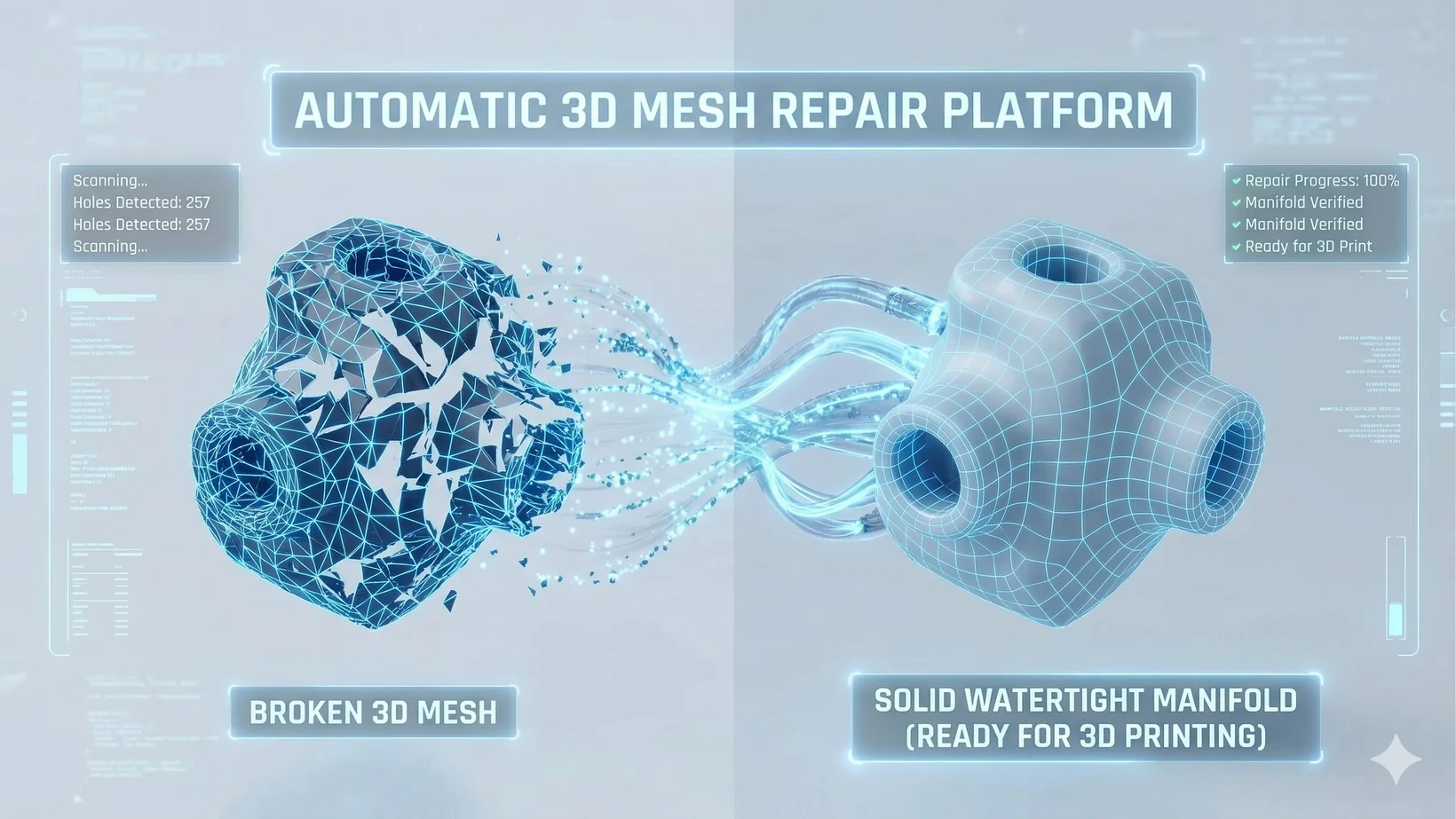
By utilizing an advanced AI 3D modeling tool for 3D printing with wall thickness adjustment, systems automatically strip away self-intersecting faces, inverted normals, and mesh holes, ensuring the generated geometry is a perfect watertight manifold.
Traditional manual CAD modeling and digital sculpting processes are inevitably accompanied by human topological errors. Particularly when handling complex organic shapes or attempting to extrude two-dimensional sketches into three-dimensional profiles, broken geometric features are highly probable. Slicing engines are completely incapable of parsing open edges or internally disorganized, overlapping polygon faces. In this specific phase, the automated manifold optimization capabilities of an AI 3D modeling tool for 3D printing with wall thickness adjustment become indispensable. As the AI 3D model generator instantaneously generates 3D assets, it automatically executes rigorous mesh diagnostic protocols in the background. The AI 3D modeling tool for 3D printing with wall thickness adjustment stitches all surface breaches, uniformly orients all polygon normals, and dissolves redundant internal surface structures, guaranteeing the model renders as a continuously closed physical entity.
Seamless Integration with Slicing Engines
A mature AI 3D modeling tool for 3D printing with wall thickness adjustment ensures exported files possess reasonable physical scaling, optimized polygon distribution, and a gravity-compliant base structure, achieving seamless integration with downstream slicing software. Digital assets must ultimately be converted into machine code (G-code) executable by industrial-grade equipment. To achieve this perfect crossover between digital and physical realms, an AI 3D modeling tool for 3D printing with wall thickness adjustment must serve as a robust bridge between virtual environments and real-world manufacturing.
Strict Product Line Separation: Studio Versus API Ecosystems
The provider offers enterprise developers and creators with solutions featuring absolutely clear boundaries and totally independent billing systems, distinctly separating the interactive web platform from the underlying enterprise interface for the AI 3D modeling tool for 3D printing with wall thickness adjustment.
The Computational Power of Algorithm 3.1 and 200 Billion Parameters
Deeply reliant on the Algorithm 3.1 architecture and a staggering model scale exceeding 200 billion parameters, the AI 3D modeling tool for 3D printing with wall thickness adjustment possesses extraordinary spatial semantic inference capabilities, accurately replicating the volume distribution of the real world.

Smart Retopology and Industrial-Grade Optimization
As an enterprise-grade AI 3D modeling tool for 3D printing with wall thickness adjustment, the system not only conquers thickness challenges but also features built-in smart polygon optimization and PBR material generation, perfectly adapting models for multi-dimensional digital twin displays.
The Evolution of Generative Manufacturing in 2026
As the AI 3D modeling tool for 3D printing with wall thickness adjustment thoroughly permeates the industrial sector, end-to-end automated prototype validation has become the core technological paradigm for reshaping supply chains and accelerating product iteration cycles.