Game Designer Guide: How to Become One in 2026
TL;DR
- A game designer shapes a game's core rules, gameplay mechanics, level layouts, and overall player experience.
- This beginner-friendly guide thoroughly explains the core responsibilities of professional game designers.
- It covers essential industry skills and real-world salary ranges for different career stages.
- It also provides a complete zero-entry roadmap to help beginners become game designers.
- Additionally, it introduces modern AI prototyping tools to optimize and streamline design workflows.
A game designer is the person who shapes how a game plays—its rules, mechanics, levels, and the moment-to-moment experience. This guide explains what game designers actually do, the skills you need, what they earn, and a step-by-step roadmap to become one, even if you're starting from zero.
What Is a Game Designer?
A game designer creates the rules and experiences that define how a game feels to play.
They decide what players can do, why those actions are interesting, how challenges develop, how rewards are delivered, and how the game teaches its systems. A designer may define a combat loop, create a puzzle sequence, balance an economy, build a level layout, write a quest flow, or improve the clarity of a menu.
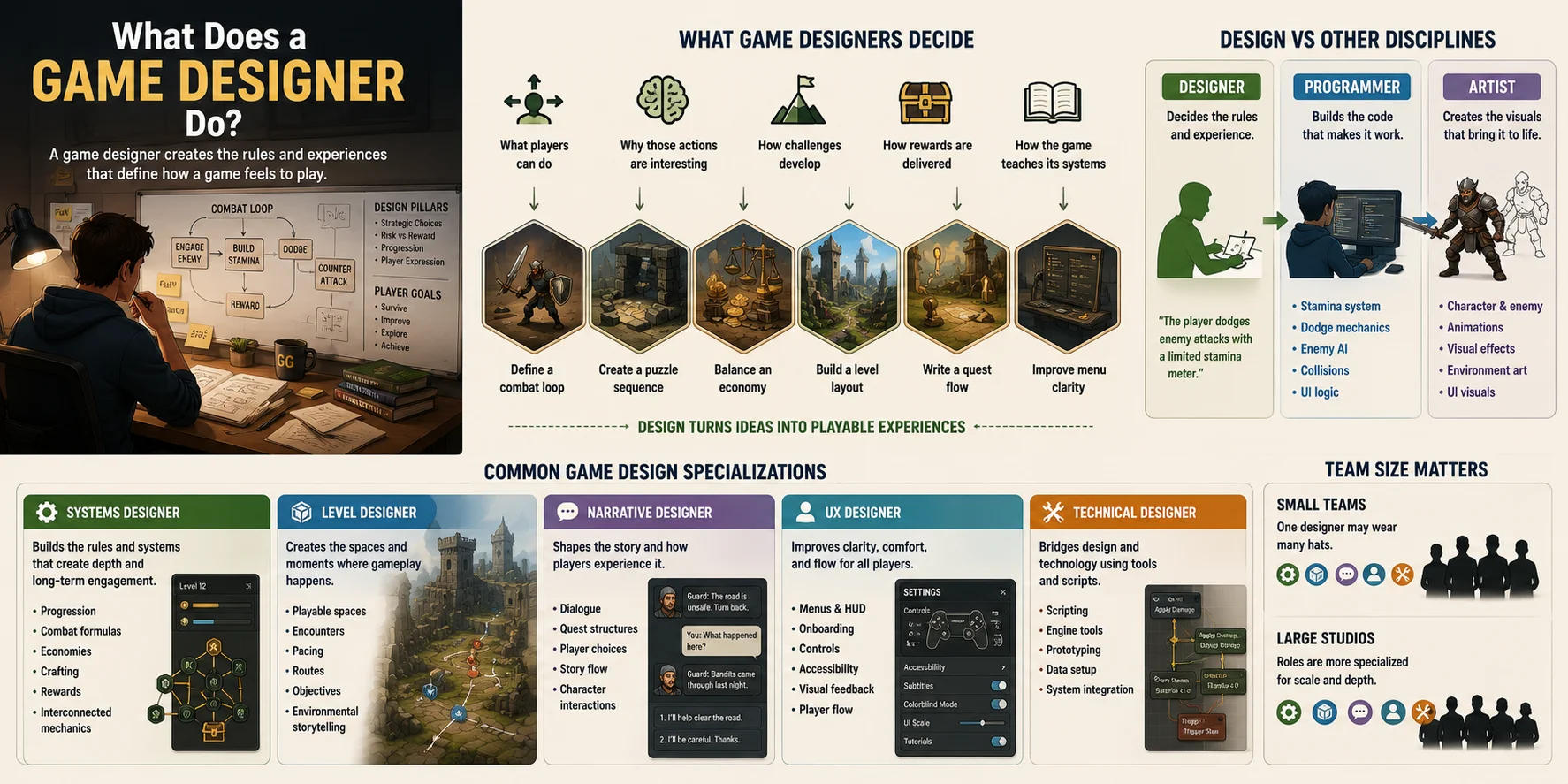
Game design is different from programming and art. A designer may decide that a player should dodge enemy attacks with a limited stamina meter. A programmer builds code that makes the system work. An artist creates the character, enemy, animation, effects, and visual style that makes the action readable.
Common game design specializations include:
- Systems designer: Builds progression, combat formulas, economies, crafting, rewards, and interconnected mechanics.
- Level designer: Creates playable spaces, encounters, pacing, routes, objectives, and environmental storytelling.
- Narrative designer: Develops dialogue, quest structures, player choices, story flow, and character interactions.
- UX designer: Improves menus, onboarding, controls, accessibility, visual feedback, and player flow.
- Technical designer: Uses scripting and engine tools to connect design ideas with implementation.
In small teams, one person may handle several of these responsibilities. Larger studios usually divide them into more specialized roles.
What Does a Game Designer Do? (Day-to-Day)
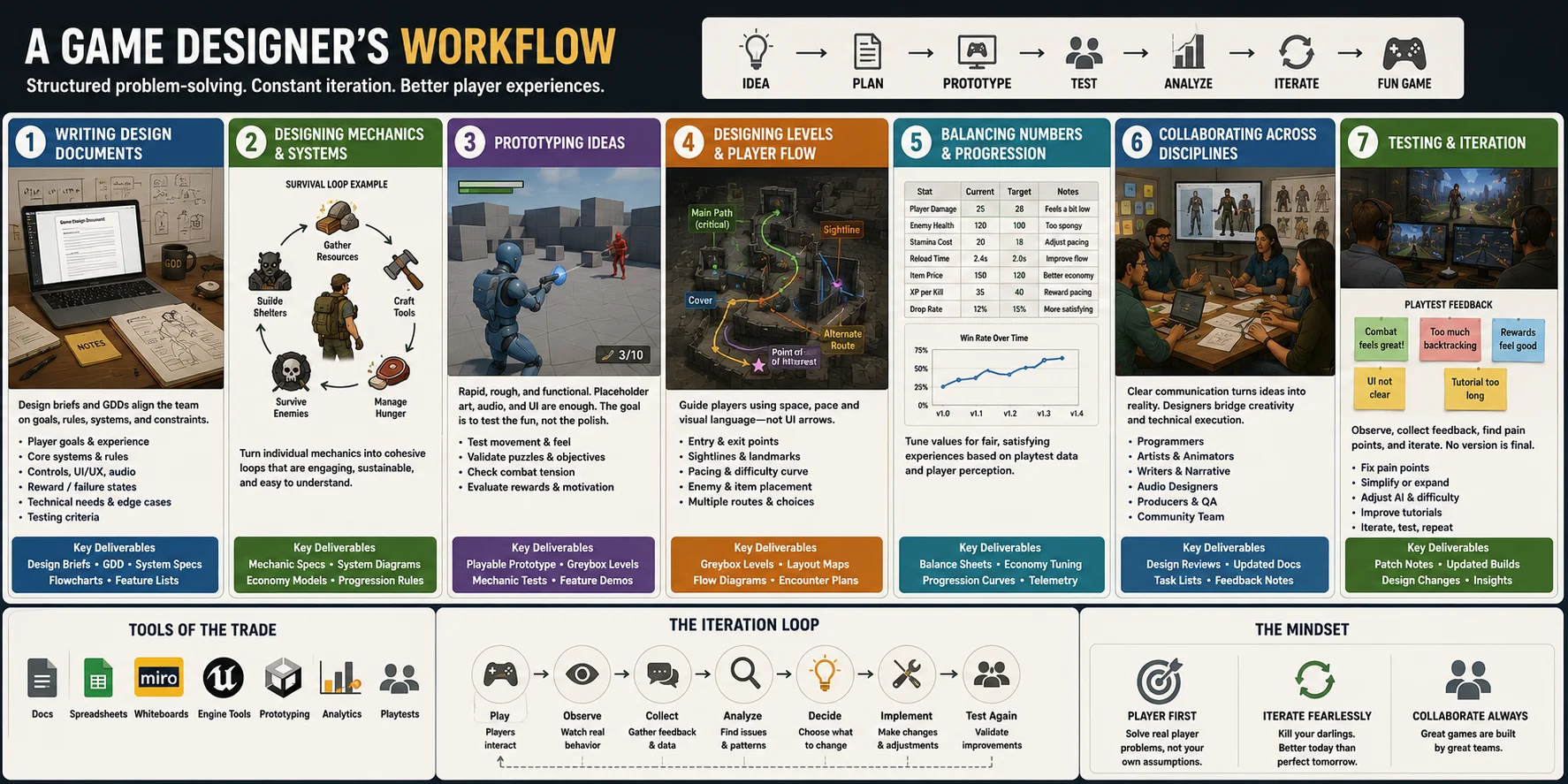
A game designer's daily work focuses on structured problem-solving rather than passive inspiration. A typical workflow includes writing design docs, building rough prototypes, testing features, analyzing player feedback, aligning with programmers and artists, tuning balance values, and iterating levels after playtests.
Writing design documents
Design briefs and formal GDDs (Game Design Documents) standardize design intent for team alignment. Effective documents concisely outline player goals, system rules, controls, reward/failure states, UI and audio requirements, technical dependencies, edge cases, and testing criteria.
The goal is to provide clear, actionable guidance for teammates while remaining flexible for iterative adjustments.
Designing mechanics and systems
Mechanics are a game's basic interactive actions: movement, jumping, aiming, stealth, crafting, dialogue, and puzzle solving.
Systems designers integrate individual mechanics into cohesive, sustainable gameplay loops. For survival games, this combines resource gathering, tool crafting, hunger management, shelter building, and enemy encounters. The core challenge is creating engaging loops without repetitive or overwhelming gameplay.
Prototyping ideas
Prototypes are rough, functional test versions of gameplay features, using placeholder geometry, simple UI, temporary audio, and unfinished animations.
Polished visuals are irrelevant in prototyping; the only goal is to validate design decisions—whether movement feels satisfying, puzzles are intuitive, combat builds tension, and rewards motivate continued play.
Designing levels and player flow
Level design guides player behavior through spatial layout and environmental cues. Designers control player entry points, visual hierarchy, mechanic learning curves, danger placement, and difficulty pacing.
Effective levels use sightlines, landmarks, cover, alternate routes, lighting, and enemy placement to guide players naturally, reducing reliance on intrusive tutorials and UI arrows.
Balancing numbers and progression
Games require continuous tuning of damage, cooldowns, pricing, XP, enemy health, loot rates, speed, resources, and reward timing. Balancing focuses on player perception rather than pure mathematics.
Well-tuned systems deliver fair, satisfying experiences through reasonable difficulty and timely feedback, adjusted via spreadsheets, telemetry, and playtest data.
Collaborating across disciplines
Game designers work cross-functionally with programmers, artists, animators, writers, audio teams, producers, QA, and community staff. Clear communication is as critical as creative ideas.
Designers must articulate intent, adapt to technical limits, and provide sufficient context for consistent team execution.
Testing and iteration
No initial design version is final. Designers observe gameplay, collect feedback, identify pain points, and iterate actively. Iteration may involve simplifying mechanics, adjusting AI, trimming tutorials, modifying rewards, or remaking levels.
Professional designers prioritize solving real player problems over clinging to original ideas.
Game Designer vs Developer vs Artist
These roles overlap, especially on small teams, but they have different primary responsibilities.
| Role | Main Focus | Typical Work | Core Question |
|---|---|---|---|
| Game Designer | Rules, systems, levels, player experience | Mechanics, progression, balance, documentation, prototypes | "What should the player experience?" |
| Game Developer / Programmer | Technical implementation | Code, tools, systems, performance, bug fixing | "How do we make this work reliably?" |
| Game Artist / 3D Modeler | Visual presentation and assets | Characters, environments, UI, animation, textures, props | "What should this look and feel like visually?" |
A designer may gray-box a level with simple blocks, but an environment artist turns it into a finished world. A programmer may build an inventory system, but the designer decides which items exist, how rare they are, and how they influence player choices.
Small teams often require people to wear multiple hats. Learning basic scripting, visual design, and engine tools can make you more useful, but you should still understand your main role.
Skills You Need to Be a Game Designer
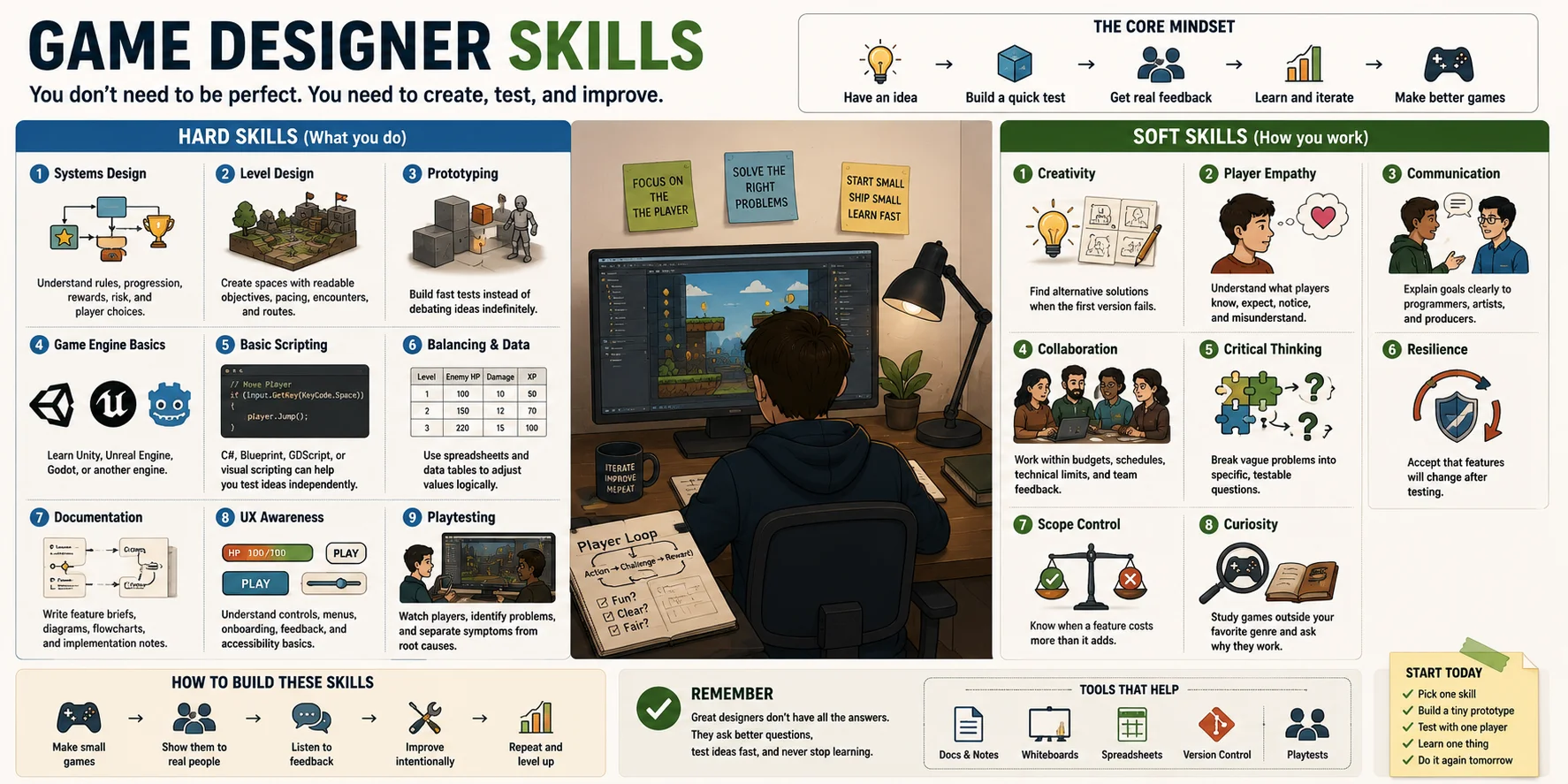
You do not need to master every skill before starting. You need enough practical ability to communicate ideas, test them, and improve them.
Hard skills
- Systems design: Understand rules, progression, rewards, risk, and player choices.
- Level design: Create spaces with readable objectives, pacing, encounters, and routes.
- Prototyping: Build fast tests instead of debating ideas indefinitely.
- Game engine basics: Learn Unity, Unreal Engine, Godot, or another engine.
- Basic scripting: C#, Blueprint, GDScript, or visual scripting can help you test ideas independently.
- Balancing and data: Use spreadsheets and data tables to adjust values logically.
- Documentation: Write feature briefs, diagrams, flowcharts, and implementation notes.
- UX awareness: Understand controls, menus, onboarding, feedback, and accessibility basics.
- Playtesting: Watch players, identify problems, and separate symptoms from root causes.
Soft skills
- Creativity: Find alternative solutions when the first version fails.
- Player empathy: Understand what players know, expect, notice, and misunderstand.
- Communication: Explain goals clearly to programmers, artists, and producers.
- Collaboration: Work within budgets, schedules, technical limits, and team feedback.
- Critical thinking: Break vague problems into specific, testable questions.
- Resilience: Accept that features will change after testing.
- Scope control: Know when a feature costs more than it adds.
- Curiosity: Study games outside your favorite genre and ask why they work.
The best way to develop these skills is to make small games, show them to real people, and improve them based on feedback.
How to Become a Game Designer: Step-by-Step Roadmap
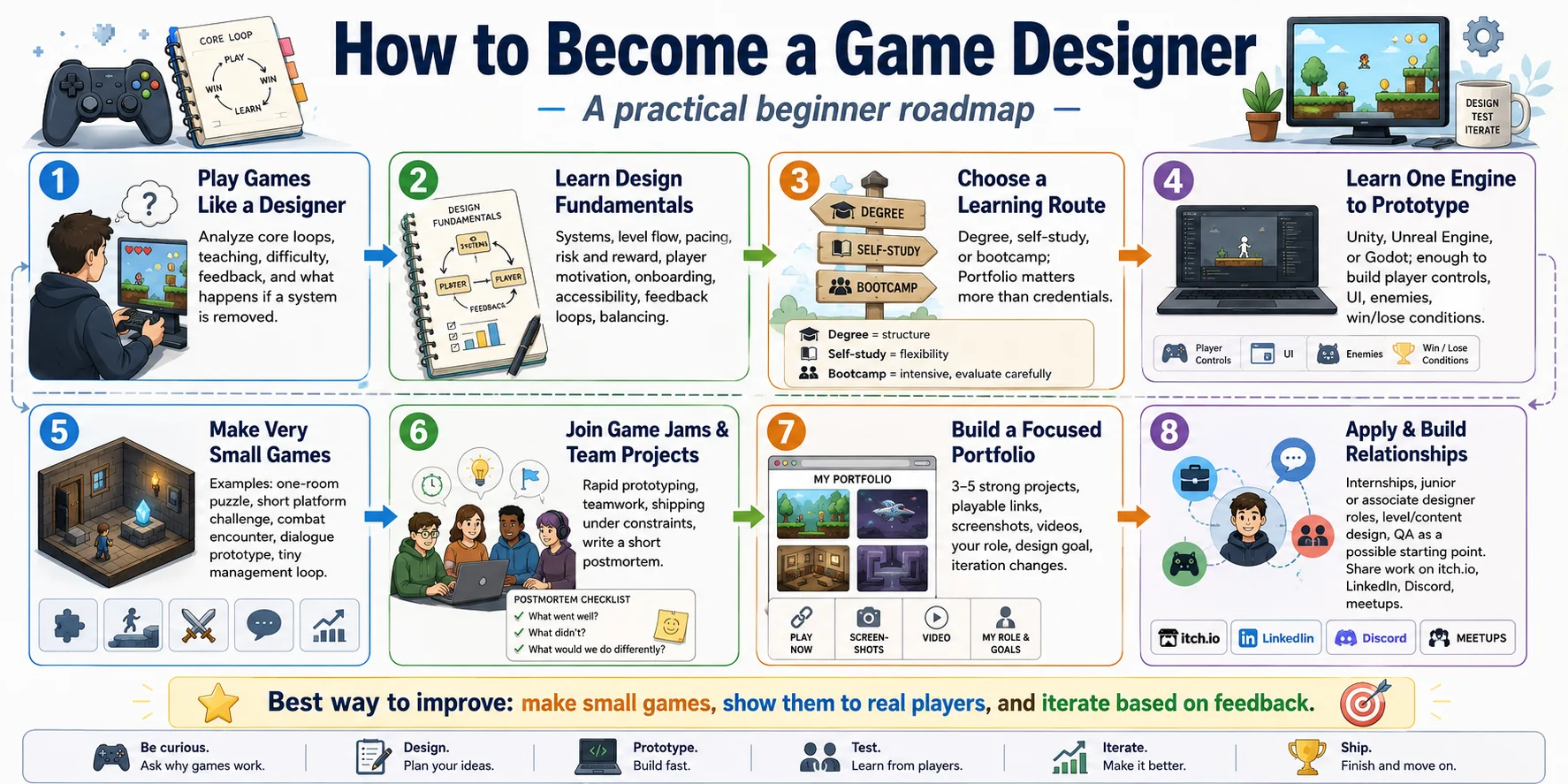
Play games like a designer
Do not only play for entertainment. Analyze what games are doing.
Ask questions such as:
- What is the core gameplay loop?
- How does the game teach a new mechanic?
- What makes the player continue?
- How is difficulty increased?
- What feedback tells the player they succeeded or failed?
- What would happen if one system were removed?
Write short design breakdowns. The goal is to train yourself to notice intentional decisions.
Learn design fundamentals
Study systems, level flow, pacing, risk and reward, player motivation, onboarding, accessibility, feedback loops, and balancing.
Use books, talks, postmortems, courses, and video essays, but apply what you learn immediately. Read about reward pacing, then build a small reward loop. Learn level flow, then create a one-room encounter.
Choose a learning route: degree, self-study, or bootcamp
A formal game design degree is not a mandatory requirement for becoming a professional game designer.
Relevant academic backgrounds—including game design, computer science, interactive media, art, writing, psychology and UX—provide structured learning, mentorship, peer resources, studio exposure and internship opportunities. Degrees with strong graduate portfolios and industry connections deliver the most professional value.
Even so, game studios prioritize practical portfolios over academic credentials. Self-taught designers with polished, playable projects often outperform graduates with only classroom-based work in job competitions.
Choose a degree if you want structure and can justify the cost. Choose self-study if you are disciplined and need flexibility. Evaluate bootcamps carefully by reviewing instructor experience, graduate work, job outcomes, and total cost.
Learn one game engine well enough to prototype
Choose one engine and stay with it long enough to finish projects.
- Unity is useful for C#, broad tutorials, mobile development, and many commercial workflows.
- Unreal Engine is useful for Blueprint visual scripting, advanced 3D, and high-fidelity environments.
- Godot is lightweight and approachable for small projects, 2D games, and rapid iteration.
Your first goal is not mastery. It is enough skill to create a player controller, basic interaction, simple enemy, UI, win condition, lose condition, and playable build.
Make very small games
Do not begin with an MMO, open-world RPG, online shooter, or giant survival game.
Make projects you can finish in days or weeks:
- a one-room puzzle;
- a short platforming challenge;
- a small combat encounter;
- a dialogue-choice prototype;
- a card-game mechanic;
- a tiny resource-management loop;
- a short horror level;
- a basic shop or crafting system.
Finished projects teach more than unfinished ambition. Every small project builds your ability to scope, test, debug, communicate, and deliver.
Join game jams and collaborative projects
Game jams are one of the fastest ways to gain practical experience. They teach time management, teamwork, rapid prototyping, and shipping under constraints.
You do not need to win. Finish the game, gather feedback, and write a short postmortem explaining what worked, what failed, and what you would change.
Build a focused portfolio
Your portfolio is proof that you can design, make, test, and revise.
Aim for three to five strong projects rather than a long list of unfinished ideas. Include playable links, screenshots, videos, your role, the design goal, and the changes you made after testing.
Apply for entry-level roles and build relationships
Look for internships, junior designer positions, associate designer roles, level design internships, content design roles, and QA jobs.
QA can be a useful starting point because it teaches test cases, bug reporting, production workflows, and how games break. It is not the only route into design, but it can build valuable experience.
Share your work on itch.io, LinkedIn, game-jam pages, local meetups, Discord communities, and portfolio sites. Networking is not only asking for jobs. It is showing work, learning from others, and building professional relationships over time.
Tools & Software Game Designers Use (Incl. AI for Prototyping & Assets)
Game designers use tools to communicate, prototype, test, organize work, and collaborate.
Core tools
- Game engines: Unity, Unreal Engine, Godot
- Documentation: Google Docs, Notion, Confluence
- Planning and diagrams: Miro, FigJam, whiteboards
- Balancing: Google Sheets, Excel
- Project tracking: Trello, Jira, Linear
- Version control: GitHub, GitLab, Bitbucket, Perforce
- Communication: Discord, Slack
AI for faster prototyping and placeholder assets
Designers do not need final art before testing a game idea. Early prototypes often use temporary objects to test interaction, scale, readability, movement, and pacing.
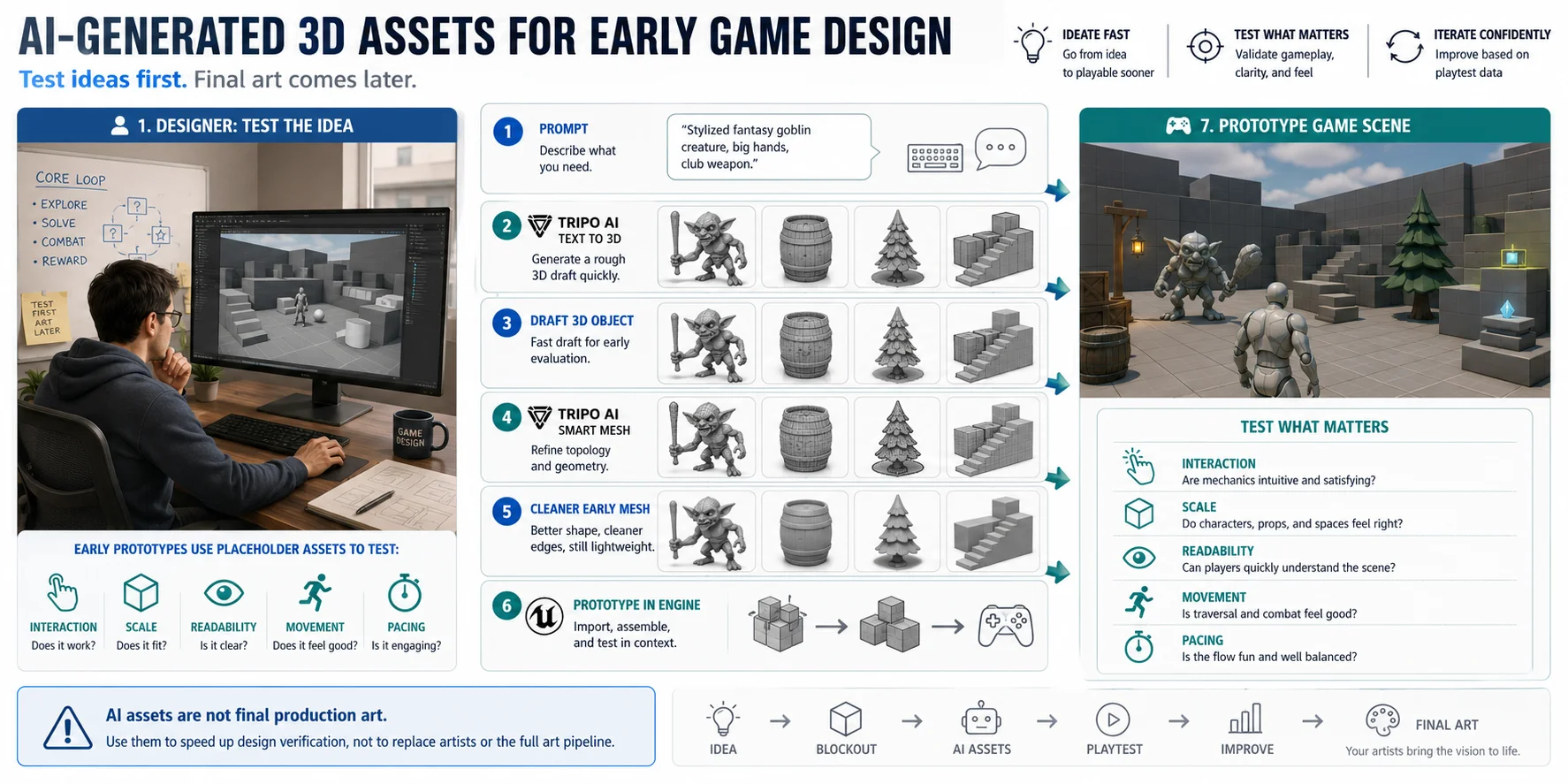
For example, Tripo AI Text to 3D can generate a draft 3D object from a prompt, while Tripo AI Smart Mesh can help create a cleaner early mesh for testing. This can be useful for placeholder props, creatures, environmental objects, or level-blockout elements.
However, it should be noted that the resources generated by AI are by default not considered as finished design art. Their purpose is to accelerate the design verification process, rather than replacing artists or the production process.
Building a Game Design Portfolio
A strong game design portfolio shows what you think, not just what you made.
Hiring managers want to understand your contribution. They need to know what problem you were solving, what choices you made, what constraints existed, and how you improved the project after feedback.
For each project, include:
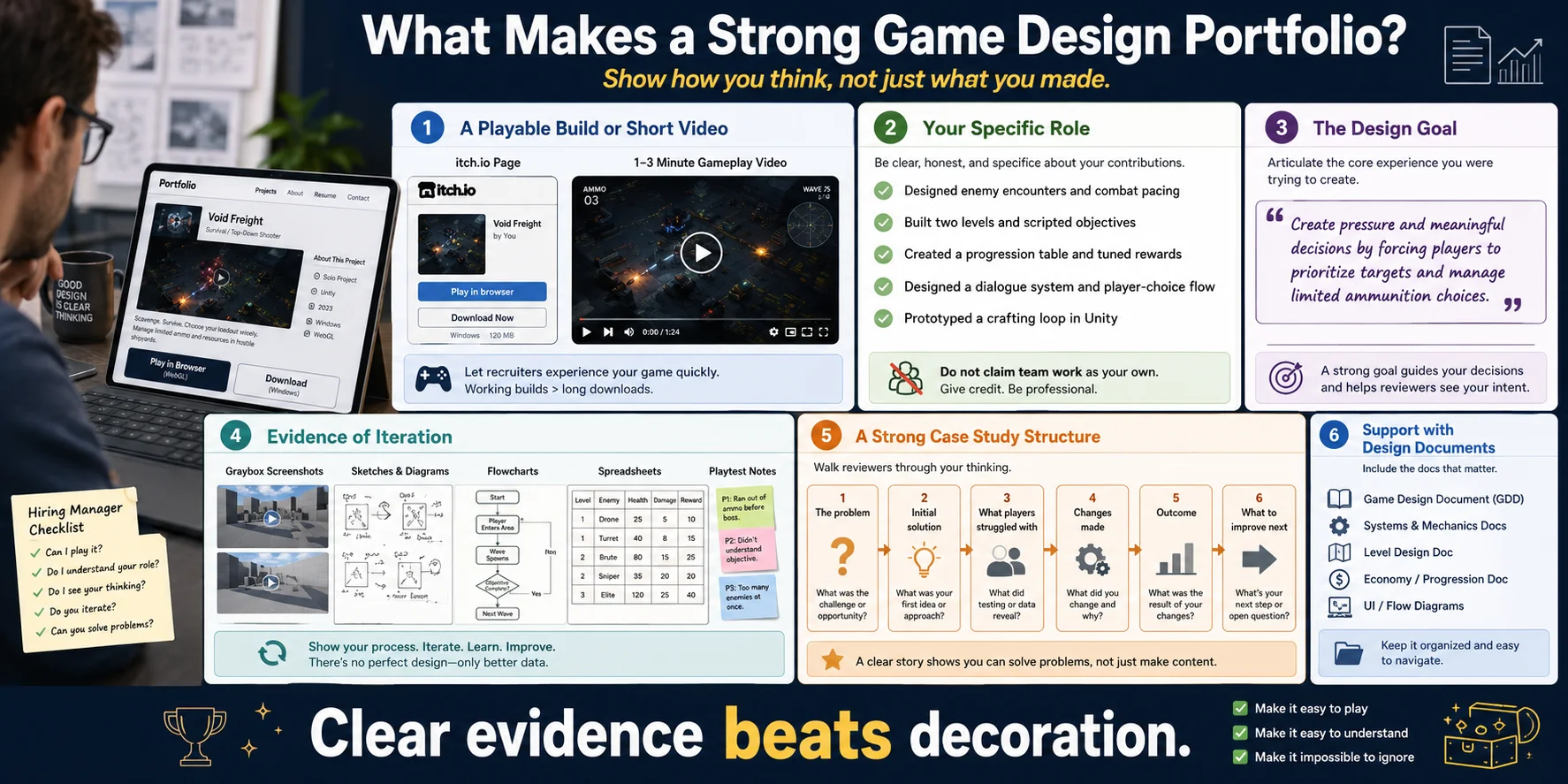
A playable build or short video
Use an itch.io page, browser build, downloadable build, or short gameplay video. A one- to three-minute video helps recruiters quickly understand the project.
Your specific role
Be direct about your contribution.
For example:
- Designed enemy encounters and combat pacing.
- Built two levels and scripted objectives.
- Created a progression table and tuned rewards.
- Designed a dialogue system and player-choice flow.
- Prototyped a crafting loop in Unity.
Do not claim credit for work completed by the whole team.
The design goal
Explain the player experience you wanted to create.
For example: "I wanted players to feel pressure when deciding whether to spend limited ammunition now or save it for a later encounter."
That is more informative than simply writing, "I made a survival level."
Evidence of iteration
Show gray-box screenshots, sketches, flowcharts, spreadsheets, playtest notes, before-and-after comparisons, and design documents.
A strong case study often follows this structure:
- The problem.
- Your initial solution.
- What players struggled with.
- The changes you made.
- The outcome.
- What would you improve next.
A simple, readable portfolio is better than a visually complicated one. Clear evidence beats decoration.
Game Designer Salary
Game designer salaries vary by country, city, studio size, experience, specialization, and whether a reported figure includes bonuses or stock.
In the United States, salary trackers commonly place many game designer roles in the high-five-figure to low-six-figure range. Junior roles may begin lower, while senior, lead, or highly specialized roles at major studios can pay much more.
| Career Stage | Typical Annual Pay Context |
|---|---|
| Entry-level or junior designer | Often around 90,000, depending on location and studio |
| Mid-level designer | Commonly around 130,000 |
| Senior or lead designer | Often 160,000+, with higher totals at large studios or expensive regions |
These figures are broad estimates, not guarantees. Indie studios may pay less but offer wider responsibilities. Larger studios may offer stronger pay, benefits, bonuses, and specialist career paths, but they are often more competitive.
When comparing jobs, consider more than salary. Look at benefits, work-life balance, overtime expectations, remote-work policy, job stability, studio culture, team size, and opportunities to ship work.
Frequently Asked Questions
How do I become a game designer with no experience?
Start by making small playable projects. Learn one engine, join game jams, study games critically, and build a portfolio with prototypes, levels, systems, and postmortems. You do not need a professional job before creating evidence of your design skills.
Do you need a degree to be a game designer?
No. A degree can provide structure, mentors, peers, and internship access, but it is not required. A strong portfolio, completed projects, practical engine skills, and clear communication often matter more.
What skills does a game designer need?
Game designers need systems thinking, prototyping ability, level-design awareness, communication, documentation, balancing, player empathy, playtesting, and scope control. Basic scripting and game-engine knowledge are also valuable.
How much do game designers make?
Salary depends on location, experience, studio size, and specialization. In the United States, many roles fall between the high five figures and low six figures, while entry-level roles may pay less and senior positions may pay more.
What software do game designers use?
Common tools include Unity, Unreal Engine, Godot, spreadsheets, planning boards, documentation tools, task trackers, version control systems, and prototyping software. AI tools can also help create temporary assets for early design tests.
Conclusion
Game designers shape the rules, choices, systems, and spaces that make games meaningful and playable. The most reliable way into the field is to make small projects, test them with real people, document your decisions, and build a focused portfolio.
Start with one mechanic, one level, or one short prototype. When you are ready to test a 3D idea, you can create game-ready placeholder assets from text or images with Tripo AI and spend more time evaluating the design itself.