What Is an Environment Artist? Skills, Salary & How to Become One
TL;DR
- An environment artist builds the 3D worlds used in games, film, VFX, and visualization, from landscapes and interiors to props, materials, lighting, and set dressing.
- The role combines artistic judgment with technical production skills such as modeling, UV mapping, PBR texturing, retopology, engine setup, and real-time optimization.
- A strong environment artist portfolio should show finished scenes, breakdowns, wireframes, material work, lighting passes, and clear notes about your role in the project.
- AI 3D tools can speed up base meshes, props, and kitbash assets, but the artist still controls composition, style consistency, topology, scale, and final quality.
- To enter the field, learn a DCC tool, build complete scenes, practice in Unreal Engine or Unity, seek feedback, and apply for environment artist internships or junior jobs.
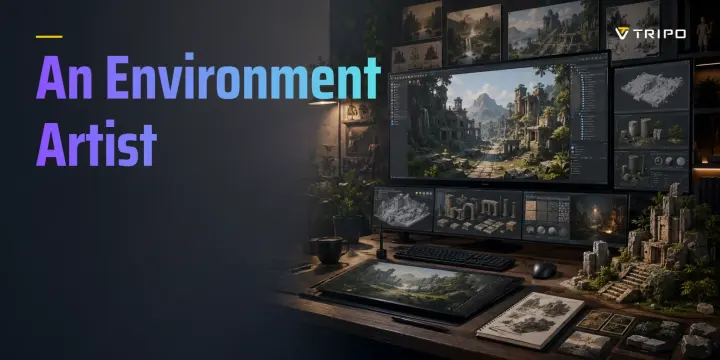
An environment artist is a 3D artist who builds the worlds you see in games and film—landscapes, buildings, interiors, props, and set dressing. Working from concept art, references, and scans, they model, texture, and light entire scenes so they feel believable and support the story or gameplay.
What Does an Environment Artist Do?
Environment artists turn concept art, reference images, scans, and design briefs into usable 3D worlds.
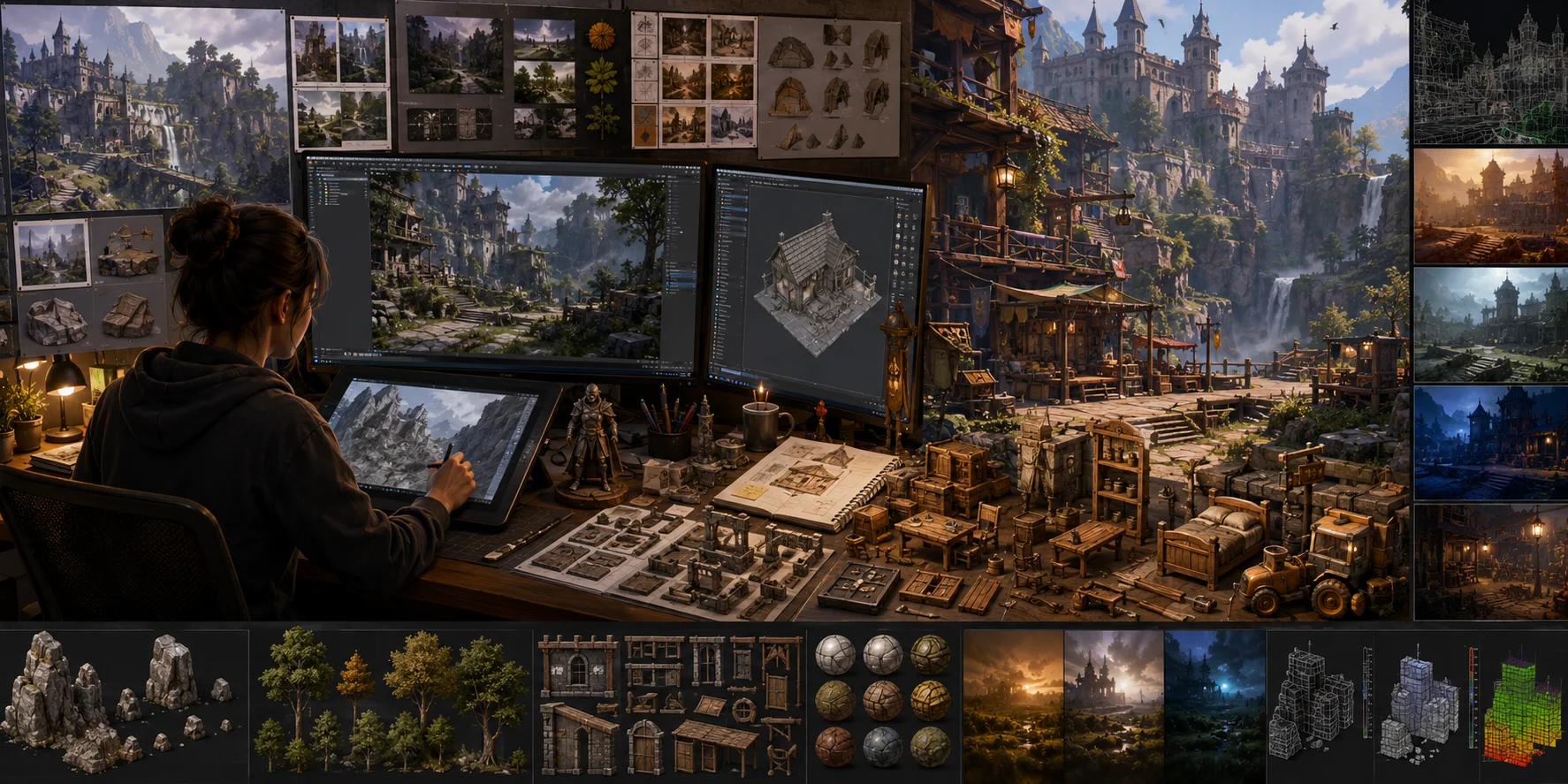
Typical work includes:
- terrain, rocks, foliage, and natural landscapes;
- modular buildings, interiors, and architecture;
- props such as furniture, machinery, crates, signs, and vehicles;
- set dressing, decals, clutter, and environmental storytelling;
- material creation, lighting support, and scene optimization.
In games, the role emphasizes real-time performance, modularity, player navigation, collision, LODs, and engine integration. In film and VFX, environment artists may focus more on cinematic detail, digital sets, camera-specific work, scans, and final rendered realism.
Environment Artist vs Concept Artist
A concept artist creates the visual direction: sketches, mood boards, color studies, silhouettes, and scene paintings.
An environment artist builds that idea into a functional 3D scene.
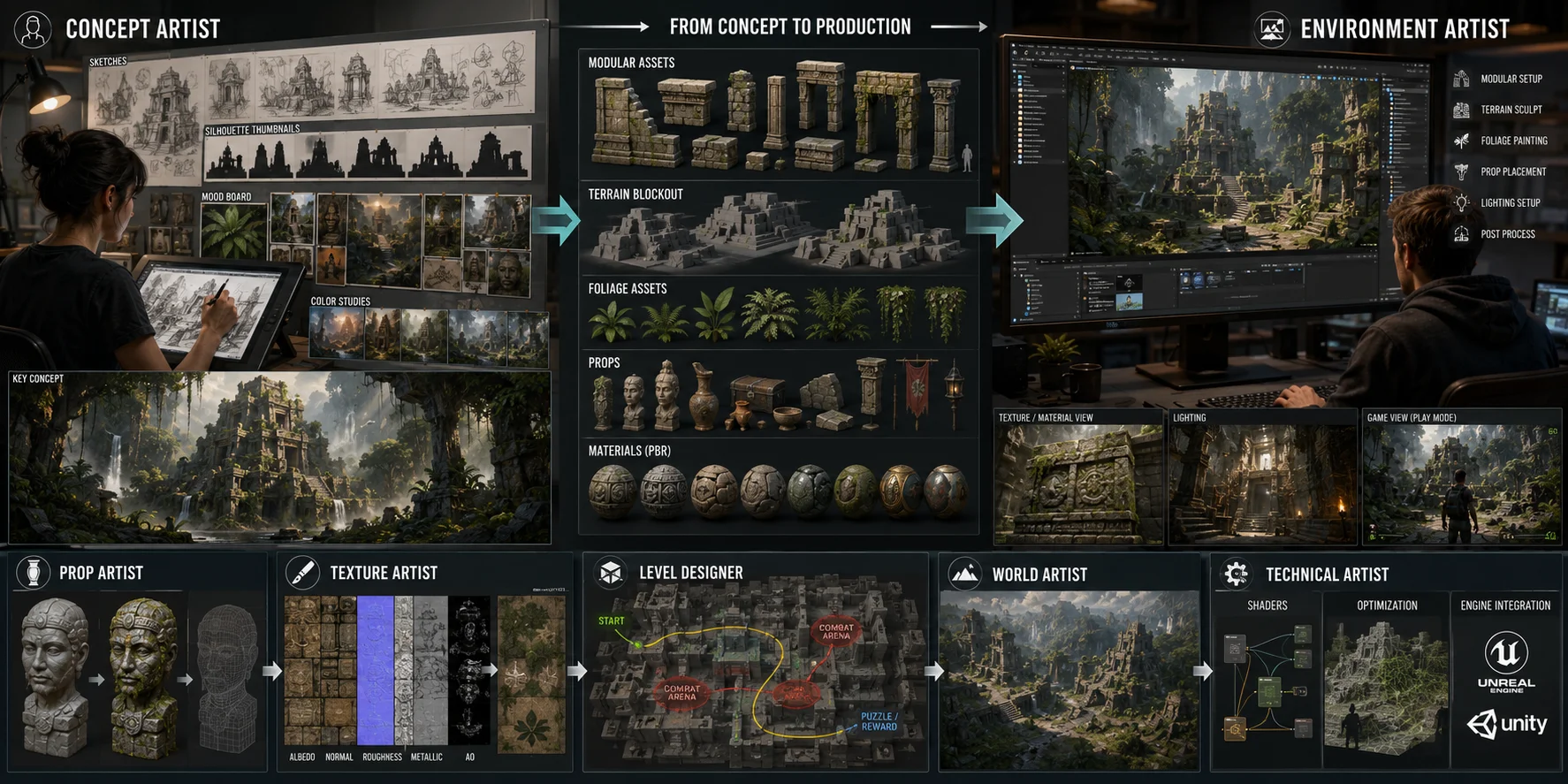
For example, a concept artist may paint a ruined jungle temple. The environment artist models the stone modules, terrain, plants, props, textures, lighting setup, and scene composition.
Related roles include:
- Prop artist: creates individual objects such as tools, furniture, weapons, and machinery.
- Texture artist: creates PBR materials, decals, surface wear, dirt, and color variation.
- Level designer: plans gameplay flow, player routes, encounters, and mission spaces.
- World artist: assembles and dresses larger spaces using existing assets.
- Technical artist: solves pipeline, shader, optimization, and art-engine integration problems.
A Day in the Life of an Environment Artist
A task often starts with a brief, concept image, reference pack, or level blockout.
The artist studies the intended mood, scale, architecture, gameplay needs, and performance target. They then block out the space with simple geometry before investing in detailed modeling.
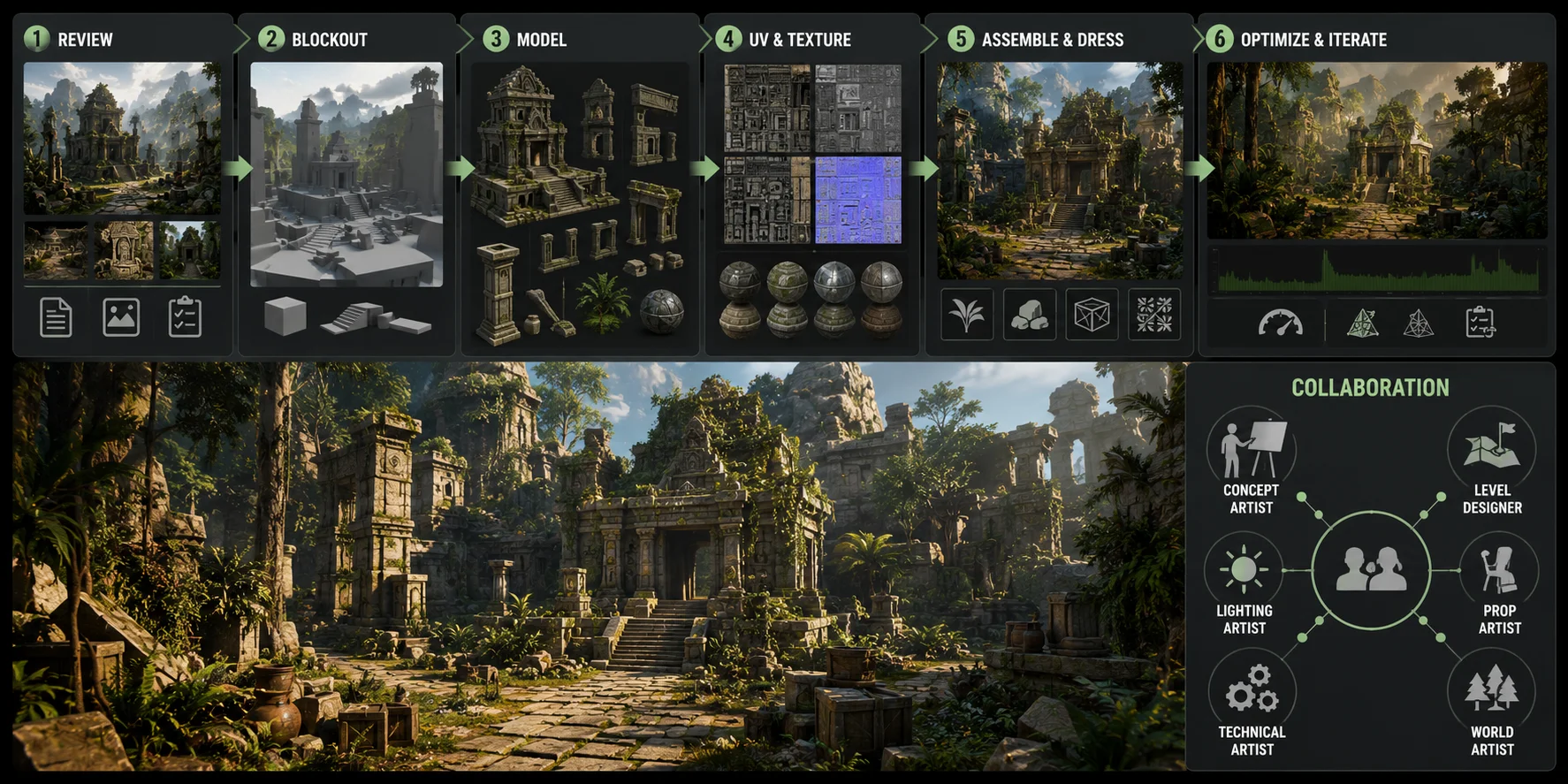
A typical workflow is:
- Review concepts, reference, and technical requirements.
- Build a greybox or blockout to test scale and composition.
- Model modular architecture, terrain pieces, props, or hero assets.
- Create UVs, bake high-poly detail, and apply PBR textures.
- Assemble the scene with set dressing, decals, foliage, and lighting.
- Test performance, collect feedback, and iterate with design, lighting, and technical art teams.
The work is highly collaborative. Environment artists regularly coordinate with concept artists, level designers, lighting artists, prop artists, and technical artists.
Skills You Need
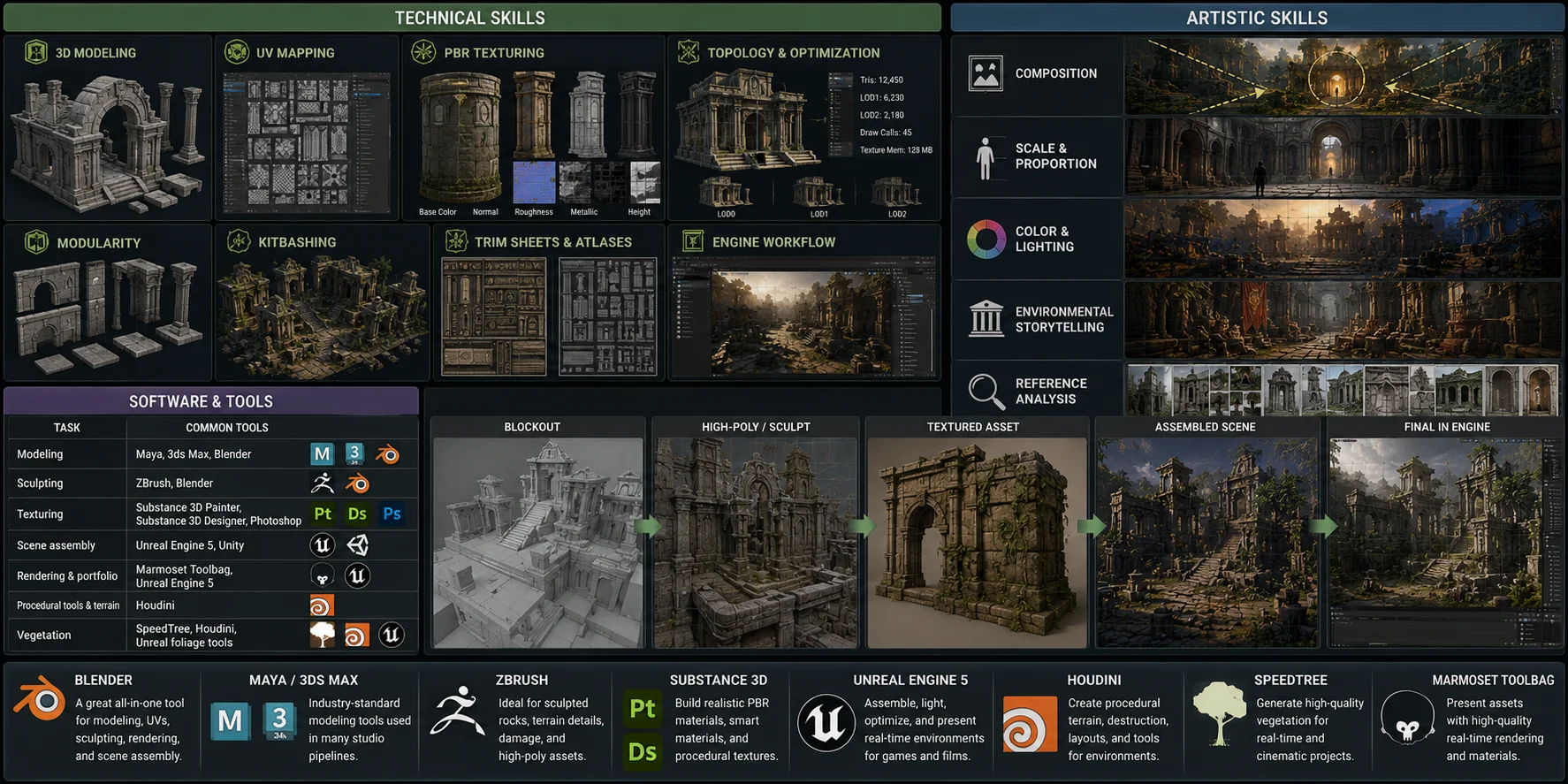
Technical Skills
- 3D modeling: Build clean assets for architecture, props, terrain, and modular kits.
- UV mapping: Prepare models for texture application and baking.
- PBR texturing: Create believable materials using base color, roughness, metallic, normal, and height maps.
- Topology and optimization: Control polygon count, LODs, collision, draw calls, and texture memory.
- Modularity: Build reusable walls, floors, trims, doors, and structural elements.
- Kitbashing: Combine existing pieces efficiently without obvious repetition.
- Trim sheets and texture atlases: Reuse materials across multiple assets.
- Game-engine workflow: Import, light, profile, and optimize scenes in Unreal Engine or Unity.
Artistic Skills
- Composition: Guide the viewer or player through focal points and visual hierarchy.
- Scale and proportion: Make buildings, furniture, terrain, and props feel believable.
- Color and lighting awareness: Support mood, readability, and atmosphere.
- Environmental storytelling: Suggest history, function, ownership, and character through space.
- Reference analysis: Study real materials, weathering, construction methods, and natural forms.
Software and Tools
| Task | Common Tools |
|---|---|
| Modeling | Maya, 3ds Max, Blender |
| Sculpting | ZBrush, Blender |
| Texturing | Substance 3D Painter, Substance 3D Designer, Photoshop |
| Scene assembly | Unreal Engine 5, Unity |
| Rendering and portfolio presentation | Marmoset Toolbag, Unreal Engine 5 |
| Procedural tools and terrain | Houdini |
| Vegetation | SpeedTree, Houdini, Unreal foliage tools |
Blender is a strong starting tool because it covers modeling, UVs, sculpting, rendering, and basic scene assembly. Maya and 3ds Max remain common in studio pipelines. ZBrush is widely used for sculpted rocks, damaged surfaces, terrain details, and high-poly assets.
The Asset and Scene Creation Workflow
A game-ready environment asset usually follows this sequence:
- Reference and blockout: Define scale, silhouette, composition, and gameplay or camera requirements.
- High-poly modeling or sculpting: Create detailed source geometry for hard-surface or organic assets.
- Retopology and UVs: Build efficient low-poly geometry and prepare UV layouts.
- Baking: Transfer high-poly detail into normal, ambient occlusion, curvature, and other texture maps.
- PBR texturing: Add materials, wear, color variation, decals, and surface history.
- Assembly and set dressing: Place modular assets, props, foliage, clutter, and decals in the engine.
- Lighting: Check material response, mood, depth, and focal points.
- Optimization: Configure LODs, collision, draw calls, texture budgets, and real-time performance.
The goal is not simply to make a detailed asset. It must be visually convincing, reusable, technically efficient, and appropriate for the target platform.
Tools and AI in the Environment Art Workflow
AI 3D tools are becoming useful for early asset exploration, base meshes, background props, kitbash elements, and rapid prototyping.
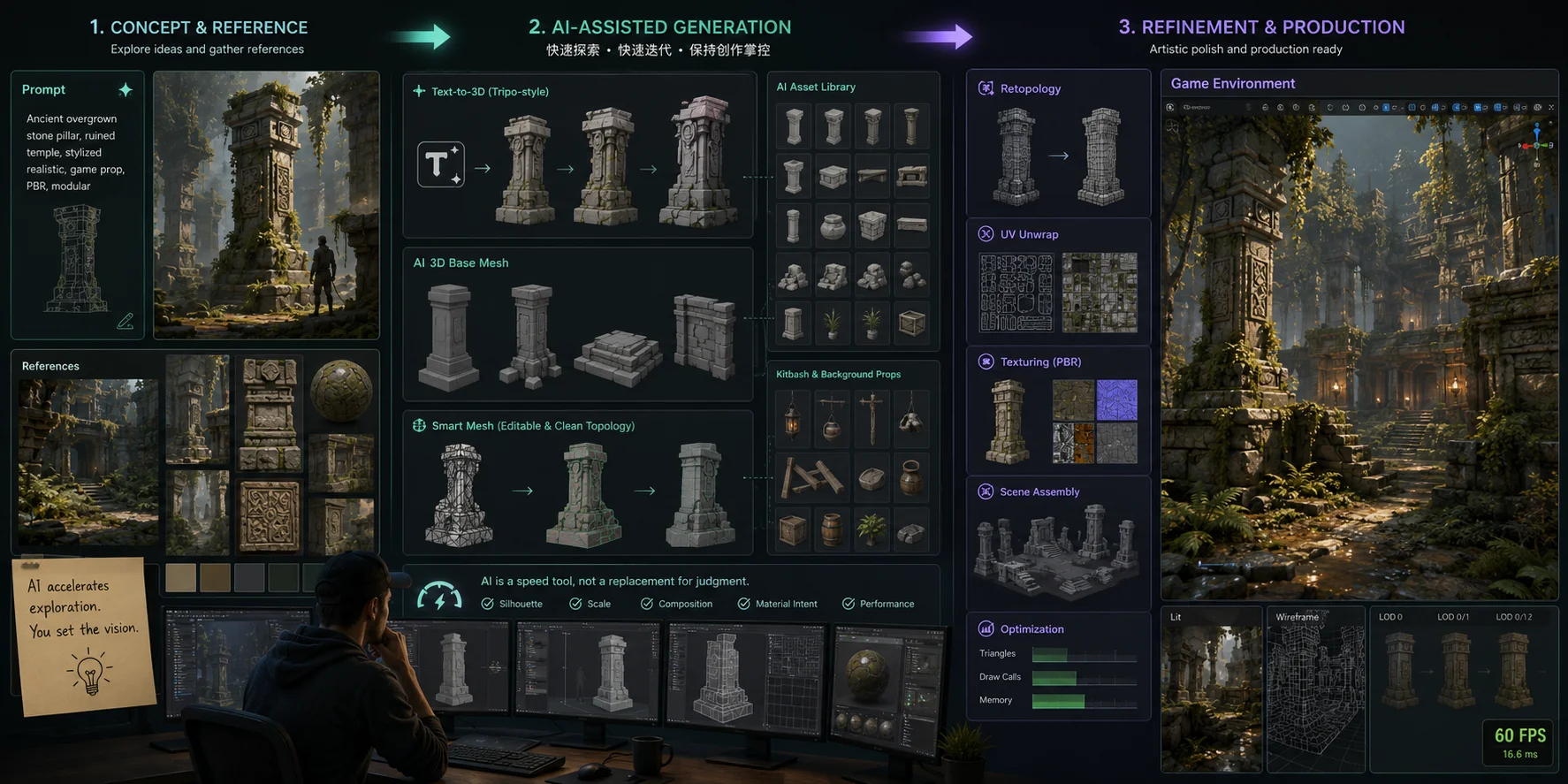
Instead of starting every prop from an empty scene, an artist can generate a rough model from a prompt or image, then refine it through retopology, UVs, texturing, and scene assembly.
For text prompts, Tripo AI Text to 3D can provide editable starting models that artists can use for prop ideation, set dressing, blockout replacement, and visual variations. Image-based workflows can also support early exploration when a reference image or sketch already exists.
For real-time pipelines, Tripo AI Smart Mesh can help generate cleaner, optimized meshes for game-oriented workflows. The artist still controls final quality: silhouette, topology, materials, scale, style consistency, and performance must be reviewed before an asset enters production.
AI is best treated as a speed tool for repetitive asset creation, not a substitute for composition, reference study, technical optimization, or artistic judgment.
How to Become an Environment Artist
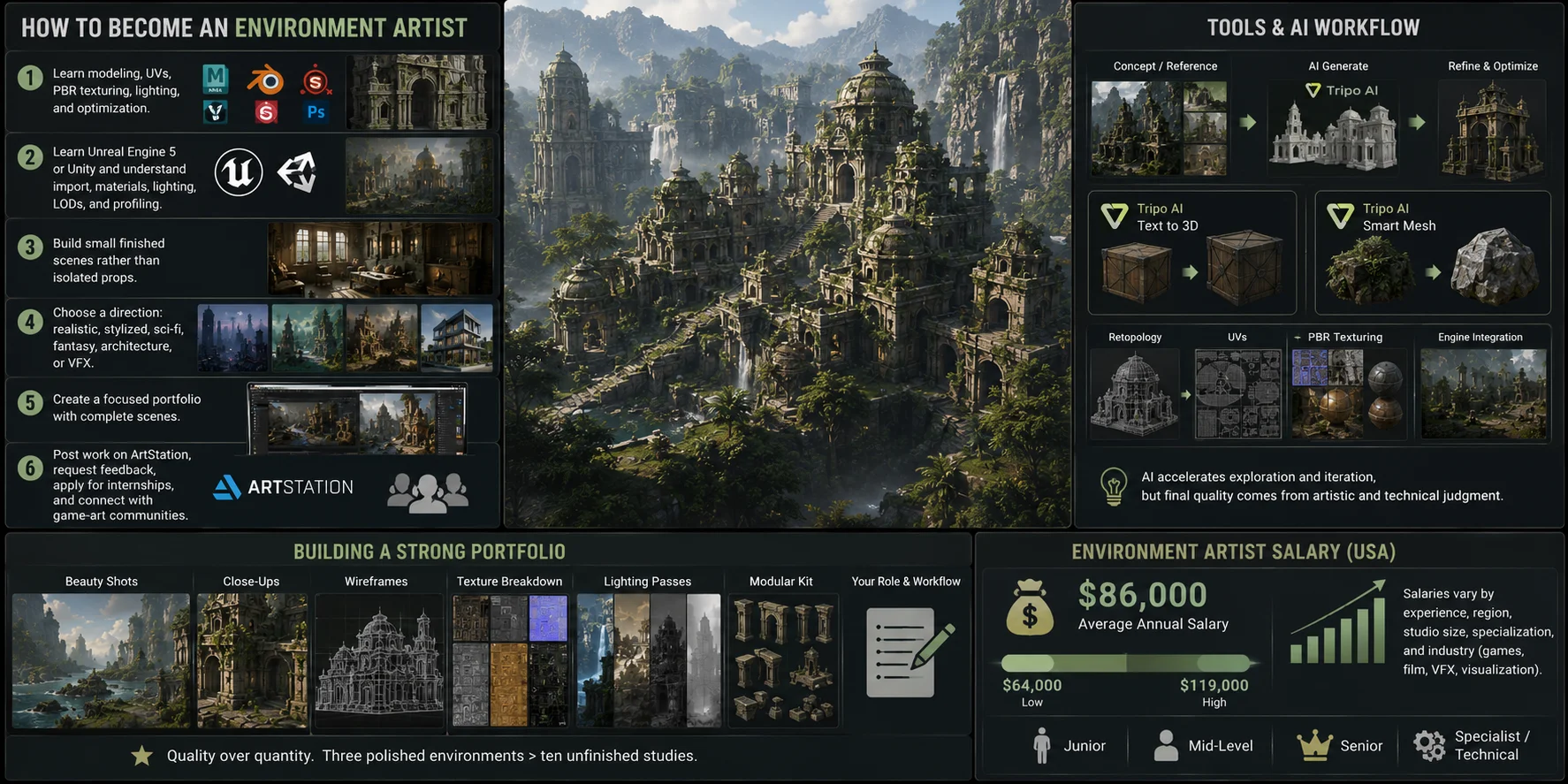
- Learn modeling, UVs, PBR texturing, lighting, and optimization.
- Learn Unreal Engine 5 or Unity and understand import, materials, lighting, LODs, and profiling.
- Build small finished scenes rather than isolated props.
- Choose a direction: realistic games, stylized environments, sci-fi, fantasy, architecture, or VFX.
- Create a focused portfolio with complete scenes.
- Post work on ArtStation, request feedback, apply for internships, and connect with game-art communities.
A degree can help, but it is not required. A strong portfolio matters more than a specific educational path. If you prefer structured learning, an environment artist course can give you assignments, critiques, and software practice; if you prefer self-teaching, follow production breakdowns and rebuild small scenes from reference.
For early environment artist jobs, studios usually look for clean fundamentals more than huge projects. Search for junior 3D environment artist jobs, environment artist internships, and trainee roles, then tailor each application with a focused portfolio, a short breakdown of your workflow, and notes on the tools you used.
Building a Strong Portfolio
Quality matters more than quantity.
Three polished environments are stronger than ten unfinished asset studies. A strong environment artist portfolio should show finished scenes with clear beauty shots, close-ups, wireframes, texture breakdowns, lighting passes, modular kits, and concise notes about your role and workflow.
Recruiters and art leads need to understand both the final image and the production choices behind it. Include a short breakdown for each scene: the reference goal, software used, asset count, trim sheets or texture sets, engine setup, optimization choices, and what you personally created if the project involved a team.
Use ArtStation for presentation. Tailor the portfolio to the work you want: a stylized mobile-game portfolio should look different from a realistic Unreal Engine environment portfolio.
Environment Artist Salary
Environment artist salaries depend on experience, region, studio size, specialization, and whether the work is in games, film, VFX, or visualization.
In the United States, salary aggregators such as Glassdoor commonly place 3D environment artist salary around 64,000 and $119,000. Junior roles may fall below this range, while senior artists, technical specialists, and artists at larger studios may earn more.
Frequently Asked Questions
What does an environment artist do?
An environment artist creates 3D spaces and assets such as terrain, buildings, interiors, props, vegetation, materials, and set dressing for games, film, VFX, or visualization.
How do I become an environment artist?
Learn modeling, UVs, PBR texturing, lighting, optimization, and a game engine. Build finished scenes, create a focused ArtStation portfolio, seek feedback, and apply for internships or junior roles.
What is the difference between an environment artist and a concept artist?
Concept artists create the early visual direction in 2D. Environment artists build the final usable 3D world from those concepts and references.
Who are the most famous environmental artists?
“Environmental artist” can refer to land-art practitioners rather than game or VFX artists. For 3D environment art, study credited game teams, ArtStation portfolios, and studio breakdowns.
What skills do environment artists need?
Environment artists need 3D modeling, UV mapping, PBR texturing, lighting, composition, scale, and optimization skills. For game work, they also need to understand engines, LODs, collision, modular kits, and texture budgets.
What software do environment artists use?
Common tools include Blender, Maya, 3ds Max, ZBrush, Substance 3D Painter, Substance 3D Designer, Unreal Engine 5, Unity, Houdini, SpeedTree, and Marmoset Toolbag. The exact stack depends on whether the artist works in games, film, VFX, visualization, or stylized production.
Is environment art a good career?
Environment art can be a strong career for artists who enjoy building spaces, solving production problems, and improving both art and technical skills. Competition is real, so a focused environment artist portfolio with finished scenes is more important than a long list of unfinished studies.
Do you need a degree to become an environment artist?
A degree can help, but it is not always required. Many environment artists enter through self-study, online courses, mentorships, internships, junior roles, and portfolio feedback from game-art communities.
What should an environment artist portfolio include?
An environment artist portfolio should include complete scenes, beauty shots, close-ups, wireframes, texture breakdowns, modular kits, lighting passes, and short workflow notes. It should show the kind of environment artist jobs you want, such as realistic games, stylized games, VFX, or architectural visualization.
How can AI tools help environment artists?
AI tools can help generate rough base meshes, props, and kitbash assets for early exploration or set dressing. They are most useful as a starting point; artists still need to refine topology, UVs, materials, scale, composition, and performance before assets are production-ready.
Conclusion
Environment art rewards patience, reference, and a strong portfolio—and modern AI 3D tools can speed up the asset-heavy parts so you spend more time on composition and polish. Try generating game-ready base meshes and props with Tripo AI.