AI-Generated Proxy Meshes for Film Scene Optimization
Film LayoutScene OptimizationAI 3D

AI-Generated Proxy Meshes for Film Scene Optimization

Accelerating Pre-visualization and Scene Optimization with Tripo AI Generated Proxy Meshes

Tripo Team
2024-05-23
6 min

Document Information

VersionActionOwner
1.0Document Creation王磊

Managing multi-million polygon assets during the initial stages of film production creates severe bottlenecks for layout departments. As scene complexity scales, viewport performance degrades exponentially, causing software instability and hindering directorial decision-making. Utilizing an AI 3D model generator solves this friction by providing lightweight, spatially accurate stand-ins that maintain real-time performance while accelerating the pre-visualization pipeline. By integrating automated mesh generation, studios can bypass the tedious process of manually modeling placeholder assets, ensuring that technical directors and layout artists focus entirely on spatial composition and camera blocking.

Key Insights

  • Proxy meshes act as crucial performance safeguards, allowing layout artists to manipulate massive digital sets without triggering hardware throttling or VRAM exhaustion.
  • Integrating automated generation replaces tedious manual placeholder modeling, reducing asset creation turnaround from days to mere minutes.
  • A hybrid approach combining automated base meshes with traditional refinement cuts total retopology workflows from six hours to under forty-five minutes while maintaining professional quality.
  • Universal export support guarantees seamless asset transfer into standard virtual production engines, preserving critical scale and hierarchical data.

The Role of Proxy Meshes in Heavy Film Layouts

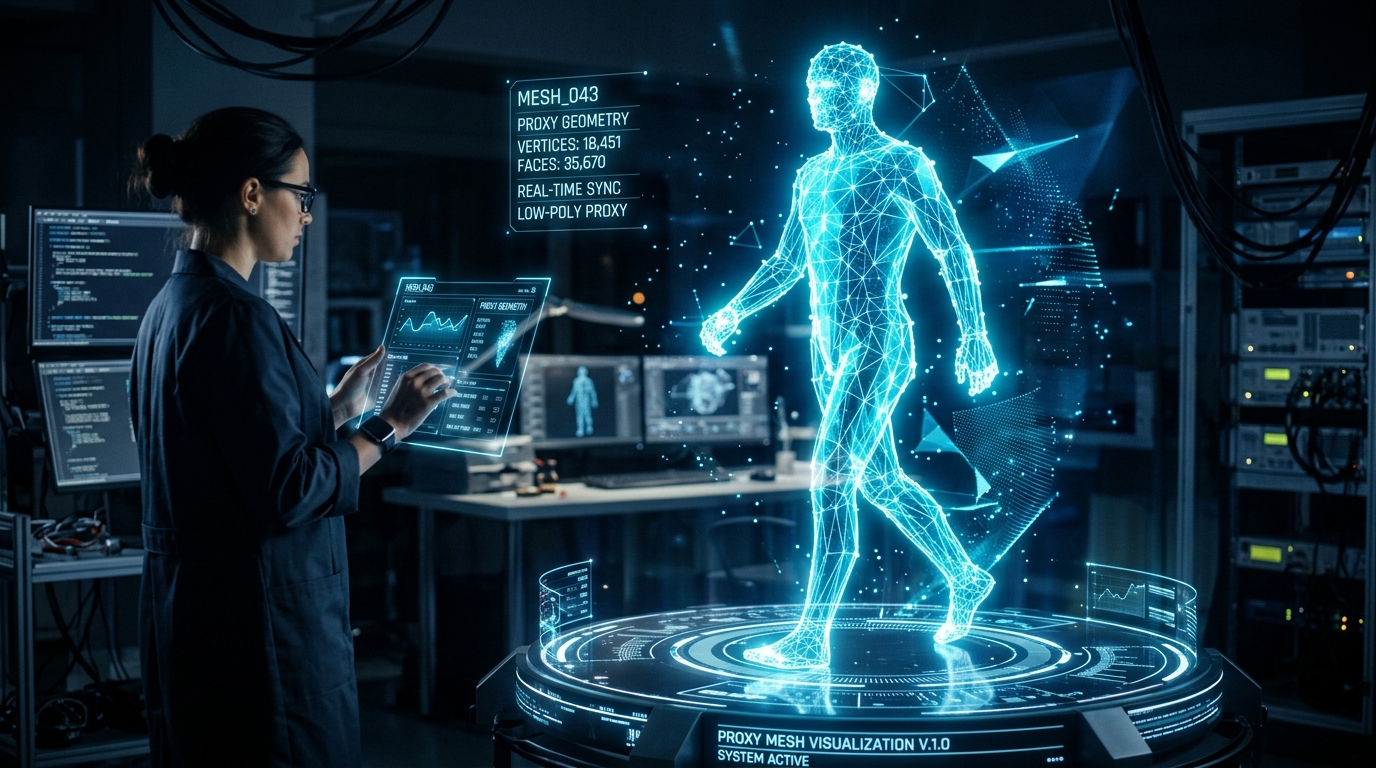
In heavy film layout tasks, proxy meshes act as lightweight 3D stand-ins for complex final assets. They drastically reduce polygon counts, preventing DCC software crashes and ensuring real-time viewport performance during camera blocking, spatial planning, and initial scene optimization across massive virtual sets.

Viewport Performance vs. Render Fidelity

During the layout phase of film production, the primary objective is to establish camera angles, character blocking, and environmental scale. High-fidelity hero assets, often consisting of millions of polygons, are entirely unnecessary for these tasks. Proxy meshes serve as the essential bridge; by substituting a dense architectural column with a low-polygon equivalent, the viewport engine requires a fraction of the computational power. This allows directors to iterate on shot composition without lag.

Traditional vs. AI-Driven Proxy Creation

Historically, proxy creation diverted valuable human resources. Today, a hybrid approach is preferred. Automated generation is used for rapid concept exploration and immediate deployment of base meshes. While professional pipelines still require inspection for non-manifold geometry or floating vertices, this hybrid method typically reduces total retopology time from six hours to under forty-five minutes.

How Tripo AI Accelerates Proxy Mesh Generation

Tripo AI revolutionizes scene optimization by instantly generating low-poly proxy meshes from concept art or text prompts.

Holographic 3D proxy mesh concept

Rapid Prototyping for Set Dressing

By utilizing advanced prompt to mesh workflows, environment artists can populate background elements with unprecedented speed. Powered by Algorithm 3.1 with over 200 Billion parameters, the system accurately interprets complex spatial requests. Note that the platform operates on a credit system: the Free tier provides 300/mo (no commercial use), while the Pro tier allocates 3000/mo, granting full commercial rights.

Maintaining Spatial Proportions for Camera Blocking

For a proxy mesh to be useful, it must accurately represent the volumetric space the final hero asset will occupy. Automated generation excels at establishing these accurate spatial footprints. Because these proxies maintain the correct silhouette and scale, cinematographers can confidently select focal lengths and plot camera moves.

Seamless Integration: Supported Export Formats

To ensure immediate usability in industry-standard tools like Maya and Unreal Engine, Tripo allows seamless exporting in USD, FBX, OBJ, STL, GLB, and 3MF formats.

Leveraging USD for Universal Scene Description

USD has become the backbone of modern film pipelines. Utilizing USD ensures that hierarchical data and spatial transforms remain intact. This allows a low-poly proxy to exist on a "layout" layer while the high-resolution hero asset resides on a "render" layer, creating a frictionless workflow from pre-vis to final composite.

FBX Workflows for Standard Animation Software

FBX remains critical for animation and specific asset transfers. If assets need to be routed through specialized optimization software, utilizing reliable 3D format conversion ensures that geometric data moves flawlessly between suites.

FAQ

1. Can Tripo AI proxy meshes hold basic textures for layout readability?

Yes, they generate basic vertex colors and initial textures for visual clarity. For optimal memory management, it is recommended to use 2K maps for foreground and 1K for background elements.

2. Which file formats are best for transferring AI proxies into Unreal Engine?

For virtual production, USD and FBX are most effective. USD handles complex hierarchies, while FBX is reliable for individual static meshes and animation data.

3. How much does viewport FPS improve when using AI proxy meshes?

Substituting multi-million polygon sculpts with lightweight stand-ins results in massive framerate boosts. Viewports struggling at 5-10 FPS can easily achieve a locked 60 FPS or higher.

Streamline Your Film Layout with AI Proxies