3D Printer Filament Types: PLA, ABS, PETG & More (2026)
TL;DR
There isn't a single "best" 3D printing filament—only the one that's best for your specific project. PLA is ideal for beginners, PETG offers an excellent balance of strength and ease of printing, while ABS, ASA, TPU, Nylon, and other engineering materials each excel in specialized applications.
The key to successful printing is matching the material to the job. Consider factors such as strength, flexibility, heat resistance, weather exposure, and printability, then use the temperature and storage guidelines to get the best possible results. Keeping moisture-sensitive filaments dry is just as important as choosing the right print settings.
Already have a model to print? You can generate one from text or an image with Tripo AI, then export it as STL or 3MF—or even one-click send it to Bambu Studio. Once your model is ready, simply choose the filament that best fits your application and start printing with confidence.
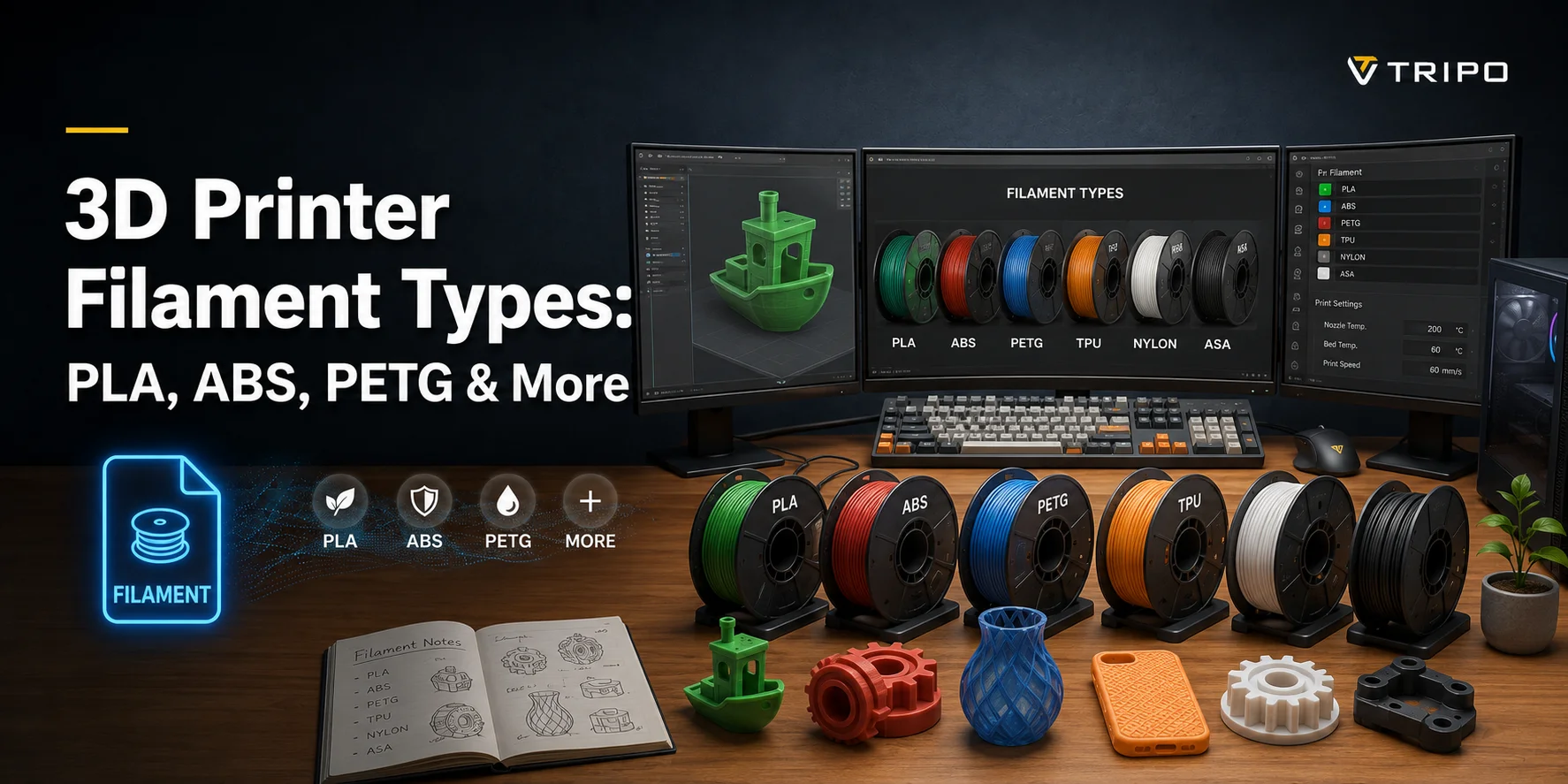
The main 3D printer filament types are PLA (easy, rigid, great for beginners), PETG (tough and water-resistant), ABS (heat-resistant and strong), TPU (flexible like rubber), and nylon (durable for mechanical parts). Specialty options—PC, PVA, plus wood, carbon-fiber, and silk blends—cover everything else. This guide covers each material's strengths, weaknesses, recommended print temperatures, and best use cases—plus a comparison chart and storage tips to help you choose with confidence.
What Is 3D Printer Filament? (And What It's Made Of)
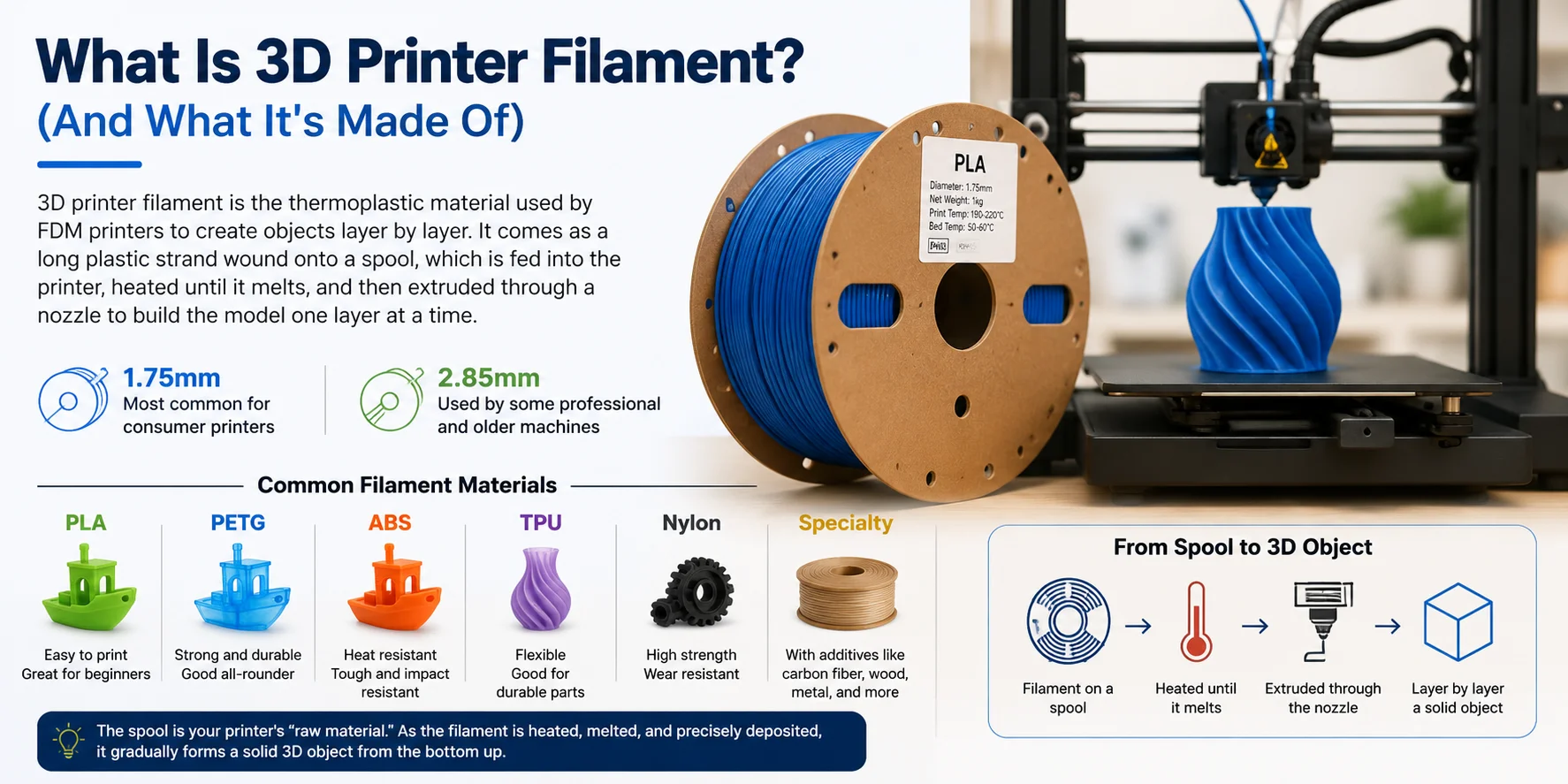
3D printer filament is the thermoplastic material used by FDM (Fused Deposition Modeling) 3D printers to create objects layer by layer. It comes as a long plastic strand wound onto a spool, which is fed into the printer, heated until it melts, and then extruded through a nozzle to build the model one layer at a time.
Most consumer 3D printers use 1.75 mm filament, while some professional and older machines use 2.85 mm filament (often referred to as 3 mm). The filament diameter must match your printer's extruder, so it's important to choose the correct size before printing.
Filament is made from different types of thermoplastics, each designed for specific applications. Common materials include PLA for easy everyday printing, PETG for added strength and durability, ABS for heat resistance, TPU for flexible parts, and nylon for demanding mechanical components. Many specialty filaments also contain additives such as carbon fiber, wood powder, or metal particles to achieve unique mechanical properties or visual finishes.
In simple terms, the spool is your printer's "raw material." As the filament is heated, melted, and precisely deposited, it gradually forms a solid 3D object from the bottom up.
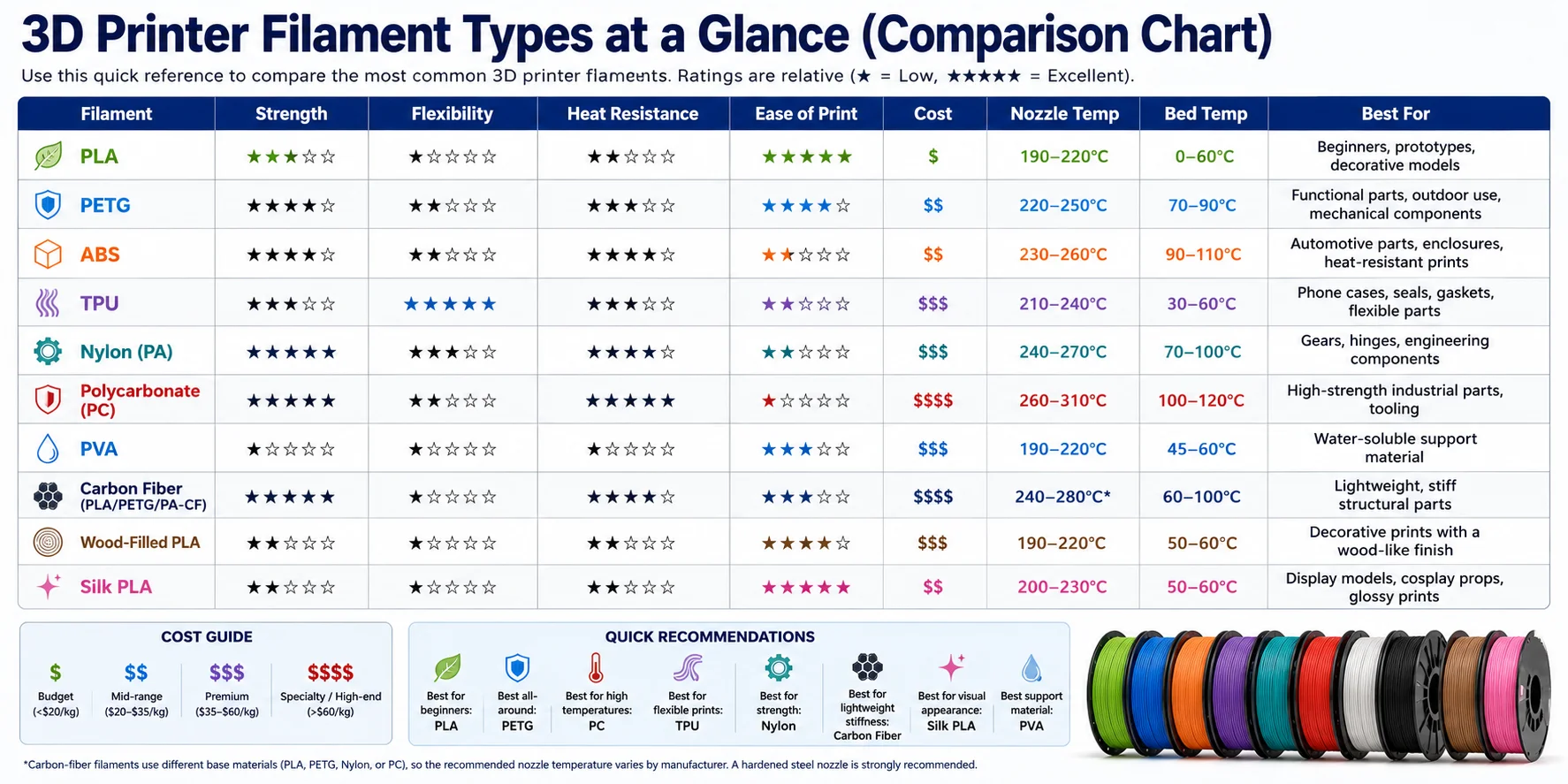
3D Printer Filament Types at a Glance (Comparison Chart)
Choosing the right filament is just as important as choosing the right printer. Different materials offer different levels of strength, flexibility, heat resistance, and printability, making each one better suited to certain projects. Use the comparison table below as a quick reference, then read the individual material guides for more detailed recommendations.
| Filament | Nozzle Temp | Bed Temp | Difficulty | Best For | Moisture Sensitivity |
|---|---|---|---|---|---|
| PLA | 190–220°C | 50–60°C | Easy | Beginners, decorative, prototypes | Low |
| PETG | 230–250°C | 70–80°C | Medium | Functional parts, outdoor use | Medium–High |
| ABS | 230–250°C | 90–110°C | Hard | Mechanical, automotive, enclosures | Low |
| ASA | 235–255°C | 90–110°C | Hard | Outdoor, UV-resistant parts | Low |
| TPU | 220–250°C | 45–60°C | Medium | Flexible parts, cases, gaskets | Medium |
| Nylon | 240–270°C | 70–90°C | Hard | Gears, mechanical, engineering | Very High |
| PC | 260–310°C | 90–120°C | Very Hard | High-temp, structural engineering | Medium |
| PVA | 190–220°C | 45–60°C | Medium | Water-soluble supports | Very High |
| CF Composite | Varies* | Varies* | Hard | Stiff engineering parts | Low–Medium |
| Wood-filled | 190–220°C | 50–60°C | Easy–Medium | Decorative, artistic | Low |
| Silk PLA | 190–220°C | 50–60°C | Easy | Display, decorative, gifts | Low |
*Carbon-fiber filaments use different base materials (PLA, PETG, Nylon, or PC), so the recommended nozzle temperature varies by manufacturer. A hardened steel nozzle is strongly recommended because carbon fibers are abrasive.
Quick Recommendations
- Best for beginners: PLA
- Best all-around filament: PETG
- Best for high temperatures: Polycarbonate (PC)
- Best for flexible prints: TPU
- Best for mechanical strength: Nylon
- Best for lightweight stiffness: Carbon Fiber composites
- Best for visual appearance: Silk PLA or Wood-filled PLA
- Best support material: PVA (for dual-extruder printers)
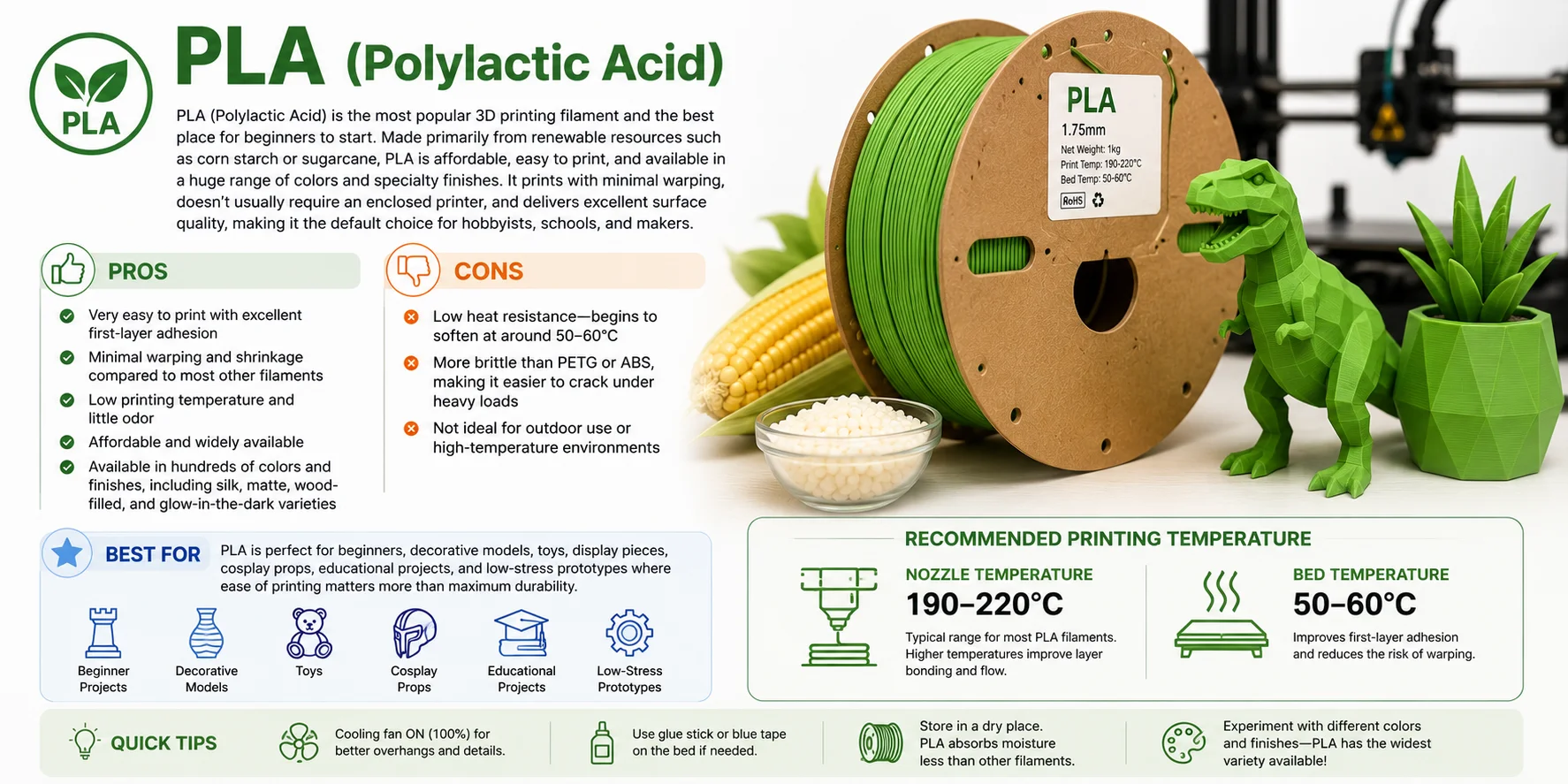
PLA (Polylactic Acid)
PLA (Polylactic Acid) is the most popular 3D printing filament and the best place for beginners to start. Made primarily from renewable resources such as corn starch or sugarcane, PLA is affordable, easy to print, and available in a huge range of colors and specialty finishes. It prints with minimal warping, doesn't usually require an enclosed printer, and delivers excellent surface quality, making it the default choice for hobbyists, schools, and makers.
Pros
- Very easy to print with excellent first-layer adhesion
- Minimal warping and shrinkage compared to most other filaments
- Low printing temperature and little odor
- Affordable and widely available
- Available in hundreds of colors and finishes, including silk, matte, wood-filled, and glow-in-the-dark varieties
Cons
- Low heat resistance—begins to soften at around 50–60°C
- More brittle than PETG or ABS, making it easier to crack under heavy loads
- Not ideal for outdoor use or high-temperature environments
Best For
PLA is perfect for beginners, decorative models, toys, display pieces, cosplay props, educational projects, and low-stress prototypes where ease of printing matters more than maximum durability.
Recommended Printing Temperature
- Nozzle: 190–220°C
- Bed: 50–60°C
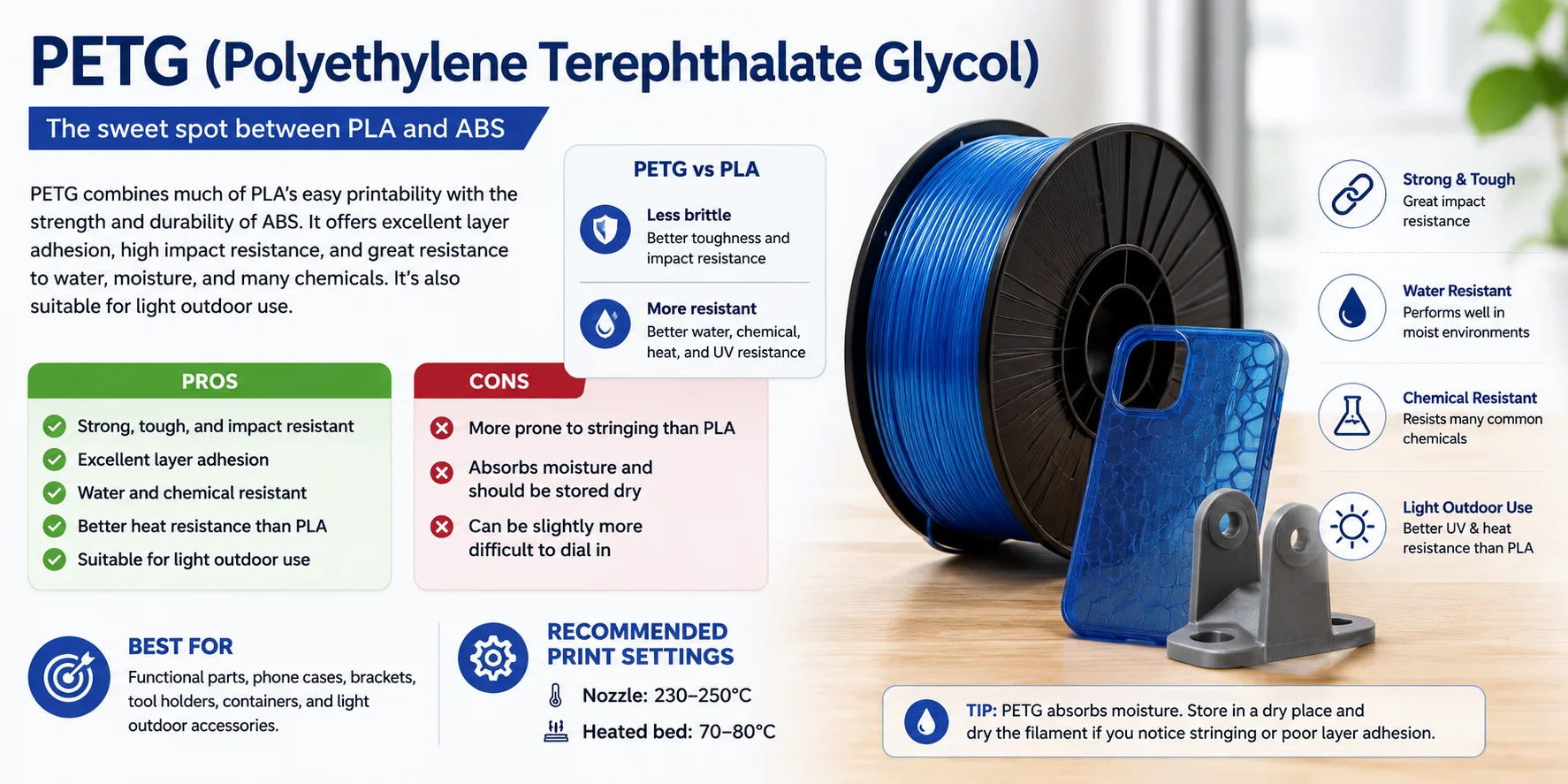
PETG (Polyethylene Terephthalate Glycol)
PETG is often considered the sweet spot between PLA and ABS. It combines much of PLA's easy printability with the strength and durability of ABS, making it one of the most popular filaments for functional 3D printing. PETG offers excellent layer adhesion, high impact resistance, and good resistance to water, moisture, and many common chemicals. It also handles moderate outdoor exposure better than PLA thanks to its improved heat and UV resistance.
The trade-off is that PETG requires a bit more tuning. It tends to produce fine strings between printed features and absorbs moisture from the air over time, which can reduce print quality. Keeping filament dry and adjusting retraction settings usually minimizes these issues.
Pros
- Strong, tough, and impact resistant
- Excellent layer adhesion
- Water and chemical resistant
- Better heat resistance than PLA
- Suitable for light outdoor use
Cons
- More prone to stringing than PLA
- Absorbs moisture and should be stored dry
- Can be slightly more difficult to dial in
Best For
Functional parts, phone cases, brackets, tool holders, containers, and light outdoor accessories.
Recommended Printing Temperature
- Nozzle: 230–250°C
- Bed: 70–80°C
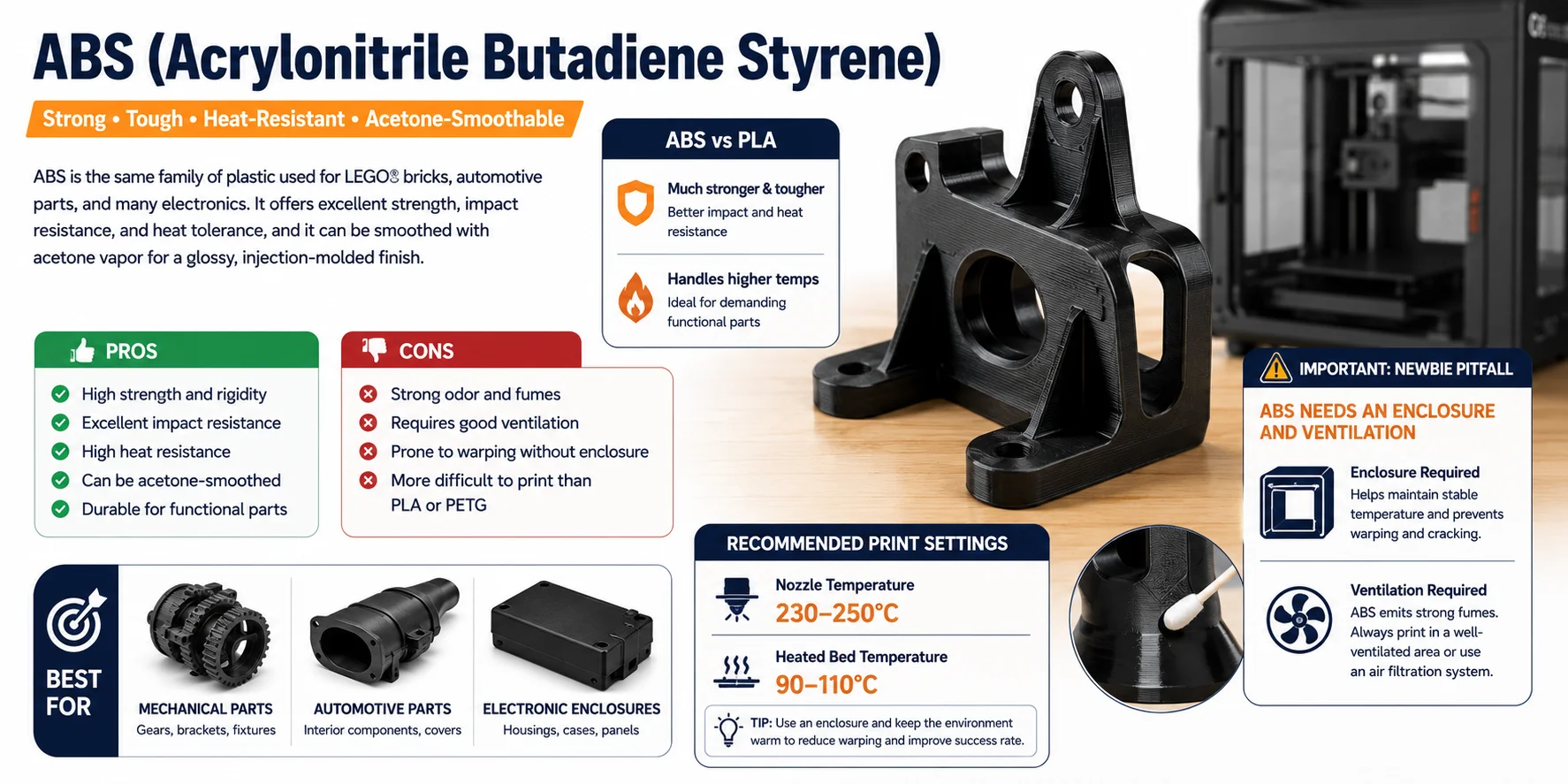
ABS (Acrylonitrile Butadiene Styrene)
ABS is one of the most durable and heat-resistant filaments available for consumer 3D printers. It's the same family of plastic used to make LEGO® bricks, automotive components, and many household electronics, making it a trusted choice for functional parts that need to withstand mechanical stress and elevated temperatures. ABS is also one of the few common filaments that can be smoothed with acetone vapor, producing a glossy, injection-molded appearance.
The downside is that ABS is significantly more challenging to print than PLA or PETG. It shrinks as it cools, making it prone to warping and layer separation, especially on larger models. An enclosed printer is strongly recommended to maintain a stable printing temperature. ABS also releases noticeable fumes while printing, so good ventilation or an air filtration system is important.
Pros
- High strength and rigidity
- Excellent impact and heat resistance
- Can be acetone-smoothed for a polished finish
- Durable enough for mechanical and engineering parts
Cons
- Strong odor and fumes during printing
- Requires good ventilation
- Prone to warping and cracking without an enclosure
- More difficult to print than PLA or PETG
Best For
Mechanical parts, automotive components, electronic enclosures, tools, and functional prototypes.
Recommended Printing Temperature
- Nozzle: 230–250°C
- Bed: 90–110°C
TPU (Thermoplastic Polyurethane) — Flexible Filament
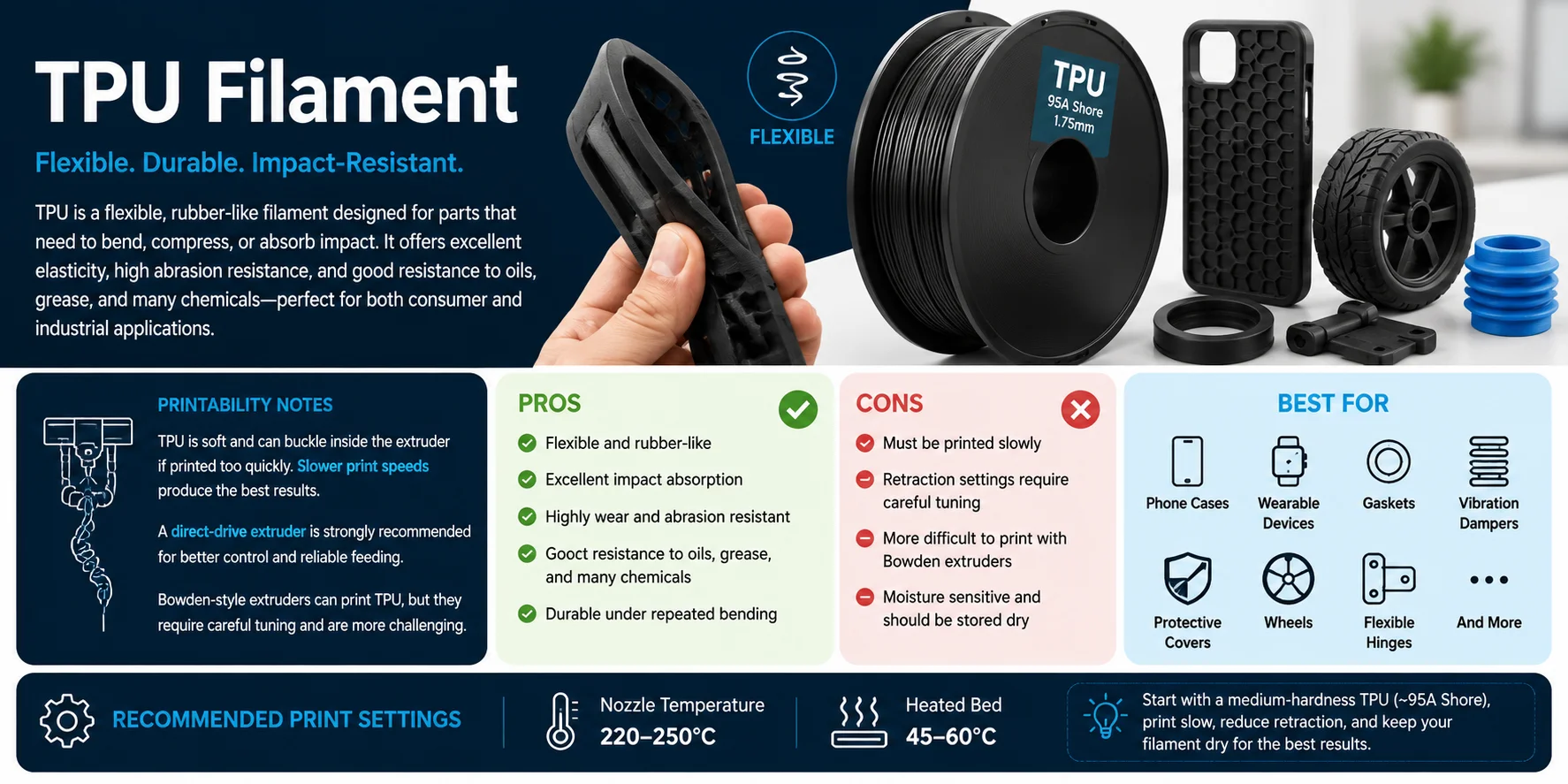
TPU is a flexible, rubber-like filament designed for parts that need to bend, compress, or absorb impact. Unlike rigid materials such as PLA or ABS, TPU combines excellent elasticity with high abrasion resistance, making it ideal for durable parts that experience repeated flexing. It also offers good resistance to oils, grease, and many chemicals.
The biggest challenge with TPU is printability. Because the filament is soft, it can buckle or deform inside the extruder if printed too quickly. Slower print speeds generally produce much better results, and a direct-drive extruder is strongly recommended because it provides a shorter, more controlled filament path.
Pros
- Flexible and rubber-like
- Excellent impact absorption
- Highly wear and abrasion resistant
- Good resistance to oils, grease, and many chemicals
- Durable under repeated bending
Cons
- Must be printed slowly
- Retraction settings require careful tuning
- More difficult to print with Bowden extruders
- Moisture sensitive and should be stored dry
Best For
Phone cases, wearable devices, gaskets, vibration dampers, protective covers, wheels, and flexible hinges.
Recommended Printing Temperature
- Nozzle: 220–250°C
- Bed: 45–60°C
Nylon (Polyamide)
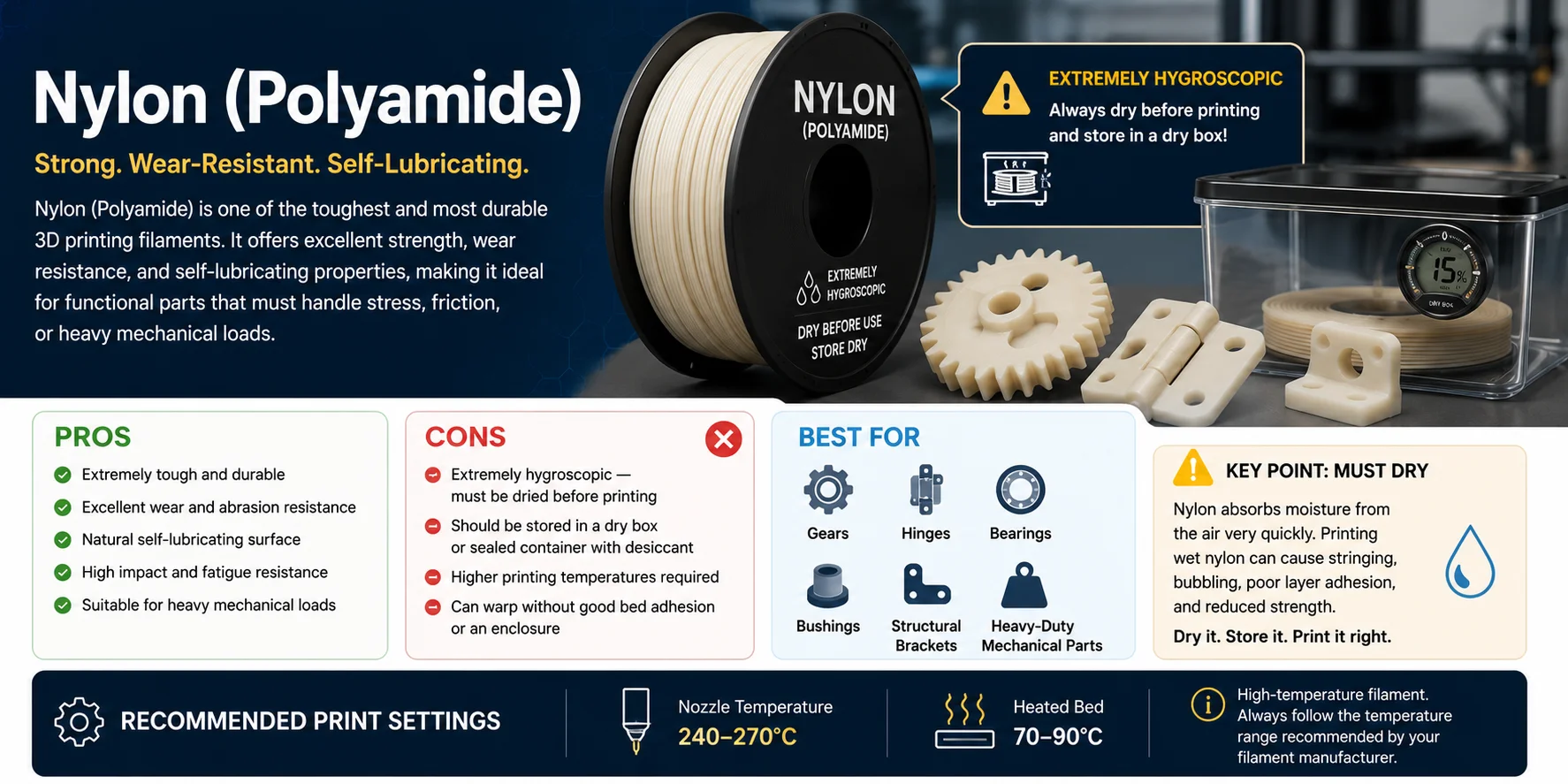
Nylon (Polyamide) is one of the toughest and most durable 3D printing filaments available. It offers outstanding strength, excellent wear resistance, and natural self-lubricating properties, making it ideal for functional parts that must withstand repeated stress, friction, or heavy mechanical loads.
The biggest challenge with Nylon is that it is extremely hygroscopic, meaning it absorbs moisture from the air very quickly. Even a few hours of exposure can cause poor layer adhesion, stringing, bubbling, rough surface finishes, and reduced strength. Always dry the filament before printing and keep it in a dry box or filament dryer during long print jobs.
Pros
- Extremely tough and durable
- Excellent wear and abrasion resistance
- Natural self-lubricating surface
- High impact and fatigue resistance
- Suitable for heavy mechanical loads
Cons
- Extremely hygroscopic — must be dried before printing
- Should be stored in a dry box or sealed container with desiccant
- Higher printing temperatures required
- Can warp without good bed adhesion or an enclosure
Best for: Gears, bearings, hinges, bushings, structural brackets, heavy-duty mechanical parts, and functional engineering prototypes.
Recommended print settings: Nozzle 240–270°C · Heated bed 70–90°C
PC (Polycarbonate) & Other Engineering Filaments
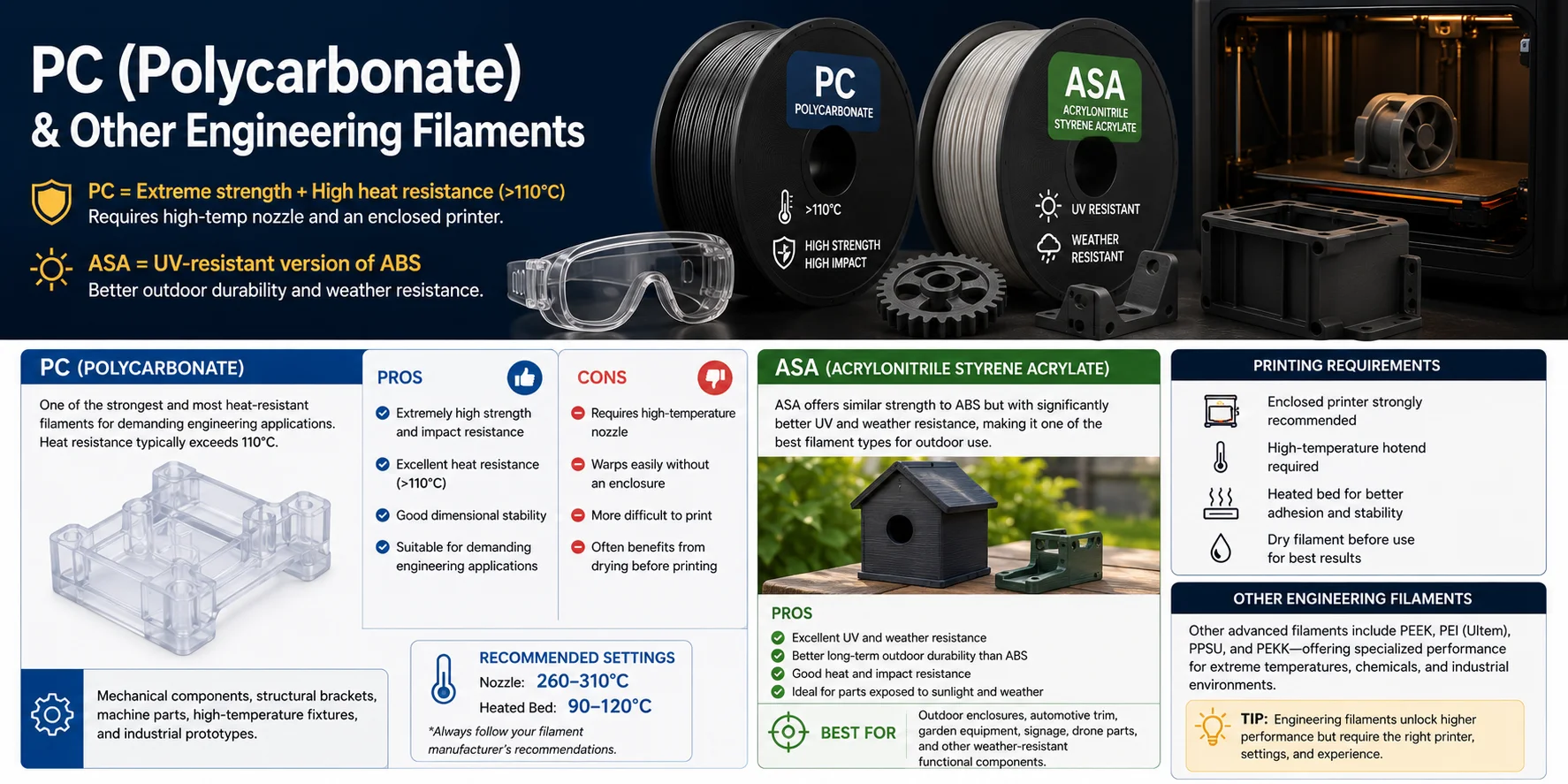
Polycarbonate (PC) is one of the strongest and most heat-resistant filaments available for desktop 3D printing. It combines exceptional mechanical strength, high impact resistance, and excellent dimensional stability, with heat resistance that typically exceeds 110°C. These properties make PC a popular choice for demanding engineering applications where standard filaments like PLA or PETG are not durable enough.
The trade-off is that PC is one of the most challenging materials to print. It requires a high-temperature hotend, a heated bed, and preferably an enclosed printer to reduce warping and layer separation.
If your goal is outdoor durability, consider ASA (Acrylonitrile Styrene Acrylate). ASA offers mechanical properties similar to ABS but with significantly better UV and weather resistance, making it one of the best filament types for outdoor use.
PC (Polycarbonate)
Pros
- Extremely high strength and impact resistance
- Excellent heat resistance (typically over 110°C)
- Good dimensional stability
- Suitable for demanding engineering applications
Cons
- Requires a high-temperature nozzle
- Warps easily without an enclosure
- More difficult to print than standard filaments
- Often benefits from drying before printing
Best for: Mechanical components, structural brackets, machine parts, high-temperature fixtures, and industrial prototypes.
Recommended print settings: Nozzle 260–310°C · Heated bed 90–120°C
ASA (Outdoor Alternative)
Why choose ASA?
- Excellent UV and weather resistance
- Better long-term outdoor durability than ABS
- Good heat and impact resistance
- Ideal for parts exposed to sunlight and changing weather
Best for: Outdoor enclosures, automotive trim, garden equipment, signage, drone parts, and other weather-resistant functional components.
PVA & Support Materials
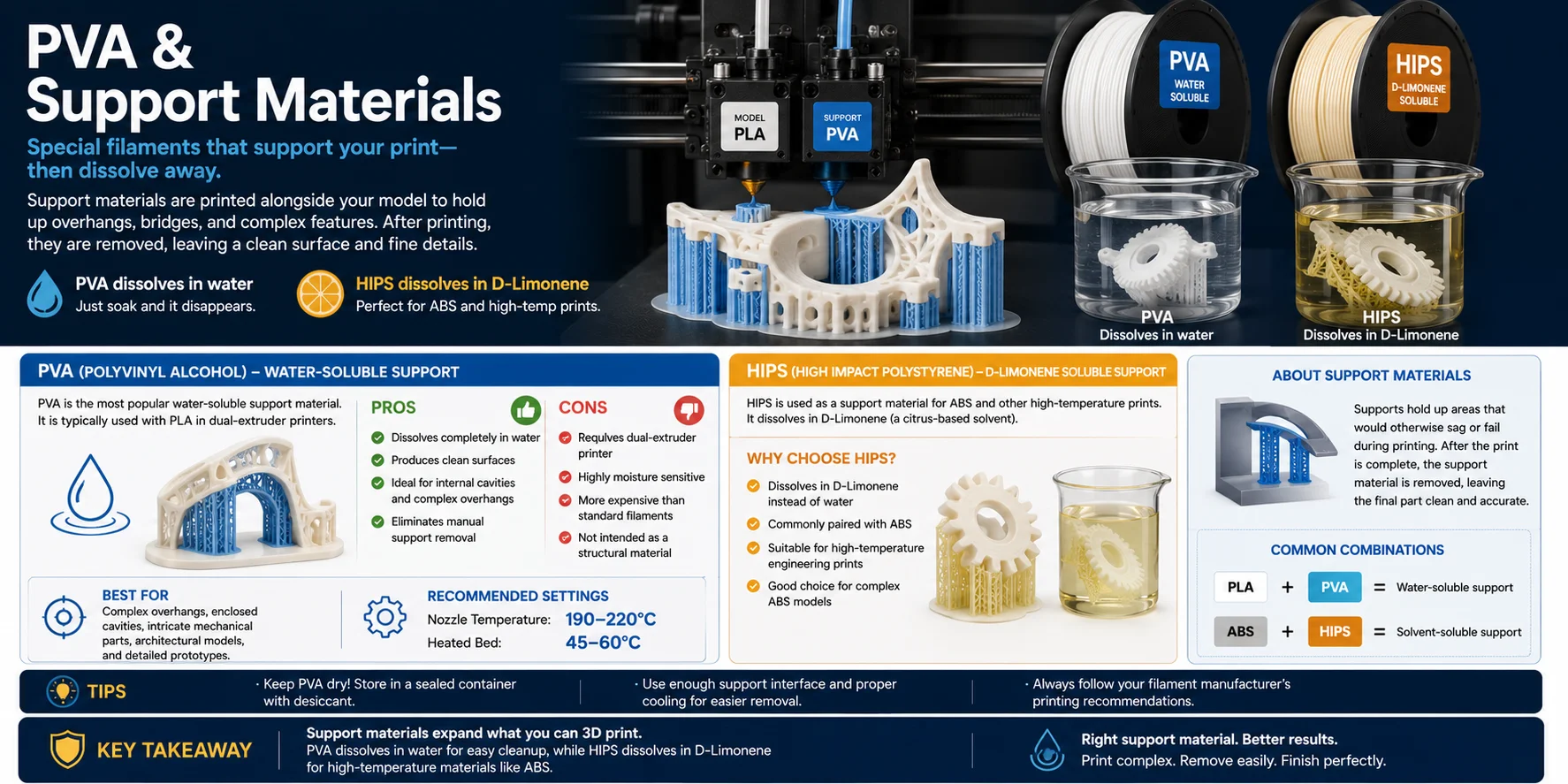
Not every filament is designed to become part of the final print. Support materials are special filaments that temporarily hold up overhangs, bridges, and complex internal features during printing, then are removed afterward.
PVA (Polyvinyl Alcohol) is the most common water-soluble support filament. It is typically paired with PLA in a dual-extruder 3D printer. After printing, simply immerse the part in water and the PVA gradually dissolves, leaving behind a clean surface without the need to cut or break away supports by hand.
Like Nylon, PVA is highly moisture sensitive and should always be stored in a sealed dry box or airtight container with desiccant.
Another common support material is HIPS (High Impact Polystyrene), which can be dissolved in D-Limonene and is commonly paired with ABS.
PVA (Water-Soluble Support)
Pros
- Dissolves completely in water
- Produces clean surfaces on complex prints
- Ideal for internal cavities and difficult overhangs
- Eliminates manual support removal
Cons
- Requires a dual-extruder printer for best results
- Highly moisture sensitive
- More expensive than standard filaments
Best for: Complex overhangs, enclosed cavities, intricate mechanical parts, architectural models, and detailed prototypes.
Recommended print settings: Nozzle 190–220°C · Heated bed 45–60°C
Specialty & Composite Filaments (Wood, Carbon Fiber, Silk)
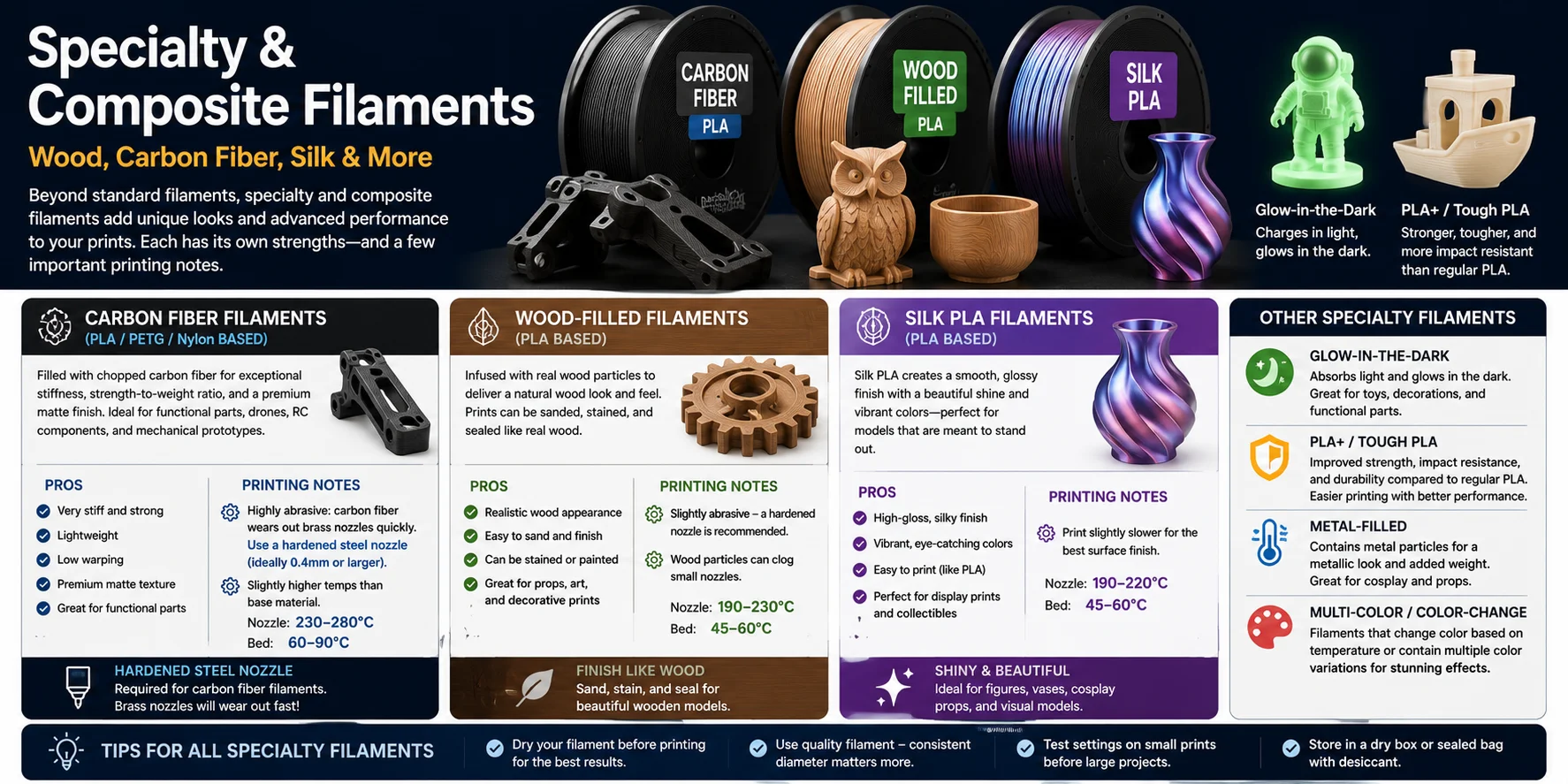
Once you've mastered the standard filaments, specialty and composite materials open up a whole new range of possibilities. These filaments are typically based on common materials such as PLA, PETG, or Nylon, but are blended with additives like carbon fiber, wood powder, or special pigments to improve performance or create unique visual effects.
Carbon Fiber-Filled Filaments
Carbon fiber filaments are usually PLA-, PETG-, or Nylon-based composites reinforced with short carbon fibers. The added fibers increase stiffness, reduce weight, and improve dimensional stability. Carbon fiber is highly abrasive, so a hardened steel nozzle is strongly recommended.
Best for: Drone parts, RC components, machine brackets, jigs, fixtures, and lightweight engineering parts.
Wood-Filled Filaments
Wood-filled filaments combine PLA with fine wood fibers to create prints that closely resemble real wood. They can be sanded, stained, painted, or sealed. Many users prefer a 0.5 mm or 0.6 mm nozzle for more reliable printing.
Best for: Decorative models, cosplay props, architectural models, signs, crafts, and artistic projects.
Silk PLA
Silk PLA is formulated to produce an exceptionally glossy, metallic-looking finish without any post-processing. It prints similarly to standard PLA but is optimized for appearance.
Best for: Display models, figurines, vases, gifts, cosplay accessories, and decorative prints where visual quality is more important than mechanical performance.
Other Specialty Filaments
- Glow-in-the-Dark PLA contains phosphorescent additives ideal for toys, signs, and decorative prints.
- PLA+ (Tough PLA) offers improved toughness and impact resistance while remaining easy to print.
- Other options include metal-filled, marble, color-changing, and temperature-reactive filaments for unique visual effects.
How to Choose Filament by Use Case
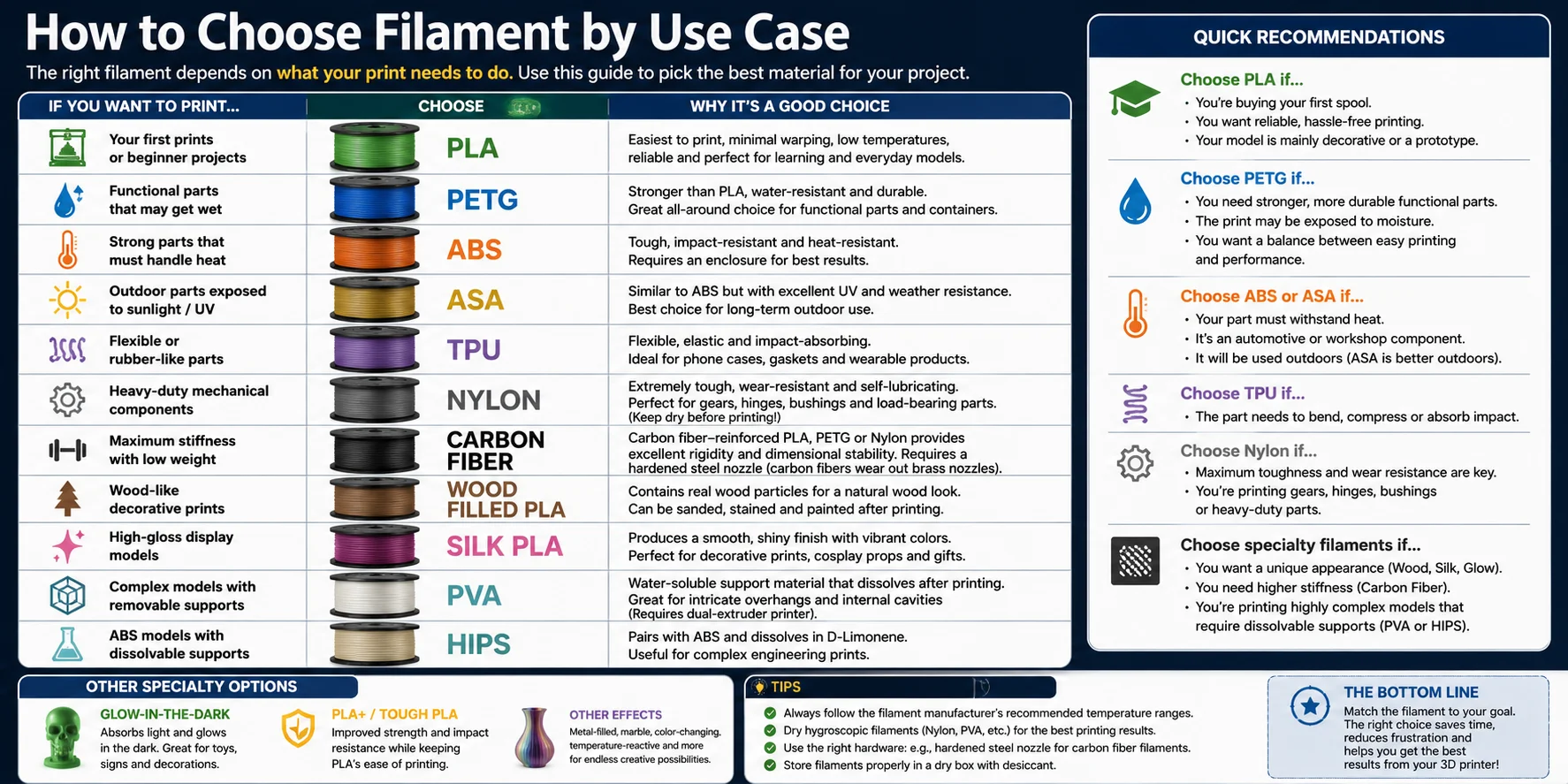
With so many filament types available, the easiest way to choose isn't by material properties—it's by what you're trying to make. Instead of asking, "Which filament is best?", ask "What does my print need to do?"
| Use Case | Recommended Filament | Why |
|---|---|---|
| First print / beginner | PLA | Easy to print, low warp, inexpensive |
| Strong functional parts | PETG | Tougher than PLA, water-resistant |
| Heat-resistant parts | ABS or PC | High heat tolerance |
| Outdoor use | ASA | UV and weather resistant |
| Flexible parts | TPU | Rubber-like, bend and compress |
| Mechanical gears/bearings | Nylon | Self-lubricating, very tough |
| High stiffness / lightweight | Carbon Fiber composite | Excellent stiffness-to-weight |
| Decorative / visual | Silk PLA or Wood-filled PLA | Attractive finish |
| Complex overhangs | PVA (dual extruder) | Water-soluble support removal |
Quick Recommendations
Choose PLA if... you're buying your first spool, you want reliable hassle-free printing, or your model is mainly decorative or a prototype.
Choose PETG if... you need stronger more durable functional parts, the print may be exposed to moisture, or you want a balance between easy printing and performance.
Choose ABS or ASA if... your part must withstand heat, it's an automotive or workshop component, or it will be used outdoors (ASA is the better outdoor choice).
Choose TPU if... the part needs to bend, compress, or absorb impact.
Choose Nylon if... maximum toughness and wear resistance are more important than easy printing, or you're printing gears, hinges, bushings, or heavy-duty mechanical parts.
Choose specialty filaments if... you want a unique appearance, need higher stiffness, or are printing complex models that require dissolvable supports.
The Bottom Line
For most people, PLA remains the best starting point. As your printing needs become more specialized, move to PETG for functional parts, ABS or ASA for heat and outdoor durability, TPU for flexibility, Nylon for engineering applications, and specialty filaments when you need unique aesthetics or advanced performance.
Print Settings & Temperature Chart per Filament
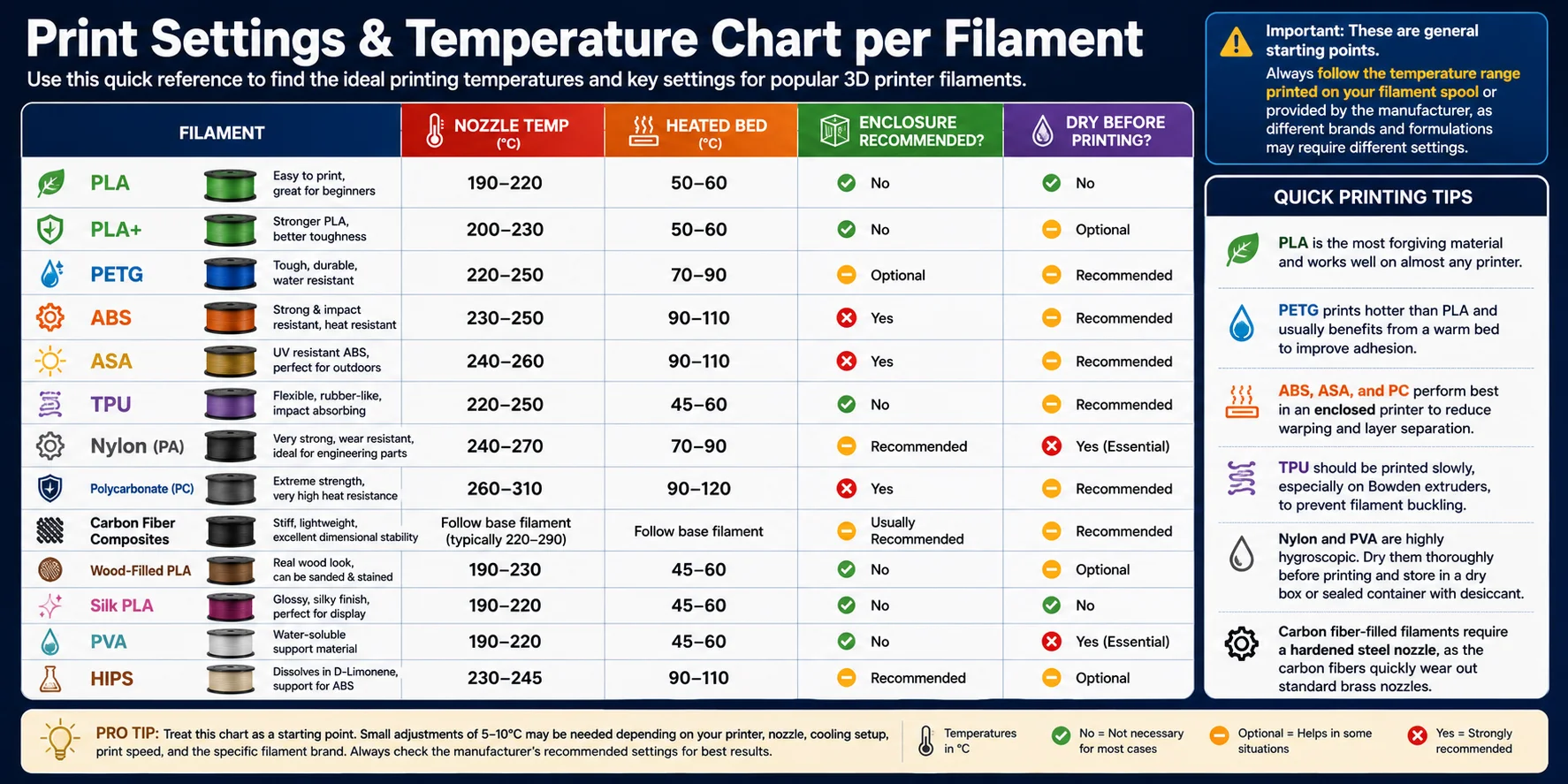
Every filament has its own ideal printing temperature range. Using the correct nozzle and bed temperatures is one of the easiest ways to improve print quality, reduce warping, and achieve stronger layer adhesion.
Important: These are general starting points. Always follow the temperature range printed on your filament spool or provided by the manufacturer, as different brands and formulations may require different settings.
| Filament | Nozzle Temp | Bed Temp | Enclosure | Drying Recommended |
|---|---|---|---|---|
| PLA | 190–220°C | 50–60°C | Not required | Optional |
| PETG | 230–250°C | 70–80°C | Not required | Recommended |
| ABS | 230–250°C | 90–110°C | Strongly recommended | Optional |
| ASA | 235–255°C | 90–110°C | Strongly recommended | Optional |
| TPU | 220–250°C | 45–60°C | Not required | Recommended |
| Nylon | 240–270°C | 70–90°C | Recommended | Strongly recommended |
| PC | 260–310°C | 90–120°C | Strongly recommended | Recommended |
| PVA | 190–220°C | 45–60°C | Not required | Strongly recommended |
| CF Composite | Varies | Varies | Varies | Optional |
Quick Printing Tips
- PLA is the most forgiving material and works well on almost any printer.
- PETG prints hotter than PLA and usually benefits from a warm bed to improve adhesion.
- ABS, ASA, and PC perform best in an enclosed printer to reduce warping and layer separation.
- TPU should be printed slowly, especially on Bowden extruders, to prevent filament buckling.
- Nylon and PVA are highly hygroscopic. Dry them thoroughly before printing and store them in a dry box with desiccant.
- Carbon fiber-filled filaments require a hardened steel nozzle, as the carbon fibers quickly wear out standard brass nozzles.
Storage & Handling (Keeping Filament Dry)
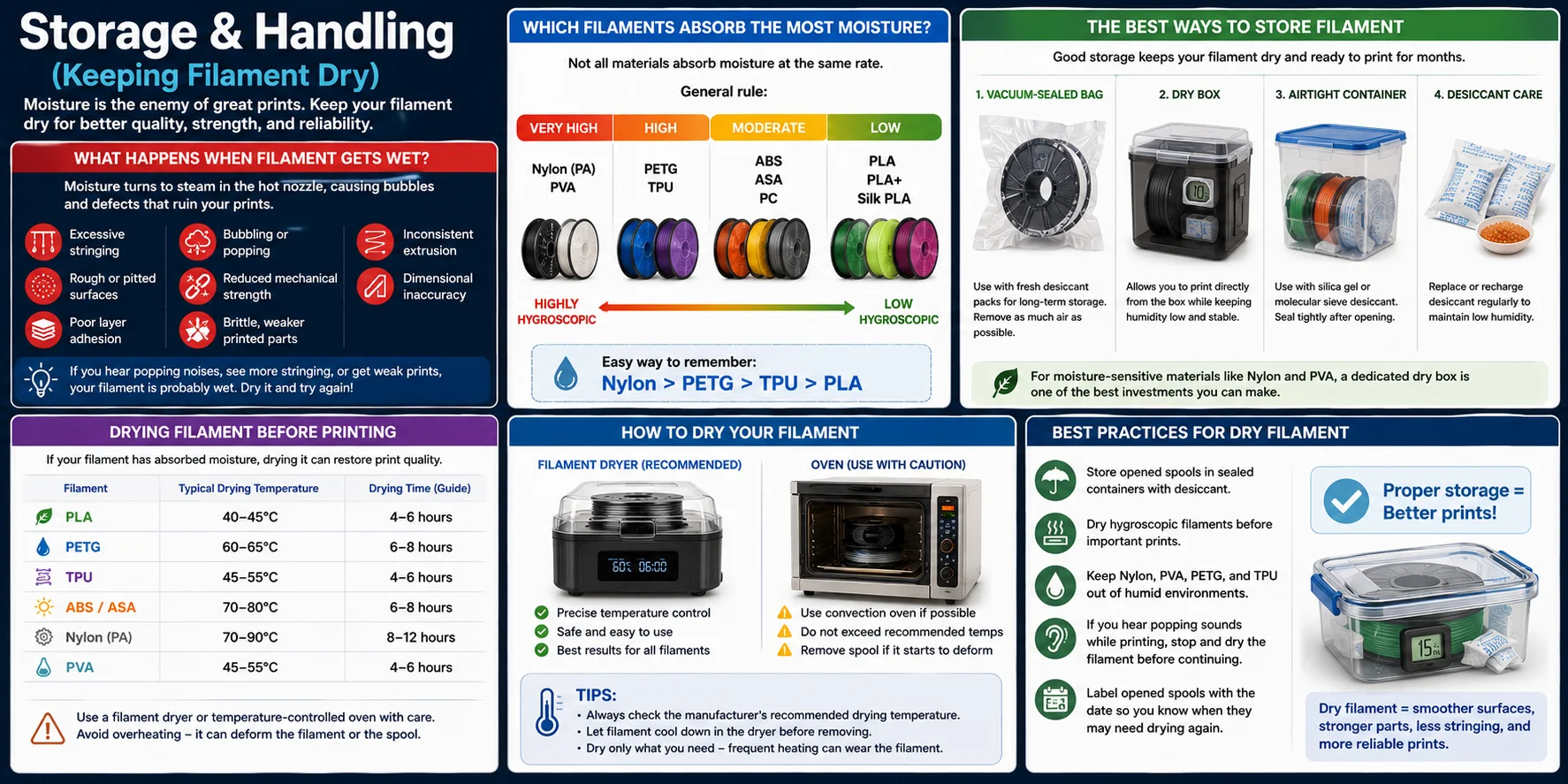
One of the most overlooked factors in 3D printing is filament moisture. Many printing problems that seem like incorrect temperatures or poor slicer settings are actually caused by wet filament. If your filament suddenly starts producing excessive stringing, popping or crackling noises, rough surfaces, inconsistent extrusion, or brittle parts, moisture is often the first thing to check.
Which Filaments Absorb the Most Moisture?
| Filament | Moisture Sensitivity | Storage Priority |
|---|---|---|
| Nylon (PA) | Very High | Critical — always dry and seal |
| PVA | Very High | Critical — always dry and seal |
| PETG | Medium–High | Important — store sealed with desiccant |
| TPU | Medium | Important — store sealed |
| PC | Medium | Store sealed with desiccant |
| ABS | Low | Standard sealed storage |
| PLA | Low | Standard sealed storage |
A simple way to remember it: Nylon > PETG > TPU > PLA
The Best Ways to Store Filament
- Vacuum-sealed bags with fresh desiccant packs for long-term storage.
- Dry boxes that allow you to print directly from the container while keeping humidity low.
- Airtight plastic containers with reusable silica gel or molecular sieve desiccants.
Drying Filament Before Printing
| Filament | Drying Temperature | Drying Duration |
|---|---|---|
| PLA | 45–55°C | 4–6 hours |
| PETG | 65–75°C | 4–6 hours |
| ABS | 60–80°C | 3–4 hours |
| TPU | 55–65°C | 4–6 hours |
| Nylon | 70–90°C | 8–12 hours |
| PVA | 45–55°C | 4–6 hours |
| PC | 80–90°C | 6–8 hours |
Use a dedicated filament dryer or a temperature-controlled convection oven with care. Avoid overheating the spool, as excessive temperatures can deform both the filament and the spool itself.
Best Practices
- Store opened spools in sealed containers with desiccant.
- Dry hygroscopic filaments before important prints.
- Keep Nylon, PVA, PETG, and TPU out of humid environments whenever possible.
- If you hear popping sounds while printing, stop and dry the filament before continuing.
- Label opened spools with the date they were first used so you know when they may need drying again.
Frequently Asked Questions
What are the different types of 3D printer filaments?
The most common 3D printer filaments include PLA, PETG, ABS, ASA, TPU, Nylon (PA), Polycarbonate (PC), PVA, and HIPS, along with specialty materials like carbon fiber-, wood-, and silk-filled filaments. Each material has different strengths: PLA is best for beginners, PETG for durable functional parts, ABS and ASA for heat and outdoor use, TPU for flexibility, and Nylon or PC for demanding engineering applications.
Should I use PETG or PLA?
Choose PLA if you're a beginner or printing decorative models and prototypes—it's easier to print and produces excellent surface quality. Choose PETG if you need stronger, more durable, and water-resistant parts, such as functional brackets, containers, or outdoor items.
Is PLA or PETG less toxic?
PLA is generally considered less toxic than PETG. PLA is made from renewable plant-based materials and typically produces less odor during printing. Regardless of the material, it's always a good idea to print in a well-ventilated area.
What filament should I use for outdoor 3D prints?
For outdoor use, ASA is the best choice because it combines ABS-level strength with significantly better UV and weather resistance. PETG is a solid second option for light outdoor exposure. Avoid PLA outdoors, as it softens in warm temperatures and breaks down with UV exposure.
What is the difference between PLA and ABS filament?
The main difference is heat resistance and printability. PLA is easier to print—it requires lower temperatures, rarely warps, and produces little odor. ABS handles higher temperatures (up to ~100°C) and is tougher under mechanical stress, but it warps easily, requires an enclosure, and releases noticeable fumes.
What is the strongest 3D printer filament?
For desktop FDM printing, Polycarbonate (PC) is generally considered the strongest filament—it combines exceptional tensile strength, high impact resistance, and heat tolerance above 110°C. Nylon is a close second and better for parts that need toughness and fatigue resistance.
How do I choose the right filament for my 3D print?
Start by asking what the printed part needs to do: if it is decorative or a first print, choose PLA; if it needs strength and water resistance, go with PETG; if it must handle heat or mechanical stress, use ABS, ASA, or Nylon; if it needs to flex, pick TPU.
How does PETG compare to PLA and ABS?
PETG sits between PLA and ABS in almost every category. It is tougher and more heat-resistant than PLA (softening around 80°C vs PLA's 60°C) while being far easier to print than ABS—no enclosure required and minimal warping. For most functional prints, PETG is the best all-around choice when PLA is not durable enough but you do not want ABS's complexity.
What filament is best for 3D printing miniatures?
For miniatures and highly detailed models, standard PLA or PLA+ is the most popular FDM choice—it holds fine detail well, prints at lower temperatures that reduce stringing, and comes in a wide range of colors and finishes. If you want exceptional surface smoothness, resin printing outperforms FDM for miniature detail.
Can I use any filament with any 3D printer?
Not all filaments work on all printers. Most standard printers handle PLA, PETG, and TPU without modification, but high-temperature materials like ABS, ASA, Nylon, and PC require a heated bed and ideally an enclosed frame. Carbon fiber and other abrasive composites also require a hardened steel nozzle.
Conclusion
There isn't a single "best" 3D printing filament—only the one that's best for your specific project. Start by thinking about how the part will be used, then choose the material that matches those requirements for strength, flexibility, heat resistance, durability, or appearance.
Already have a model to print? You can generate one from text or an image with Tripo AI, then export it as STL or 3MF—or even one-click send it to Bambu Studio—and use the filament guide above to pick the right material for the job.