2D vs 3D Games: Key Differences & Which to Choose (2026)

TL;DR
- 2D games use sprites on a flat X/Y plane; 3D games add depth with the Z-axis, polygonal models, and free camera movement
- The 2D vs 3D games debate is not about which is better—it is about different trade-offs in visuals, cost, controls, and development complexity
- 3D is harder in technical pipelines (modeling, rigging, UV); 2D is harder in animation volume—they are hard in different areas
- Budget: 2D scales with content volume, 3D scales with pipeline complexity
- AI tools like image-to-3D and auto-rigging are closing the gap for indie developers and solo teams
- No universal winner: pick based on your target platform, team size, budget, and creative goals
The main difference between 2D and 3D games is dimensionality. 2D games render on a flat plane (X and Y axes) using sprites, making them faster and cheaper to build and easier to pick up. 3D games use depth (X, Y, and Z axes) with polygonal models, lighting, and free camera movement, offering deeper immersion at the cost of more development work and higher hardware demands.
What Are 2D and 3D Games?

The main difference between 2D and 3D games is dimensionality. In practice, this affects how games are rendered, how players move through space, and how developers build the world. When people compare 2D vs 3D games, they are really comparing two different ways of simulating space: a flat coordinate system versus a fully spatial environment.
It's also important to clarify a common misconception early: 2D and 3D refer to rendering space, not art style. A pixel-art game can still run on a 3D engine, and a 3D game can intentionally mimic 2D visuals through fixed cameras or stylized design. The distinction is technical, not aesthetic.
Defining 2D games (sprites & the flat plane)
2D games are built on a flat plane using only the X and Y axes. Everything exists in two dimensions, and objects are typically represented as sprites—flat images that move left/right and up/down without depth. This is why 2D games are often faster to build and easier to optimize, especially for indie developers exploring 2d vs 3d game development workflows.
Classic examples include Celeste, Stardew Valley, and Hollow Knight, where gameplay focuses on timing, precision, and side-scrolling or top-down movement rather than spatial depth. This simplicity is also why many players search for the best 2d games when they want tight mechanics and readable gameplay.
Defining 3D games (meshes, depth & the Z-axis)
3D games introduce a third axis—the Z-axis—adding depth to the world. Instead of sprites, objects are built from polygonal meshes, combined with textures, lighting systems, and shaders that simulate realistic surfaces and environments. This allows free camera movement and more complex spatial interaction.
Games like Elden Ring, Minecraft, and Call of Duty demonstrate how 3D environments enable exploration, verticality, and immersive storytelling. However, this also increases production complexity, which is why developers often debate is 2D or 3D easier to make when planning a project.
In short, 2D games prioritize clarity and efficiency, while 3D games prioritize depth, immersion, and interaction—setting the foundation for the broader difference between 2d and 3d games that we'll explore next.
2D vs 3D Games: The Core Differences

Once you understand what 2D and 3D games are, the next step in the 2d vs 3d games comparison is to break them down by core design dimensions. Instead of treating one as "better," it's more accurate to view them as different trade-offs in visuals, movement, controls, and immersion. This is why the difference between 2d and 3d games is not just technical—it directly shapes how players experience a game and how developers build it.
Visuals and art style
In 2D games, visuals are typically built from sprites, pixel art, or hand-drawn illustrations. Everything is presented on a flat plane, so artists focus heavily on readability, silhouette clarity, and strong visual contrast. Because there is no real depth, each frame must clearly communicate gameplay information. This is why 2D games often feel instantly readable, even during fast action. However, this also means visual perspective is limited, and environmental depth must be implied rather than simulated.
In 3D games, visuals are constructed using polygonal models, textures, lighting systems, and often physically based rendering (PBR). Instead of drawing each frame, developers build objects in three-dimensional space and rely on cameras, shadows, and shaders to generate realism. This allows for more dynamic environments—like changing lighting, weather effects, and cinematic camera angles—but also increases production complexity significantly.
So, 2D visuals prioritize clarity and artistic expression, while 3D visuals prioritize realism and spatial depth. This makes 2D ideal for stylized or highly readable experiences, while 3D is better suited for immersive, cinematic worlds.
Movement and camera
In 2D games, movement is restricted to two axes: left/right and up/down (X and Y). The camera is usually fixed or side-scrolling, meaning players always see the action from a consistent angle. This removes camera control issues and ensures the gameplay space is always readable. Designers can fully control what the player sees at any moment, which reduces confusion and enhances precision platforming or puzzle design.
In 3D games, movement expands into three axes (X, Y, and Z), allowing players to move freely in all directions. The camera is dynamic and often controlled by the player or automated systems. This enables exploration, vertical level design, and more complex spatial puzzles—but also introduces challenges like camera collision, occlusion, and motion sickness if not designed carefully.
So, 2D movement is more controlled and predictable, while 3D movement is more expressive and exploratory. This is why is 2D or 3D easier to make often depends on whether developers want simplicity or full spatial freedom.
Controls and gameplay mechanics
2D games usually rely on simpler input systems: directional movement, jump, attack, and a small set of contextual actions. Because gameplay exists on a flat plane, mechanics are easier to balance and more immediately responsive. This is one reason many best 2d games feel "tight" and skill-based—players focus on timing and pattern recognition rather than spatial aiming.
In contrast, 3D games require more complex control schemes. Players often need to manage camera direction, aim in 3D space, and coordinate movement across uneven terrain. Mechanics like shooting, stealth, or combat become more layered because depth changes positioning and visibility. While this increases complexity, it also allows for more emergent gameplay systems.
So, 2D controls prioritize precision and simplicity, while 3D controls prioritize flexibility and depth of interaction.
Immersion and realism
2D games often lean toward stylization rather than realism. Because the world is flat, designers use strong visual language, animations, and sound design to create emotional impact. This can actually improve clarity and storytelling efficiency, since players quickly understand what is happening on screen. Many iconic indie games rely on this strength to create memorable experiences without needing photorealism.
3D games, however, excel in immersion and realism. Depth, lighting, and camera movement all contribute to a sense of "being inside" the world. Players can explore environments from multiple angles, interact with objects spatially, and experience more cinematic storytelling. This makes 3D especially powerful for open-world games, shooters, and simulation-heavy genres.
So, 2D immersion comes from clarity and artistic focus, while 3D immersion comes from spatial presence and realism.
Summary comparison (quick view)
| Dimension | 2D Games | 3D Games |
|---|---|---|
| Visuals | Sprites, pixel art, hand-drawn | Meshes, textures, PBR lighting |
| Movement | X/Y axes, fixed camera | X/Y/Z axes, dynamic camera |
| Controls | Simple, precise input | Complex, spatial control |
| Immersion | Stylized, readable | Realistic, exploratory |

A Brief History: How Games Went From 2D to 3D
The evolution from 2D to 3D games is not a clean replacement—it's a technological shift that happened in stages, and both formats still coexist today. Understanding this history helps explain the modern 2d vs 3d games landscape, where the choice is no longer about limitations, but about creative direction and production goals.
Early video games in the 1970s and 1980s were almost entirely 2D, driven by hardware constraints. Arcade titles like Pac-Man and Donkey Kong used sprite-based graphics on a flat plane, where gameplay was defined by X and Y movement only. These systems were simple but highly effective, focusing on clarity, speed, and addictive mechanics rather than realism. This era established the foundation of 2D game design, where readability and tight control loops became core principles.
In the early 1990s, gaming experienced a major turning point with the rise of 3D graphics. Consoles like the PlayStation and Nintendo 64 introduced polygon-based rendering, allowing developers to build worlds with depth (X, Y, and Z axes). This shift enabled entirely new genres—3D platformers, first-person shooters, and open environments. Games like Super Mario 64 demonstrated how camera control and spatial navigation could completely redefine gameplay, while early experiments like Doom pushed immersive 3D perspective forward even with limited technology.
At the same time, 2D did not disappear. Instead, it evolved. Titles such as early GTA 1 and GTA 2 used top-down or pseudo-3D perspectives, blending 2D and 3D elements—what we now often call 2.5D / 2D 3D hybrid games. This shows that the transition was not a replacement, but an expansion of design options.
In the 2000s and beyond, 3D became the dominant mainstream standard, especially for AAA games. However, 2D experienced a strong revival through indie development and mobile platforms. Games like Celeste and Stardew Valley proved that 2D games could still achieve massive success by focusing on gameplay depth, emotional storytelling, and artistic identity rather than graphical complexity.
Today, modern engines like Unity, Unreal Engine, and Godot fully support both 2D and 3D pipelines. This is why the question of is 2D or 3D easier to make is no longer about technical capability—both are equally accessible. Instead, the real decision is design-driven: developers choose 2D for precision, speed, and clarity, or 3D for immersion, scale, and spatial freedom.
In short, the history of gaming shows a clear pattern: 3D did not replace 2D. It expanded it. Both continue to evolve side by side, shaping modern game development in different but equally important ways.

Is 3D Harder to Make Than 2D? (Development Effort Compared)

The question of is 3D or 2D harder to make doesn't have a single correct answer—because "difficulty" depends on which part of game development you are talking about. When you break game creation into systems rather than treating it as one block, the comparison becomes much clearer. In reality, 2D vs 3D game development is not a simple difficulty ladder; it's a trade-off between different types of work: art production, animation complexity, programming logic, and technical optimization.
A useful way to understand this is: 2D is not "easy," and 3D is not "hard"—they are hard in different areas.
What makes 3D harder (modeling, rigging, optimization)
3D games introduce an entire production pipeline that does not exist in 2D workflows. The biggest challenge is asset creation. Instead of drawing flat images, developers must build polygonal models, which involves multiple technical steps:
- Modeling (creating the 3D shape)
- UV unwrapping (flattening the model for textures)
- Texturing (painting surface details)
- Rigging & skinning (building skeletons for animation)
- Lighting setup (simulating realistic or stylized illumination)
- Optimization (reducing polygon count, LODs, performance tuning)
On top of that, 3D games require more complex spatial reasoning. Cameras must work in full 3D space, collisions must be calculated across X/Y/Z axes, and level design must account for verticality and player perspective. This is why many developers perceive 3D as more "resource-heavy."
Even small mistakes—like bad topology or incorrect UVs—can break animations or cause rendering issues. That's why in traditional pipelines, 3D development is often more expensive and time-consuming, especially for indie teams.
However, this complexity also enables what 2D cannot easily achieve: full freedom of movement, cinematic presentation, and immersive world-building.
What's surprisingly hard about 2D (animation & content volume)

While 2D games are often perceived as simpler, they come with their own hidden difficulty: manual content production.
Because 2D relies heavily on sprites and frame-by-frame animation, every movement must be drawn or generated individually. This creates a major workload challenge:
- Walk cycles require multiple frames
- Combat animations require precise timing
- Environmental effects (water, fire, particles) must be drawn frame-by-frame or carefully simulated
- Every variation (hit, idle, jump, attack) increases asset count
In many cases, 2D animation becomes a content multiplication problem. As noted in discussions across Unity communities and game development forums, 2D projects can sometimes require more raw animation work than equivalent 3D characters, especially when animations are highly detailed or stylized.
Programming-wise, 2D games are often simpler. Physics is usually constrained to two axes, collision detection is more straightforward, and camera systems are easier to manage. But the trade-off is that art workload scales very quickly as content grows.
So while 3D is harder in technical pipelines, 2D can be surprisingly demanding in artistic production volume.
Side-by-side breakdown (by development task)
A clearer way to understand difficulty is to compare tasks directly:
| Task Area | 2D Games | 3D Games |
|---|---|---|
| Asset creation | Faster but frame-heavy | Complex pipeline (modeling, UV, rigging) |
| Animation | Frame-by-frame, high volume | Skeleton-based, reusable animations |
| Programming | Simpler physics & logic | More complex spatial systems |
| Camera system | Fixed or limited | Fully dynamic 3D camera |
| Optimization | Lightweight | Performance-heavy (lighting, meshes) |
This shows why asking "which is harder" is misleading. Instead, the real question is: which part of development is harder for your specific project?
How AI is closing the gap (asset generation & auto-rigging)

The traditional difference between 2D and 3D development is starting to shrink due to AI tools. One of the biggest bottlenecks in 3D—asset creation—is now being automated.
Modern AI pipelines can generate:
- 3D models from text or images
- Auto-generated textures and materials
- Automatic UV mapping and cleanup
- Auto-rigging systems for character animation
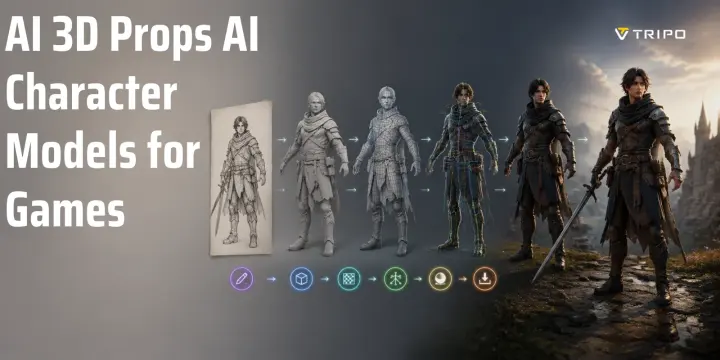
This dramatically reduces the time needed for modeling and rigging, which used to be the most technical barrier in 3D workflows. Tools like Tripo AI Studio (including features like Image-to-3D and auto-rigging workflows for T-pose humanoid and standard quadruped characters) allow developers to produce usable assets in minutes instead of days. This shifts 3D development closer to 2D in terms of accessibility, especially for solo developers and indie studios.
At the same time, AI is also improving 2D workflows—generating sprites, in-between frames, and even full animation cycles. So instead of replacing one format, AI is reducing the friction in both pipelines.
You can even find strong community discussions on this shift across:
- Reddit r/gamedev (asset pipeline debates)
- Unity Discussions (workflow complexity comparisons)
- GameDev StackExchange (technical difficulty breakdowns)
And many creators reference videos like "Which is easier, 2D or 3D?" (Code Monkey) that highlight the same conclusion: difficulty is no longer fixed—it depends on tools.

Cost of Developing 2D vs 3D Games
The cost difference between 2D and 3D game development is one of the most practical factors in deciding a project scope. In 2d vs 3d game development, budget is less about the engine and more about what scales faster: content, pipeline, or technical complexity.
Cost drivers breakdown
| Area | 2D Games | 3D Games |
|---|---|---|
| Art | High sprite/frame volume | Modeling + textures |
| Animation | Frame-by-frame | Rig-based system setup |
| Engineering | Simpler systems | Physics + camera + Z-axis |
| Optimization | Lightweight | Performance-heavy |
👉 2D cost = content-driven
👉 3D cost = pipeline-driven
Why 3D is usually more expensive
3D games require more specialized roles:
- 3D modelers
- Riggers & animators
- Technical artists
- Lighting & environment artists
Each asset goes through multiple steps (model → UV → texture → rig → animate). Any change often requires rework across the pipeline. This increases both time and labor cost.
Because of this, even small 3D indie projects can take significantly longer than 2D equivalents, especially when aiming for polished visuals.
Why 2D is not always cheap
2D development avoids complex pipelines, but it scales differently. The main cost comes from manual content production:
- Frame-by-frame animations
- Multiple sprite variations (idle, attack, damage)
- Environmental art assets
- Visual effects drawn manually
A polished 2D game can require thousands of frames, which increases workload significantly even without 3D complexity.
So 2D is simpler technically, but still expensive in art production.
Typical budget ranges
- Small indie 2D game: 50K
- Polished 2D indie game: 300K+
- Small 3D indie game: 200K
- Mid-scale 3D game: $500K+
The key difference is scaling: 2D scales with content volume, 3D scales with pipeline complexity.
How AI is changing costs
AI tools are reducing the biggest cost driver in 3D development:
- Text/image → 3D models
- Auto UV + texture generation
- Auto-rigging systems
- Faster iteration cycles
Combined with asset stores, this significantly lowers entry barriers for 3D production.

Performance and Hardware Requirements
Performance is a key part of the 2D vs 3D games decision, especially when choosing target platforms. In general, 2D games are lightweight and run well on most devices, while 3D games require significantly more CPU, GPU, and memory—but offer far richer visuals and interaction.
2D games: lightweight and widely compatible
2D games use sprites and a flat X/Y plane, with minimal lighting and physics cost. As a result, they can run smoothly on:
- Mobile devices
- Low-end PCs
- Web browsers
This makes 2D ideal for accessible, cross-platform releases with simple optimization needs.
3D games: higher demand, more optimization
3D games render full environments with depth (X, Y, Z), lighting, shadows, and camera systems. This increases hardware load on CPU and GPU.
Common optimization techniques include:
- Level of Detail (LOD)
- Occlusion culling
- Draw call batching
These help maintain performance but add development complexity.
Platform choice matters
Performance often decides platform fit:
- Mobile / Web → 2D or light 3D
- Low-end PC → optimized 2D
- PC / Console → full 3D
- VR → advanced 3D only
So in 2d vs 3d game development, performance is not just technical—it directly affects your distribution strategy.
Engines and Tools for 2D vs 3D Games
Modern game development uses many of the same tools for both 2D and 3D, which makes the 2d vs 3d game development gap smaller than before. Most engines today support both workflows, and the difference is mainly in pipeline complexity rather than tool availability.
Game engines
Common engines include:
- Unity — strong for both 2D and 3D
- Unreal Engine — primarily 3D, but supports 2D workflows
- Godot — lightweight and flexible for both
This means developers can choose one engine and still switch between 2D and 3D depending on project needs.
Art and asset tools
2D and 3D still differ more clearly in asset creation:
2D tools:
- Aseprite (pixel art, sprites)
- Photoshop / Krita (illustration)
3D tools:
- Blender (modeling, rigging, animation)
- Maya / 3ds Max (AAA pipelines)
- Substance Painter (PBR textures)
2D focuses on frame/sprite creation, while 3D requires a full modeling and animation pipeline.
AI-powered workflow integration
A major change in modern pipelines is AI-assisted asset creation. Tools like Tripo AI Studio can generate 3D models from text or images and export them directly into Blender, Unity, Unreal, Godot, or Cocos workflows.
This allows developers to skip parts of the traditional modeling and rigging process, especially in early prototyping, and makes 3D production faster and more accessible.
What About 2.5D and Hybrid Games?
Not all games fit cleanly into 2D vs 3D games. Between them is a hybrid space called 2.5D games, which mixes 2D gameplay with 3D visuals or partial depth.
What is 2.5D?
2.5D games combine dimensions in different ways:
- 3D graphics with 2D movement (fixed camera)
- 2D sprites in a 3D world
- Limited depth with controlled gameplay
Examples include Ori and the Blind Forest and Octopath Traveler, where visuals feel 3D but gameplay stays mostly on a 2D plane.
Why developers use 2.5D
2.5D is popular in 2d vs 3d game development because it balances cost and quality:
- More visual depth than pure 2D
- Less complexity than full 3D
- Easier camera and movement control
- Faster production for small teams
It's often a "middle ground" for indie developers.
2D sprites in 3D space
A common approach is placing 2D sprites inside 3D environments, used for:
- Characters (billboarding)
- Effects (fire, magic)
- UI-style elements
This allows teams to reuse 2D pipelines while gaining 3D lighting and depth effects.

2D vs 3D — Which Should You Choose?
There is no universal "better" choice in 2D vs 3D games. The right option depends on your goals, budget, skills, and platform.
Pick 2D if…
- You are solo or making your first game
- Budget and time are limited
- Targeting mobile, web, or casual players
- You want stylized visuals (pixel art, hand-drawn)
- Gameplay focuses on precision or simplicity
2D works best when speed and clarity matter more than scale.
Pick 3D if…
- You want immersion or exploration
- Targeting PC, console, or VR
- Your game relies on space, camera, or physics
- You can handle or outsource 3D pipelines
3D is ideal for open worlds and cinematic experiences.
Consider 2.5D if…
- You want 3D visuals with 2D gameplay
- You need balance between cost and quality
- You're an indie team aiming for strong visuals with limited scope
AI changes the equation
Tools like Tripo AI Studio reduce the barrier of 3D asset creation by generating models and exporting directly into Unity, Unreal, or Blender workflows.

Frequently Asked Questions
Are 2D games better than 3D games?
No, neither is objectively better. In 2D vs 3D games, the right choice depends on your goals, budget, and platform. 2D is often better for small teams and fast production, while 3D is better for immersion and exploration.
Is Roblox a 2D or 3D game?
Roblox is a 3D game platform. All experiences are built in a 3D space using X, Y, and Z axes, even if individual games use simplified or stylized visuals.
Is GTA 2 a 2D game?
Yes, GTA 2 is primarily a 2D top-down game using sprite-based graphics. It uses a flat gameplay plane (X and Y axes) with limited pseudo-3D elements, making it a transitional design between 2D and early 3D games.
What is the difference between 2D and 3D games?
2D games use a flat plane with sprites and only X/Y movement. 3D games add depth with the Z-axis, polygonal models, lighting systems, and free camera movement, enabling full spatial exploration and more immersive environments.
Is 2D or 3D game development easier for beginners?
2D is generally easier to start with. Fewer assets, simpler physics, and no camera system make the learning curve gentler. Most beginner-friendly engines like GameMaker and Godot encourage 2D as a first project. That said, AI tools are quickly lowering the barrier for 3D—generating models and rigs automatically—so the gap is narrowing.
What are 2.5D games?
2.5D games combine 3D graphics with 2D gameplay mechanics. The world looks three-dimensional, but player movement stays on a 2D plane. Examples include Ori and the Blind Forest and Octopath Traveler. It is a popular middle ground for indie developers who want visual depth without the full complexity of a 3D pipeline.
Which game engines support both 2D and 3D?
Unity, Unreal Engine, and Godot all support both 2D and 3D pipelines in the same engine. Unity and Godot are especially popular for indie developers switching between formats. GameMaker is primarily 2D, while Unreal is optimized for 3D but can handle 2D workflows.
Are 3D games more expensive to make than 2D games?
Generally, yes—but not always. 3D games require more specialized roles (modelers, riggers, technical artists) and a longer asset pipeline. 2D games avoid that complexity but scale in art volume instead. A polished 2D game with detailed frame-by-frame animation can cost as much as a small 3D title. AI asset tools are also reducing 3D production costs significantly.
Conclusion
There is no universal winner in the 2D vs 3D games debate. The right choice depends on your creative goals, target platform, team size, and budget. 2D excels at clarity, speed, and accessibility; 3D delivers immersion, spatial depth, and cinematic scale. And with 2.5D as a middle ground, developers today have more options than ever.
What has changed is the barrier. AI tools are making 3D production faster and more accessible for solo developers and indie studios—so the old assumption that "3D is only for big studios" no longer holds.
Worried 3D means months of modeling? Tools like Tripo AI's image-to-3D and auto-rigging generate game-ready 3D assets in seconds—so building a 3D game is more accessible than ever. Try it free in Tripo AI Studio.