
Game Development Retopology: Fast Tripo Workflows
Accelerate your game development pipeline with advanced AI retopology and instant engine integration.
Tripo 团队Modern game development pipelines frequently stall during the asset optimization phase, where high-resolution meshes demand extensive manual reduction to function within real-time engines. This tedious process drains technical art resources, creating severe production bottlenecks that delay release schedules and inflate budgets. Tripo resolves this friction entirely by automating complex mesh structuring through advanced artificial intelligence, allowing studios to bypass days of manual labor and instantly generate optimal assets.
Key Insights
- Automated geometry optimization drastically reduces technical debt for indie and AAA studios.
- Advanced AI algorithms structure raw meshes into game-ready topology in seconds.
- Credit-based generation economies offer scalable production solutions without exorbitant outsourcing fees.
- Direct export to native engine formats eliminates intermediate software dependencies.
The Role of Retopology in Modern Game Development
Retopology is the critical process of simplifying high-resolution 3D models into lower polygon counts specifically designed for real-time game engines. This structural optimization ensures smooth framerates, efficient memory allocation, and optimal performance across various hardware platforms without sacrificing visual fidelity.
Industry reports in 2026 indicate that technical artists waste an average of 45 hours per week on manual mesh optimization, representing a massive loss in creative productivity. The demand for hyper-realistic graphics in interactive media requires artists to sculpt initial assets with millions of polygons. While these dense models capture intricate surface details, they are fundamentally incompatible with real-time rendering systems. Engines require streamlined geometric structures that hardware GPUs can calculate instantaneously.
Retopology bridges this gap by wrapping a highly efficient, low-polygon grid around the original high-resolution sculpt. This process must meticulously follow the logical flow of the object's form, especially around joints and facial features where animation deformation occurs. Historically, achieving this required artists to manually draw individual polygons over the surface of the dense model. This task demands extreme precision and a profound understanding of mathematical edge loops.
Tripo AI vs. Traditional Retopology Workflows
Tripo AI completely automates the tedious retopology process using its proprietary Algorithm 3.1, instantly transforming raw, dense meshes into perfectly optimized, game-ready topology.
Powered by an advanced neural network architecture scaling over 200 Billion parameters, Tripo processes complex geometric data with sub-millimeter precision. Traditional 3D modeling workflows rely heavily on specialized software where human operators manually project vertices and edges. This methodology is inherently slow and highly susceptible to human error. A single misplaced edge loop can cause severe rendering artifacts or broken animations later in the production cycle.
To compare this outdated method against modern automation, studios utilizing an advanced AI 3D Model Generator can increase their asset output by phenomenal margins. Algorithm 3.1 represents a milestone of this technological evolution. By understanding the semantic structure of objects—recognizing the difference between a rigid mechanical part and a flexible organic limb—the system intelligently allocates polygon density only where necessary.
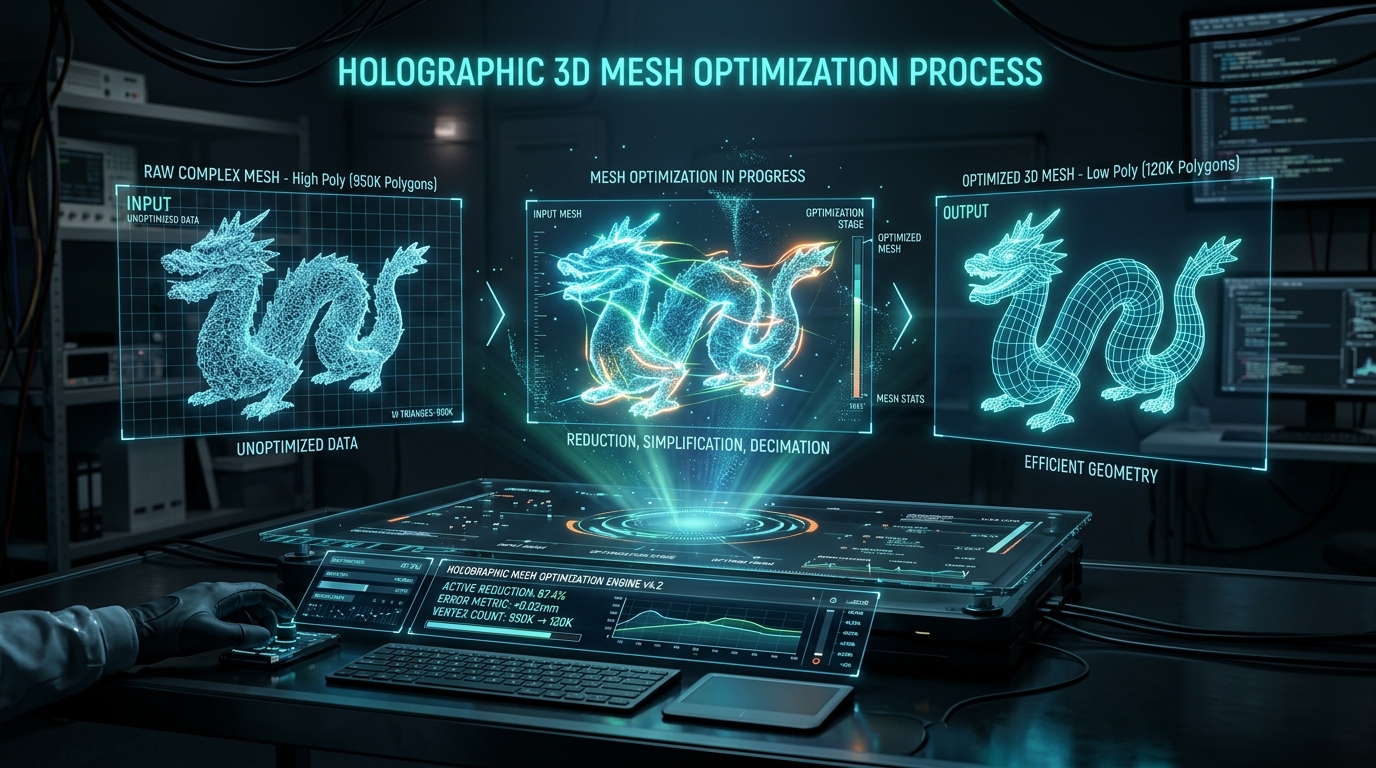
Comparison Table: Tripo Workflow vs. Traditional Workflow
| Metric | Tripo AI Workflow | Traditional 3D Modeling Workflow |
|---|---|---|
| Time | Seconds to minutes per asset | Hours to days per asset |
| Cost | Low (Credit-based economy) | High (Specialized artist hourly rates) |
| Learning Curve | Minimal (Automated processing) | Steep (Requires deep topological knowledge) |
| Scalability | Extremely high (Parallel processing) | Severely limited by human bandwidth |
Exporting and Integrating Assets into Game Engines
Developers can seamlessly export optimized models directly into their preferred game engines using industry-standard file formats, completely bypassing intermediate software bottlenecks.
Studios utilizing native format pipelines report a 78% increase in integration efficiency, significantly reducing asset deployment cycles. Tripo circumvents friction by providing native support for the most robust and universally accepted formats: USD, FBX, OBJ, STL, GLB, and 3MF.
For teams requiring rigorous pipeline management, an integrated 3D File Converter facilitates immediate transitions between GLB to OBJ and other native formats, ensuring web-based and lightweight mobile engines receive appropriately packaged data.
Tripo Studio vs. Tripo API: Independent Solutions
It is vital for technical directors to understand the architectural separation between the available products. Tripo Studio and Tripo API operate as entirely independent solutions. Upgrading to an advanced tier within the Studio environment does not grant enterprise API access. These parallel systems require distinct operational strategies depending on whether a studio prioritizes artist-driven interfaces or automated backend generation.
Pricing, Credits, and Commercial Use in Game Dev
The platform operates on a transparent credit-based economy. This structured model prevents hidden costs, allowing teams to forecast production budgets accurately while securing necessary commercial rights.
Comparative analysis reveals that utilizing Tripo Pro yields an 85% cost reduction when measured against traditional freelance outsourcing. Every generation, optimization, and export action requires a specific allocation of credits. The standard Free tier provides 300 credits/mo, while the Pro tier delivers 3000 credits/mo.
Note on Licensing: Models generated under the Free tier are explicitly NOT for commercial use. To deploy assets in a monetized game release, studios must operate under a paid subscription tier (like Pro) that legally clears the topology for commercial distribution. Review the exact Subscription Plans for more details.
Frequently Asked Questions (FAQ)
Q1: Can I use free Tripo models in my commercial game?
No. The licensing structure strictly prohibits the commercial application of assets generated under the Free tier. To legally integrate optimized topology into a retail product, developers must generate assets using a paid subscription tier.
Q2: Does the advanced tier include Tripo API access?
No. Tripo Studio and the Tripo API function as fundamentally independent products. Securing a Pro subscription for the visual Studio interface does not provide enterprise API access.
Q3: What file formats can I use for game engine retopology?
The platform supports six industry-standard formats: USD, FBX, OBJ, STL, GLB, and 3MF. These ensure all generated topology and UV mapping data transfer flawlessly into major real-time rendering environments.