
Comprime modelos de muebles GLB para una carga rápida del sitio web
Optimización de activos 3D mediante decimación de malla y compresión de texturas para comercio electrónico
La integración de modelos de muebles 3D de alta fidelidad en plataformas de comercio electrónico a menudo introduce graves cuellos de botella en el rendimiento debido al enorme tamaño de los archivos. Como las plataformas centradas en el diseño de hogar 3D con IA exigen una respuesta visual instantánea, los activos pesados provocan una carga lenta de las páginas y, inevitablemente, alejan a los compradores potenciales. Comprimir archivos GLB mediante una decimación de malla dirigida y la optimización de texturas proporciona una solución práctica para mantener la fidelidad visual mientras se garantiza un rendimiento web ultrarrápido. Al aprovechar un generador de modelos 3D con IA de nivel empresarial, los desarrolladores pueden establecer un flujo de trabajo que genere activos optimizados de forma nativa, listos para su despliegue inmediato en el navegador.
Perspectivas clave
- Los archivos GLB sirven como el estándar universal para la visualización 3D basada en web, combinando geometría y texturas en un paquete único y eficiente.
- Los modelos de muebles no optimizados pueden superar fácilmente los 50 MB, lo que aumenta drásticamente las tasas de rebote y degrada la experiencia del usuario en dispositivos móviles.
- La compresión efectiva se basa en equilibrar la reducción de polígonos con técnicas avanzadas de horneado de texturas para preservar el fotorrealismo.
- Los flujos de trabajo modernos requieren un cumplimiento estricto de los presupuestos de rendimiento, con el objetivo de que los archivos pesen menos de 5 MB por activo.
Por qué GLB es el estándar para sitios web de diseño de hogar 3D con IA
GLB se ha convertido en el formato nativo web para activos 3D, ofreciendo un excelente equilibrio entre calidad y rendimiento. Sin embargo, los modelos de muebles generados por IA a menudo requieren una compresión específica para evitar cargas lentas, una mala experiencia de usuario y altas tasas de rebote en plataformas de diseño interactivo.
El impacto del tamaño del archivo 3D en la experiencia del usuario
En el contexto de los sitios web de diseño de hogar interactivo, la correlación entre el tamaño del archivo y la retención del usuario es absoluta. Cuando un consumidor intenta configurar un sofá o visualizar una mesa de comedor en una habitación virtual, el navegador debe descargar, analizar y renderizar el activo 3D en tiempo real utilizando WebGL. Si el archivo GLB es excesivamente grande, el navegador requiere un ancho de banda significativo para descargar los datos y una VRAM sustancial para procesar la geometría y las texturas. En dispositivos móviles con capacidades de hardware limitadas, este proceso puede hacer que la pestaña del navegador se bloquee o que el dispositivo se sobrecaliente.
Además, los tiempos de carga influyen directamente en las tasas de conversión. Las analíticas de comercio electrónico demuestran constantemente que los retrasos en la carga de la página superiores a tres segundos resultan en aumentos exponenciales en las tasas de rebote. Un modelo 3D que tarda diez segundos en aparecer deja al usuario mirando un indicador de carga vacío, rompiendo la inmersión de la experiencia de compra. Al controlar estrictamente el tamaño en bytes de los activos 3D, los minoristas aseguran que las configuraciones visuales ocurran instantáneamente, manteniendo el compromiso del usuario y facilitando un camino fluido hacia la compra. Explora más sobre flujos de trabajo optimizados en nuestro centro de Diseño de hogar 3D con IA.
Cómo comprimir modelos de muebles GLB para una carga rápida del sitio web
Reducir el tamaño de archivo de los modelos de muebles GLB implica una combinación de decimación de malla, compresión de texturas y la eliminación de geometría oculta. Al aplicar estas técnicas, los diseñadores pueden asegurar que sus activos 3D se carguen instantáneamente en los sitios web sin sacrificar la fidelidad visual necesaria para el diseño de interiores.
Optimización de texturas y materiales para la web
Las texturas representan frecuentemente hasta el 80% del tamaño total de un archivo GLB. Los activos 3D sin procesar a menudo utilizan imágenes PNG o TIFF 4K sin comprimir para sus canales de material, lo cual es totalmente innecesario para la visualización web estándar. El primer paso en la optimización implica reducir estos mapas a resoluciones de 2K o 1K. Para una silla o una mesa de centro vista en la pantalla de un teléfono inteligente, un mapa de textura de 1024x1024 proporciona más que suficiente densidad de píxeles para transmitir el realismo del material.
La optimización avanzada de texturas también implica el empaquetado de canales. En lugar de utilizar archivos de imagen separados para la oclusión ambiental, la rugosidad y los datos metálicos, los desarrolladores combinan estos mapas en escala de grises en los canales Rojo, Verde y Azul de una sola imagen (comúnmente conocido como mapa ORM). Esto reduce el número de solicitudes HTTP y reduce el tamaño del archivo de material en dos tercios. La implementación de un flujo de trabajo de texturizado con IA sofisticado permite a los desarrolladores generar mapas de materiales altamente optimizados y pre-empaquetados. Además, aplicar la supercompresión KTX2 permite a la GPU leer texturas comprimidas directamente sin decodificarlas primero en la VRAM, mejorando enormemente el rendimiento de renderizado.
Técnicas de reducción de geometría y decimación de malla
La complejidad geométrica de un modelo de mueble se mide en polígonos o triángulos. Los modelos de visualización arquitectónica de alta gama pueden contener millones de polígonos, capturando detalles microscópicos como tejidos de tela o sutiles hendiduras en la veta de la madera. Para el despliegue web, este nivel de densidad geométrica es catastrófico.
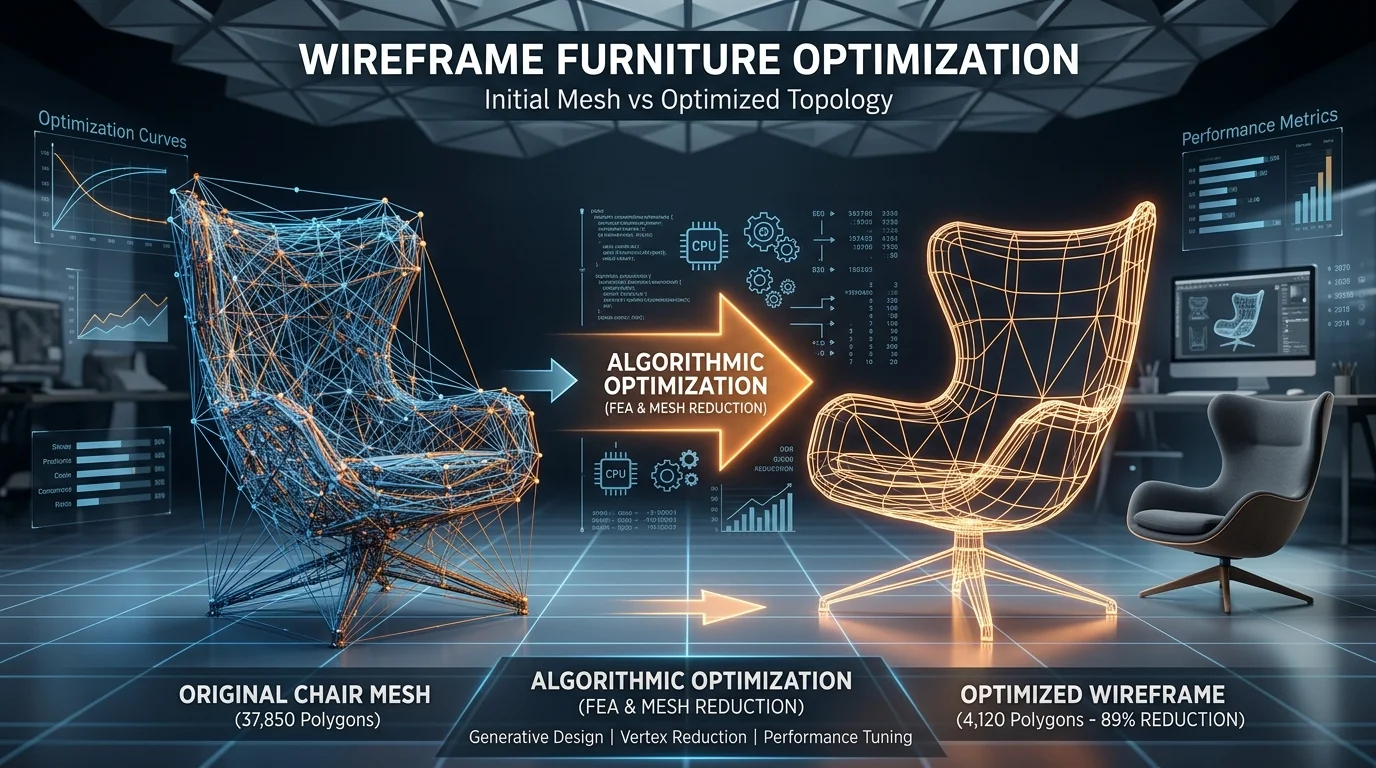
Los algoritmos de decimación de malla colapsan sistemáticamente los bordes y fusionan vértices para reducir el conteo de polígonos mientras preservan matemáticamente la silueta y el volumen del objeto. La decimación efectiva implica la retopología, donde la malla caótica de alta densidad se reemplaza por una estructura limpia de pocos polígonos. Los intrincados detalles de la superficie perdidos durante este proceso no se descartan; en cambio, se hornean en un mapa de normales. Un mapa de normales simula la forma en que la luz reacciona a la geometría compleja, permitiendo que un modelo web de 5,000 polígonos se vea visualmente idéntico a un modelo fuente de 500,000 polígonos. Además, aplicar la compresión Draco al archivo GLB final reduce drásticamente el tamaño del archivo de los datos de vértices, asegurando que la geometría se transmita a través de la red de la manera más eficiente posible.
Generación de activos listos para la web con Tripo AI
Tripo AI agiliza la creación de muebles 3D al permitir a los diseñadores generar modelos de alta calidad rápidamente. Al preparar estos modelos para la integración web, los usuarios pueden exportarlos fácilmente en formato GLB—junto con USD, FBX, OBJ, STL y 3MF—asegurando la máxima compatibilidad con las herramientas de compresión web.
Al escalar la producción de activos 3D para catálogos masivos de comercio electrónico, comprender la tecnología subyacente dicta el flujo de trabajo. El motor de generación central utiliza el Algoritmo 3.1 con más de 200 mil millones de parámetros, otorgando al sistema una comprensión sin precedentes del volumen espacial y las topologías complejas de los muebles. Esta profundidad computacional asegura que las mallas base iniciales requieran menos limpieza manual antes de entrar en la fase de decimación.
Para las organizaciones que estructuran su arquitectura de despliegue, es crucial reconocer la distinción entre la creación individual y la generación masiva empresarial. La API y el Studio basado en web son independientes. El nivel avanzado no tiene API empresarial, lo que requiere que los directores técnicos planifiquen sus estrategias de integración basadas en el nivel de acceso correcto. Del mismo modo, la distribución comercial y la planificación presupuestaria están estrictamente regidas por la estructura de licencias de la plataforma. El sistema opera con créditos; el nivel gratuito proporciona 300 créditos por mes sin permiso de uso comercial, mientras que el nivel Pro proporciona 3000 créditos por mes, autorizando completamente el despliegue comercial de los activos de muebles generados. Integrar una conversión de formato 3D confiable dentro de este flujo de trabajo garantiza que los activos exportados tengan el formato perfecto para la posterior compresión Draco y KTX2.
Preguntas frecuentes
P: ¿Cuál es el tamaño de archivo GLB ideal para una herramienta de diseño de hogar 3D basada en web?
R: Para un rendimiento web óptimo, el tamaño objetivo para un modelo de mueble GLB debería mantenerse idealmente por debajo de 2 MB a 5 MB. Mantener los tamaños de archivo dentro de este umbral garantiza velocidades de carga rápidas del sitio web y un rendimiento fluido del navegador interactivo, particularmente para los usuarios que acceden a la plataforma a través de redes móviles.
P: ¿Comprimir un modelo de mueble GLB reduce su calidad visual?
R: Cuando se ejecuta correctamente, comprimir un modelo GLB no degrada notablemente su apariencia. La compresión de texturas adecuada y la decimación inteligente de malla conservan la fidelidad visual mientras reducen drásticamente el tamaño total del archivo.
P: ¿Puede Tripo AI exportar modelos en formatos adecuados para visores web?
R: Sí, la plataforma está diseñada para admitir flujos de trabajo de despliegue web modernos. Tripo AI admite exportaciones GLB—además de USD, FBX, OBJ, STL y 3MF—que son ideales para el despliegue web y se integran perfectamente con los algoritmos de compresión estándar de la industria.